

KJAN News can be heard at five minutes after every hour right after Fox News 24 hours a day!
Keep up-to-date with Fox News Radio, Radio Iowa, Brownfield & the Iowa Agribusiness Networks!


KJAN News can be heard at five minutes after every hour right after Fox News 24 hours a day!
Keep up-to-date with Fox News Radio, Radio Iowa, Brownfield & the Iowa Agribusiness Networks!
(Fontanelle, Iowa) – A Special, Joint Meeting of the CAM and Nodaway Valley School District Boards of Education will be held Monday, Feb. 3rd (2025) in Fontanelle. The meeting takes place at the Nodaway Valley Middle School Media Center, beginning at 6-p.m., and is with regard to the superintendent hiring process. The Nodaway Valley Board, which holds the contract of current Superintendent Paul Croghan, voted in November, 2024, not to renew his contract.
Both Boards met January 22nd in Massena, to began the process of finding a replacement for Superintendent Paul Croghan, by agreeing to select a search firm. The Boards chose to go with the search firm of McPherson & Jacobson, from Omaha. The two districts will split the cost of hiring the firm.
The Special Meeting agenda calls for discussion and/or action on:
The Boards hope to have a replacement for Superintendent Croghan in place, by July 1st.
(Council Bluffs, Iowa) – Officials in Pottawattamie County report earlier this month, the Pottawattamie County Conservation Board (PCCB) held its 2025 organizational meeting at the Pottawattamie County courthouse where they swore in a new member, Heidi Hough of Underwood, and elected officers. Hough was appointed by the Pottawattamie County Board of Supervisors and sworn in by Supervisor Brian Shea.
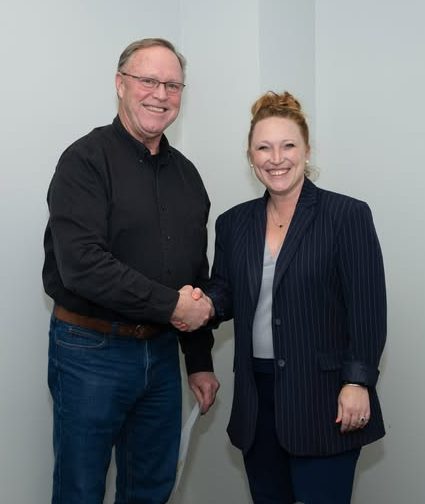
Heidi Hough of Underwood is welcomed as the newest member of the Pottawattamie County Conservation Board (Facebook photo)
Following the swearing-in ceremony, the five-member PCCB elected its officers: Jerry Mathiasen of Council Bluffs as President; Chris Ruhaak of Council Bluffs as Vice President; and Brittany McGee of Council Bluffs as Secretary. In addition to Hough and the officers, the board includes Mary Kramer of Neola.
In a press release, Pott. County Conservation Executive Director Jeff Franco said “This is a hardworking volunteer board whose guidance and leadership helps preserve the county’s natural resources, including the globally significant Loess Hills, and provide meaningful opportunities for the public to connect with our beautiful county parks.” Jerry Mathiasen added that the PCCB, “is looking forward to working with Heidi and tapping into her variety of expertise as we meet our mission and follow our vision on behalf of our county citizens and visitors.”
Hough has over 20 years of marketing and digital technology experience and is currently the Vice President of Global Ag Dealer Enablement at Valmont Industries. She and her family have enjoyed the county parks for many years, and she has also volunteered for the conservation department. The retired President & CEO of the local community foundation, Mathiasen has been a board member since 2021 and has previously served as its vice president and secretary.
The board would like to thank outgoing board president Eric Hough for his ten years of service on the conservation board where he helped lead the organization through exciting change including park expansions at Hitchcock Nature Center and campground renovations at Arrowhead Park and Botna Bend Park.
The Pottawattamie County Conservation Board’s mission is to provide resources and opportunities that encourage county residents and visitors to appreciate Pottawattamie County’s unique natural resources, develop a connection to the natural environment, and foster responsible stewardship for future generations.
(Radio Iowa) – No one was hurt in a house fire Thursday afternoon near Stanhope, a fire authorities say was intentionally set. The Hamilton County Sheriff’s Department reported that the fire was allegedly started by the homeowner who was later arrested and transported to the Hamilton County Jail in Webster City. The name of the individual has not been released.
The home was declared a total loss with the chimney still standing. There was also a concern of ammunition inside the home. Firefighters on the scene escaped unharmed.
(Radio Iowa) – The U-S Department of Education’s national report card released this week showed an increase in Iowa’s reading scores, but a drop in math. Iowa Department of Education director McKenzie Snow says the National Assessment of Educational Progress (NAEP or nape) covers fourth and eighth graders. “Our math ranking fell significantly to 30th in the nation in fourth grade math and 23rd in the nation in eighth grade math,” she says. Snow says it wasn’t just a drop in Iowa’s math performance the lowered their ranking, other states made progress. “It’s a mix of both. There’s both progress of other states in recovering learning loss experienced during the pandemic, and a drop in achievement on the NAEP (nape) assessment among Iowa’s fourth and eighth graders in math,” Snow says. Snow says the numbers show the need for the statewide evidence-based mathematics instruction the governor has proposed.
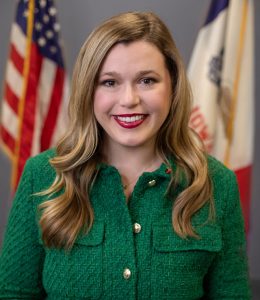
Iowa Education Department Director McKenzie Snow. (Ed Dept photo)
“It includes strong intervention structures and personalized math plans for those students in need of support. It supports our educators, both in service and pre-service, with evidence-based professional development in those schools most in need of support, as well as strong teacher preparation and evidence-based math instruction,” she says. Snow says the program also extends beyond the classroom. “It supports family-centered resources that help advance a child’s math development at home,” she says. Snow says the evidenced-based math teaching would be similar to what’s been done with reading.
Iowa’s reading ranking went from 22nd to tenth. “We are also in the top five of all states for improvement since 2022 again in eighth grade reading for all students and for students from low-income backgrounds,” Snow says.
The Governor proposed the evidence-based math program in her Condition of the State Address, but Snow says it has not yet been introduced in the Legislature. You can see more on the report card at: www.nationsreportcard.gov.
(Radio Iowa) – Iowa native Peggy Whitson will be inducted into the U-S Astronaut Hall of Fame this spring, recognizing her near-four decades of work at NASA and her continued career at Axiom Space. Six-time shuttle astronaut Curt Brown is executive director of the Hall of Fame, based at Kennedy Space Center in Florida. Brown says Whitson is America’s most experienced astronaut and deserves this honor. “She did three long-duration missions. She commanded two of the International Space Station expeditions. She did a gob of spacewalks, I think 10 spacewalks or so, and then she was actually chief of the astronaut office. We call it the chief astronaut,” Brown says. “And even now, after she left NASA, she’s working with Axiom. She’s flown with them once, and she’s going to fly with them again as an astronaut.”
Whitson, who grew up on a farm near Beaconsfield, is scheduled to command another two-week Axiom mission to the International Space Station this year, though a launch date hasn’t been released. She’ll command an international crew of four, with the other three astronauts hailing from India, Poland and Hungary. So far, Brown says Whitson’s spent 675 days in orbit — and counting. “She’s wide open. She has more time in space than any other woman astronaut, and she has the most time in space of any American astronaut,” Brown says. “So she’s one of the most deserving folks I know to be inducted in the Hall of Fame.” Astronauts are typically lauded as American heroes with parades and all sorts of accolades, like having schools or bridges named after them, so Brown was asked how big of a deal it is to be reach the Astronaut Hall of Fame. Brown was inducted in 2013.
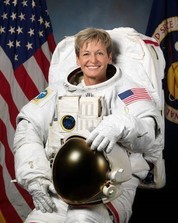
Dr. Peggy Whitson
“I think it’s one of the greatest things that happened in my career,” Brown says. “You know, these are all your peers that vote you into this. So it’s quite an honor to receive that kind of praise or that kind of recognition from your peers, your leaders, your subordinates, the whole group that was part of the shuttle program or the astronaut program.” Whitson decided to become an astronaut after watching the first moon landing on television as a child in 1969. She will turn 65 on February 9th. There will be a gala Hall of Fame event to induct Whitson, and fellow astronaut Bernard Harris, at the Kennedy Visitor Complex on May 31st, beneath the retired Space Shuttle Atlantis. The space center draws one-and-a-half million visitors a year, and Brown says Whitson will become a part of the Hall’s permanent display.
“In the Heroes and Legends Hall, you’ll see a big plaque of Peggy with her likeness, and then all her mission patches and a short recap of her career at NASA,” Brown says. Whitson’s first mission was aboard the Space Shuttle Endeavour in 2002, heard here on NASA-TV:
Since 1990, the Astronaut Scholarship Foundation, which oversees the Hall of Fame, has provided more than nine-million dollars in college scholarships to hundreds of promising STEM students.
(Des Moines, Iowa) – A new state report on staffing in Iowa nursing homes indicates employee turnover rates are continuing to climb 15 years after state lawmakers approved, but failed to fund, a program to address the issue. According to the Iowa Capital Dispatch, the 2024 Nursing Facility Turnover Report from the Iowa Department of Health and Human Services indicates that between 2022 and 2023, the average rate of turnover among registered nurses working in nursing homes increased from 52% to 66%. Among licensed practical nurses, turnover increased from 53% to 68%.
Among certified nurse aides, who provide much of the hands-on care in Iowa nursing homes, the average turnover rate increased from 72% to 77%. Turnover rates reflect the percentage of workers who left their job during the course of a year. If a nursing home had nine aides on staff and seven of them left during the year, the turnover rate would be just under 78%. If 18 aides vacated those nine positions during the year, the turnover rate would be 200%.
The federal Centers for Medicare and Medicaid Services considers high staff turnover to be a major contributor to lesser quality care, in part because newly hired or temp-agency nurses and aides don’t know the residents and their needs.
According to the report, the Iowa home with the highest turnover rate among caregivers in 2023 was Northbrook Healthcare and Rehabilitation Center, formerly Northbrook Manor, in Cedar Rapids. The home saw a 612% turnover among its CNAs, a 667% turnover among LPNs, and a 720% turnover in registered nurses. In the position of administrator, there was a 300% turnover at Northbrook, indicating three different administrators left the facility over the course of just one year.
Some of the Iowa nursing home chains that have been cited for significant regulatory violations are also among those with the highest reported turnover. For example, homes that are part of the Aspire chain are run by a Florida for-profit company called Beacon Health Management that saw two of its Iowa facilities closed by the state in 2024. Three of the chain’s homes reported turnover rates of 300% or more in 2023.
On the other end of the spectrum, 14 of the 16 Iowa nursing homes run by the nonprofit Good Samaritan Society reported no turnover whatsoever among all of their nurses and CNAs, according to the new report. According to DHHS, the state-run Iowa Veterans Home did not report employee retention data to Iowa Medicaid for 2023, and so it was excluded from the statewide report on turnover.
The DHHS report suggests the turnover rate in Iowa nursing homes continues to outpace that of many other states. In 2022, the Long-Term Care Community Coalition reported that nationally, the average nursing home had an annual turnover rate of 53.3% among nursing staff. A separate set of data published by the Centers for Medicare and Medicaid Services indicates that in fiscal year 2023, 14% of Iowa’s 422 nursing facilities were cited for insufficient staffing. That was more than double the national average, which was 5.9%.
Only five other states — Hawaii, Michigan, Montana, New Mexico and Oregon — had a worse record of compliance with new federal staffing requirements. Iowa’s neighboring states of Nebraska, South Dakota, Wisconsin and Missouri had no more than 2% to 6.8% of their facilities cited for insufficient staffing in 2023.


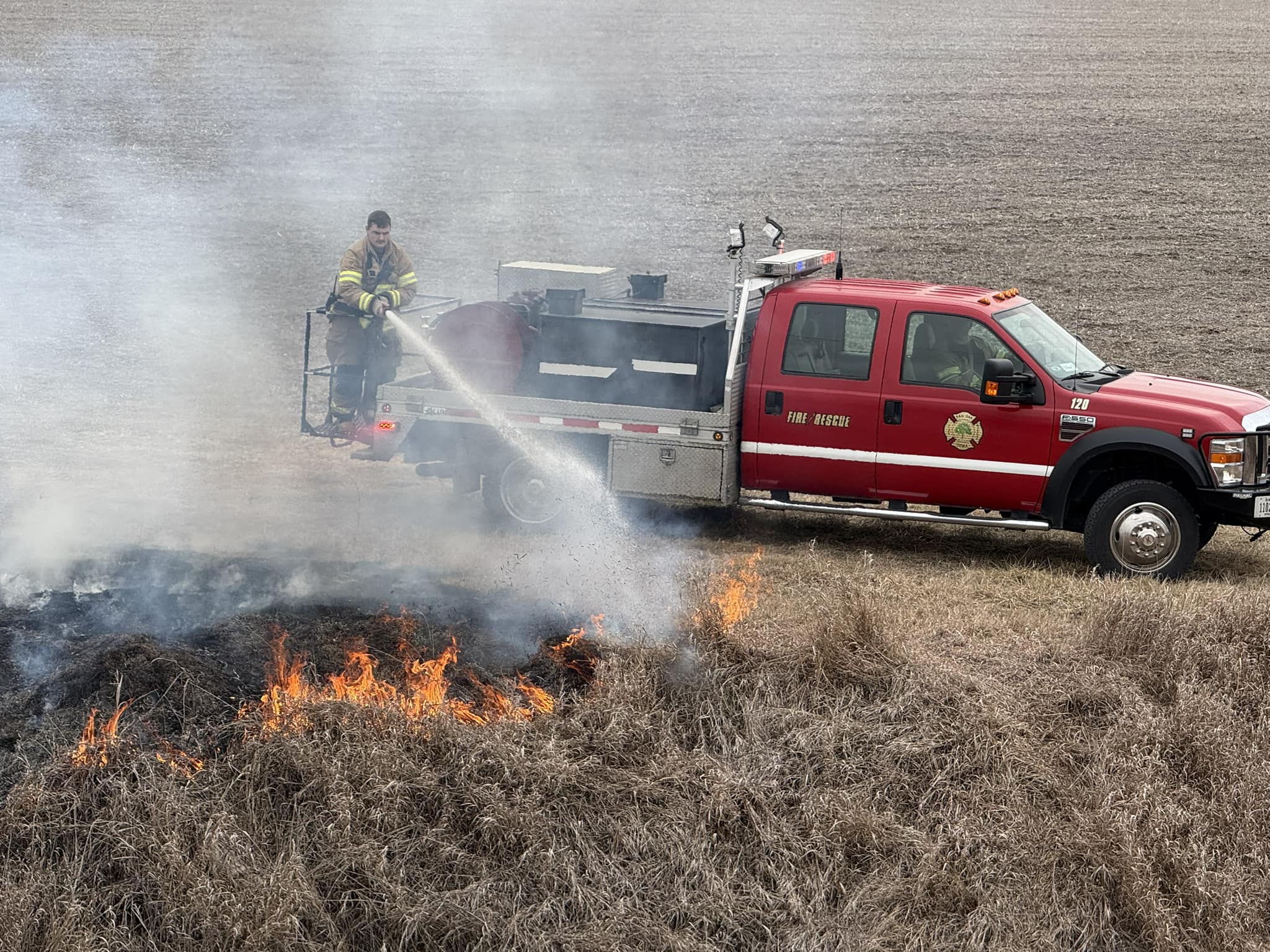

(Radio Iowa) – Today (Friday) is former Governor Terry Branstad’s last day as president of the World Food Prize. “But I intend to still be involved as a volunteer and I want to do what I can to help,” Branstad says. Branstad says one of his accomplishments has been reconnecting the World Food Prize with the work of Nobel Peace Prize winner Norman Borlaug, the agricultural scientist who founded the World Food Prize in 1986.
“We’ve taken the staff and many other people up to see the Borlaug farm where he grew up in Howard County and we were in Mexico this year, next year we’re going in India and the year after to Africa, tracing where Borlaug did a lot of his research.” Branstad, who turned 78 this past November, grew up on a farm near Leland. He served nearly 22 and a half years as governor — the longest tenure ever for an American governor. He was the nation’s oldest governor in 2017 when he left office to become U-S Ambassador to China. When he was first elected governor, Branstad was just 36 years old — the nation’s youngest governor.
“It was a difficult year, 1982,” Branstad said. “Interest rates nationwide were over 10%. They were 8.3% in Iowa. We were at the onset of the Farm Crisis and it was a very challenging time. I was running against a very capable opponent: Roxanne Conlin.” Branstad left office in 1999 after four terms as governor and became president of Des Moines University in 2003. “The challenge was I was not an academic and I was not a doctor, so I was immediately suspect from the faculty,” Branstad says, “but I won them over.”
Branstad says he had an “open door” policy in his office and started eating lunch in the school’s cafeteria. When he returned to the governor’s office in 2011, Branstad periodically ate in the statehouse cafeteria. Branstad has basic advice for people who want to enter politics. “First of all, you want to treat everyone with respect and dignity, so you want to treat people well,” Branstad says. “You also want to build (friendships.) I found internationally that is very important.” Branstad was U-S Ambassador to China from mid-2017 to the fall of 2020.
“It was a great experience and the Chinese people are nice people,” Branstad says. “Even though we have really big differences with their political system, we also have great respect for their work ethic, their commitment to education, and their friendliness and hospitality.”
Branstad says the contacts he made as a U-S ambassador were an asset in his work at the World Food Prize.
(Van Meter, Iowa) – A collision on Interstate 80 in Dallas County Wednesday night resulted in a man from Adair County being flown to a hospital in Des Moines. The Iowa State Patrol reports a 2011 Ford Escape (SUV) driven by 81-year-old Charles Huddleson, of Orient, was traveling west on I-80, just west of the Van Meter interchange (Exit 113) at around 8-p.m. Wednesday, when the vehicle struck the rear of a semi tractor-trailer traveling westbound in the same lane.
Following the collision, the SUV ran off the road to the right and overturned and came to rest in what the Patrol said was an “Uncontrolled resting position” in a construction area. Huddleson – who was not wearing a seat belt – was injured, and flown by medical helicopter to Methodist Hospital in Des Moines. Information on the semi and its driver was not immediately available.
Multiple agencies assisted at the scene. The crash remains under investigation.
(Radio Iowa) – A five-year moratorium on new casinos in Iowa has passed the Iowa House this (Thursday) afternoon and the same proposal has been approved by a committee in the senate. If the bill becomes law by next Thursday morning, it will block state regulators from considering the application for a new casino in Cedar Rapids. The Racing and Gaming Commission is scheduled to vote on the Cedar Crossing Casino project on February 6th.
Representative Bobby Kaufmann, a Republican from Wilton, points to recent studies suggesting a Cedar Rapids casino would draw customers — and revenue — from currently operating casinos. “I think the cannibalism is very real,” Kaufmann said. “…I think a ruling of this significance should have us electeds’ involvement.”
Representative Sami Scheetz, a Democrat from Cedar Rapids, says the legislature should let the Racing and Gaming Commission make the call. “It shouldn’t be our job, the second of third week of session, to be protecting existing casino operators,” Scheetz said.


 Facebook
 Twitter
 YouTube
 RSS
RSS