

KJAN News can be heard at five minutes after every hour right after Fox News 24 hours a day!
Keep up-to-date with Fox News Radio, Radio Iowa, Brownfield & the Iowa Agribusiness Networks!


KJAN News can be heard at five minutes after every hour right after Fox News 24 hours a day!
Keep up-to-date with Fox News Radio, Radio Iowa, Brownfield & the Iowa Agribusiness Networks!
The charges stem from her duties as Madison County Treasurer. The investigation is on-going and additional charges pending. State Auditor Rob Sand released the following statement on the arrest of Madison County Treasurer Amanda Devos. “We are aware of multiple issues in Madison County and have been working with local officials on appropriate courses of action,” Sand said.
Chapter 11.42 of the Code of Iowa requires the Auditor’s Office to maintain confidential all information received during the course of an audit or examination, including allegations of misconduct or noncompliance, until a report is issued.
(Radio Iowa) – A five-year moratorium on new state-licensed casinos easily passed the Iowa House yesterday, but Iowa Senate President Amy Sinclair suggests its chances in the Senate are far different. “Honestly, I’d say the prospect of a moratorium is basically a jump ball in the senate,” she said. “…I don’t know. I’ve tried to do a soft vote count. I can’t honestly tell you where the senate will land.”
Sinclair indicates a provision tucked in the bill that makes the moratorium retroactive to January 1st of this year means there’s no rush to approve the bill before February 6. That’s when the Iowa Racing and Gaming Commission is scheduled to decide whether to grant a state license for a casino in Cedar Rapids.
Sinclair said the bill that passed the House on a 68-31 vote yesterday will be sent to the Senate State Government Committee next week for review. “I don’t believe there is any fast tracking that we can do,” Sinclair said, “that we would do.”
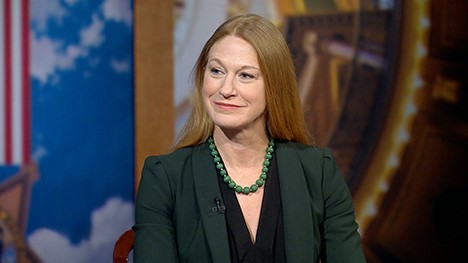
Senate President Amy Sinclair (R-Allerton) on the “Iowa Press’ set on Jan. 30, 2025. (Iowa PBS photo)
The Senate Local Government Committee passed its own version of a casino moratorium yesterday, but Sinclair said that bill also will be referred to the State Government Committee. The pace will allow for an important “philosophical conversation,” Sinclair said.
“This isn’t a Republican versus Democrat issue. This is an Iowa issue and the question is: Are there enough casinos in the state or are there not?,” Sinclair said. “The quetion is: Should we allow those established boards and commissions to do the job they were appointed to do or do we not?”
Sinclair made her comments this afternoon during taping of the “Iowa Press” program that airs tonight on Iowa PBS at 7:30.
(Radio Iowa) – Iowa Senator Joni Ernst says President Trump is scrutinizing federal spending with his recent actions which at least temporarily suspended funding for government programs and agencies. Ernst says she wants to reassure Iowans who are concerned about things like their SNAP and Medicare benefits.
“(Trump) is protecting funds that serve Americans,” Ernst says, “and examining how to save taxpayer dollars over programs that don’t work. The Office of Management and Budget has said — just so everyone understands — that things like SNAP, Medicare and any direct benefits to individuals will not be affected.”
The OMB this week rescinded the Trump Administration’s pause on federal grants and loans after a federal judge temporarily blocked the president’s aid freeze. However, White House officials claim the executive order on funding reviews remains intact. Those orders included funding associated with immigration, energy, and DEI or diversity, equity and inclusion programs.
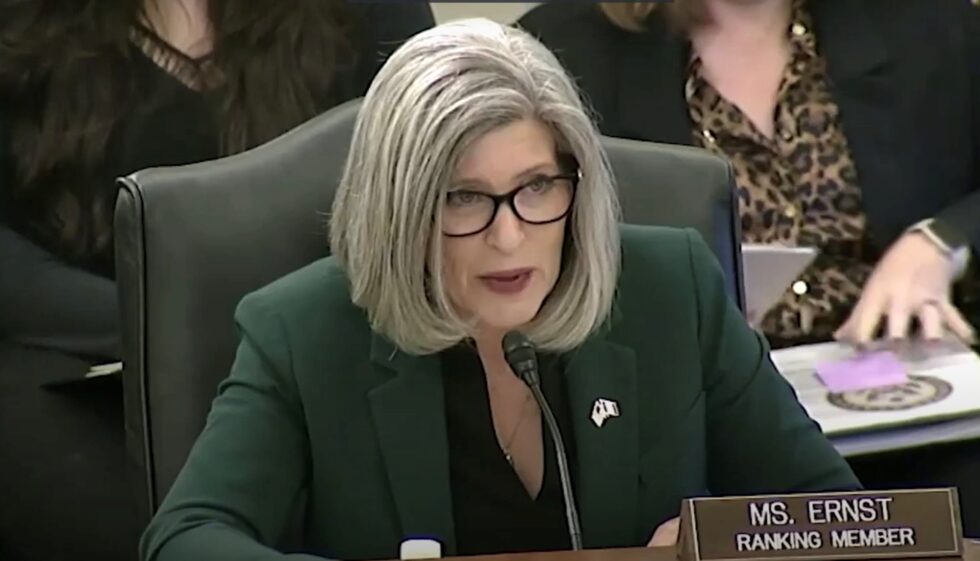
Sen. Ernst (File photo)
Ernst, a Republican from Red Oak, says Trump wants to eliminate funding that benefits programs and initiatives in foreign countries.
“We’re not talking about the programs that benefit our citizens in small town Iowa,” she says. “There’s a lot of other programs where we’re basically just funneling dollars to corporations that don’t ever benefit Americans. So, I do think he’s doing the right thing.”
Ernst, who chairs the U.S. Senate’s DOGE Committee, cited money spent on humanitarian aid for Ukraine, which is at war with Russia.
“When we are directing dollars, say, to humanitarian efforts that are going to Ukraine,” Ernst says, “what we have found out — especially through the work that I have done in scrutinizing USAID — is that the billions of dollars that are going to these types of activities where it’s humanitarian aid, the USAID was not able to actually push those out intro contracts to benefit the Ukrainian people.”
Ernst talked with KMA on Wednesday, shortly before the federal funding freeze was rescinded. Iowa Democrats blasted Trump’s funding freeze.
Iowa Democratic Party Chair Rita Hart said veterans, farmers, children, and senior citizens could all lose vital services due to what she called, “incompetence in Washington.” Hart added, “Widespread confusion is only making a bad situation worse.”
(Radio Iowa)- – A bill moving through the state legislature would provide some budget stability to public school districts in areas hit by last year’s devastating tornadoes and historic flooding. General state spending is distributed on a per pupil basis. If the bill becomes law, a district with declining enrollment before a disaster and even more student exits afterwards would get the same level of per pupil funding for the next academic year. Margaret Buckton, a lobbyist for Rural School Advocates of Iowa, says the proposal makes good sense. “One of the reasons why this is important is when you have a natural disaster you can have a temporary decline in enrollment that comes back once housing is restored and jobs open back up again,” Buckton says, “so this would allow that budget guarantee of the higher amount to continue to the next year and hopefully those families come back.”
Michelle Johnson is a lobbyist for the Iowa Association of School Boards. “We think it’s pretty simple,” she says, “and it’s good for districts that have experienced a natural disaster.” Senator Lynn Evans, a retired superintendent from Aurelia, says Iowa law allows school districts in these kind of predicaments to petition the School Budget Review Committee, but the bill clarifies the process. “Moving forward, knowing that Iowa’s had tornadoes and flooding for as long as we’ve been around, that’s not going to change,” Evans says, “we can make the process a little easier.”
Evans is chairman of the Senate Education Committee. The proposal cleared a House subcommittee this week.
(Radio Iowa) – Woodbury County Sheriff Chad Sheehan is helping pay for the new county jail by taking in more federal prisoners. Sheehan is asking the county supervisors for funds to hire eight more officers to help handle and transport the federal prisoners from North Dakota. “We’re certainly ready to start bringing North Dakota inmates from the Marshals here, but part of that is going to be a strain specifically on transporting because there are times that we may have to meet them halfway. There may be even some exigent times where we would have to go all the way back and forth to Fargo,” Sheehan says. The Sheriff says the newly opened Law Enforcement Center now has them working on two different floors and more staff would help with that.
“We’re basically operating almost as two separate areas. You work in booking an intake, you’re working long term, and this would just give us the opportunity to add a little bit of staff to that,” he says.
Sheehan says it will cost 650-thousand dollars to hire the new staff and that would be paid for with revenue from taking care of 18 federal inmates from North Dakota. Sheehan expects to hold some 40 federal inmates from North Dakota and they would generate nearly one-and-a-half million dollars. He says additional staff would allow them to handle more than 100 federal inmates from various states.
“We’re prepared to handle 125 to 150 with this, I think we all would be more confident in that 150 number. Without this, it’s probably staying closer to that 125,” Sheehan says. The additional revenue from holding the federal inmates would be used to pay down the new law enforcement center. Sheehan says they are not expecting to be holding inmates arrested by ICE as illegal immigrants.
(Ames, Iowa) – A new study from Iowa State University researchers found that diversifying crop rotations does not aid in carbon sequestration but is beneficial in lowering the need for synthetic fertilizers, which has positive environmental impacts of its own. The Iowa Capital Dispatch says Wenjuan Huang, study co-author and ISU assistant professor of ecology, evolution and organismal biology, reports the team used new methods of measuring carbon in the soil to come to its conclusion. “Even though the study shows no significant difference in carbon sequestration,” Huang said, “diversified crop systems still help improve soil health and reduce the need for our synthetic fertilizer, probably leading to reduced greenhouse gas emissions, especially the nitrous oxide.”
Utilizing soil samples from the university’s Marsden Farm, Huang said the team compared soil samples from a two-year, corn-soybean crop rotation and a three- or four-year rotation that added alfalfa, clover or oats to the corn and soybean crops, as well as manure instead of synthetic fertilizer, to see how they differ. She says the farm has been running the different crop rotations experiment for more than 20 years. More carbon enters the soil when crops are diversified, as different roots, plant matter and manure is added to it, and Huang said the team was able to see which crops left which types of carbon isotopes in both topsoil and samples taken a few feet into the ground.
The team used a new method in its research, Huang said, by looking at isotopes in the soil samples and trying to “chase carbon change.” She described it as finding out what the soil microbes ate for dinner, and from what plants. Huang said the team found no differences between the carbon stock of the two crop rotation soil samples, due to increased carbon decomposition in the diversified rotation. However, researchers did identify a “critical trade-off” between carbon and nitrogen, Huang said. “Because increased carbon decomposition releases more nitrogen,” she said, “this helps the crops grow, and more importantly, it also reduces the use of a synthetic nitrogen fertilizer.”
Iowa State University researchers found that diversifying crop rotations doesn’t impact carbon sequestration but does aid in decreasing the use of synthetic fertilizers. (Photo courtesy of Iowa State University)
While carbon sequestration is important, Huang said people shouldn’t ignore other greenhouse gases impacted by different crop practices, like nitrous oxide emissions. With more nitrogen available in the soil for crops, Huang said emissions can be reduced by lessening the need for synthetic fertilizers that contribute to nitrous oxide emissions. Both the findings and methods of study will provide tools for others involved in agricultural research and the industry in general, Huang said. Utilizing the carbon isotope method will provide more accurate information on the carbon’s source, helping to better predict carbon change.
Huang and other researchers’ work will also help inform people on what else they need to focus on when it comes to diversifying crops and trying to lessen agricultural environmental impacts, one subject being nitrogen and the nitrous oxide produced through it.
(Radio Iowa) – With high temperatures expected back in the low 50s in parts of Iowa today (Friday) and into the weekend, the unseasonable mid-winter weather will bring more Iowans outdoors — and into potential danger. Dr. Laurel Vaughan, a trauma and critical surgeon with Gundersen Health, says Iowa drivers need to stay especially alert as they may not be used to seeing so many pedestrians at this time of year. “From the driver side, obeying the laws of the road, putting your cell phones down, trying not to be distracted while you’re driving,” Vaughan says, “and just keeping a sense of the space around your car.” With no snow drifts or icy sidewalks to navigate, plenty of Iowans will be going out for strolls to welcome February’s arrival, and Vaughan says they also have a responsibility — to watch for vehicles.
“Head up, phone down. That’s what we are always telling people, and then making sure you’re also paying attention to your surroundings, seeing the cars coming, and making sure you’re having eye contact with the cars in your area if you’re going to cross the street,” Vaughan says. “Also, using sidewalks is a big thing instead of walking in the roads.” Vaughan says many areas of the region are seeing an increase in crashes involving pedestrians, and the national numbers are staggering. “In 2022, over 17% of traffic accidents were actually pedestrians who were hit,” she says, “and that accounted for over 9,000 people who ended up dying in that year.”
Gundersen Health System has clinics in Calmar, Decorah, Fayette, Lansing, Postville and Waukon, and a hospital in West Union.
(Radio Iowa) – Tomorrow, February 1st is National Unclaimed Property Day and State Treasurer Roby Smith says his office has plenty of it. “We have $587 million that we have to return to Iowans,” Smith says. Banks and businesses that lose contact with the owner of financial assets turn that unclaimed property to the state treasurer’s office. It includes money in inactive bank accounts, uncashed checks, misplaced stocks and bonds — even insurance payouts that didn’t make it to the right person. There’s a website where you can check to see if you might have unclaimed property in Smith’s office.
“We tell people it’s fast, it’s free, it’s easy. You just go to GreatIowaTreasureHunt.com. We encourage them to do it once a year…They can do it around tax season,” Smith says. “We’re always receiving more money in. We just want to get it back to the rightful owners.” Unclaimed safety deposit boxes are also turned over to Smith’s office.
State Treasurer Roby Smith (RI file photo)
According to the National Association of Unclaimed Property Administrators, one in every seven Americans has unclaimed property sitting in a state treasurer’s office. That’s better odds than winning the lottery. During the last fiscal year — which ended June 30th of 2024 — state treasurers around the country returned nearly four-and-a-half BILLION dollars in unclaimed property to its rightful owner.
(Creston, Iowa) – A Creston man was arrested recently for allegedly Harboring a Runaway Child (against the wishes of parent) – an Aggravated Misdemeanor. A Criminal Complaint in the case was filed Thursday. According to Creston Police, 18-year-old Talon Dee Bolinger was arrested at his residence and transported to the Union County Jail. Bolinger posted a $2,000 bond, and was released.
(Washington, D-C; Iowa Capital Dispatch) – Iowa Senator Joni Ernst and Iowa Representative Randy Feenstra, both Republicans, have introduced matching bills aimed at reducing over-payments made to recipients of the Supplemental Nutrition Assistance Program, or SNAP, but Iowa advocates say the bills won’t be effective at reducing payment errors. The bills, titled Snap Back Inaccurate SNAP Payments Act, state they would “improve the calculation and reduce the taxpayer cost of payment errors” for SNAP. A press release from Ernst said the act could reduce spending by nearly $91 billion over the next decade by requiring all payment errors be reported and holding states and recipients accountable for over-payments.
According to a report from the U.S. Government Accountability Office, or GAO, improper SNAP payments totaled approximately $10.5 billion nationwide in 2023. Across all government agencies, the report estimates $238 billion of improper payments were made in 2023. SNAP was singled out in a report because its rate of improper payments, at 11.7% in 2023, exceeded 10%. Ernst said errors like this are contributing to the nation’s $36 trillion debt. “SNAP plays an essential role in helping feed families, that’s why we need to strengthen its integrity by holding states accountable for growing error rates, implementing a zero-tolerance policy, and snapping back over-payments,” she said in a statement.
The act would require states to pay back what they owe from payment errors and it would require all errors to be reported, as opposed to the current rule which only requires reports on payment errors in excess of $54. The figure was increased in 2022 when officials undertook a serious update to the Thrifty Food Plan, which sets the purchasing power of SNAP, and increased overall SNAP benefits by 21%. Feenstra said there was “no time to waste” to save taxpayer dollars and “hold bureaucrats accountable.” Feenstra and Ernst both serve on their respective Department of Government Efficiency, or DOGE, caucuses. Feenstra said in a statement on the bill that President Donald Trump and Republican majorities were “elected to cut waste from the government.”

(Photo by Lance Cheung/USDA)
“One sector that needs serious reform is the SNAP program,” Feenstra said. “That’s why Senator Ernst and I introduced legislation to strengthen the integrity of the SNAP program by establishing a zero-tolerance policy on benefit over-payments.” Both members of Congress introduced bills of the same title in 2023. Luke Elzinga, policy and advocacy director for Des Moines Area Religious Council and chair of Iowa Hunger Coalition, said the bills from Ernst and Feenstra, if passed, would increase Iowa’s error rate and slow down application processing timelines. “Reducing the error rate is a good thing that everything wants, but I think the bills introduced by Senator Ernst and Representative Feenstra are the wrong way to go about it,” Elzinga said.
Elzinga said the states have a balancing act between getting SNAP applications processed quickly, and processing them accurately. Recipients must be able to participate in the program within 30 days of submitting a typical application in order to meet the U.S. Department of Agriculture’s timeliness requirements. Currently, Iowa’s timeliness rate is 77%. Elzinga stressed that SNAP payment errors can occur for a number of reasons and are inadvertent errors from either the person applying or the agency processing the application. The error rate is affected by both underpayments and over-payments. “The payment error rate is not fraud,” Elzinga said.
According to the GAO report, most of these errors in 2023 occurred because agencies failed to verify certain criteria, like income, household size, education, or employment. Benefit recipients are also required to reimburse the state for any over-payments they receive, and likewise the state reimburses recipients for underpayments. In 2023, Iowa’s error rate was 5%, putting it at less than half the national average. That’s an improvement for the state, which was issued a $1.8 million USDA fine in 2019 for its high payment error rate of 10% in 2018. Following the fine, the Iowa Department of Health and Human Services focused on increasing efficiency and accuracy in the application process through a business process redesign.
An Iowa Hunger Coalition report from July 2024 applauded the department’s work in significantly lowering the rate. Elzinga said Iowa’s improvements over the past several years show the effectiveness of the current quality control programs. Elzinga, and the Iowa Hunger Coalition report, noted that updated technology and expanded workforce would help to improve both accuracy and timeliness of processing SNAP applications.


 Facebook
 Twitter
 YouTube
 RSS
RSS