

KJAN News can be heard at five minutes after every hour right after Fox News 24 hours a day!
Keep up-to-date with Fox News Radio, Radio Iowa, Brownfield & the Iowa Agribusiness Networks!


KJAN News can be heard at five minutes after every hour right after Fox News 24 hours a day!
Keep up-to-date with Fox News Radio, Radio Iowa, Brownfield & the Iowa Agribusiness Networks!
(Radio Iowa) – An Iowa House committee has unanimously approved a bill that would remove the requirement that dental assistants register with the Iowa Board of Dentistry. Representative Thomas Jeneary, of Le Mars, is a retired dentist.
Representative Josh Turek of Council Bluffs says none of the states that surround Iowa require dental assistants to register with the state board that oversees dentists.
The license fee for dental assistants is 40 dollars per year. The annual fee is 20 dollars higher for dental assistants with additional training to do X-rays.
(Radio Iowa) – Iowa Congresswoman Ashley Hinson says she supports the efforts of the Department of Government Efficiency to cut costs and waste in the federal government. Hinson, a Republican from Marion, was asked about criticisms of the DOGE efforts. “When it comes to DOGE, I actually had a chance to hear directly from Elon (Musk) this week. The amazing amount of fraud, waste and abuse that is being uncovered is going out publicly. Everything’s publicly available, and they’re being very, very transparent,” Hinson says. During her conference call with reporters she was asked about claims from Veterans Administration employees in Iowa that cuts are impacting services to veterans.
“The Secretary said blatantly that none of the reductions in workforce will be directly for the care of veterans. So if that is happening, I certainly want to know about it. But that was a directive from the head of from the Secretary himself,” she says”. Hinson says there are people in the bureaucracy that are deliberately trying to undermine the Trump Administration’s goals of finding efficiencies. “We learned this week, for example, that in one case when, DOGE and the administration went to one of these department heads and told them to eliminate probationary employees who are not doing their job, they just eliminated them all out of spite,” Hinson says. “So I think my goal is going to be to sort through and go through and fact, find on what’s actually happening. Because my goal is to make sure veterans are getting the care that they deserve.”
Hinson was also asked about some members of Congress canceling meetings because of protests over the cuts in Washington. Hinson says she will continue to have town hall meetings in her district to answer questions about the things that are happening in the federal government.
(Washington, D.C.) – The Defense POW/MIA Accounting Agency, Thursday, announced that the remains of a World War II soldier from the tiny southeastern Iowa town of Cincinnati, have been accounted for. 21-year-old U.S. Army Pvt. James L. Harrington was accounted on August 21st, 2023. Harrington’s family recently received their full briefing on his identification.
In June 1944, Harrington was assigned to Company A, 149th Engineer Combat Battalion in the European Theater. On June 6, Harrington was aboard Landing Craft Infantry (Large) 92, along with roughly 200 other service members, en route to land on Omaha Beach, in Normandy, France. As the LCI-92 steamed toward the shore, it hit an underwater mine which caused the craft to burst into flames. The craft was also hit by enemy artillery fire, causing an explosion that ignited the ships fuel stores and instantly killed everyone in the troop compartment. Due to the urgency of the situation, it was impossible for others to search for survivors. Harrington’s remains were not accounted for after the war.
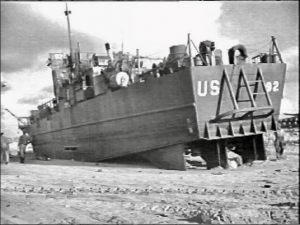
LCI-92
Around June 10th, 1944, members of the 500th Medical Collecting Company examined the wreckage of LCI-92 and noted the burnt remains of servicemen in the troop compartment, where Harrington and others were last seen. American Graves Registration Command (AGRC), the organization that searched for and recovered fallen American personnel in the European Theater, removed small amounts of remains from LCI-92 and buried them in the United States Military Cemetery St. Laurent-sur-Mer. Beginning in 1946, AGRC analyzed the remains found in LCI-92, segregating them into four separate Unknowns (X-53, X-83, X-83B, and X-83C). Despite their efforts, AGRC were unable to identify the Unknowns at the time and they were interred in Normandy American Cemetery, an American Battle Monuments Commission site in Normandy, France.
In June and August 2021, the Department of Defense and ABMC officials exhumed the comingled remains of the four Unknowns and transferred them to the DPAA Laboratory for analysis. To identify Harrington’s remains, scientists from DPAA used anthropological analysis. Additionally, scientists from the Armed Forces Medical Examiner System used mitochondrial DNA and Y-chromosome DNA analysis.
Harrington’s name is recorded on the Walls of the Missing at Normandy American Cemetery in Colleville-sur-Mer, France, along with others still missing from WWII. A rosette will be placed next to his name to indicate he has been accounted for. Harrington will be buried in Cincinnati, Iowa on a date yet to be determined.

Army Pvt. James L. Harrington (US DPAA photo)
(Ames, Iowa) – The Iowa Department of Transportation, today (Friday) finalized its offers of funding for the Federal Fiscal Year (FFY) 2026 City Bridge Program. For this funding cycle, funds were available to offer assistance to bridges that had 20 or more priority points. The final rankings are shown on the City Bridge Candidate Award List. Among the projects the DOT declined to fund, was:
The DOT agreed to fund bridge projects in Corning (A west-south bridge over a stream on 8th Street), and in Manning (A west-north bridge on East Street, over Willow Creek). 
The Iowa DOT annually makes Federal-aid and State funds available for the purposes of reducing the number of “Poor” bridges (formerly known as Structurally Deficient or Functionally Obsolete bridges) on the local roadway system. Bridges are ranked to receive funding based on a priority point system explained in Local Systems, Federal and State Bridge Programs
The Qualified Bridge List (QBL) for cities has also been updated to include the FFY 2026 accepted awards. The updated City QBL can be found here. Beginning in October, the Iowa DOT will make another round of offers for Federal-aid and State funds to qualifying bridge projects. The number of offers will depend on the funds available.
(Radio Iowa) – Family and friends plan to gather in Sioux City tomorrow (Saturday) to highlight the unsolved murder of a Native American woman more than 30 years ago. Danielle LaPointe is the niece of Lori Ann DeCora, who died five weeks after she was beaten and stabbed in an attack at a house party in 1992. LaPoint says one person was arrested but never prosecuted. “She was just missed. I feel like on all fronts,” LaPointe says, “and we were just trying to bring that awareness and bring that back, like, hey, here, she’s a cold case, she’s right there from Sioux City, Iowa, like she’s not forgotten. She is somebody’s family member.”
DeCora was a member of the Winnebago Tribe of Nebraska. A spokesperson from the Sioux City Police Department says the case isn’t closed and anyone with new evidence should contact authorities. The gathering Saturday will be held in the area where DeCora was attacked — on the 33rd anniversary of her death. “She isn’t forgotten, she isn’t invisible,” LaPointe says. “She did matter and she still has loved ones here that care about her and want to see justice for her.” 
There was a break in another Sioux City cold case earlier this year. Police arrested Thomas Duane Popp for the murder of Terry McCauley in 1983. McCauley was a young mother of two and a member of the Omaha Tribe. Family members credit awareness through social media for keeping the McCauley investigation alive. That gives the DeCora family hope for justice in their case.
WEST DES MOINES, IA – Iowa Renewable Fuels Association (IRFA) producer member Elite Octane, an ethanol plant near Atlantic, today (Friday, March 7th) celebrated producing its 1 billionth gallon. Since the plant began operating on July 1, 2018, it has processed over 300 million bushels of corn from area farmers. IRFA Executive Director Monte Shaw congratulated Elite Octane, “for reaching the one-billion-gallon milestone.” Shaw said “Not only does this milestone celebrate the plant, but it celebrates the impact Elite Octane has on the local community, area farmers, and consumers across the nation. This is a testament to ethanol’s role in American energy dominance while providing consumers with a cleaner-burning, cost-savings solution at the pump.”
With its 53 employees, Elite Octane has paid more than $1.6 billion to local corn farmers since commencing operations in 2018, nearly all funds received within 60 miles of Atlantic, Iowa. The over 300 million bushels of corn were processed into more than just ethanol.

Elite Octane, Atlantic Iowa (photo from the company’s website)
Elite Octane also produced more than 2 million tons of high protein animal feed and over 300 million pounds of corn oil as well. Additionally, 50 percent of all the water used in the ethanol production process is recycled water from the City of Atlantic that would otherwise be discharged down the river.
(Radio Iowa) – The U-S State Department is ending its support of the University of Iowa’s International Writing Program. A statement from the State Department says the University of Iowa’s program for authors from around the globe is no longer a priority for the agency and a nearly one MILLION dollar grant is being withdrawn. Christopher Merrill, director of the University of Iowa program, says it’s a devastating turn of events. “We had a 58 year long relationship with the State Department, a continuous relationship, a very productive partnership that with one stroke of the pen has ended,” Merrill says. The program typically hosts 30 writers from around the world for 11 weeks during the fall.
Merrill says they’ll cut that to about 15 writers. “I think we have enough money to host, as I said, a small cohort of writers this fall as a sort of placeholding opportunity,” Merrill said, “and then during these next six months, we’ll hope that we can figure out a different way to keep this storied program going.” Three past participants in the program have won the Nobel Prize for Literature.
Last year, the U-S State Department’s Bureau of Educational and Cultural Affairs launched a six-month mentoring program with the University of Iowa for writers from Ukraine, Afghanistan, Nicaragua and Myamar. That program is being cancelled, along with a summer
youth program.
(Red Oak, Iowa) – The Red Oak Police Department a Clarinda woman Failed to Yield from a Stop sign Thursday afternoon, resulting in a collision between her SUV and a car. No injuries or citations were reported, though. Authorities say at around 4:05-p.m. a 2018 Buick SUV driven by 46-year-old Melissa Mullins, of Clarinda, was stopped at the stop sign located at the intersection of E. Coolbaugh and N. 5th Streets, in Red Oak, and attempting to proceed south through the intersection on N. 5th Street.
A legally parked vehicle on E. Coolbaugh obstructed Mullins’ view of a 2004 Buick LeSabre, driven by a 17-year-old female from Red Oak. When Mullins entered the intersection believing it was clear to do so, her SUV struck the Buick, which was traveling east on E. Coolbaugh, causing minor damage to both vehicles. Police estimated the damage at $2,000 altogether. Both vehicles were able to be driven away from the accident scene.
(Atlantic, Iowa) – The City of Atlantic’s Board of Adjustment will hold a Public Hearing Monday evening at City Hall, with regard to a Conditional Use Permit for property located at 501 Chestnut Street. The building is owned by Randy Roy, and houses his business, Randy’s Computer. The hearing begins at 5:30-p.m.
Zoning Administrator John Lund said in his meeting agenda packet, that Roy wants a permit that will allow for a single-family residence on the first story of the building abutting Chestnut Street, north of 7th Street, in the C-3 “Central Business” District, as allowed by the Zoning Ordinances, in Atlantic.
In his Conditional Use Permit Application, Randy Roy said the main floor of his building is 6,250-square feet. There is a 2,500-square foot mezzanine that has its own bathroom and shower, and that they would like to use as a one-bedroom apartment, so he can live on-site where his business is located. The living quarters will be completely isolated from the main floor working environment. As mentioned, Randy Roy owns the building.
The Board of Adjustment will hold the public hearing and discussion prior to taking action on the permit request. Their options are to: Accept the application without conditions; Accept the application and place conditions of operation attached to the permit, or, they may reject the application entirely.
Zoning Administrator John Lund notes “All requirements for a conditional use permit must be satisfied for the permit to be granted. Failure on any one requirement should result in a rejection of the application.” He did not offer his opinion on the matter for the Board to consider.
(Creston, Iowa) – Officials with the Creston Police Department say a man from Polk County was arrested on a Harassment charge, Thursday morning. 21-year-old Rowan Davis Pope, of Des Moines, was arrested at around 11:45-a.m. in the 1700 block of Townline. He was taken into custody for Harassment in the 3rd Degree. Pope was being held without bond in the Union County Jail, pending an appearance before the Magistrate.

 Facebook
 Twitter
 YouTube
 RSS
RSS