

KJAN News can be heard at five minutes after every hour right after Fox News 24 hours a day!
Keep up-to-date with Fox News Radio, Radio Iowa, Brownfield & the Iowa Agribusiness Networks!


KJAN News can be heard at five minutes after every hour right after Fox News 24 hours a day!
Keep up-to-date with Fox News Radio, Radio Iowa, Brownfield & the Iowa Agribusiness Networks!
(Washington, D-C/ Iowa Capital Dispatch) – The cost of child care now exceeds the price of college tuition in 38 states and the District of Columbia, according to a new analysis conducted by the Economic Policy Institute. The left-leaning think tank, based in Washington, D.C., used 2023 federal and nonprofit data to compare the monthly cost of infant child care to that of tuition at public colleges.
The tally increased five states since the pandemic began. EPI’s last analysis relied on 2020 data, which showed child care costs outstripped college costs in 33 states and Washington, D.C., said EPI spokesperson Nick Kauzlarich. Child care in Iowa comes close, but does not exceed the cost for in-state tuition at a four-year public university, according to the report.
The organization released a state-by-state guide showing the escalating cost of child care. Average costs range from $521 per month in Mississippi to as much as $1,893 per month in Washington, D.C., for households with one 4-year-old child, EPI found. The analysis also found child care costs have exceeded rent prices in 17 states and the District of Columbia.
EPI leaders said child care is unaffordable for working families across the country, but especially for low-wage workers, including those who provide child care.
(Montgomery County, Iowa) – Firefighters from Villisca, New Market and Corning battled a field fire that ignited Sunday evening in the 1300 block of Elk Avenue, near Villisca. The flames were quickly brought under control before they could spread. The blaze was reported a little after 5:30-p.m.. There were no injuries, and no property damage was reported. The Montgomery, Adam, and Taylor County Communications Centers helped to coordinate response to the field fire.

VFD photo
(Union County) – The Creston Fire Department responded to a detached garage fire on Patt Street, at around 8:45 p.m., Saturday. Authorities say in addition to the garage fire, the roof of an adjacent travel trailer caught fire. The first firefighters on the scene requested a second page at 8:51 p.m. for more resources. A total of 10 firefighters responded with four trucks. Following the suppression of the presenting fire, firefighters began the overhaul process. They used thermal imagers to detect hot spots and pike poles to remove exterior siding, eaves, fascia, and interior ceiling materials, allowing them to extinguish any smoldering wood and insulation. The cause of the fire is under investigation.
Firefighters from the Afton Volunteer Fire Department assisted Creston Fire at the scene. Also on hand were officers with the Creston Police Department and medics with the Greater Regional Medical Center in Creston.

Creston FD Facebook page photos. (Chuck Spindler – CFD photo credit)


(Radio Iowa) – A program that gives money from state gambling profits to the 84 counties without a casino is now 20 years old. Iowa Gaming Association president Wes Ehrecke gave the annual report on the County Endowment Fund to the Racing and Gaming Commission. “This year was 18-hundred and 30 grants for 11-point-six million dollars,” Ehrecke says. Ehrecke says the program has had a lot of impact since it was created by the Iowa legislature in 2004.
“In 20 years, it’s been like 38-thousand-745 grants for 160 million (dollars),” he says. “So a very impressive program, and we like to think that every single citizen is benefiting in some way in the impact with these nonprofits in each of these counties.” Ehrecke says there are a variety of different ways the money is spent. “It can be just a few grants or many grants. Each of the those counties foundations have their own separate board of directors to be able to determine how best to spend that money for their area, and so I think it’s been a remarkable program,” Ehrecke says. 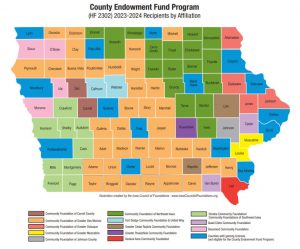
You can see more on the money and how it was spent at IowaCommunityFoundations.org.
(Radio Iowa) – A Democratic leader in the Iowa legislature says she’s disappointed with the lack of bills that would lower costs for Iowans advancing past a cutoff for legislation to make it through committee. House Minority Leader Jennifer Konfrst says she’s also frustrated with Republican proposals she says would provide immunity for pesticide companies, restrict vaccines and require physicians to share inaccurate claims about medication abortion reversals. Konfrst says GOP priorities are answering to special interests and not what Iowans want.
“For the party of small government, the Republicans sure do think a lot of great ideas come out of Des Moines,” Konfrst says, “and are sure interested in taking over the decisions that we make, about vaccines, about education, about how we live our lives, about who gets civil rights who doesn’t.”
Konfrst says lawmakers need to consult cities and counties when developing the upcoming property tax relief bill. She says democrats have pushed legislation to make housing, health care and child care more affordable but the bills failed to advance.
(Indianola, Iowa) – Five students from the Atlantic High School competed over the weekend in Indianola, at the Iowa Forensic League State Tournament at Simpson College. Atlantic Head Speech/Debate Coach Trisha Koenig says “Every one of them broke to Finals and is bringing home a plaque!”


They results include:


Coach Koenig says Alix was also a finalist for Student of the Year! As a team, we placed 5th in the overall Sweepstakes. “In addition,” Coach Koenig says she had “an incredible honor” bestowed upon her: She was named the IFL Coach of the Year for 2025, “voted upon by my peers, coaches across the state. I am beyond excited and flattered to have been chosen. Many tears have been shed already.”






Coach Trisha Koenig
The IFL Weekend continued with Atlantic’s Congress students competing Fri-Sat. The Congress students consisted of Nissa Molgaard, Bailey Grieshaber, Hope Mathis, and Ean Bloomfield. “Unfortunately,” Coach Koenig says, “none of our 4 broke to the final round. However, I am very impressed by the work put in to prepare. I love seeing the Senior leadership of Nissa and the experience of Bailey guiding Hope and Ean to learn more about Congress. I can see those younger students continuing with Congress in the future.”
The Coach added, “Bryce Smith helped me out by taking some of the previous IFL students over to CAM for the 54th Annual Walnut Hill Individual Speech Tournament. We again had success!” The results:
“As a team, our Atlantic kids placed 4th in the overall Sweepstakes,” the Coach says, “which is quite impressive given our small team size. I am so proud of this whole weekend and the work our students put in on both the Speech & Debate side. As it was said at IFL, we “do a lot with very little”, and I will embrace that with pride! Thank you for your continued support of our activity!”
CEDAR RAPIDS, Iowa (KCRG) – This past weekend marked the 5th anniversary of the first case of the COVID-19 virus diagnosed in Iowa. Data compiled by Johns Hopkins University shows 903,991 confirmed cases of COVID-19 were reported in Iowa from March 2020 to March 2023. During that time more than 10,000 deaths were said to have been COVID-related.
A Pew Research poll conducted last month found that 7 out of 10 Americans surveyed believed the COVID-19 pandemic drove the nation further apart. When asked if COVID took a toll on them, almost half said yes, but they’ve recovered. 24% said they’ve somewhat recovered, and a quarter of those asked said COVID did not take a toll on them.
The pandemic happened fast with people hustling to find a way to reduce the spread of the disease best. It came with confusing mandates, masking up, and changing our daily life. Even five years later, some are still dealing with the effects.The Johns Hopkins University of Medicine says 64 percent of Iowans are fully vaccinated, and more than 6 million COVID-19 vaccine doses have been administered in the state.
SIOUX CITY, Iowa (KTIV) — A man accused of murdering a young woman over 40 years ago has returned to Iowa. As of Saturday, March 8, 62-year-old Thomas Popp was booked into the Woodbury County Jail on a $3 million bond.
Popp is accused of killing 18-year-old Terri McCauley, who died back in 1983. In January 2025, a Woodbury County grand jury indicted Popp on a charge of first-degree murder, which began the process of bringing him to Woodbury County to face trial.
In 1983, the 18-year-old McCauley met with some friends in downtown Sioux City during late September and never came home. On Oct. 1 of that year, McCauley’s mother contacted the Sioux City Police Department and filed an “attempt to locate” report to find her daughter. With no success, McCauley’s mother filed an official missing person report on Oct. 5. McCauley’s body was found less than 24 hours later. Her body was discovered near 33rd Street, off of Floyd Boulevard.
Investigators say she had been shot point-blank with a 20-gauge shotgun. The gravel road where her body was found no longer exists in Sioux City, it has since been paved over.
(Iowa News Service) – A new report by the group Food and Water Watch says egg companies are exploiting the bird flu outbreak for profit in Iowa. Data show egg prices in the Midwest were already sharply higher long before the latest wave of avian flu. Some 75% of egg-laying hens are raised on almost 350 factory farms in the U.S. – each housing about 850,000 birds. Now over $5 a dozen, egg prices in Iowa grocery stores are nearly twice what they were two years ago.
Rebecca Wolf, senior food policy analyst with Food and Water Watch, said highly consolidated corporate egg producers are using the outbreak and their market control to drive the numbers still higher – even though egg production costs have remained nearly flat. “Prices rising before the bird flu outbreak, and now an astronomical impact with the actual, real impacts of the bird flu,” said Wolf, “which is a classic case of what we say is price-gouging consumers, so really taking advantage of that market control.”
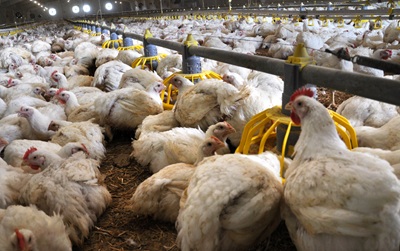
Farm for growing broiler chickens to the age of one and a half months
Iowa raises more egg-laying hens on factory farms than any other state, and the Centers for Disease Control and Prevention says Iowa has lost nearly 30 million birds in the current avian flu outbreak. As the nation’s leader in raising egg-laying hens, Wolf said Iowa’s consolidation makes the industry fragile and highly sensitive to any disruption. She claimed operators designed it that way.
“So, if one birds is sick in one of those 300-some facilities, which is what we’re seeing,” said Wolf, “then all of those birds, in this case, have been culled for the bird flu.” Chickens are more susceptible to disease in cramped confinements, and concentrated manure also threatens air and groundwater quality.
Industry operators say they’re trying to address potential environmental pollution while meeting consumer demand for high-quality poultry.
DES MOINES, Iowa (March 8, 2025) – The Iowa Department of Agriculture and Land Stewardship and the United States Department of Agriculture (USDA) Animal and Plant Health Inspection Service (APHIS) have detected a case of Highly Pathogenic Avian Influenza (H5N1 HPAI) in a mixed species backyard flock in Dallas County, Iowa. This is Iowa’s fifth detection of H5N1 HPAI within domestic birds in 2025.
About H5N1 HPAI
H5N1 HPAI is a viral disease that affects both wild and domestic bird populations. H5N1 HPAI can travel in wild birds without those birds appearing sick, but is often fatal to domestic bird populations, including chickens and turkeys. H5N1 HPAI can also impact dairy cattle, and 13 cases were detected in Iowa dairy herds in June of 2024. With supportive care, dairy herds recover with limited, or no mortality associated with the disease.
Heightened Biosecurity
The Iowa Department of Agriculture and Land Stewardship is strongly encouraging Iowa poultry producers and dairy farmers to bolster their biosecurity practices and protocols to protect their flocks and herds. In addition, the Department has numerous biosecurity resources for poultry producers and dairy and livestock farmers to reference on its website.
Suspected Cases in Poultry
If poultry producers or those with backyard birds suspect signs of H5N1 HPAI, they should contact their veterinarian immediately. Possible cases must also be reported to the Iowa Department of Agriculture and Land Stewardship at (515) 281-5305.
Clinical signs of H5N1 HPAI in birds may include:
Food Safety
It remains safe to enjoy eggs and poultry products. As a reminder, consumers should always properly handle and cook eggs and poultry products, including cooking to an internal temperature of 165˚F.
Public Health
The Centers for Disease Control (CDC) continues to believe the threat to the general public remains low. Any questions related to public health should be directed to the Iowa Department of Health and Human Services.
Wild and Migratory Birds
The Iowa Department of Natural Resources (DNR) asks those who find five or more sick or dead flocking birds within a week to report their findings to their local wildlife biologist or state conservation officer. Do not approach or bring home wild or migratory birds that appear sick or are deceased.
List of Confirmed Cases
As H5N1 HPAI detections are confirmed by the National Veterinary Services Laboratory (NVSL) in Ames, those cases are added to tracking websites located on the USDA APHIS website.
(Breda, Iowa) – Officials with Western Iowa Networks (WIN) say they are continuing to bridge the digital divide in rural Iowa. Through funding acquisitions and strategic partnerships, WIN has expanded its fiber optic network, delivering high-speed internet to underserved communities. Since 2019 WIN has constructed nearly 2,200 miles of fiber and added 22 communities to the list it serves with fiber optics.
WIN CEO Jeff Roiland says “We recognize that reliable, high-speed internet is no longer a luxury—it’s a necessity for rural communities to thrive. Thanks to critical funding programs like the USDA’s ReConnect Program, the FCC’s Rural Digital Opportunity Fund (RDOF), and multiple rounds of the State of Iowa’s Empower Rural Iowa Broadband Grant Program, we’ve been able to accelerate our fiber expansion and bring world-class connectivity to unserved and underserved areas,” said WIN CEO Jeff Roiland.
A key contributor to WIN’s growth, according to Roiland, “has also been the USDA’s ReConnect Loan and Grant Program, which supports broadband deployment in areas with limited connectivity. With ReConnect funding, WIN constructed a fiber network in the Arcadia, IA exchange, benefiting households, farms, and businesses.
“WIN’s participation in the Rural Digital Opportunity Fund (RDOF) has further advanced broadband expansion. RDOF funding was awarded for projects in Mills and Crawford Counties, reinforcing WIN’s mission to bring cutting-edge fiber technology to rural areas. Beyond federal and state funding, WIN has partnered with local governments to facilitate fiber
expansion. Collaborations with Mills County and the City of Glenwood have been instrumental in advancing broadband projects. By working closely with local officials, WIN has addressed community needs and ensured long-term sustainability.”
WIN CEO Jeff Roiland continued, “Through these strategic investments and local partnerships, we’re not just building infrastructure—we’re creating opportunities for education, business growth, and innovation. We are proud of the work everyone at WIN has done to bring this state- of-the-art technology to the communities we serve.”
WIN currently serves nine counties, including the communities of Arcadia, Auburn, Breda, Carroll, Council Bluffs, Dedham, Denison, Farragut, Glenwood, Glidden, Halbur, Hastings, Lidderdale, Macedonia, Malvern, Maple River, Mineola, Mount Carmel, Nemaha, Pacific Junction, Roselle, Silver City, Treynor, Vail, Westside, and Willey residing in nine counties.
About Western Iowa Networks: Breda Telephone Corp. ~ d.b.a. Western Iowa Networks (WIN) ~ is a leading communications company based in Breda, IA. It is one of western Iowa’s largest independent telephone companies, and one of the area’s most diverse service providers. WIN was founded in 1905 as Breda Telephone Company and today provides telephone, Internet, cellular, cable, and many complementary services to customers across Western and Southwestern Iowa.


 Facebook
 Twitter
 YouTube
 RSS
RSS