

CLICK HERE for the latest market quotes from the Iowa Agribusiness Network!
CLICK HERE for the latest market quotes from the Brownfield Ag News Network!


CLICK HERE for the latest market quotes from the Iowa Agribusiness Network!
CLICK HERE for the latest market quotes from the Brownfield Ag News Network!
DES MOINES –Iowa Secretary of Agriculture Mike Naig today (Tuesday), announced the extension of three water quality demonstration projects focused on innovative ways to encourage adoption of water quality-focused conservation practices. The projects were initially funded in 2015 and are being extended for three years to scale-up their efforts and accelerate practice implementation in support of the Iowa Nutrient Reduction Strategy. Naig says “By extending these projects, we can build on their strong foundations and early successes. These projects are great examples of innovative approaches to engage farmers and encourage the adoption of water quality-focused practices. We look forward to adding new partners to these projects and continuing to work with local farmers and agribusinesses to make measurable progress toward our water quality goals.”
Among the three projects receiving extensions, is the Taylor County Water Quality Initiative – The project works with farmers in Taylor County by promoting alternative land management practices on farmed areas identified to be marginal or potentially unprofitable. The project works with farmers to evaluate the specific production levels and goals within their farming operation. It utilizes several tools to evaluate current farm-scale profitability combined with conservation practice and land use alternatives. Rather than focus on the entire field, this project demonstrates which areas of a field should be considered for alternative forms of production, thus making them more profitable and more sustainable.
The project has already engaged 85 participants in the first two years, and 60 of those farmers have already implemented conservation management changes on their fields. More than 30 additional farmers are on a waiting list to participate in the project. The other projects are the Iowa Seed Corn Cover Crops Initiative, and the Central Iowa Watershed Management Authority WQI Project. The three projects will receive over $2 million in additional funding through the Iowa Water Quality Initiative over the next three years. In addition to the state funds, these projects will generate an estimated $5 million in matching funds and other in-kind contributions to support water quality improvement efforts.
Additional details about these and all other demonstration projects that are part of the Iowa Water Quality Initiative is available at https://www.cleanwateriowa.org/farm-1/.
A hunting incident late Sunday morning in northwest Iowa’s Clay County has claimed the life of a Granville man. The Iowa DNR reports at around 11:15-a.m., Sunday, Clay County Sheriff’s deputies, Iowa DNR conservation officers and local emergency personnel responded to a report of a hunting incident near County Highway B53 and 160th Ave., in Clay County. 47-year old Kirk Struve, of Granville, was struck by a round believed to be fired from another member of his hunting party. The incident occurred while Struve was coyote hunting with a large group of hunters.
Struve was taken to a hospital where he was pronounced dead. The investigation into the shooting is on-going and further information will be released throughout the investigation as necessary.
CHEROKEE, Iowa (AP) — An idle meat processing plant that closed in 2014 in northwest Iowa will reopen this week with new owners. The Sioux City Journal reports the Iowa Food Group has hired about 35 people initially and plans to increase that to about 100 this year. The company plans to process beef, chicken, pork and lamb that is slaughtered elsewhere and package it for retail.
Arkansas-based Tyson Foods closed the plant in September 2014, taking 450 jobs with it. Tyson held onto its lease and weathered criticism that it was holding the county hostage economically.
(Radio Iowa) — Media mogul Martha Stewart addressed nearly a thousand people over the noon-hour Friday, at a conference in downtown Des Moines. “I’ve always wanted to come to Iowa,” Stewart said, with a laugh. “I have some ties here. Meredith Corporation is publishing ‘Martha Stewart Living’ and ‘Martha Stewart Wedding’ and our special issues and it was a great opportunity to come and visit…and to see what’s going on here in farm country. ” Stewart was the keynote speaker at the 12th annual “Land Investment Expo” which draws bankers and farmers for a day-long series of seminars. Stewart described her own 150-acre farm in New York State. “I do get dirty. I do get out into the garden. I do clean out the chicken coops. I do know how to do all of that stuff, so it’s authentic,” Stewart said. “…When you’re trying to teach people, if you’re not authentic, you’re not a very good teacher.”
Stewart used the phrase “backyard farm” to describe her operation and she listed the wide variety of livestock, poultry, vegetables and fruits produced there. “Even though I’m just on a little ‘farmette’ I like the idea of farming and growing,” Stewart said. Most Americans are “really ignorant” about where their food comes from, according to Stewart. “I think there is room for more exploration and more teaching in that area,” Stewart said. “I think all the fabulous farmers in this room should promote, more, about how it happens.”
Stewart, an advocate of organic food and farming practices, said consumers are growing more concerned about “chemicals and byproducts” in their food. Developing more small-scale organic farms is important, according to Stewart. “The big farms, of course, they’re important and they feed the world,” she said, “but the small farms, too, should be encouraged and subsidized in some way.”
The third season of Stewart’s television collaboration with rapper Snoop Dogg, an advocate for recreational marijuana, starts in February. Stewart emphasized that she does not smoke pot on the show, but Stewart said she is investing in research of the potential medical benefits from cannabis in products for pets as well as humans.
AMES, Iowa ― Iowa State University Extension and Outreach will host a MarketReady workshop for area producers in Atlantic on Tuesday, February 26. The training is designed to provide producers with the skills and knowledge needed to make sound decisions about diversifying operations into wholesale, retail, and institutional market outlets. The workshop will be held from 10 a.m. to 3 p.m. at the Cass County Community Center, 805 West 10th St., Atlantic. This training will focus on best marketing practices when dealing with these market outlets, including communications and relationship building, regulations, packaging and labeling, grading, pricing, logistics, and more.
The workshop will also include a buyer panel. The intent of this part of the program is for buyers to meet farmers and producers, and for both sides of the sales transaction to understand what the other needs in order to supply and buy local food. Panelists will include chefs, grocers, and institutional buyers such as those working for school districts and hospitals.
Cost for the workshop is $20 per person or $35 per couple (or two employees from the same farm). The fee includes training materials, lunch, and refreshments. Pre-registration is required by 4 p.m. Friday, Feb. 22. To register, visit www.extension.iastate.edu/cass, stop by the Cass County Extension Office, or call (712) 243-1132 by 4 p.m. Friday, Feb. 22. For more information about the workshop, contact Emily Coll, program assistant with ISU Extension and Outreach Local Foods and Value Added Agriculture Programs, at ecoll@iastate.edu or (515) 296-0586.
LYONS, NEBRASKA – The Center for Rural Affairs has a new helpline available for farmers and ranchers. Farmers and ranchers need to manage risk, whether from weather, markets, or other forces. Crop insurance can be used to manage some of their risk. “There can be several reasons why many farmers and ranchers don’t buy crop insurance,” said Anna Johnson, policy manager with the Center for Rural Affairs. “Maybe they haven’t found an option that covers their operation. Maybe they don’t know how to find a crop insurance agent to work with, or don’t know what questions to ask when they meet with an agent.”
Staff on the helpline can address questions on available crop insurance options, how crop insurance works, and how to decide which option is right for an operation. Farmers and ranchers may call the Center for Rural Affairs’ crop insurance helpline at 402.687.2100 ext. 1027 or 1012. In early January, the Center for Rural Affairs hosted a three-part webinar series, covering crop insurance for beginners, an introduction to Whole Farm Revenue Protection, and livestock insurance options. Questions on these topics are also welcome on the crop insurance helpline. Recordings of the webinars can be accessed at cfra.org/crop-insurance-resources.
This project is funded in partnership by the U.S. Department of Agriculture, Risk Management Agency, under award number RM18RMEPP522C015.
Officials in Adair County report Blake Anderson of Fontanelle was re-elected as president of “Ag 4 All” during the group’s first annual meeting. Last year, a group of agricultural groups that had been working together as a collaborative took action to form the non-profit 501(c)3 with the sole purpose of reaching people of all ages with the stories of Iowa agriculture. Other officers elected for the 2019 year are vice-president, Cory Kirkpatrick of Stuart; secretary, Erika Lundy of Adair; and treasurer, Brian Rohrig of Orient. Additional board members include Judy Wedemeyer of Casey and Grace Evans of Bridgewater.
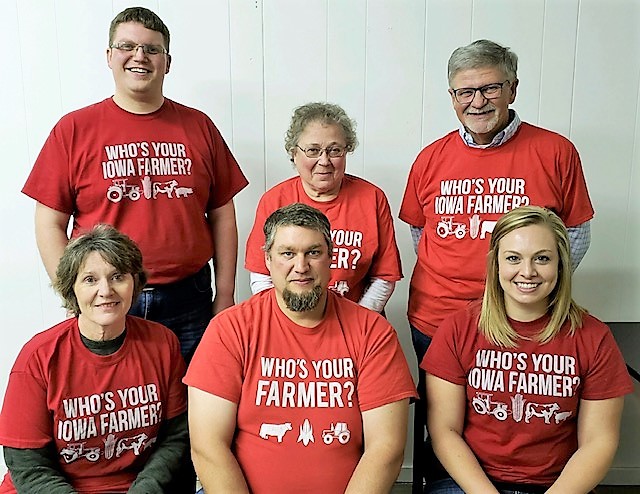
Ag 4 All Board
The group’s current initiatives include: Who’s Your Iowa Farmer? Facebook page, school programs for PK, K, 2nd, and 3rd graders in Adair County, and Ag Adventure at community celebrations. Funding to operationalize the programs comes from partner organizations, program sponsors, grants, and individual contributions. Current partners include: Adair County Cattlemen, Adair County and Iowa Corn Growers, Adair County Extension and Outreach, Adair County Farm Bureau, and Adair County Pork Producers.
(Radio Iowa) — Pork producers in Iowa and across the country are growing increasingly concerned about the threat of African Swine Fever (ASF). Curtis Meier runs a 160 sow farrow-to-finish operation near Clarinda. “It would be disastrous if we get it here in the U.S.,” Meier says. ASF has been spreading in China in recent months and products with the virus have been detected in Australia, South Korea, Japan and Taiwan. Here in Iowa, Meier says producers have always emphasized bio-security on their farm, but there are some things they just can’t control. “You know, it’s really scary the amount of feed ingredients we get from China,” Meyer says. “And it doesn’t necessarily have to be in the ingredients, it can be on the confounded containers that they use to haul the stuff over here.”
Livestock economist Steve Meyer says African Swine Fever could have a big impact on hog prices in coming months. If ASF continues to spread in China, it could be positive for U.S. pork producers. “If the losses in China get completely out of hand and they have to go to the world market to just feed their people – and if we can get our tariff situation settled enough that we can participate in that – that would be a real positive,” Meyer says. But if AFS were to enter the U.S., Meyer says, it would obviously be devastating. “If it comes here, we’re blocked from exports immediately, and we have 23 percent more pork and we’ve got to work through all that…so, even if we contain it quickly and it doesn’t kill many pigs, we can’t export until we prove it’s contained,” Meyer said.
But Meyer also thinks the U.S. is much better prepared to deal with an ASF outbreak, which could limit any potential long-term damage to markets. Curtis Meier and Steve Meyer both spoke with Brownfield Ag News during this week’s annual meeting of the Iowa Pork Producers Association in Des Moines.
GUTHRIE CENTER – Iowa State University Extension and Outreach (ISUEO) is hosting a new program for women beef cattle producers in February at the Guthrie County Extension Office in Guthrie Center. Boots in the Barn is a four-part series for women involved in cattle production. This program is designed to provide women with the latest-research based information pertaining to beef herd management including pasture, nutrition, health, calving, and financial management. The full scope of the program’s topics will be determined by the interests of the audience.
The main focus of the program is to provide an open atmosphere for women to come, learn, and ask questions of experts. The course is also designed to keep things hands-on and provide a small-group environment for participants to learn from their peers. Boots in the Barn will be held Feb. 5, 12, 19, and 26 from 6-8 p.m. with a light meal being served at 5:30 p.m. The program will be held at the Guthrie County Extension Office, 212 State St, in Guthrie Center. Speakers from ISUEO include Erika Lundy, beef field specialist, Aaron Saeugling, agronomy field specialist, and Tim Christensen, farm management specialist. Additional speakers include Dr. Courtney Blake, Anita Veterinary Clinic, Brandy Rudy, Exchange State Bank, and Clara Lauritsen, Lauritsen Cattle Company.
For more information on Boots in the Barn or to register before Jan. 30, contact Krista Downing at 641-747-2276 or kristad@iastate.edu. Registration is $25 for all four sessions, although participants are not required to attend all four sessions. The program is partially sponsored by Adair Feed & Grain. A brochure with registration and program details can be found at https://www.extension.iastate.edu/guthrie/news/boots-barn-guthrie-county.


 Facebook
 Twitter
 YouTube
 RSS
RSS