

KJAN News can be heard at five minutes after every hour right after Fox News 24 hours a day!
Keep up-to-date with Fox News Radio, Radio Iowa, Brownfield & the Iowa Agribusiness Networks!


KJAN News can be heard at five minutes after every hour right after Fox News 24 hours a day!
Keep up-to-date with Fox News Radio, Radio Iowa, Brownfield & the Iowa Agribusiness Networks!
(Radio Iowa) – A bill eligible for debate in the Iowa Senate Education Committee would require that public schools show students in all grades ultrasounds and computer-generated animation that explain pregnancy and fetal development. Amber Williams, a lobbyist for an Iowa organization called Inspired Life, says getting this kind of information when she was a student may have changed her decision to have an abortion at the age of 18.
“By passing this bill we can provide a compelling, science-based view of a baby’s development in the womb,” she said. “This type of education has the potential to profoundly impact how young people perceive life and the choices that they will face.” Similar bills that stalled in the legislature last year specified the “Meet Baby Olivia” video produced by an anti-abortion group would have to be shown to students, starting in 7th grade.
There’s no reference to that video in this year’s bill — and the legislation no longer says what’s presented to students should be based on research by medical organizations like the American College of O-B-G-Y-Ns. Johnston High School student Genevieve Weis is asking legislators to reject the bill. “When students are given false information, it leads to confusion and hinders the understanding of important concepts,” she said. “This not only affects their academics, but their ability to make informed decisions about their future.”
Bill backers say the legislation requires students be presented with research-based, unbiased information that depicts the humanity of the unborn child. A lobbyist for Planned Parenthood Advocates of Iowa says it’s a politically motivated bill that’s meant to influence the trajectory of young Iowans’ lives.
McLEAN, Va., Jan. 23, 2025 — Glen R. Smith, a native of Atlantic (Iowa), was elected this week as chairman of the Farm Credit System Insurance Corporation board of directors. He succeeds Jeffery Hall, who served as chairman of the FCSIC board of directors from November 2016 until he was designated board chairman and CEO of the Farm Credit Administration (FCA) on Jan. 20, 2025.
“I would like to thank the FCSIC board for electing me chair,” said Chairman Smith. “I am honored to have the opportunity to lead FCSIC because I recognize and value the role it plays in maintaining investor confidence in the Farm Credit System (FCS or System). This confidence is crucial for the System to have a dependable source of funds to lend to agriculture and rural America. I also want to thank Board Member Jeff Hall for his exemplary leadership of the FCSIC board of directors for the past eight years. I look forward to working with him and Board Member Vincent Logan as we continue to fulfill FCSIC’s mission.”
The Insurance Corporation is an independent U.S. government-controlled corporation responsible for ensuring the repayment of principal and interest on certain Farm Credit System debt obligations issued to investors. As of Sept. 30, 2024, the FCSIC insurance fund held $7.8 billion in total assets, insuring $434.8 billion in outstanding FCS debt. The FCS includes a nationwide network of borrower-owned cooperative lending institutions and affiliated service entities that have a leading role in providing financing to agriculture and rural America. The Insurance Corporation is managed by a three-member board of directors consisting of individuals who serve concurrently as members of the FCA board. FCA is the regulator of the FCS.
Chairman Smith has served as a member of the FCA board, as well as a member of the FCSIC board of directors, since December 2017, when President Donald J. Trump appointed him to the FCA board. President Trump designated him chairman of the board and CEO of FCA in 2019, and he served in that capacity through most of 2022. In his role on the FCA board, Mr. Smith has been particularly interested in encouraging the advancement of System programs for young, beginning, and small farmers and ranchers, in addition to promoting the safety and soundness of System institutions. These board efforts culminated in regulatory actions that were entered into the Federal Register in February 2024.

Glen R. Smith (File photo)
Chairman Smith was raised on a diversified crop and livestock farm in rural Atlantic. His farm experience started at a very early age, after his father was involved in a disabling farm accident. He graduated from Iowa State University in 1979 with a Bachelor of Science degree in agricultural business. In 1982 Chairman Smith and his wife, Fauzan, moved back to his hometown and started their family agricultural operation as “beginning farmers.” In that same year, he established a locally based land service company. Today, their family farm, Smith Generation Farms Inc., has grown to encompass about 2,000 owned acres devoted to corn, soybeans, and hay. The company, Smith Land Service, specializes in farm management, land appraisal, and farmland brokerage, serving landowners in about 30 Iowa counties.
The Smiths have four grown children and six grandchildren, all involved in various degrees with production agriculture. In 2017, their son Peter assumed managerial responsibilities for both the family farm and business.
(Radio Iowa) – The Iowa Racing and Gaming Commission heard details of two studies on the state of the gambling market and the impact of a new casino in Cedar Rapids at their meeting today (Thursday) in Jefferson. Brent Wittenberg of Marquette Advisors talked about the impact of a new casino in Linn County. “You can see a statewide net impact of about 64 million in terms of new revenue, new commercial, concealed revenue flowing into the state,” he says. Wittenberg says 57 percent of the revenue for Cedar Rapids would come from existing casinos.
“Facilities at Riverside and Meskwaki and Isle of Waterloo, that’s where the impact is likely to be most felt,” he says. The other study showed similar numbers, with some 60 million in new revenue, but around 56 million cannibalized from existing casinos. Jonathan Swaim spoke for casino developers and said those predictions have been wrong in the past.
“Seventy-nine-percent of the revenue and the application for this facility we’re standing in today was to be cannibalized. That license was issued. Obviously, none of those revenue cannibalization numbers occurred,” Swaim says. Swaim says they believe the proposed Cedar Rapids casino meets all the requirements of the state. “We believe there’s 12 ‘yes’ check marks next to each of these criteria as it relates to this project, whether it’s economic impact, community support, the viability, net benefits, the tourism, employment opportunities,” he says.
A spokesman for the Meskwaki Casino spoke at the meeting against the Cedar Rapids casino, saying it would impact their operation. The I-R-G-C is set to vote on the new license February 6th.
COUNCIL BLUFFS, Iowa – A Newton man was sentenced on January 15, 2025 in Council Bluffs U-S District Court, to 100 months (a little over 8-years) in federal prison for receipt of child sexual abuse material.
According to public court documents, between October 2022 and January 2024, Charles Gordon Feagins, 24, purchased and received images and videos containing child sexual abuse material. During a search of Feagins’s Newton residence, law enforcement seized electronic devices that had more than 500 images and videos containing child sexual abuse material.
After completing his term of imprisonment, Feagins will be required to serve a fifteen-year term of supervised release. There is no parole in the federal system. Feagins was also ordered to pay $45,000 in restitution. Feagins will be required to register as a sex offender.
United States Attorney Richard D. Westphal of the Southern District of Iowa made the announcement. This case was investigated by the Federal Bureau of Investigation-Child Exploitation Task Force.
COUNCIL BLUFFS, Iowa – A Council Bluffs man was sentenced on January 16, 2025 to 11 years (132 months) in federal prison for conspiracy to distribute methamphetamine and possession with intent to distribute methamphetamine.
According to public court documents, in May 2024, law enforcement conducted a traffic stop on a vehicle and identified the driver as Mexican national, Jose Remiro Casillas, Jr., 29. Casillas was in possession of over two pounds of methamphetamine and almost $2000. Casillas was distributing methamphetamine while on probation in Nebraska for a drug-related offense.
After completing his term of imprisonment, Casillas will be required to serve a five-year term of supervised release. There is no parole in the federal system.
United States Attorney Richard D. Westphal of the Southern District of Iowa made the announcement. This case was investigated by the Drug Enforcement Administration, Iowa Department of Public Safety-Division of Narcotics Enforcement, and Southwest Iowa Narcotics Enforcement Task Force.
COUNCIL BLUFFS, Iowa – A Shelby County man was sentenced on January 14, 2025 to 270 months in federal prison for conspiracy to distribute methamphetamine.
According to public court documents, on January 2, 2024, law enforcement pursued a vehicle in a high-speed chase through Harlan and Avoca, including on Interstate 80. The driver of the vehicle was identified as Sean Patrick Gifford, 41. On January 31, 2024, Gifford engaged in a second high-speed chase with law enforcement and was in possession of over 190 grams of methamphetamine and $29,845. Evidence located during a forensic search of Gifford’s cell phone corroborated his drug trafficking activities and linked him to the distribution of 4.5 kilograms of methamphetamine.
After completing his term of imprisonment, Gifford will be required to serve a five-year term of supervised release. There is no parole in the federal system.
United States Attorney Richard D. Westphal of the Southern District of Iowa made the announcement. This case was investigated by the Council Bluffs Police Department, Southwest Iowa Narcotics Enforcement Task Force, and Iowa State Patrol.
COUNCIL BLUFFS, Iowa – A Council Bluffs man was sentenced on January 21, 2025 to 210 months in federal prison for receiving child pornography.
According to public court documents, the National Center for Missing and Exploited Children received CyberTips that an account, later determined to be associated with Todd David Matheson, 63, had files containing child sexual abuse material. Law enforcement seized electronic devices during a search of Matheson’s Council Bluffs residence and an Omaha residence. A forensic examination of the seized electronic devices showed that Matheson used the devices to receive and distribute images and videos containing child sexual abuse material.
After completing his term of imprisonment, Matheson will be required to serve a five-year term of supervised release. There is no parole in the federal system. Restitution to the victims will be determined at a later date. Matheson will be required to register as a sex offender.
United States Attorney Richard D. Westphal of the Southern District of Iowa made the announcement. This case was investigated by the Federal Bureau of Investigation-Child Exploitation Task Force, Council Bluffs Police Department and Omaha Police Department.
This case was brought as part of Project Safe Childhood, a nationwide initiative to combat the growing epidemic of child sexual exploitation and abuse launched in May 2006 by the Department of Justice. Led by U.S. Attorneys’ Offices and the Child Exploitation and Obscenity Section, Project Safe Childhood marshals federal, state, and local resources to better locate, apprehend and prosecute individuals who exploit children via the Internet, as well as to identify and rescue victims. For more information about Project Safe Childhood, please visit https://www.justice.gov/psc.
(Radio Iowa) – A Des Moines hospital is the first in Iowa to perform brain surgery using a new type of treatment called GammaTile therapy. Dr. Sam Schroeder, radiation oncologist at UnityPoint Health — John Stoddard Cancer Center, says a postage stamp-sized chip that’s embedded with radiation is implanted in the brain after a tumor is removed. Aggressive brain tumors, which impact more than 200-thousand Americans a year, tend to resist traditional treatments and have a high recurrence rate.
“If the tumor has returned, the GammaTile allows us to deliver radiation from the inside out, which is very different than the vast majority of radiation treatment, particularly within the brain,” Schroeder says. “I think it’s a very attractive way to treat an area that’s in a challenging location.” If a brain tumor returns, he says it’s often treated with external radiation, and a surgeon may go back in and remove the new tumor. That’s where this new technique might best be used.
“There could be that risk that if there are any cells left behind, it can come right back and doing subsequent procedures can be very challenging,” Schroeder says. “So a way of thinking about the GammaTile is, it’s like an insurance policy to minimize the likelihood that a spot should come back in these fairly challenging situations.” The first GammaTile surgery in Iowa was performed at UnityPoint in Des Moines within the last month, and Schroeder says the technique may only be used on 10 or 20 patients, at least initially.
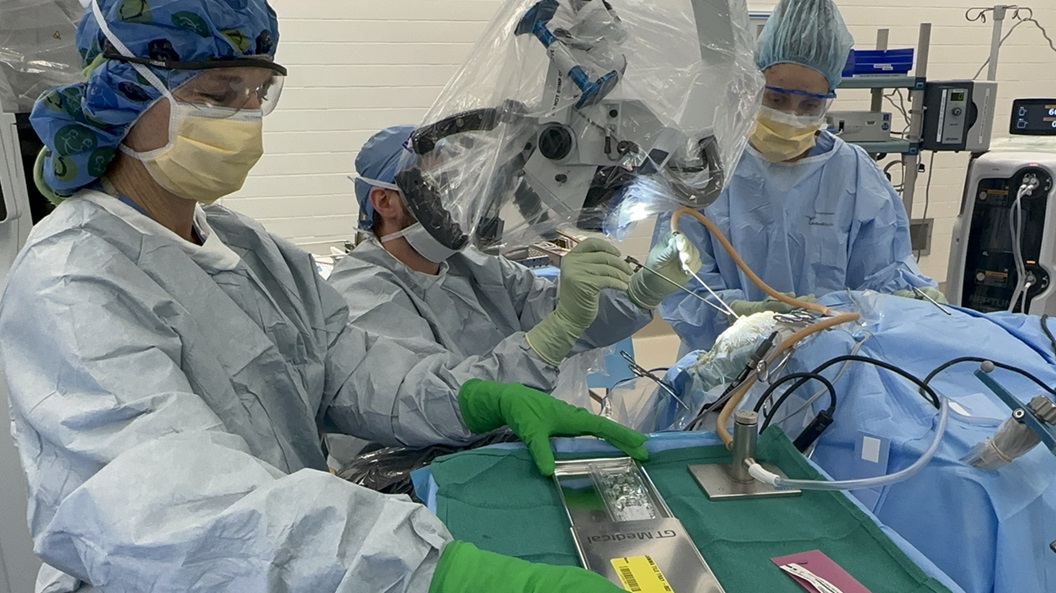
UnityPoint Health photo
“We won’t be treating hundreds or thousands of patients a year with this,” he says. “We think it is a very important tool to be able to offer because sometimes, patients are doing very well, aside from maybe a spot that’s causing issue within the brain. So we want to make sure that we can take care of these patients and give them the best treatment possible.”
The FDA-cleared procedure, called Surgically Targeted Radiation Therapy or STaRT, is designed to delay tumor regrowth while preserving healthy brain tissue. Schroeder says it targets tumor cells precisely where recurrence is most likely, bringing new hope to people with life-threatening brain tumors.
(Radio Iowa) – The author of a bill to establish a five-year moratorium on new casino licenses says it will be considered in a House committee next week. Representative Bobby Kaufmann’s bill would block the bid for a new casino in Cedar Rapids. Backers of the Cedar Crossings Casino project say it would inject competition in Iowa’s gambling industry. Kaufmann rejects that.
“There is no such thing as a free market in the casino industry. That is a fallacy and it’s complete B.S.,” Kaufmann says. “The Iowa Racing and Gaming Commission is a government body that chooses winners and losers and the free market does not exist.”A southeast Iowa lawmaker has introduced a bill in the Iowa Senate that would establish a five-year moratorium on new gambling licenses. Kaufmann’s bill goes farther, to set criteria in state law for regulators who’d be reviewing casino license applications in the future.
Backers of the Cedar Rapids project point to an estimate indicating the Cedar Crossings Casino would generate 60 MILLION dollars in gambling taxes for the state. Kaufmann, a Republican from Wilton, says hundreds of people who live in his House district are employed at the Riverside casino that would lose customers to a Cedar Rapids casino. “The benefit does not outweigh people losing their jobs in my personal opinion,” Kaufmann says.
The Iowa Racing and Gaming Commission is scheduled to vote February 6th on the Cedar Rapids casino plan. It’s possible a fast-tracked bill could be signed into law by the governor before then. Governor Reynolds has not indicated whether she supports a moratorium on new licenses.
COUNCIL BLUFFS, Iowa – A Council Bluffs man was sentenced on January 16, 2025 to 22 years (264 months) in federal prison for conspiracy to distribute methamphetamine.
According to public court documents, Ricardo De Jesus Guzman-Corona, 39, a Mexican national, facilitated the importation and distribution of mass amounts of methamphetamine to the Omaha/Council Bluffs metropolitan area over a three-year period while living in Mexico. Guzman-Corona conspired to distribute methamphetamine with individuals linked to the Sinaloa cartel. Guzman-Corona was responsible for the distribution of more than 4.5 kilograms of methamphetamine in the Omaha and Council Bluffs areas.
After completing his term of imprisonment, Guzman-Corona will be required to serve a five-year term of supervised release. There is no parole in the federal system.
United States Attorney Richard D. Westphal of the Southern District of Iowa made the announcement. This case was investigated by the Drug Enforcement Administration, Southwest Iowa Narcotics Enforcement Task Force, Council Bluffs Police Department, and Omaha Police Department.

 Facebook
 Twitter
 YouTube
 RSS
RSS