

KJAN News can be heard at five minutes after every hour right after Fox News 24 hours a day!
Keep up-to-date with Fox News Radio, Radio Iowa, Brownfield & the Iowa Agribusiness Networks!


KJAN News can be heard at five minutes after every hour right after Fox News 24 hours a day!
Keep up-to-date with Fox News Radio, Radio Iowa, Brownfield & the Iowa Agribusiness Networks!
(Des Moines, IA) – [KCCI/Iowa DOT] – As severe winter weather rolled across the state Sunday, authorities shut down one of the busiest roadways to keep drivers safe. As of 3:10-a.m. Monday (Today), the Iowa Department of Transportation’s 511ia.org website indicated Interstate 35 between US Highway 30 (near Ames) and the Minnesota Border (23 miles north of the Clear Lake area), is blocked due to a winter storm..
The DOT and the Iowa State Patrol urged drivers to not seek alternate routes north because conditions on side highways are just as bad. Some counties in the northern part of the State are also under a tow ban. The Iowa Falls Times-Citizen is reporting that motels in that area are full. The Iowa Falls Fire Station on South River Street were set up as an emergency shelter for stranded motorists.
The Iowa State Patrol responded to 31 crashes between 6 a.m. and 8 p.m. Sunday. Of those crashes, 22 resulted in property damage only and eight included injuries. One crash was fatal. The ISP also responded to 127 motorist assist calls during that time frame. The largest crash the ISP responded to on Sunday afternoon was a 14-vehicle crash on Interstate 35. The high winds and blowing snow reduced visibility to zero at that time. Officials with the Iowa DOT said people were driving too fast for conditions, and not heeding heeding warnings to slow down and stay if possible.
Interstate 29 was closed in both directions for several hours, Sunday, between Onawa and Sloan, due to a multi-vehicle pile-up. According to the Woodbury County Sheriff’s Office Facebook, there were two accidents on I-29 near the Woodbury and Monona County line involving multiple vehicles. Part of I-80 between Cass and Pottawattamie County were partially blocked Sunday morning, due to crashes involving semis and other vehicles. Minor injuries were reported in some of those accidents.
A blizzard warning remains in effect until 9-a.m. today (Monday) for 20 counties in mainly northern and parts of northwest Iowa.
(Radio Iowa) – House Speaker Pat Grassley says Republicans in the Iowa House will seek longer prison sentences for people who’ve previously been convicted of violent crimes. “As we’ve seen lawlessness take over some of these cities across the country, I think it’s something we need to be serious about,” Grassley says. “That’s something Iowans expect from us, is to have safe places to raise a kid.”
Grassley points to the man accused of stabbing a 23-year-old Ukrainian refugee to death on a train in North Carolina in August. The man had over a dozen prior arrests and had served five years in prison for armed robbery. “As a parent of somebody the same age as this girl, I don’t want to live in a place where I have to worry about these types of things,” Grassley says. Grassley says violent offenders with a laundry list of past criminal behavior should face longer prison sentences — with no leeway for judges or parole boards to reduce the prison term.
“Making sure that those individuals that are continuous career criminals, especially focused on the violent type of offenders, we’re going to make sure this is not a place that they want to live,” Grassley says. “You should not come to Iowa and think you can have a long track record and a criminal history and that there’s not going to be a consequence for that.”
Republican Representative Steven Holt of Denison is working on the details of an anti-crime package, which he says will be focused on habitual violent offenders. “We have some mandatory sentencing and things like that in Iowa, but I just heard recently from county attorneys about an individual who received a 20 year prison sentence and was let out after one year,” Holt says. “That’s 1/20th of the prison sentence.”
Under current Iowa law, someone previously convicted of two serious felonies may be charged as a habitual offender, which brings a longer prison sentence and the person isn’t eligible for parole until they’ve spent at least three years in prison. Holt says the legislation under development may address those considered a threat to public safety who’ve committed lesser crimes.
“Requiring mandatory sentences so that these people cannot get back out on the street. I think the old adage that you often hear that 10% of the people commit 90% of the crimes is true and we need to do whatever we need to do to keep those people behind bars,” Holt said. “It’s not just about rehabilitation. It’s also about paying a debt to society and making sure justice is served.” Holt says legislation should be ready for debate early in the 2026 legislative session, which begins Monday, January 12th.
Damage to west residence (structure and vehicles) unknown value at time of the press release. Damage to the southern residence appears to be limited to exterior siding ( value unknown at time of report).
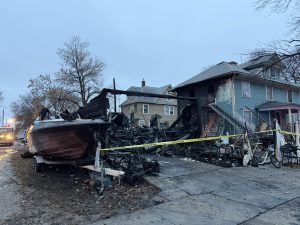
Red Oak FD photo

Red Oak FD photo

Photo credit Kyle Cross
Other agencies assisting in handling the incident included:
(Des Moines, IA) – The average price for gas in Iowa took another dip this past week. According to AAA’s latest weekly report, the price of regular unleaded gasoline as of Dec. 24th in Iowa, was $2.42 per gallon, on average. That’s down six-cents from the previous week, and down 36 cents from a year ago.
The national average on Wednesday was $2.86, down five cents from the week before. Retail diesel prices in Iowa fell eight-cents over the past week, to a statewide average of $3.31 per gallon.
One year ago, diesel prices in Iowa averaged $3.28. The current Iowa diesel price is 28 cents lower than the national average of $3.59.
(SE Union County, IA) – A man from Murray escaped injury after the pickup he was driving left the road and rolled into a ditch Friday evening, southeast of Arispe, in Union County. According to the Union County Sheriff’s Office, 45-year-old Matthew J. Henrichs was driving a 2011 Ford F-350 Super Duty pickup that was pulling a large utility trailer (equipped with 2 axles), when he felt the trailer pull off the side of the road on eastbound 270th Street/Trout Avenue.
When Henrichs attempted to correct what was happening with the trailer, he realized he was going to fast. When he over-corrected, and before he could brake in time, the pickup & trailer went into the ditch, causing the truck to roll into the north ditch. Both curtain airbags deployed in the pickup. The accident happened at around 5:05-p.m., Friday.
The vehicle sustained a sheriff’s deputy-estimated $15,000 damage. A fence was also damaged in the accident. The fence, belonging to Landy Livingston sustained an estimated $500 damage. No citations were issued.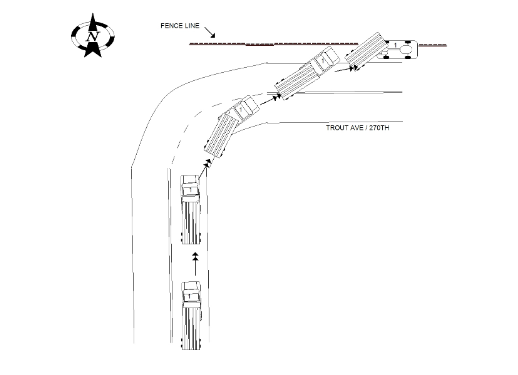
(Sioux County, IA) – KCAU-TV reports a plot of land in northwest Iowa has set a new record for the most expensive land sale in the State’s history. A plot of land measuring nearly 35.5-acres northwest of Orange City, sold for $32,000/acre at auction on December 1st. The total purchase price was just over $1-million.
That breaks the previous land sale auction price of $30,000/acre, also set in Sioux County, back in 2022. The winning bidder was a neighboring property owner who plans to farm corn and soybeans on the land.
(An IOWA CAPITAL DISPATCH report) – Research led by a University of Iowa student is opening new doors to potential uterine cancer treatments that could allow patients to regain their health while retaining their ability to have children, the university reported.
Katie Colling, a fourth-year doctoral candidate in the UI cancer biology program, has found promising results from testing different types of drugs aimed at balancing hormones in the uterus — called progestins — on cell cultures created from patient tumor tissue, according to a university news release.
Most uterine cancer cases are caught early, Colling said, and are treated with a surgery that removes the uterus, cervix, fallopian tubes and ovaries. This leaves these patients without the ability to have children. Surgery isn’t always viable, however, for patients with other health factors or those planning to have children, and the current progestins used for uterine cancer treatment are not effective for everyone.
“The problem with these drugs is that they don’t work for every patient. So some patients respond well initially, but for up to 40% of them, their cancer actually comes back, and that’s not a good thing,” Colling said in an interview. “Currently, there are only three progestins used in the clinic, or three hormone therapies, yet over 20 are used for other purposes in women’s health, such as contraception, and we don’t understand which is most effective for treating uterine cancer.”
Uterine cancer is the fourth-most common cancer in women and the fifth-most common cause of cancer death in the U.S., Colling said, and it recently passed ovarian cancer to become the deadliest form of gynecologic cancer. According to the National Cancer Institute, the cancer’s five-year survival rate between 2016-2021 was just over 80%, and close to 14,000 people have died of uterine cancer in 2025.
Working in the lab of obstetrics and gynecology researcher and UI professor Kristina Thiel, Colling said she has spent the past two-and-a-half years testing different progestins on cell cultures from tumors called “organoids” to see how they impact tumor growth and cell death within it. She called the results she’s seen so far “really promising.” Colling’s work had a big hand in earning the UI, as well as the University of New Mexico, University of Utah and University of Kansas, a five-year, $12.8 million grant from the National Cancer Institute, Thiel said.
The University of New Mexico Health Sciences Center is the lead organization on the project, titled “Advancing Hormone Therapy for Endometrial Cancer” and awarded its funding in August, and the UI team will receive around $500,000 annually to continue with its work testing progestins. Next steps in Colling’s work include taking the top progestin candidates she’s identified and testing them in mice, with the data from that phase planned to be combined with data from other institutions and used for clinical trials.
One question Colling said she’s asked herself is why, with so many progestin options available and being used for other means, they haven’t been tried for uterine cancer treatment. The current progestin treatments have been utilized since the 1970s, and she said women’s health has been traditionally under-researched. This is why she said she’s “really excited” to further this study and advance cancer treatment therapies.
Both Colling and Thiel emphasized that the public should be educated about their research, as well as signs of cancer developing and other information to keep them safe and healthy. Colling recently won the 2025 Three Minute Thesis competition on campus, where she had to explain her research in language the general public would understand in three minutes.
One fact Thiel called “absolutely alarming” is that mortality related to uterine cancer is worse today than in the 1970s.
CEDAR RAPIDS, Iowa (KCRG) – A new feature on the Iowa 511 app lets you report a road hazard directly to the DOT.
You can choose from three main categories – traffic (like crashes or standstill traffic), road hazards (potholes or debris), and flooding.
The app also allows drivers to report an incident hands-free with Siri, if you have iOS. The Iowa DOT reminds drivers that if you don’t have hands-free access, to have a passenger make a report.
Reporting is limited to Iowa DOT-managed roadways (Interstates, US and State highways). The app won’t accept reports on roads the DOT does not maintain.
You can also make a report by calling 511.
(Radio Iowa) – As we approach New Year’s Eve, a common resolution is to get in better shape, and an Iowa State University psychology professor is studying ways to help make exercise a habit we enjoy. Dr. Alison Phillips, a social and health psychologist at I-S-U, says they tried out a variety of strategies with an online exercise program to see what was most effective at making participants, including some who were new to the practice, stick with it. “We tested eight different groups, so just a combination of three different strategies, and they all worked,” Phillips says. “Even the control group got basic goal setting, which is, we treated it like the standard advice that not everybody does, but that helped them to form habits and stick with their exercise more frequently and for a longer amount of time. We followed them for a whole year.”
Phillips says exercise preparation habits proved to be the best method. She says they guided participants to form habits around getting ready to exercise, essentially making sure they had everything they needed. “If you want your exercise routine to be going to the gym every day after work, your preparation habit might be making sure your gym bag is packed the night before,” she says, “maybe even loaded into your car so that it’s ready to go and you have fewer barriers when it’s time to exercise.” By getting one’s gym clothes — or whatever gear is necessary — organized ahead of time helped to cement the plan to exercise in a person’s mental schedule.
“It depends on the person, of course, but maybe it’s doing laundry right when you get home from work, to make sure your clothes are clean, putting your shoes by the door so that you see them and they’re ready to go,” Phillips says, “really dependent by the person, but it was around getting stuff ready, rather than an exercise habit itself.” The popularity of pickleball has skyrocketed in recent years, and Phillips says enthusiastic participants in a sport often create an identity for themselves around that activity.”That’s part of what motivates us to do something, is how we see ourselves, and those pickleball players? That is a big part of their identity, and it’s become something they’re competitive about, it’s their social circle, it’s their exercise,” Phillips says. “But the fact that it’s exercise is probably far down the list of the reasons why they’re doing it.”
That sense of identity can also be a strong motivator in a host of sports, she says, from running to racquetball.
(Radio Iowa) – The leader of Iowa State’s Master Gardener Program says gardening continues to be a popular hobby. Alicia Herzog says some people turned to it when they were stuck at home during the pandemic.
Herzog says she doesn’t have exact numbers, but she knows through their the winter home gardener webinar series that there’s a lot of interest.
She says it’s something that anyone can learn to do.
Herzog says Iowa State University can answer a lot of the questions people may have on how to start a garden and how to keep it growing.


 Facebook
 Twitter
 YouTube
 RSS
RSS