

KJAN News can be heard at five minutes after every hour right after Fox News 24 hours a day!
Keep up-to-date with Fox News Radio, Radio Iowa, Brownfield & the Iowa Agribusiness Networks!

KJAN News can be heard at five minutes after every hour right after Fox News 24 hours a day!
Keep up-to-date with Fox News Radio, Radio Iowa, Brownfield & the Iowa Agribusiness Networks!
(Radio Iowa) – Hundreds of students from all corners of Iowa will be in Des Moines this weekend to take aim at winning medals and scholarship money in the 18th annual state archery tournament. Zach Benttine, the Iowa D-N-R’s archery coordinator, says the competition has continued to improve every year, along with the growing field of participants in grades four through 12. “This will be the biggest tournament we’ve had to date. We’ll have almost 2,100 individuals competing in bullseye, representing 140 schools,” Benttine says, “and then 3-D, we have 1,020 students competing, and last year, our record number was 840, so we increased that by 180 archers.” This state division of the National Archery in the Schools Program (NASP) features two types of competition. The bullseye tournament has traditional square targets with colored, concentric rings, while the 3-D tournament has students zeroing in on a half-dozen types of styrofoam animals.
“The standard six targets, no matter if you’re shooting at the Iowa NASP state championships or any of the other 50 states or the national, we have a stone sheep, we have an antelope, we have a white-tailed deer, a bear, a turkey and a coyote,” Benttine says, “so it’s your typical North American animals that you can see almost everywhere in the country.” The top Iowa finishers this weekend will go on to the national tournament. The archery program was launched in Iowa in 2006 with a few pilot schools, and it’s quickly grown. Benttine says there’s a 10-hour curriculum that’s taught at each competing school. The sport, he says, is a tremendous equalizer.
“Anyone can shoot archery, and this gives the kids who maybe don’t wrestle or play basketball or baseball or any of the sports that end in -ball, it gives them an opportunity to feel a sense of their school,” Benttine says, “so they’re still an athlete for their school, so that’s a huge reason we see growth.” The tournament runs today (Friday) through Sunday at the Richard O. Jacobson Exhibition Center and the 4H Building at the Iowa State Fairgrounds. Prizes include more than $10,000 in college scholarships based on performance at the state tournament, while another $13,000 will be awarded outside of the competition to archers based on academics, essays, and other criteria. Teams are also aiming for some $18,000 in archery equipment for their schools.
(Radio Iowa) – The governor’s declared today (Friday) a statewide Day of Kindness, as Iowans are urged to find ways to be intentional with acts that will make someone’s day — or at least make them smile. Kara Matheson, a vice president at the West Des Moines Chamber of Commerce, says the day started as a local event five years ago and quickly went viral. “People in all four corners of the state really latched onto it,” Matheson says, “because who doesn’t enjoy that feel-good moment of being able to do any kind of small act of kindness for a stranger, for a loved one, you name it.” The act can be big or small, monetary or action-oriented, anonymous or direct, and she says Iowans have the ability to swiftly make #IowaKind spread far and wide.
“We’ve seen businesses bring coffee to first responders,” Matheson says. “Let a stranger cut in line in front of you. We always hear about pay it forward in coffee lines. It can be calling or texting a friend or a family member and just telling them how much you have been thinking about them and that you appreciate them.” The chamber’s own event today is called Socks of Love, where people are encouraged to donate new pairs of socks — solo pairs or a multi-pack — to be given to those in need. Last year, the effort netted more than two-thousand pairs. Anyone, anywhere can donate socks by clicking here, (https://www.amazon.com/registries/gl/guest-view/17ROL11RTJHIM) or, during the course of the day, just find some way to do something nice for someone.
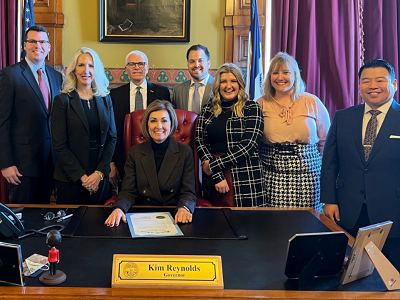
This photo of the State Proclamation is from Day of Kindness in February 2024.
“It doesn’t have to cost money, it doesn’t have to take a lot of time, thought or effort. It’s just kind of pausing to think, what small thing could I do to make a difference in someone else’s life?” Matheson says. “Truly, that one act that you can do will have a ripple effect, and it can inspire other people to turn and go and do an act of kindness to someone else.” She says studies show kindness benefits not only the recipient but also the giver.”It really feels good for you as someone who is giving that act of kindness, and of course, it’s going to feel good for the other person who’s receiving it,” Matheson says. “It really is just a ripple effect, and it spreads kindness even outside of this one day where our intention is to keep the focus on it, because I think every day of our lives, Iowans and people everywhere could benefit from more kindness.”
(Radio Iowa) – The state Board of Regents approved an increase in the budget for replacement of the windows at the University of Iowa Children’s Hospital. U-I vice president Rod Lehnertz says nearly all of the windows have been replaced after de-lamination and cracking developed that presented potential safety hazards. “We have been prudent in replacing the windows that need to be for safety and operation purposes, but also tried to continue to monitor window systems to make sure we weren’t replacing those that didn’t need to be,” Lehnertz says. He asked the Regents Thursday to approve adding eight more sections of windows to the project.
“In this case, this revised budget moves from the original 45 million to 52-point-five million, which, as the description in the docket information, indicates the vertical slot windows that go nine stories and connecting all the floors would be added to this, effectively replacing all the windows except for those that are on the ground floor,” he says.
The hospital was completed in 2017 and the building has gained national notoriety from “The Wave” where everyone in nearby Kinnick Stadium waves to patients in the hospital after the first quarter of home football games.

The Hawkeye Wave takes place at the end of the first quarter during home football games, (U-o-I Facebook photo)
(Radio Iowa) – Maple syrup season gets underway this weekend at the Indian Creek Nature Center near Cedar Rapids. Center spokesman Eric Hart says they began preparations last month. “We put in over 100 spires on February 15th, and then once the weather warmed up this past week, the sap has started flowing,” Hart says. Volunteers and staff collect the tree sap and to start the process of boiling down into maple syrup. Hart says the weather conditions play a big part in how much sap they can collect. “This time of year is usually really good for it, but it kind of does depend on what kind of weather we get,” he says. “Usually, temperatures during the day that are above freezing, around 40 degrees, and then temperatures at night below freezing, make it ideal for that sap to start flowing.”
Hart says you can come out starting this weekend to learn about the process. “They just have to register for one of our ‘It’s Maple Syruping Programs.’ These are open to the public, they’re five dollars per person, and we host multiple ones throughout the month of March that happened before the maple syrup festival.” This 42nd Maple Syrup Festival wraps up the syrup season on March 29th and 30th. Hart says 2023 was one of their better years for collecting sap and making syrup. “We collected one-thousand-927 gallons of sap, and then we that got boiled down into 46 gallons of maple syrup,” he says. Hart says you can see the process at their events and festival, and also get a taste of the syrup.

Collecting maple syrup. (Indian Creek Nature Center photo)
“It really reveals how nature can provide so many things for us, and opens people’s eyes to how processes in nature can be used to create all kinds of things, including something as sweet as maple syrup,” Hart says. “And that’s one thing we try to bring into all of our events and programs, is that element of nature, and getting people outside to kind of they can get hands on.”
Find out more about the maple syrup events at: indiancreeknaturecenter.org.
(Des Moines, Iowa) – An Iowa House subcommittee advanced a bill Thursday that would require water use permits be evaluated on a case-by-case basis in terms of “beneficial use.” According to the Iowa Capital Dispatch, Representatives and supporters of the bill cited the depletion of the Ogallala Aquifer in Kansas, and the associated hardships, as a reason for the bill.
Rep. Cindy Golding, who helped author the bill and chaired the subcommittee, said the past four years of drought conditions in Iowa and the things she has heard from friends and family in Kansas, showed her that water use in Iowa needed to be addressed. “Water is a real problem,” Golding, a Republican from rural Linn County, said. “And not wanting Iowa to get (like Kansas), I’d like us to have a process in place before we get there.”
House File 480 would remove the definition of beneficial use from current code and redefine it so the Department of Natural Resources would determine beneficial use in a “case-by-case basis” that is not based on the applicant’s category of use. Iowa Code holds that beneficial use includes that “waste or unreasonable use” of water resources be prevented and the “conservation and protection” of water resources is “required.”
The DNR’s interpretation of beneficial use has been central to an ongoing fight between water advocates and landowners in northeast Iowa over a water use permit renewal for a cattle operation near Bloody Run Creek. In November, an administrative law judge remanded the DNR’s decision to renew the permit and said the department needed to evaluate quality, as well as quantity when determining beneficial use.
Wally Taylor, legal chair of the Iowa Chapter of Sierra Club, said Iowa Code as written has “conflicting definitions of beneficial use” but that the bill would clear up the definition to be in the interest of the people. Iowa’s relation to groundwater was an issue at the Statehouse last year as well, when the Legislature voted to allocate $250,000 to research the condition of the state’s aquifers.
The proposal advanced with unanimous support. Other lobbyists registered, including DNR, took an undecided stance.
Iowa to be first in the nation to remove civil rights from a state law
(Des Moines, Iowa) – The Iowa House and Senate, working simultaneously Thursday, passed a bill removing gender identity from the Iowa Civil Rights Act. It is the first bill of the 2025 legislative session to reach Gov. Kim Reynolds’ desk. The Iowa Capital Dispatch reports the Senate voted 33-15 and the House 60-36 in favor of Senate File 418, a bill that would amend parts of Iowa Code providing protections against discrimination in areas like employment, housing, public accommodations and education, to no longer include “gender identity” from these civil rights sections.
The bill would also change language defining “sex” and “gender” in Iowa law and would remove the ability for a transgender person to change the sex designated on their birth certificate after receiving gender-affirming surgery or other related treatment from a licensed medical provider.

Hundreds gathered in the rotunda of the Iowa State Capitol Feb. 27, 2025, protesting legislation to remove gender identity from the Iowa Civil Rights Act that lawmakers are expected to debate on the floor Thursday. (Photo by Robin Opsahl/Iowa Capital Dispatch)
Hundreds of Iowans filled the rotunda of the Iowa State Capitol, chanting and holding signs that called for lawmakers to reject the measure. Some opponents to the legislation were removed from chamber galleries for disruptive actions.
Sen. Jason Schultz, R-Schleswig, said gender identity protections added in 2007 to the Iowa Civil Rights Act conflict with laws passed by Republican lawmakers in recent years on issues like transgender women competing in women’s sports and the ability of transgender people to use school bathrooms corresponding with their gender identity, and repealing these civil rights protections was a necessary step to ensure such laws can survive court challenges.
House Minority Leader Jennifer Konfrst said Iowa would also be in a unique position in being the first state in the nation to strip a group of people of their protected class status in a state civil rights code. Currently, there are 23 states, including Iowa, with state protections against discrimination based on gender identity and sexual orientation according to the Human Rights Campaign.
Senate Minority Leader Janice Weiner said Iowa lawmakers were elected to pass laws for Iowa, and that comparisons should not be made on the basis of other states’ civil rights code. Weiner said this legislation will not stop legal challenges to other Iowa laws related to transgender people. Rep. Aime Wichtendahl, D-Hiawatha, the first transgender Iowan elected to the Legislature, shared her story of facing discrimination in her business career and in housing after coming out as transgender.
Democrats introduced amendments in both chambers that would change sections of the bill specifically removing “gender identity” from protections related to access to credit, housing and employment. All of the amendments were voted down. Schultz called for the Senate to resist these amendments because it would create conflicts within Iowa Code. An amendment introduced by 10 House Republicans removing sections of the bill repealing bans on gender identity discrimination for housing and credit was withdrawn.
Rep. Steven Holt, R-Denison, said people who used the state’s motto, “our liberties we prize and our rights we will maintain” to criticize the measure should ask whether they believed women are entitled to these rights and liberties as well. Gov. Reynolds did not respond to requests for comment on whether she plans to sign the legislation. However, there were multiple discussions at the Statehouse signaling that Reynolds supported the move to remove gender identity from the Iowa Civil Rights Act. One Iowa, an LGBTQ advocacy organization, stated in a news release from late January that “multiple independent sources” confirmed the governor was considering introducing such legislation.
If the measure is signed into law, it will likely face legal challenges.
(Radio Iowa) – The Regents approved the renovation of part of the Mayflower residence hall during their meeting today (Thursday). U-I vice president Rod Lehnertz presented the renovation project. “First floor of the building, which is the public floor of that building built in 1968 as one of our residence halls on Dubuque Street. The two-point-four million dollar project will allow for us to expand and modernize the spaces that we believe are success oriented for the students that live in that hall,” Lenhertz says.
He talked more about the improvements. “Upgrades to study spaces, to study lounges, to fitness space, to social spaces, cafe spaces and others that allow for the students in that community to be more self served by Mayflower,” he says.
Mayflower had been up for sale and Lehnerts was asked about that and says it is now off the market as they renovate it to meet increased student demand.
(Glenwood, Iowa) – Police in Glenwood, Wednesday, arrested 35-year-old Ashley Flint, of Glenwood. She was taken into custody on an Eluding charge. Bond was set at $1,000.
(Radio Iowa) – Two-thirds of Iowans say food insecurity is a problem in their local community, according to a survey released by the Iowa Food Bank Association. It found 35-percent of respondents said groceries and food were their biggest monthly expenses, while more than half said the state isn’t doing enough to support people facing food insecurity. Chris Ackman is communications & volunteer manager at the Hawkeye Area Community Action Program, a food bank in eastern Iowa.
“We’ve been talking about food insecurity for a long time, and we’ve obviously known that it’s been an issue for Iowans, and we’ve been saying all these things,” Ackman says, “but to have hard numbers and to have data associated with it, it just confirms what we’ve been talking about.” Ackman says releasing the survey results was strategic in getting the attention of state legislators.

Food rescue visit at Catholic Charities in Des Moines, Iowa on February 7, 2024.
“It’s easy to share stories and the stories make a big impact, but I think legislators also want to see numbers behind it,” he says, “and they want to see numbers if how it’s specifically affecting people in their state and in their communities.” Ackman says food insecurity is not a partisan issue, and that fighting food insecurity has bipartisan support.
The survey was conducted by the online polling company Civiqs.
(Iowa Capital Dispatch; updated 2/28) – An Administrative Law Judge has ruled a former county sheriff who collected unemployment benefits after losing his bid for reelection will now have to repay those benefits. State records indicate James “Marty” Arganbright served as Guthrie County sheriff for 16 years before losing his bid for reelection in November 2024. Arganbright became unemployed when his successor, who is now suing Arganbright in federal court, took office in January of this year. Arganbright subsequently applied for, and received, unemployment benefits from the state. In a phone call to KJAN Friday morning (2/28), Arganbright said he never received unemployment compensation, and there are no bank records to substantiate the receiving of such funds.
Guthrie County appealed that decision and the matter recently went before Judge Daniel Zeno for a hearing. At the hearing, Arganbright argued he was a full-fledged employee of Guthrie County as evidenced by the fact that he was subject to county policies and training requirements. He also noted that he had collected employment benefits through the Iowa Public Employees’ Retirement System (IPERS) and through Guthrie County itself. In a decision rendered earlier this week, Zeno ruled Arganbright’s loss of employment, since it resulted from the 2024 election, did not qualify him for unemployment benefits. Judge Zeno noted that under Iowa’s unemployment-benefits law, the term “employment” does not apply to services performed as an elected government official. While Arganbright may have fit the definition of a county employee for purposes such as training and health benefits, Zeno ruled, he did not meet the state’s definition of a county employee with regard to unemployment benefits.
Iowa Workforce Development overpaid Arganbright $2,408 in benefits for the period from Jan. 5, 2025, to Feb. 1, 2025, Zeno ruled, adding that Arganbright must now repay IWD for those benefits. The ruling is subject to appeal to the state’s Employment Appeal Board, although there’s no indication such an appeal has been filed. 
Last September, Arganbright was sued by the current Guthrie County sheriff, Matthew Harmann, who was then a county deputy. In his lawsuit, Harmann alleged that “rather than accept the rather common occurrence of a subordinate seeking to unseat the sheriff,” Arganbright and Guthrie County Attorney Dana Minteer, along with Chief Deputy Jeremy Bennett, had “engaged in an unconstitutional and coordinated campaign to impugn Harmann’s sterling reputation in an effort to undermine his political campaign.” Harmann alleged the defendants tried to knowingly and falsely accuse him of misconduct in office. When an independent investigator cleared Harmann of any wrongdoing, his lawsuit alleged, they launched an effort to have Harmann decertified as a law enforcement officer, which would render him ineligible to serve as Guthrie County sheriff.
As a result of the litigation, the investigative report that concluded Harmann hadn’t interfered with a criminal investigation and had been “essentially” honest with investigators, was made public. It was then ordered sealed by the court, but was unsealed earlier this month after the county argued it was a public document. In addressing the county’s motion for a dismissal, U.S. District Judge Stephen H. Locher recently ruled that Minteer had absolute immunity with regard to her alleged actions in the matter, adding that “the court understands, of course, that this holding might permit an unscrupulous prosecutor to disseminate unfavorable false information about a law enforcement officer with impunity. So be it. The Supreme Court has recognized that prosecutorial immunity ‘reflects a balance of evils’ in which it is better ‘to leave unredressed the wrongs done by dishonest officers than to subject those who try to do their duty to the constant dread of retaliation.’”
Judge Locher, however, allowed some of the claims against Arganbright and Bennett to proceed. A jury trial is currently scheduled for March 30, 2026.
 Facebook
 Twitter
 YouTube
 RSS
RSS