

KJAN News can be heard at five minutes after every hour right after Fox News 24 hours a day!
Keep up-to-date with Fox News Radio, Radio Iowa, Brownfield & the Iowa Agribusiness Networks!


KJAN News can be heard at five minutes after every hour right after Fox News 24 hours a day!
Keep up-to-date with Fox News Radio, Radio Iowa, Brownfield & the Iowa Agribusiness Networks!
(Atlantic, Iowa) – Firefighters in Atlantic and Cass EMS were dispatched early this (Sunday) morning to a report of a structure fire. The blaze was initially reported at around 2:28-a.m., to be in the area of 4th and Locust Street, but was soon clarified to be behind 311 Locust. When crews arrived, they found a shed and a nearby junction box on fire. AMU was notified to turn-off power to the junction box. Cass EMS was advised to disregard. The shed appeared Sunday morning to be a total loss.
No injuries were reported. Atlantic Police assisted at the scene. Additional details are currently not available.
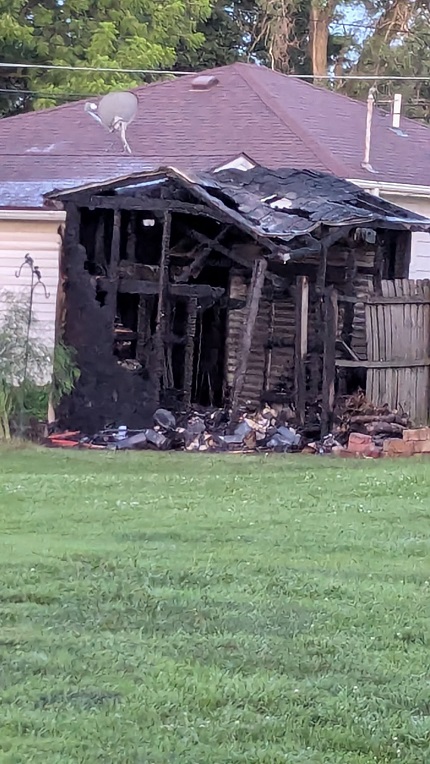
photo by Ric Hanson
(Red Oak, Iowa) – Police in Red Oak, Saturday evening, arrested a man on a felony assault charge. Authorities say 60-year-old Gregory Owen Kierstead, of Red Oak, was arrested in the 2400 block of N. 8th Street, at around 7-p.m. He was charged with Domestic Abuse Assault/choking-causing bodily injury, Obstruction of Emergency Communications, and Interference with Official Acts. Kierstead was being held without bond in the Montgomery County Jail, pending an appearance before a Magistrate.
(Iowa State Patrol crash reports) – One person died, and a total of nine others were injured in crashes on opposite sides of the State, Saturday.
(Winnebago County, Iowa [UPDATE 2-p.m. 7/6/25] – One person died and two others were injured Saturday afternoon, during a crash in northern Iowa. According to the Iowa State Patrol, a man from Spirit Lake died when the motorcycle he was riding was struck head-on by an SUV. The accident happened at around 4-p.m.
The Patrol says two Harley Davidson motorcycles were traveling west on Iowa Highway 9 from 150th Avenue, as a 2015 Buick Encore SUV was traveling eastbound. For reasons unknown, the SUV – driven by 95-year-old Leroy Weaver, of Buffalo Center, IA – crossed the center-line of the road, and sideswiped a 2010 HD operated by 64-year-old Daniel Raak, of Spirit Lake, before hitting a 2004 HD motorcycle operated by 21-year-old David Raak, also of Spirit Lake.
Daniel Raak’s cycle continued on the road prior to going out of control and stopping on the north shoulder of the highway. David Raak’s cycle was pushed backwards from the point of impact before it came to rest on the north shoulder of the highway. A passenger on David Raak’s motorcycle, 21-year-old Kayla Huddelson, of Belle Fourche, SD, was ejected from David Raak’s cycle and came to rest on the north shoulder of the road.
The SUV entered the north ditch and came to rest in a field. David Raak died at the scene. Daniel Raak, Kayla Huddelson, and Leroy Weaver were transported by ambulance to MercyOne North Hospital in Mason City. The crash remains under investigation.
******
The other accident – which also involved three vehicles – happened 12:10-a.m., Saturday, in central Iowa’s Warren County. The State Patrol reports a 2005 Jeep SUV driven by 57-year-old Angela Rae Chapman, of Indianola, was traveling south on County Road R-63, south of G014, when the vehicle crossed the center-line and side-swiped a 2001 Chevy S-10 pickup, driven by 36-year-old Jermey Lee Lawton, of Des Moines. The impact caused the pickup to rollover and come to rest on its passenger side. The Jeep continued south and immediately struck a 2014 Chevy pickup (being driven by 36-year-old Miguel Antonio Espinoza Galindo, of Des Moines), head-on.
Chapman and Miguel Espinoza, and a total of four passengers in the vehicles – all of whom were from Des Moines – were injured transported to Methodist Hospital, in Des Moines. The injured included 36-year-old Leticia Espinoza, 12-year-old Luis Antonia Espinoza (who was flown to the hospital by helicopter), 7-year old Josiah Lawton, and Jazmin Espinoza (age not listed).
Both accidents remained under investigation.
(Atlantic, Iowa) – The start of the 2025 Cass County (IA) Fair, in Atlantic, is a little less then three-weeks away. Officials with Cass County ISU Extension say Fair week is a celebration of hard work and dedication to 4-H and FFA programs throughout the past year. The week is filled with activities: free entertainment, great food, and projects to view both in the building and barns. Fair week officially kicks off July 24th and ends July 29th, after the livestock sale.
4-Hers have been working hard all year to complete projects and get them ready for this week-long showcase. Their first opportunity for judging starts with the Clothing Event contest along with the Table Setting contest. These events are judged before fair starts and are on display in the building during fair week. Awards for these contests will be given Friday evening as part of the Friday Evening Building Showcase.
Clothing Event involves 4-H’ers across Cass County who will display their skills in purchasing and creating outfits for all purposes. The judging of this contest will take place before the fair starts on July 10th at the Cass County Community Center. Participants competed in three divisions: Fashion Revue, Clothing Selection, the $20 Challenge, and Innovative Design. 
Fashion Revue participants made their garments using design elements and principles such as line, shape, color and texture. Members who chose to participate in this event must sew, construct, hand-knit, machine-knit, crochet garment(s). Clothing Selection outfits and are evaluated on overall appearance, as well as their knowledge of selection, including appropriateness, care, and money spent on the outfit. The $20 Challenge is an opportunity for 4-Hers to challenge themselves by purchasing a complete outfit for under $20. Innovative Design is a challenge for participants to create a costume, cosplay, wearable technology, sustainable/upcycled fashion, accessible fashion, or outfits that use unconventional materials.
Table Setting is a fun way to learn how to properly set a table, plan nutritious meals, and express originality and creativity. Exhibitors choose a theme, present to a judge, express knowledge of food, nutrition and food safety, and have fun planning a special occasion meal for entertaining. Exhibitors can enter a casual or formal place setting display, dishes to menus, and decorations to clothing worn during judging! Judging for this event will take place on July 15th at the Cass County Community Center. Entries are photographed and will be displayed at the fair for public viewing in the Community Center.
Awards will be presented during Friday Evening’s Building Showcase in the Community Center. Winners will be chosen from each age division and in each category. Those winners will have the opportunity to advance to the Regional Table Setting Contest in August.
Be sure to check out all the entries from this year’s Clothing Event contest and the Table Setting Contest which will be on display in the Community Center during fair week!
DES MOINES, Iowa [KCCI] — Emergency crews responded Friday afternoon to reported problem with an incoming flight at Des Moines International Airport. The report was made at about 1:30 p.m. Friday regarding Allegiant Air flight 2066 from Fort Lauderdale.
Airport officials say an engine failure was reported during descent. Allegiant officials told KCCI the flight “encountered a bird strike” upon landing.
The flight landed safely and noone was injured. Passengers used a ramp to disembark from the aircraft.
(Red Oak, Iowa) – Officials with the Red Oak Police Department say a woman was arrested on an assault charge, Friday evening. According to the report, 24-year-old Alisha Lynn Seyler, of Elliott, was taken into custody at around 7-p.m. in the 700 block of Highland Avenue, in Red Oak. She faces a charge of Domestic Abuse Assault/1st offense – a Simple Misdemeanor.
Seyler was taken to the Montgomery County Jail and held without bond.
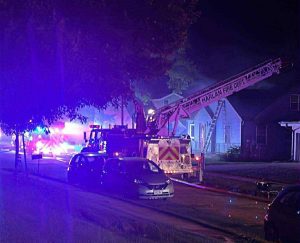
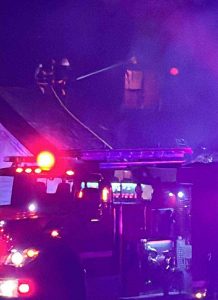
(Harlan, Iowa) – Firefighters from Harlan and Irwin were battling a structure fire late Friday night, in Harlan. According to reports, the blaze occurred at 705 Elm Street, at around 11:30-p.m. Avoca Fire was requested for mutual aid, as the structure had reached the main part of the residence.
Other agencies assisting at the scene include: The Shelby County Sheriff’s Office; Shelby County Ambulance; Shelby County Emergency Services Association; The Portsmouth, Westphalia and Shelby Fire Departments.
Additional information was not immediately available. (Photos submitted to KJAN by Harlan resident)
(Jackson County, Iowa) – A collision between two SUV’s Friday afternoon, north of Maquoketa, left one person dead and another injured. According to the Iowa State Patrol, a 2007 Chrysler PT Cruiser was traveling north on Hurtsville Road at around 4:30-p.m., when the vehicle crossed the center, divided line, for reasons unknown, and collided head-on with a 2024 Nissan Pathfinder.
One of the vehicles’ occupants died at the scene, the other was transported by air ambulance to the University of Iowa Hospital. The person who died was not wearing a seat belt. The names of the crash victims were not immediately released, and pending notification of family.
The Patrol was assisted at the scene by the Jackson County Sheriff’s Office, Maquoketa Fire Department, Jackson County Ambulance and Jackson County Medical Examiner’s Office.
(Radio Iowa) – A Democrat who represented the Fort Dodge area for 16 years has published a memoir that begins with her childhood during the early years of the civil rights movement and ends with her hopes for the future. Helen Miller was first elected to the Iowa House in 2002 – just three years after she and her husband moved to Fort Dodge. “I had to figure out being a black person with a vastly majority white legislature, how to get things done for my constituents,” Miller says.
Miller was born in 1945 — the day before World War II ended. “There was a racial incident in South Carolina and my mother and father had to leave,” Miller says. “They wound up moving to New Jersey as a result, so race determined where I was literally born.” Miller, who is 79, started writing the book about four years ago, after attending the Okoboji Writers Retreat.
“By the second one I had the idea in my head about what I wanted to do that would make the story interesting and, especially in light of the times that we’re in, relevant,” Miller said. Miller writes about the riots that erupted in her hometown of Newark in 1967 and other milestones in the civil rights movement, including her endorsement of Barack Obama before the 2008 Iowa Caucuses.
Miller, who is an attorney, spearheaded a summit in Waterloo in 2015 that featured bipartisan leaders working on criminal justice reform at the national level. “There were things that were done because we started paying attention,” Miller says. “And that was a very, very bipartisan effort because, I tell you very honestly, it probably wouldn’t have happened with Koch.” The company was run at the time by brothers Charles and David Koch, prominent Republican donors who supported criminal sentencing reform. After Miller left the legislature in 2019, Republican Governor Kim Reynolds appointed her to chair the Iowa Board of Parole.
The title of Miller’s book is “I Can’t Swim: A Memoir.” Her late husband was a physician in the military and a former commander of the hospital at Langley Air Force Base. He retired from the U-S Air Force in 1999 and the couple moved to Fort Dodge, where he joined a medical practice.
(Radio Iowa) – Our nation’s three most important and revered documents are enclosed in titanium display cases in the rotunda of the National Archives in Washington, D.C., and they rest on custom-made archival paper created at the University of Iowa. Tim Barrett, the now-retired director of the U-I Center for the Book, says he got the call in 1999 to create the special paper to cradle the Constitution, the Bill of Rights and the Declaration of Independence. Was that his dream job?
“I and my coworkers were all more immediately focused on, ‘Okay, they want us to go ahead and do this. Now, we actually have to do it and we can’t mess up. This is kind of a big deal,'” Barrett says, laughing. “Rather than letting it go to our heads, we really focused on making the paper and getting it to the National Archives.” The center on the Iowa City campus had developed a sterling reputation for being able to create special types of handmade paper from pure American-grown, textile-quality cotton using a custom-built press.
There was just one problem: “Most of the paper we made was smaller than what they needed. They needed 36-by-36-inch sheets and we didn’t have a press to squeeze out the water from the damp sheets,” Barrett says, “so we had to construct a larger press and build other pieces of equipment to be ready to go into production.” It took a few months to assemble and perfect using everything, and then it was just a matter of minutes to create the paper, which took another day to press and dry. In all, they shipped a few dozen sheets of the additive-free paper to the National Archives, and it should be good for many decades to come.
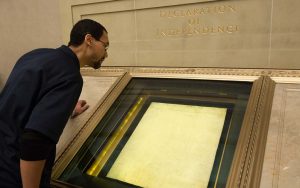
Photo from the National Archives
The highly-fortified cases were designed with aluminum plates as a base for the precious documents, which were written some two-and-a-half centuries ago on vellum, a parchment made from animal skin. “They wanted the paper in there to provide a lighter background to help illuminate, to help show off the parchment documents, to provide a cushion against the perforated aluminum plate,” Barrett says, “and also to provide a relative humidity buffer within the encasement.” The U-I Center for the Book is dedicated to preserving arts that date back centuries, like bookbinding, letterpress printing, and making paper by hand.
Barrett says it was a tremendous honor to be chosen for this project by the National Archives, which hosts more than a million visitors every year.”I’ve been there several times and it’s well worth a visit because the lighting is subdued and there’s an atmosphere of real reverence,” Barrett says. “You can wait your turn in line and walk up there and get your face literally within inches of these very important pieces of American history.” He says all residents of the state, when they go to see the Declaration of Independence and the other documents, should feel a sense of gratification.

Tim Barrett (UI photo)
“The most important thing for me, and I think for any Iowan who goes to the National Archives Rotunda, once you get in there and you get up close to those documents, if you move your head off to the side a little bit, underneath them all, you can see this white piece of paper and you know, that was made in the state of Iowa,” Barrett says, “and that’s something to be really proud of.” And by the way, the masterminded theft of the Declaration of Independence depicted in the 2004 film “National Treasure” starring Nicolas Cage? Barrett says rest assured, it’ll never happen.
https://uicb.uiowa.edu/


 Facebook
 Twitter
 YouTube
 RSS
RSS