

CLICK HERE for the latest market quotes from the Iowa Agribusiness Network!
CLICK HERE for the latest market quotes from the Brownfield Ag News Network!


CLICK HERE for the latest market quotes from the Iowa Agribusiness Network!
CLICK HERE for the latest market quotes from the Brownfield Ag News Network!
Officials with the Conservation Districts of Iowa report Alan Peterson, Assistant Soil and Water Conservation District (SWCD) Commissioner in Cass County, received the Ruth Wagner Award on September 3, 2014 at the 68th Annual Iowa Soil and Water Conservation Districts Commissioners Conference at the Sheraton Hotel in West Des Moines. 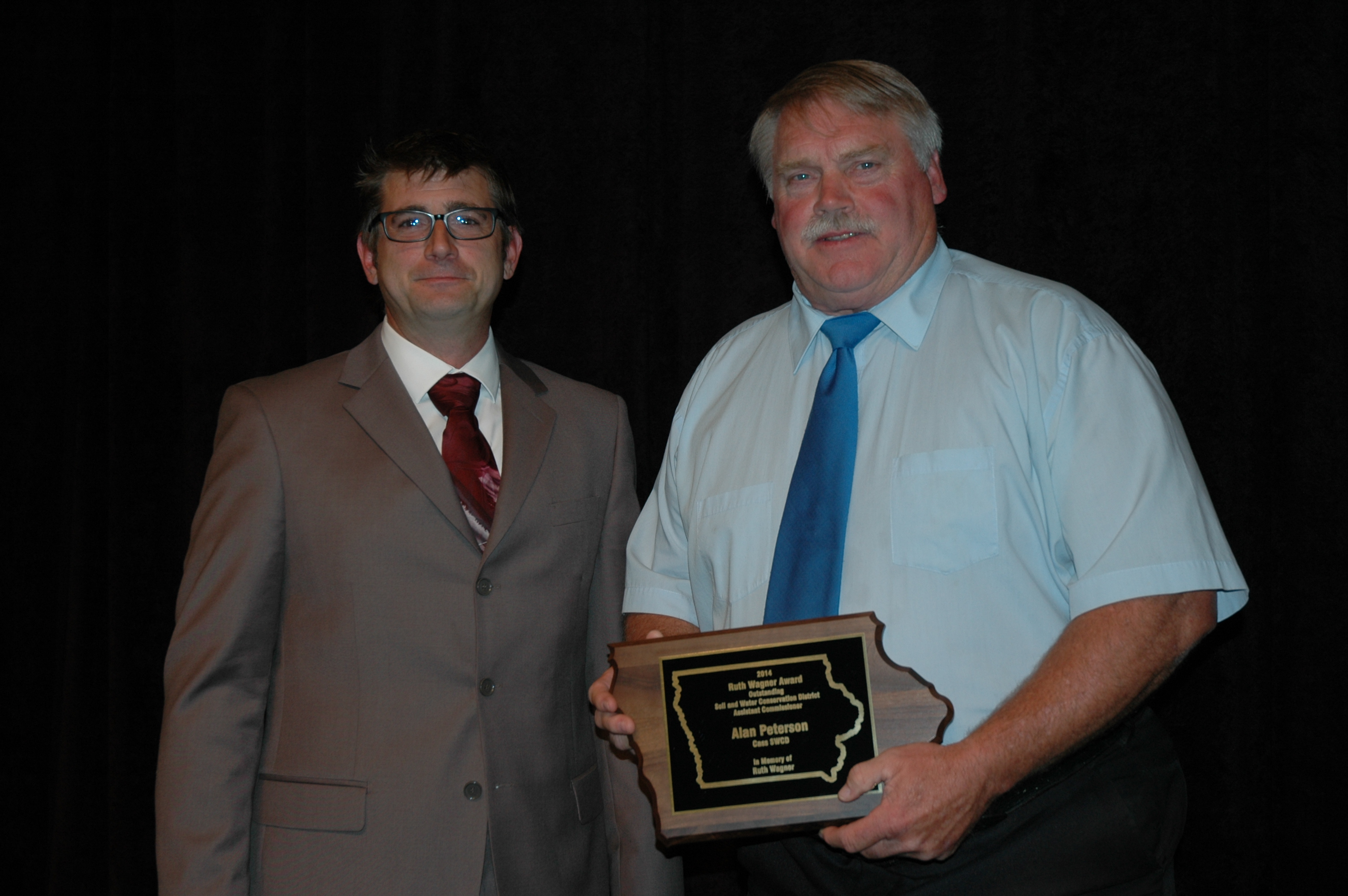
The Ruth Wagner Award is an award started in 2001 to honor Soil and Water Conservation District Assistant Commissioners. Johnson SWCD gives the award in memory and honor of Ruth Wagner, who served the Johnson SWCD for 53 years.
Clare Lindahl, Executive Director with Conservation Districts of Iowa, says Peterson is a very dedicated assistant commissioner who attends all of the district, regional and annual meetings. He had been actively participating in federal and state conservation programs even before he showed interest in serving as an assistant commissioner.
ISU Extension and Outreach, and USDA Farm Service Agency are hosting a program on the 2014 Farm Bill. The program takes place from 6:30- until 8-p.m. Tuesday, September 23rd, at the Therkildsen Activity Center 706 Victoria St. Harlan.
Shane Ellis, ISU Extension and Outreach Farm Management Specialist will be discussing the scope of the 2014 Farm Bill, updating yields and base acre allocations with the FSA, “new” crop programs, and the program sign-up process.
To assist in the planning of the event, please RSVP with the Shelby County Extension office before Sept 18th by calling (712) 755-3104 or by emailing oloff@iastate.edu.
SIOUX CITY, Iowa (AP) — Iowa landowners want to see the details of a proposed oil pipeline that would carry crude oil from North Dakota across the state to Illinois. Texas-based Energy Transfer Partners has said the 1,100-mile pipeline would likely cross 17 Iowa counties as it crosses from the northwest corner of the state to the southeast corner.
Energy Transfer Partners spokeswoman Vicki Granado says public meetings will take place across Iowa in December. Landowner Don Kreber agreed to let the company survey some of his farmland in O’Brien County, but he still hasn’t heard many details yet.
MINNEAPOLIS (AP) — Organic and specialty crop growers are trying to make a living off the rising consumer interest in locally grown and organic foods. But the smaller farms are often islands surrounded by a sea of conventionally grown crops that get sprayed with herbicides, insecticides and fungicides. Pesticide drift is a serious concern for them, and they’ve come up with a variety of defenses.
Many plant buffer strips. Twelve states participate in a registry of organic and other farms to tip aerial and ground sprayers off to areas they need to avoid. And in Iowa, a group has produced a pamphlet that instructs farmers how to protect vulnerable crops.
The aerial spraying industry and pesticide manufacturers, meanwhile, say they’ve made big strides in controlling drift through education and new technologies.
There are more than 230 farmer’s markets across Iowa and U.S. Agriculture Secretary Tom Vilsack is hoping four new postage stamps will help keep those farmer’s markets on people’s minds. “A lot of folks have talked about the benefits of farmers markets and that’s certainly true. This postage stamp will give us the opportunity to focus on those benefits,” Vilsack said at a recent ceremony at a farmer’s market near the White House to celebrate the release of the new stamps. The former Iowa governor said the stamps are coming out at a great time, as farmers markets are very popular these days.

(Image courtesy US Postal Service)
“We’ve seen a dramatic increase in farmers markets across the United States, a 76-percent increase,” Vilsack said. “Today, we have over 8,268 markets throughout the United States.” The artist who created the stamps is Robin Moline of Lakeland, Minnesota. The stamps feature images of fruits, vegetables, eggs, cheese, baked goods, and cut flowers. “They show some of what you can get there and the freshness and the spirit of the market,” Moline said. “They’re a community gathering spot. They’re a wonderful place to get good, fresh food, and you get to meet your farmers.”
A recent survey found Iowa had about $38 million worth of direct sales at farmers markets, creating an impact of $71 million on the state’s economy.
directory of Iowa farmer’s markets:
https://www.idalsdata.org/fmnp/index.cfm?fuseaction=main.formFarmersMarketDirectory
(Radio Iowa)
Iowa farm history comes to life this weekend during the 32nd annual Carstens Farm Days. During the event which takes place south of Shelby, there’ll be thrashing, a saw mill, food and crafters, a quilt show, along with tractors and Ag equipment on display, as well as historic farm memorabilia.
Steam engines will power antique threshing machines, antique machinery, a parade, crafts, and entertainment. Over two hundred restored antique tractors will be on display. The original Carstens farm buildings will be open for tours. The buildings will be alive with demonstrations that will bring back memories for older visitors and teach valuable history lessons to young people.
To start Farm Days off right, a pancake breakfast is planned at 6:30 a.m. both Saturday and Sunday. The proceeds from the pancake breakfast go to the Shelby Volunteer Fire Department. The fire department volunteers will also serve lunch both days. Various non-profit local groups will be offering refreshments and delicious desserts all weekend. On Saturday beginning at 5:30 p.m. enjoy Staley’s Chicken for a delicious dinner. Proceeds from the dinner will go toward on-going maintenance at Carstens 1880 Farmstead.
Beginning at 6 p.m. Tamie Hall and Band will entertain visitors on the front lawn of the farmhouse. Caterpillar tractors and equipment and related brands will be the featured line this year. All Cat tractors & equipment owners are invited to bring their exhibits to display throughout the weekend. Horsepower-testing, sawmill operations and field demonstrations will occupy tractor exhibitors all day.
Nearly 250 pieces of vintage equipment were on display during the 2013 Farm Days show. Visitors will enjoy watching most of the restored tractors as they go through the parade each afternoon at 2 p.m. A quilt made especially for the 2014 Carstens Farm Days show will be raffled on Sunday evening. Raffle tickets can be purchased at area businesses. The quilt is now on display at the Shelby County State Bank in Shelby. Foggy Mountain Cloggers will perform on Saturday at 12:30 p.m. on the farm’s main stage. On Sunday afternoon at 12:30 p.m., the Country Kickers America will entertain both young and old farmstead visitors alike.
Various music acts will add to the fun and folksy atmosphere of Farm Days. Admission is $5 per day for everyone nine years and older.
(KNOD)
Many Iowa corn and soybean producers are discouraged going into the fall harvest as commodity prices have dropped significantly from a year ago. Ag economist Michael Langemeier says farmers need to look at every option to counter those lower prices, including their crop insurance policies. “I would really encourage producers to take a close look at the revenue policies,” Langemeier says. “Those policies can protect against a lower yield but also lower prices. If prices drop substantially from the spring to the fall in a particular year, you’re protected on the low end from that.”
Langemeier says there are several new programs being offered that help to protect a farmer’s bottom line, including price loss coverage, or P-L-C. “Agriculture risk coverage is more of a revenue type program,” he says, “and the PLC, really what it comes down to from a producer’s standpoint is, how low do you think prices really are going to go?”
Langemeier says other new programs include Agriculture Revenue Coverage and other supplemental coverage options. Some predict farm income will drop more than 12-percent from last year.
(Radio Iowa)
DES MOINES, Iowa (AP) – Iowa wildlife officials say the pheasant population is high ahead of hunting season. The state Department of Natural Resources says the annual August roadside pheasant count recorded the highest number of birds since 2008. That’s a statewide average of about 17 birds per 30 miles. A record low 40,000 hunters pursued pheasants last year. The latest roadside index indicates hunters could harvest more than 250,000 birds.
The department says it is working to enhance the state’s habitats for pheasant and quail. That includes grant funding and a partnership with the Pheasants Forever group. The regular pheasant season is Oct. 25 through Jan. 10. The state’s youth pheasant season is set for Oct. 18 and Oct. 19.


 Facebook
 Twitter
 YouTube
 RSS
RSS