

CLICK HERE for the latest market quotes from the Iowa Agribusiness Network!
CLICK HERE for the latest market quotes from the Brownfield Ag News Network!


CLICK HERE for the latest market quotes from the Iowa Agribusiness Network!
CLICK HERE for the latest market quotes from the Brownfield Ag News Network!
Republican Senator Chuck Grassley has issued a carefully-worded written statement that takes aim at a vote Democrat Bruce Braley took in the U.S. House last week. Last week, Republicans in the U.S. House voted to block the E-P-A from imposing rules that farmers fear would give the agency authority to regulate water in ditches, farm ponds and tile lines. Grassley called that House bill “a thoughtful approach to the problem” and an “easy” yes vote for “anybody who has talked to Iowans in the last couple of months.” Braley, who is running for the U.S. Senate this year, voted no.
Grassley didn’t mention Braley by name, but Grassley said in the statement that it’s “too bad the entire Iowa delegation didn’t get the message” to vote yes. In a written statement, Braley’s staff noted Braley had supported an amendment to the bill instead. It would have barred the E-P-A from adopting rules that would change the Clean Water Act exemptions currently on the books for farmers.
A spokesman for Braley said that approach would have protected farmers, but ensured polluters “like Big Oil” are held accountable for Clean Water Act violations. Bruce Neiman, a livestock farmer from Manchester who is president of the Delaware County Farm Bureau, says based on an email he got from Braley’s congressional office, he had expected Braley to vote yes. “It was just the opposite of the way he voted,” Neiman says. “and so after the second time reading it, I said: ‘Well, I guess an actual political flip-flop right in front of me.'” Neiman lives in Braley’s congressional district, but has not supported Braley in the past.
Neiman is backing Joni Ernst, the Republican running for the U.S. Senate this year and he believes Ernst would join those who are trying to reign the E-P-A. “Anymore, there’s a very limited ag population let alone rural population so if we don’t find people that we can count on then we’re in a very difficult position because there’s been a lot of EPA — I’m going to call it static,” Neiman says. “I mean, when they’re concerned about dust coming out of a field, they’ve gotten everybody’s attention in production agriculture.”
Ernst told a group of farmers in Independence, Iowa, last Friday that the E-P-A was “overreaching” and she accused Braley of voting no on the bill because Braley has the backing of an “extreme environmentalist” from California. The E-P-A is one of the federal agencies Ernst has said she’d like to see eliminated and Braley’s spokesman calls that a “radical Tea Party” idea that would get rid of rules that “keep Iowa drinking water clean.”
(Radio Iowa)
The Atlantic Area Chamber of Commerce Ambassadors headed to the country to visit Zellmer Farms and A-Z Feeders on Highland Road.
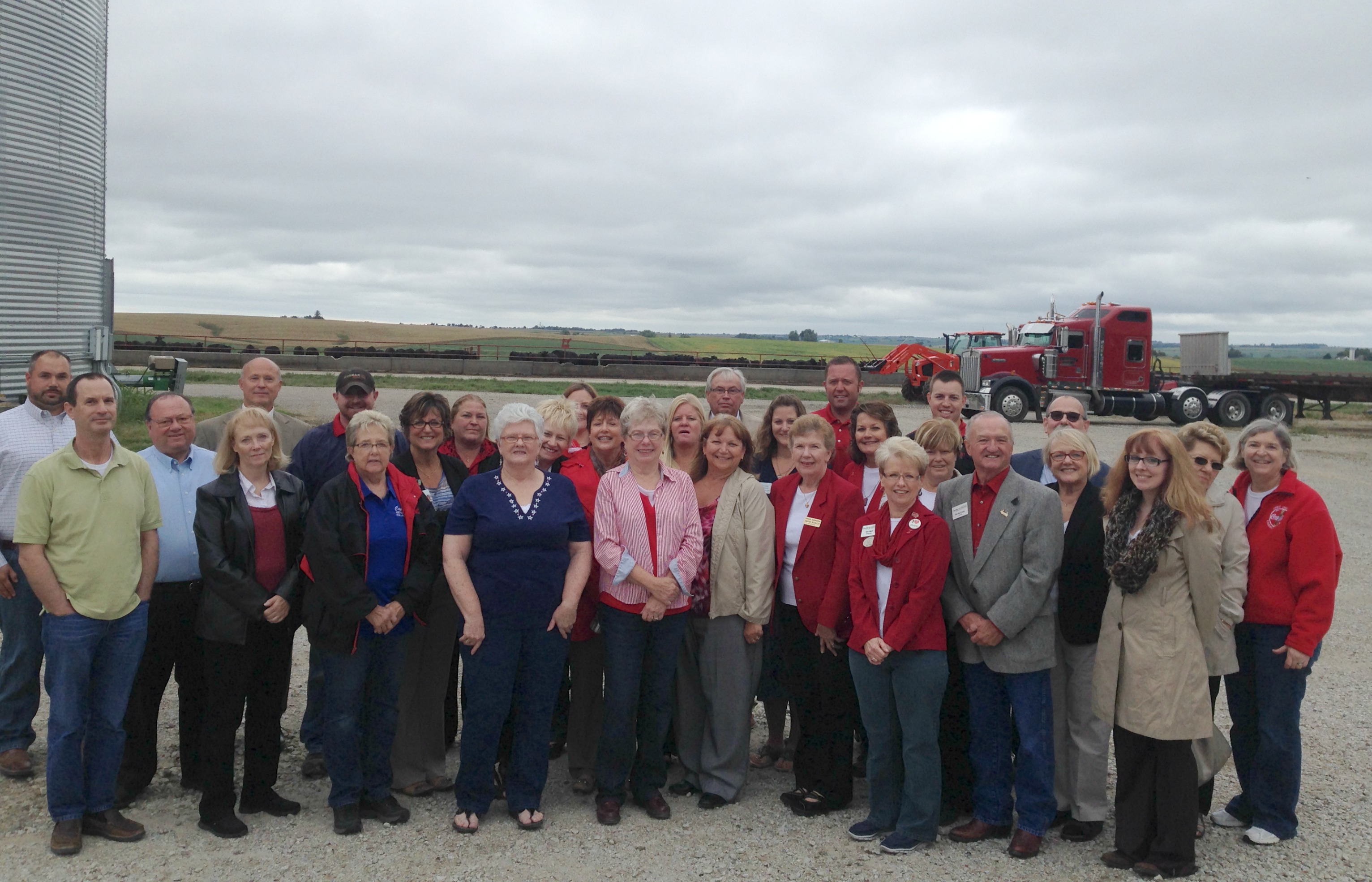
Pictured are: Gerry Ludington, Kathie Hockenberry, Janet Cappel, Sharon Ludington,
Nancy Zellmer, Jolene Roecker, Joanne Mueller, Sue Muri, Pat McCurdy, Jane Kay, Tara
Jennerjohn, Jim Skartvedt, Gerald Brink, Doug Harris, Josh Dvorak, Sara Nelson,
Darlene Ellsbury ,Rita Willmott, Kerry Jepsen, Carole Schuler, Tammy Waters, Russ
Joyce, Chrystal Christensen, Chip Hansen, Carol Seddon, JoAnn Runyan, Lucas Mosier,
Rich Perry, Lana Westphalan, and Dolly Bergmann
Alan and Brenda Zellmer began their farming career in the mid 1970’s. Alan and his two sons, are the 5th and 6th generation of Zellmer farmers. Zellmer Farms focuses on crop farming and Wagyu and Angus cattle production. The business is family owned and operated. Jim Skartvedt (son-in-law) explained the difference between Wagyu and Angus cattle.
AMES, Iowa (AP) – A new study by a sociologist at Iowa State University found three rural Iowa counties were among the top 10 in the nation in growth of income equality over more than a decade.
The gap is less obvious because showy displays of wealth are typically frowned upon in places where agriculture is the main economic driver, but that doesn’t mean it doesn’t exist, sociologist David Peters told The Des Moines Register. Emmet County was fifth on the list, O’Brien was seventh and Worth was ninth in the growth of inequality between 2000 and 2012.
“That’s shocking. It’s really a phenomenal jump,” Peters said. “It’s strongly affected by farm income.” The growth of biofuels and increase in farm commodity prices drove up incomes for some households. Because rural counties have low populations, the wealth gap can grow quickly when a relatively small number of households increase their incomes. There are fewer farmers now and some middle-skill jobs in manufacturing have disappeared, leaving people who don’t farm with fewer options.
Eight of the 10 Iowa counties with the biggest wealth gaps were rural. The other two are home to major universities and low-income students. In Emmet County, the poorest households saw their share of income decrease nearly 27 percent, while the richest saw theirs grow by 17 percent. “Iowa has never had a wealthy class and a poverty class, but we are getting more like the rest of the nation,” Peters said.
DES MOINES, Iowa (AP) – Iowa farm officials are seeking to enforce a mandatory minimum sentence for the felony theft of livestock and crops. Delegates of the Iowa Farm Bureau Federation met last week to discuss proper punishment for people who steal cattle, hogs, corn, soybeans and other farm property, the Des Moines Register reported.
Some states are seeing an increase of cattle thefts since the price of the animals have reached record highs. The problem could soon make its way to Iowa, experts say, since the state is expected to raise more cattle in light of low corn prices and a drought in Texas, the leading producer of cattle in the U.S.
Iowa is the top corn-producing state with nearly 2.2 billion bushels last year, and is ranked sixth nationally for cattle. Corey Schultz is a region executive officer for the Livestock Marketing Association and works with livestock auctions in Iowa, Minnesota, Wisconsin, Missouri, Illinois and Indiana. “The rise in cattle numbers, the rise in prices, you could definitely see a rise in cattle thefts,” Schultz said.
Novice thieves usually don’t steal livestock, according to Larry Gray, executive director of law enforcement for the Texas and Southwestern Cattle Raisers Association. “Anyone can kick down the door to a house and steal a flat screen TV,” he said. “But to steal cattle – first you have to have the ability to transport those cattle. Then you have to have the knowledge to market the cattle. You can’t run down to the local pawn store and get some money for them.”
As harvest season approaches, many charitable organizations statewide are preparing to get gifts of grain from Iowa’s farmers. Those farmers can choose to donate a portion of their stored or harvested crops and get a tax deduction at the same time. John Syverson, a certified financial planner in West Des Moines, says there are a number of advantages to donating crops instead of cash. Syverson says, “Not only do you exclude from income the amount of the value of the grain, which works better on your tax return and gets you lower taxation in federal, state and self-employment taxes, but you also get to deduct the cost of production of that grain because you had to pay for the input.”
Syverson says rather than contacting the non-profit group or grain elevator directly, it’s usually more efficient to go to a local Community Foundation. He says most are set up to help make the donation a smooth transaction. “Instead of talking to your local Boy Scout troop, I would go talk to your Community Foundation,” Syverson says.
Just ask if they take gifts of grain and if they do, you can quickly set up an account and tell them where you want the grain dispersed. More Iowa farmers may be choosing the option this fall as many commodity prices are dropping.
(Radio Iowa)
LOGAN, Iowa (AP) – A Logan church hosted Drive Your Tractor to Church Day to attract locals who aren’t regular parishioners. Immanuel Lutheran Church held the event, which featured a 17-mile tractor ride, lunch, children’s games and a shorter hayrack ride, on Sunday in an effort to strengthen the community, church trustee Justin Gochenour told the Omaha World-Herald. “We thought it would be a great way to get more kids involved with the church, which is something that a lot of parishes are struggling with right now,” he said.
Church officials said they were pleased with the turn out, from both children and adults. “We had 50 or 60 non-regulars come to Mass this morning,” Gochenour said. “We don’t know the exact number yet, but it was big enough to be substantial.”
Kids ran around, riding toy tractors and throwing footballs, while the streets were lined with all types of tractors. The event, which was embraced by the church board, will help Immanuel Lutheran stand out from other churches, according to parish officials.
The Rev. Jerald Firby, pastor of the church, said he thought Tractor Ride Sunday was a great idea. He also said he thinks the event helped to attract people who don’t typically attend services at Immanuel Lutheran. “Most farmers have their own churches they go to,” he said.
The event was so successful that parish officials want to hold it again.
The City of Atlantic’s Parks and Recreation Department Board of Director will meet Monday evening, in the Council’s Chambers at City Hall. During the 5:15-p.m. session, Parks and Rec Director Roger Herring will report on the Summer Rec Program, including slow pitch softball and the status of pool repairs as well as future pool maintenance.
Herring will also talk about progress on the Senior Activity Area at Sunnyside Park. The recent wet weather has slowed progress on some projects in that area. Herring is expected to inform the Board a retaining wall is still being constructed. Once completed, the park’s staff will place topsoil down along with seed, with final grading to finish the project.
The Atlantic Parks and Rec Board will also receive an update on the Boy Scout Cabin and the Eagle Scout fire pit project at Sunnyside, which Herring says is nearly complete. Herring will also provide a wrap on the Disc Golf Tournament, which was held Aug. 30th and 31st, and drew participants from five states. He’s also expected to note that mowing and the Senior Activity Area retaining wall have dominated the park department’s schedule over the past month.
DES MOINES, Iowa (AP) — The nation’s corn and soybean farmers will harvest by far the largest crops ever this year, the U.S. Department of Agriculture said Thursday in a new report. Bigger crops have been expected this year as adequate rain and cool temperatures made for favorable growing conditions, but the new estimates far surpass previous records.
Corn farmers are expected to harvest nearly 14.4 billion bushels of corn, up from last year’s 13.9 billion bushel record. The 171.7 bushels per acre yield is significantly higher than the previous record set in 2009 of 164.7 bushels per acre. Record yields will be set in 18 states, the USDA said.
Despite the strong forecast, concerns have grown in recent days that early cold weather is creeping into the upper Midwest and some crops are maturing later this year. Temperatures below freezing could slow or stop crops from reaching full maturity and affect the harvest. That possibility was not reflected in Thursday’s report.
Ten states including Illinois, Iowa, and Nebraska have the highest number of ears per corn stalk ever, the USDA said. After meeting all current demands for corn — including exports and use for animal feed, ethanol and food for people — the USDA estimated 2 billion bushels of corn would remain in stock. That’s the highest ending stock in a decade.
The soybean harvest estimate also moved upward to a new record of 3.9 billion bushels. The previous record was 3.4 billion bushels in 2009. The per-acre yield is now estimated at record 46.6 bushels per acre.
A new government report finds the average price to rent Iowa farmland has gone up slightly this year.
According to the U.S.D.A.’s Agricultural Statistics Service, rental rates are averaging 260-dollars per acre in Iowa this year for corn and soybean ground. That’s about five bucks an acre higher than last year. The most expensive farmland in the state is in Grundy County, where the average rental rate is 322 dollars an acre. The cheapest is in Appanoose County, where rent was 149-dollar per acre on average. (A link to the report for all of Iowa’s 99 counties can be found here: http://www.nass.usda.gov/Statistics_by_State/Iowa/Publications/County_Estimates/reports/IA_county%20Cash%20Rent%2013-14.pdf)
The U-S-D-A report concludes the average price to rent pasture land in Iowa is 50 dollars an acre. An Iowa State University Extension survey released in April concluded farmland rental prices statewide had DECLINED “moderately” from 2013. It was the first reported decrease in rental rates for corn and soybean fields since 1999. A retired I-S-U economist said the decrease was due to lower commodity prices for the crops that will be grown on that rented ground. The I-S-U and U-S-D-A reports did find the SAME average rate of 260-dollars an acre for row crop rentals.
(Radio Iowa)


 Facebook
 Twitter
 YouTube
 RSS
RSS