

CLICK HERE for the latest market quotes from the Iowa Agribusiness Network!
CLICK HERE for the latest market quotes from the Brownfield Ag News Network!


CLICK HERE for the latest market quotes from the Iowa Agribusiness Network!
CLICK HERE for the latest market quotes from the Brownfield Ag News Network!
Paddlefish season in Iowa begins this weekend on the Missouri and Big Sioux Rivers. Iowa residents can no longer apply for licenses or paddlefish tags, but D-N-R fisheries biologist Van Sterner says those who are eligible for the season — which opens Sunday — are required to follow strict rules. “We do have a protected slot limit,” Sterner says. “Fish measuring 35 to 45 inches, measured from the front of the eye to the fork in the tail, must be released immediately, unharmed.”
The odd-looking fish has a flat front that looks kind of like a paddle. It’s also known as a spoonbill. Sterner says some of the fish may have a tag in their lower jaw that’s very similar to those seen on waterfowl. Those who snag a tagged fish are asked to report it to the Department of Natural Resources to help track and research the population. “Nebraska and South Dakota do have a fairly valid estimate up there in the Gavins Point area but down this way, in the channelized stretch of the river, we just haven’t collected enough tag returns,” Sterner says. “This is all based on mark and recapture and we haven’t collected enough recaptures to give us a valid estimate yet.”
He says the department is hoping to increase interest in catching paddlefish in the future. “We offered 1,000 licenses, 950 resident licenses and 50 non-resident licenses,” Sterner says. “The 50 non-residents sold out and we sold a total of 743 licenses, so we didn’t sell out this year.”
This will be the first time anyone can legally go after paddlefish on the two rivers since 1986 when fishing was cut off out of concern for the survival of the species. The season opens Sunday and will continue through April 15th.
(Radio Iowa)
The Iowa Department of Natural Resources is encouraging hunters to be aware that gray wolves are once again a protected federal species. D-N-R furbearer biologist, Vince Evelsizer, says they want to remind Iowa hunters after the gray wolf protection was reinstated near the end of December. “It just means to be sure of your target — especially if you are out coyote hunting this time of the year when the season is still open for coyotes — to keep an eye out. Because now the gray wolf is protected both federally and state protected,” Evelsizer says.
The change protects gray wolves in all of Wisconsin and Michigan, the eastern half of North Dakota and South Dakota, and the northern half of Iowa. Evelsizer says it is possible a hunter might mistake a gray wolf for a coyote and fire at the animal. “I think you could, I think it’s possible. I think most Iowans when they are out coyote hunting are not expecting or really keeping an eye out for a gray wolf when they coyote hunt,” according to Evelsizer. “We are just reminding folks that it’s time to start doing that more. We’ve had a few larger canines in our state recently.”
Wolves generally are larger and bulkier while coyotes are shorter, sleek and lighter on their feet. Evelsizer says there is not a breeding population of gray wolves in Iowa. He says it’s hard to figure just how many might be here. “It’s been occasional, it’s always a little tough to tell as there is sometimes dog-wolf hybrids out there,” Evelsizer says.
The D-N-R has information and identification tips online at www.iowadnr.gov/wolves.
(Radio Iowa)
w/ Host Bob Bebensee and Brian Smith, Conservation Officer for Cass and Adair Counties.
Podcast: Play in new window | Download (494.1KB)
Subscribe: RSS
The Iowa D-O-T estimates the state could collect about 40-million dollars a year from farmers and construction companies if the tax exemption for so-called “red dye” fuel was lifted — and a few lawmakers are questioning why that tax advantage is being maintained. Farmers and construction companies that primarily operate diesel-powered machinery off of the state’s roads buy fuel that has a dyed with a red tint, to signify it is NOT subject to the state’s fuel tax. Representative Ralph Watts, a Republican from Adel, says the size of farming operations has grown significantly and heavy farm equipment is now being driven on more miles of road to get from field to field.
“If you live in a rural area, you meet them all the time,” Watts says. “The heavier equipment with cleated tires place more stress on the roadway than vehicles with road tires.” That “additional stress” is taking a toll on rural roads and bridges, according to Watts. “The need for moving manure from hog confinements has become a huge factor for rural roads where the movement of manure is done by large tank wagons pulled by farm tractors over the roads,” Watts says. “My personal experience in watching this happen showed me those movements literally pulverize the existing gravel, which requires replacement.” Watts tried, but failed this past week to get his fellow legislators to go along with charging just a 10-cent-a-gallon state tax on red dye fuel.
“Some misguided miscreant might ask: ‘What do you have against farmers?'” Watts said during House debate of the bill that raised the state’s motor fuel tax by a dime a gallon. “I have nothing against farmers. Although I am not a farmer, I am a member of the Farm Bureau — at least I was earlier this morning.” The Iowa Farm Bureau opposes the idea of taxing the diesel fuel that’s used in farm equipment. Only eight other members of the Iowa House joined Watts this past Tuesday to try to force a debate over his proposal, while 87 voted against Watts and his idea was permanently tabled.
(Radio Iowa)
A Cass County farmer who was selected as a winner in a seed company’s contest, has donated his winnings to the Cass County FFA organization. Delbert Westphalen, of Atlantic, who’s been farming for more than 52-years, won a $2,500 prize in the “America’s Farmers Grow Communities” contest, sponsored by the Monsanto Fund. It was his option to decide which non-profit group or organization would receive the funds.
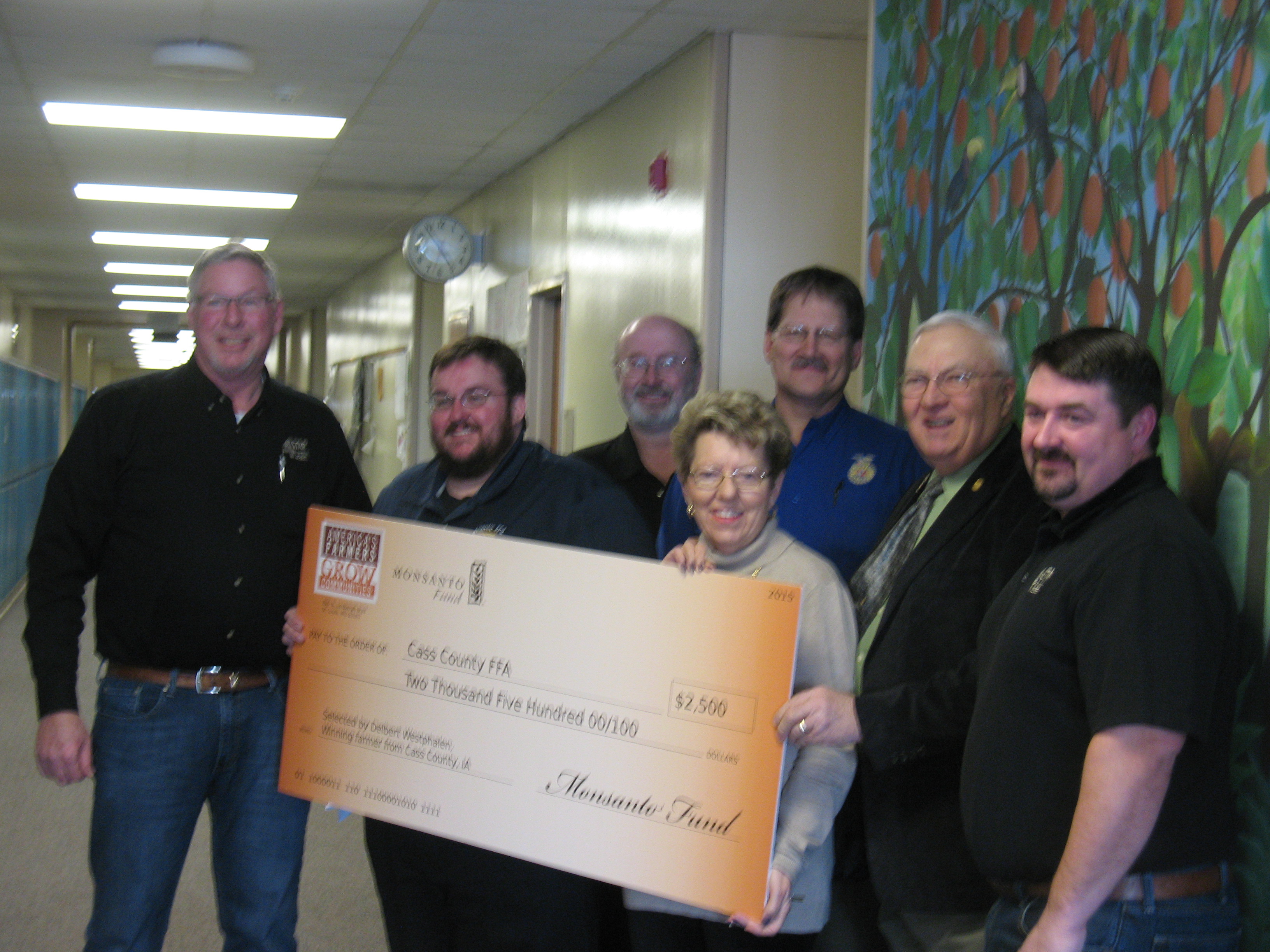
(from left to right) Dennis Kenealy (President, 4 Star Seed); Eric Miller (Atlantic FFA Advisor); Gary Miller (CAM FFA Advisor); Kevin Blair (Griswold FFA Advisor); Delbert Westphalen; Mike Lund (Sales Mgr.,4 Star Seed); Lana Westphalen (Center)
Delbert said “We wanted to do something that was going to benefit a lot of the people in the County, not just one particular area or one particular group.” By choosing the FFA Food Stand at the Cass County Fair, he says “we’re benefiting everybody, but most of all we’re benefiting the county fair so we can maintain that as the only free county fair in the State of Iowa. And we want to keep it that way.” Westphalen told KJAN News the FFA is near and dear to his heart.
He said “I was actually in FFA longer than 4-years because I stayed to get my American Farmer degree, and it’s some of the best times that I had growing up.” He said the FFA taught him responsibility, and “Is one of the reasons I’m a farmer.” Westphalen received his check Thursday afternoon at the Atlantic High School from 4 Star Seed President Dennis Kenealy and 4 Star Sales Manager Mike Lund, who represented the Monsanto Company.
The funds were presented to FFA Advisors Eric Miller (Atlantic High School), Gary Miller (CAM FFA) and Kevin Blair (Griswold FFA). Eric Miller said they hope to raise 40- to 45,000-dollars to construct the FFA Food Stand. Miller said they “Can do it less cheaper, but we want to do it right. We don’t want to just piece-meal it, put it together part-time. If we’re gonna do it, let’s do it right.”
So far, he says, they’ve raised $28,000, with almost no fundraising efforts conducted. $9,000 was raised through word of mouth contributions. The Trevor Frederickson Foundation contributed $5,000 early on in the process, and they’ve received a $2,000 grant from the Iowa West Foundation. Miller says he’s applied for a $10,000 Cass County Endowment Fund grant, and if it is approved, the project is a go for this summer. He says they should know by the end of this month if the grant is approved. Once the project begins, the old FFA Food stand will be razed and the new structure put up in its place.
He says the new FFA Food Stand will have better plumbing, better electrical service, and be more modern, making it more safe than it is now. “America’s Farmers Grow Communities” was launched by the Monsanto Fund is 2010, and has grown to include 1,324 eligible counties in 40 states. The program is part of the “America’s Farmers” Initiative, which highlights the important contribution farmers make every day. For a list of the “Grow Communities” winners and more program information, go to growcommunities.com, on the web.
A workshop focused on comparison of feedlot facility investments, production benefits, cattle comfort and environmental stewardship will be held at the Wallace Foundation Learning Center/Armstrong Research Farm near Lewis, IA on March 18th from 9:45- 3:00 pm.
Iowa State University Extension and Outreach and the Iowa Beef Center will conduct the workshops. The workshops are supported by a North Central Region Risk Management Education grant. Iowa Cattlemen’s Association and the Coalition to support Iowa Farmers are cooperating partners. A revised feedlot systems manual and decision tool will be available to workshop participants.
Workshop participants will work with several scenarios to make decisions regarding feedlot facility investments and learn how different facility types may work for each scenario. A $20 registration fee will be payable at the door but those interested in participating need to contact Chris Clark, ISUEO Beef Specialist to pre- register and reserve a noon meal. Clark can be reached at caclark@iastate.edu or by phone at 712-250-0070.
This meeting is part of a state-wide program with a complete listing of meeting dates and locations described below. Additional information on the upcoming series can be found on the Iowa Beef Center Website: http://www.iowabeefcenter.org/news/FeedlotFacilitiesWorkshops2015.html
Feb. 18 Nashua – Borlaug Center meeting room Northeast Research Farm
Feb. 24 Manchester – Delaware County Extension office
Feb. 25 Dewitt – Clinton County Extension office
Feb. 26 Ames – Hansen Ag Student Learning Center Iowa State University
March 3 Emmetsburg – Iowa Lakes Community College
March 4 Cherokee – Western Iowa Tech
March 4 Osceola – Clarke County fairgrounds
March 6 Oskaloosa – Mahaska County Extension office
March 9 Tama – Tama County Extension office
March 18 Lewis – Wallace Foundation Learning Center Armstrong Farm
March 25 Carroll – Carroll County Extension office
The cold weather of winter is the time to plan for future gardens. The Cass County Master Gardeners group is again offering grant money to be used in the 2015 growing season, to encourage gardening to grow food and/or beautify local communities. The money may also be used for gardening education purposes. The David Williams Master Gardener Grants are offered to honor the many years of service Master Gardener David Williams provided as a long-time volunteer, with the Master Gardener program and other community organizations, including a term as Cass County Master Gardener president in 2012.
Any Cass County not-for-profit group or individual may apply. Schools, churches, libraries, 4-H clubs, Scouts, and individuals working to improving their communities can use the money to begin or improve gardens or landscaping, or to provide education for their members or the public. To ensure the money is helping a wide variety of community organizations, groups who were funded by 2014 grants will not be eligible to apply in 2015. Each grant has a maximum value of $300. The application must also include plans for teamwork and sustainability. Consideration for the environment is also an important selection factor.
Applications must be received by Monday, March 30th for consideration. They may be submitted by mail or email. Grant recipients will be informed of their selection by the end of April. For more information, or with questions, call the Cass County Extension office at 712-243-1132, email keolson@iastate.edu, or stop by the Extension Office at 805 W. 10th St in Atlantic. You may also contact committee members Judy Kennedy, Marla Anstey or Linda Edelman. Application forms can be picked up at the Extension Office, or printed from the Cass County Extension website- www.extension.iastate.edu/cass.
The Master Gardener program trains volunteers to develop their knowledge and skills in horticulture. These volunteers then give back to their communities through gardening service and education. The program is available in all 50 states and Canada through land grant university Extension programs such as Iowa State University. Education courses are available throughout Iowa on a regular basis. Contact Cass County Extension Program Coordinator Kate Olson, at 712-243-1132 or keolson@iastate.edufor more information.
The Iowa Department of Natural Resources (DNR) has cancelled its public meeting on hunting and trapping regulations tonight (Wednesday), due to National Weather Service issuing a winter storm warning for much of the state closing many of the meeting locations. Meetings were scheduled over the Iowa Communication Network (ICN) in Atlantic, Boone, Chariton, Clear Lake, Council Bluffs, Creston, Davenport, Decorah, Dubuque, Johnston, Marshalltown, Monroe, Ottumwa, Sac City, Sergeant Bluff, Sheldon, Spencer, Tiffin, Waverly and West Burlington.
The DNR will attempt to reschedule the meeting, if possible, to receive the public’s thoughts on the hunting and trapping regulations for this fall. The decision was made in the interest of public safety; however, the public is encouraged to send comments about what went well last fall, what didn’t, and what changes hunters and trappers would like to see for this fall to wildlife@dnr.iowa.gov.
Those comments, along with the data that the DNR Wildlife Bureau collects on harvest and population numbers, will be used to develop recommendations for any rule changes for this fall.


 Facebook
 Twitter
 YouTube
 RSS
RSS