

CLICK HERE for the latest market quotes from the Iowa Agribusiness Network!
CLICK HERE for the latest market quotes from the Brownfield Ag News Network!


CLICK HERE for the latest market quotes from the Iowa Agribusiness Network!
CLICK HERE for the latest market quotes from the Brownfield Ag News Network!
An Aerial Applicator Continuing Instructional Course (CIC) for commercial pesticide applicators is now available from Iowa State University Extension. The program will be shown at locations across Iowa through the Extension and Outreach Pesticide Safety Education Program (PSEP).
The course will provide continuing instructional credit for commercial pesticide applicators certified in category 11 and 10. Some of the topics to be covered include worker protection standards update, application technology for agricultural aircraft, fungicide, insecticide, and herbicide update, and handling pesticide containers.
To obtain additional information about the CIC, contact Jodie Smith at the ISU Extension and Outreach office in Montgomery County at 712-623-2592. The registration fee is $35. Additional information for this and other courses offered by the PSEP program can be accessed at www.extension.iastate.edu/PSEP/ComAp.html.
U-S Ag Secretary Tom Vilsack says he cannot comment on the lawsuit alleging boards of supervisors in three northwest Iowa counties failure to manage ag drainage districts has contaminated central Iowa’s drinking water supply. “But it is appropriate for me to talk about conservation and the role of USDA in all of this and I think what might surprise…many Iowans is how much conservation is actually taking place today in Iowa,” Vilsack says.
Since January of 2011, the U-S-D-A has awarded over two-point-two BILLION dollars to Iowa farmers to help finance conservation projects to reduce nitrogen and phosphorus run-off into rivers and streams. “The reality is that this is a very complicated situation,” Vilsack says. “It’s going to take time, but I am absolutely convinced that people are committed to better soil health and better water quality.”
Vilsack suggests the federal government is doing its part to stimulate conservation measures on Iowa farmland, but the state government could and should be “more aggressive” in its support of water quality initiatives. Vilsack sugests something similar to the “Vision Iowa” program he iniatated 15 years ago when he was governor .
“Let me just make a suggestion to our friends in the legislature and the governor: we did a great thing with Vision Iowa. We took gaming revenues and we put them on the table and we said to communities across the state: ‘What would you do if you had this money available to spur economic opportunity, tourism attractions, whatever?’ And people responded and we saw the landscape of this state change,” Vilsack says.
“I think it’s time that we do that with water. There’s no reason why we can’t do something similar and then that could leverage significantly greater sums from the federal government.”
Vilsack points to the Republican governor of Michigan, who has committed 45 million dollars in state money for a single water conservation project. Vilsack made his comments during taping of the “Iowa Press” program that airs tonight (Friday) on Iowa Public Television.
(Radio Iowa)
Spring in Iowa is a time for new beginnings as trees, plants and yards awaken from the cold of winter. Spring is also a time when many Iowans make plans to begin a new chapter in their lives by purchasing a home. USDA Rural Development currently has $10 million available for loans for Iowans to purchase or refinance homes in rural Iowa through its Direct Home Loan Program. The program offers 100 percent financing, a 33-year loan term and payment assistance for eligible applicants. This funding will remain on a first come first served basis through September 30, 2015.
“Each year USDA Rural Development invests more than $200 million in loans and grants that provide rural Iowa residents with decent, safe and sanitary housing,” said Bill Menner, USDA Rural Development State Director in Iowa. “It’s through housing
programs like this one that we work to ensure that as many rural Iowans as possible
have access to adequate housing.”
Recently a rural Iowa family of seven was living in a rental property that was not
suitable for occupancy. They made an offer on a home that was move-in ready. USDA
Rural Development received their purchase agreement on March 19. Their loan closed
and the family moved into their new home just 19 days later on April 7. The family
is ecstatic with their improved living conditions, and their house payment is $80
less than what they were paying for rent.
To learn more about USDA Rural Development’s housing programs please call (515)
284-4444, email DirectIA@ia.usda.gov or visit www.rd.usda.gov/ia.
USDA Rural Development also has a loan and grant program to help eligible homeowners make essential repairs such as a new furnace, roof, siding, or accessibility improvements, Homes repaired with these funds must be located in communities of less than 20,000 people or in rural areas.
USDA Rural Development has 11 offices across the state to serve the 1.7 million Iowans living in rural areas and communities. Office locations include a State
Office in Des Moines, along locally, with an Area Offices in Atlantic.
OMAHA, Neb. (AP) — The economic outlook for rural areas of 10 states in the Plains and the West remained negative in April even though it improved slightly from the previous month. Creighton University’s Rural Mainstreet index grew to 46 in April from March’s 43.6, but any score below 50 suggests a decline. The indexes range between 0 and 100.
Creighton University economist Ernie Goss says the strong U.S. dollar continues to hurt exports of agriculture and energy products. And demand for farmland remains weak, so land prices are declining. The farm equipment sales index sits at 15.6, up slightly from March’s 15.2, but well below the neutral level of 50.
Bankers from rural areas of Colorado, Illinois, Iowa, Kansas, Minnesota, Missouri, Nebraska, North Dakota, South Dakota and Wyoming were surveyed.
The Cass County Conservation Board has announced a “Wildflower Walk!” program will be held at the Frank Chapman Pellett Memorial Woods just north of Atlantic, on April 25th. The 9-a.m. event is free and open to the public. The Oak Strollers Nature Club for Families are welcome to join at the event as well.
You’re invited to join Cass County Conservation Department staff for a walk through the early spring wildflowers, and to learn the names, uses and history of the Wildflowers. Those in attendance will have the opportunity to view one of Southwest Iowa’s best locations to observe spring woodland wildflowers. The 20 acre tract of land contains 8 acres of native woodland that was established as a wildflower preserve in 1908. It is known to contain over 120 species or plants, some of which are marked along the trail.
Pellett Memorial Gardens is located just outside of Atlantic, ½ mile north and ¾ mile east of the KJAN radio station. For more information, call Lora Kanning, Naturalist
with the Cass County Conservation Board, at 712-769-2372.
The City of Atlantic has qualified for and is officially designated, as a “Tree City USA” community for the 20th year. Dolly Bergman, with the local Trees Forever group, told the Atlantic City Council Wednesday evening, that she and Atlantic Parks and Recreation Dept. Director Roger Herring, along with Assistant Parks Director Seth Staashelm, attended a Tree City USA event in Des Moines on April 10th, during which Atlantic once again received the honor of being a Tree City USA community.
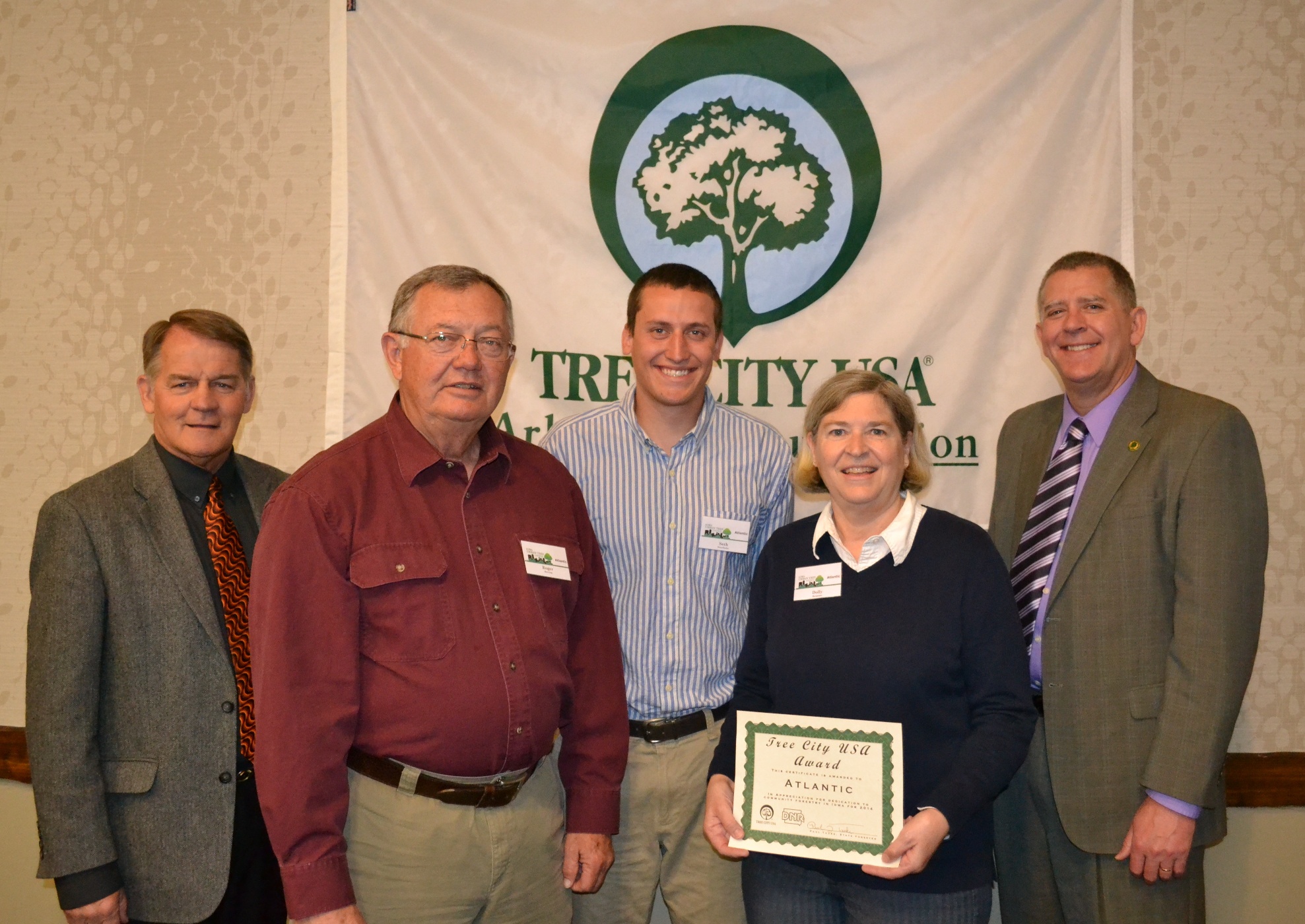
(From left) IA DNR Director Chuck Gipp, Atlantic Parks & Rec Director Roger Herring, Asst. Director Seth Staashelm, Trees Forever Chairperson Dolly Bergman & State Forester Paul Tauke.
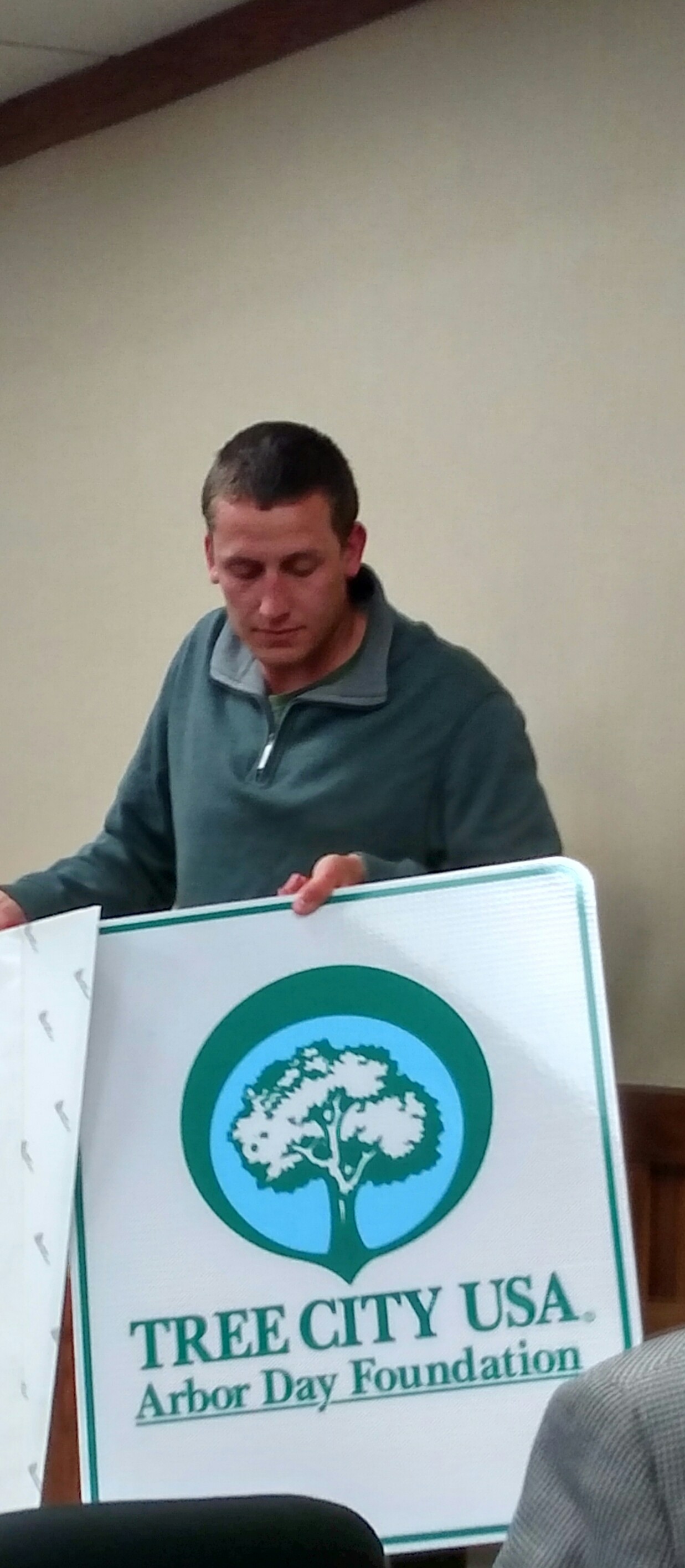
Atlantic Asst. Parks & Rec Director Seth Stasshelm with the new Tree City USA signs. (Click on the photo to enlarge)
The City received two new signs that will be erected to replace signs located on the east and west sides of town. The old signs may be relocated along Olive Street and near Mahle Engine Components, if they can be cleaned-up and/or refurbished. The new signs will also be adorned with stickers acknowledging the fact the City has been a Tree City USA for 20 years. A new Tree City USA flag will be flown over the Atlantic City Park, as well.
Bergman reminded the Council there are four criteria in order to be eligible for the designation. There must be a “Trees Board” – which in Atlantic, is the Trees Forever group, a tree care ordinance is in place, a community forestry program with an annual budget of at least $2 per capita, and an Arbor Day observation and proclamation.
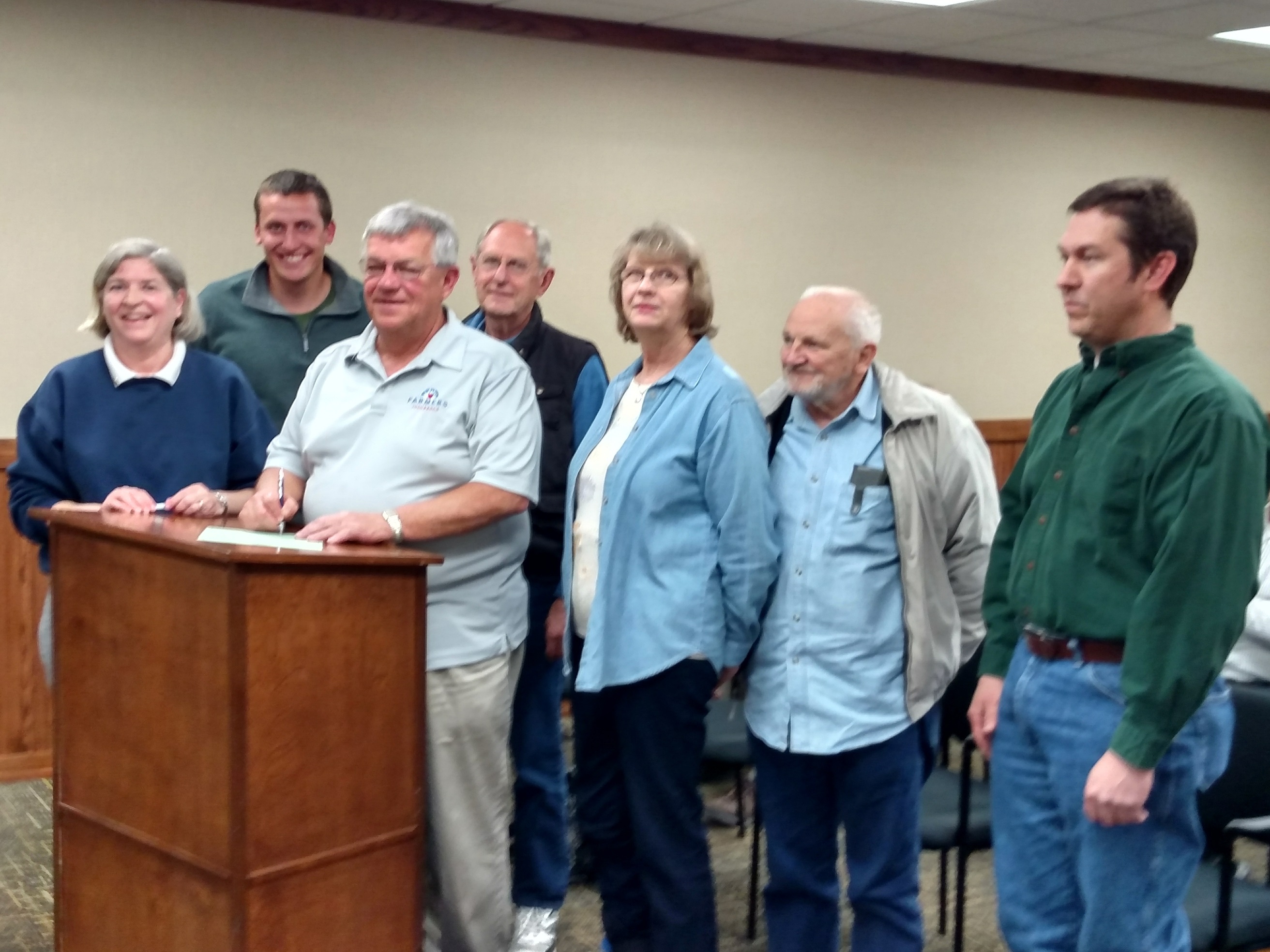
Atlantic Mayor Dave Jones, surrounded by the local Trees Forever group, signs the annual Arbor Day Proclamation.
Bergman said also, there will be an an Arbor Day event on Friday, April 24th, at the Schuler Elementary School, during which a tree will be planted with the help of 4th graders, at around 2:30-p.m. In addition, each of those 4th grade students will be presented with a tree.
Bergman also had some good news for local merchants with regard to “tree economics”: She said studies have shown shoppers will travel further and longer, to visit a district with high quality trees. They will also spend more time once they arrive in the community because of the trees. Visitors to well treed central business districts, she said, will spend 9-to 12-percent more for their products, a seven percent higher rental rate for commercial offices, due to high quality landscaping. She said also, trees located near a hospital have been shown to help patients recovering from surgery who have a view of trees, have shorter post-op hospital stays.
DES MOINES – Emerald Ash Borer (EAB) has been positively identified in a residential tree in the southeast corner of rural Dallas County, making this the twenty-first county in Iowa where this invasive beetle has been found. EAB kills all ash tree species and is considered to be one of the most destructive tree pests ever seen in North America.
The current EAB infestation was found as a result of an arborist contacting state officials about a suspect ash tree. Investigation by the Iowa EAB team revealed characteristic galleries, recent woodpecker activity, and live larvae that were positively identified by federal identifiers.
“This finding is the closest to Polk County and Iowa’s capital city to date” said Mike Kintner, Iowa Department of Agriculture & Land Stewardships EAB and Gypsy Moth
Coordinator. “With this discovery, Iowa has declared three positive counties in 2015
where this ash-killing pest has been found.”
Twenty-one Iowa counties now have confirmed EAB infestations. A statewide quarantine, issued on Feb. 4, 2014, remains in place, restricting the movement of hardwood firewood, ash logs, wood chips and ash tree nursery stock out of Iowa into non-quarantined areas of other states. “We still strongly urge Iowans to not move firewood long distances,” said State Entomologist Robin Pruisner of the Iowa Department of Agriculture and Land Stewardship. “A large portion of Iowa is not showing signs of EAB infestation; let’s keep those areas EAB-free as long as possible by not moving wood that potentially harbors EAB or other tree pests. Be vigilant and report suspicious symptoms in counties that are not yet known to be infested to a member of the Iowa EAB Team.”
The Iowa EAB Team provides EAB diagnostic assistance to landowners and includes
officials from Iowa Department of Agriculture and Land Stewardship (IDALS), Iowa
State University Extension and Outreach, the Iowa Department of Natural Resources
(DNR), USDA Animal Plant Health Inspection Service and the USDA Forest Service.
The Iowa EAB Team strongly cautions Iowans not to transport firewood across county
or state lines, since the movement of firewood throughout Iowa or to other states
poses the greatest threat to quickly spread EAB and other plant pests. Most EAB
infestations in the United States have been started by people unknowingly moving
infested firewood, nursery plants or sawmill logs. The adult beetle also can fly
short distances, approximately 2 to 5 miles.
The window for preventive treatment measures (trunk injection, soil injection, soil
drench or basal trunk sprays) is mid-April to mid-May. If a landowner is interested
in protecting a valuable and healthy ash tree within 15 miles of a known infestation, they should have landscape and tree service companies bid on work, review the bids and treat during the recommended treatment time.
Please contact Iowa EAB Team members to have suspicious looking trees checked in
counties not currently known to be infested. The State of Iowa will continue to track the movement of EAB on a county-by-county basis. Before a county can be officially recognized as infested, proof of a reproducing population is needed and an EAB must be collected and verified by USDA entomologists.
To learn more about EAB and other pests that are threatening Iowa’s tree population,
please visit www.IowaTreePests.com.
(Press Release)
DES MOINES, Iowa (AP) — A bird-flu strain that has already hit numerous turkey farms in the Midwest has been found in a turkey flock in northwest Iowa. An Iowa Department of Agriculture spokesman says Tuesday the H5N2 strain of bird flu virus has been confirmed in a barn on a farm housing 27,000 birds in Buena Vista County. The disease was suspected when turkeys began dying in the barn.
An Iowa Poultry Association spokesman says the farm is under quarantine and the turkeys will be euthanized. Animal health officials have long said the virus is dangerous to all commercial poultry. Iowa has 130 turkey farms raising 11 million turkeys a year. The state also is the nation’s leading egg producer with 59.6 million egg layers. No chicken flocks in Iowa have been infected.
The U-S-D-A weekly crop report shows farmers got some field work done last week, but wet conditions — including snow in northern Iowa — slowed things down. Iowa State University Extension crop specialist, Joel DeJong, covers northwest Iowa, and says farmers are off to a good start as they move toward planting. “And as I think as the conditions warm up and dry up and if we can stay dry this week, I think early next week we can see a lot of planters in the field,” DeJong says.
Soil temperatures dictate when farmers will start putting seeds in the soil. “We’d like to see 50-degree soil temperature at four inches and rising, is kind of what our goal is. We’ve been measuring temperatures all the way into the upper 40’s, it’s dropped back just a shade again, because we cooled back again,” DeJong says. “If you want a real rough rule-of-thumb of what the temperature is at four-inch depth, you average the last three days of temperatures and you are usually pretty close at this stage of the game — unless there is a huge swing — and then sometimes it isn’t quite right.”
DeJong says there are some reports of drought-like conditions, but sub-soil moisture levels in northwest Iowa seem to be sufficient. Dejong says they took several measurements last November down to five feet, which is the rooting depth for corn and bean growth, and the numbers were a little higher. “And that doesn’t go away the winter time, it takes crops or plants growing in it to have it go away. So that tells us that we are at least average at all out sites or maybe a slight bit above average at this stage of the game,” DeJong says.
The U-S-D-A report shows soil moisture levels are adequate for most areas of the state. DeJong says most Iowa farmers will probably plant this year’s corn crop between April 20th and May 10th.
(Radio Iowa)


 Facebook
 Twitter
 YouTube
 RSS
RSS