

CLICK HERE for the latest market quotes from the Iowa Agribusiness Network!
CLICK HERE for the latest market quotes from the Brownfield Ag News Network!


CLICK HERE for the latest market quotes from the Iowa Agribusiness Network!
CLICK HERE for the latest market quotes from the Brownfield Ag News Network!
Spring in Iowa means planting fields and gardens, outdoor recreation, warm days, cool nights and, as a reminder from the Iowa Department of Public Health (IDPH), it also means the start of tick season. IDPH encourages Iowans to enjoy the many opportunities to be active outdoors, while remembering to protect against ticks. Ticks can carry the organisms that cause Lyme disease (the most common tick-borne disease), Rocky Mountain Spotted Fever, and Ehrlichiosis. In 2014, there were 194 confirmed and probable cases of Lyme disease in Iowa; so far this year, there have been two cases.
IDPH Public Health Veterinarian & Deputy State Epidemiologist, Dr. Ann Garvey says “The best way to prevent tick bites is to avoid wooded and tall grassy areas, where ticks are usually found.”. If you do spend time in these areas:
Not everyone who gets Lyme disease will have the same symptoms, but the best and earliest sign of infection is a rash that may appear within a few days to a month, usually at the site of the tick bite. The rash will first look like a small, red bump, then expand until it begins to look like a bull’s eye, with a red center and a red ring surrounding a clear area. It is important to contact your health care provider immediately if you develop this type of rash.
The Iowa State University Medical Entomology laboratory conducts tick surveillance across the state and encourages Iowans to send in tick samples for identification. For more information, visit http://bit.ly/1F5Zloa or call 515-294-0581. To learn more about Lyme disease, visit http://bit.ly/1FPGoEN.
The Nishna Valley Trails (NVT) group is very close to meeting their goal of raising enough funds for the Troublesome Creek Connector Trail to the Schildberg Quarry. The NVT’s Dave Chase appeared before the Atlantic City Council Wednesday night not to ask for money, but to instead provide an update on a project that has been in the works since 2010.
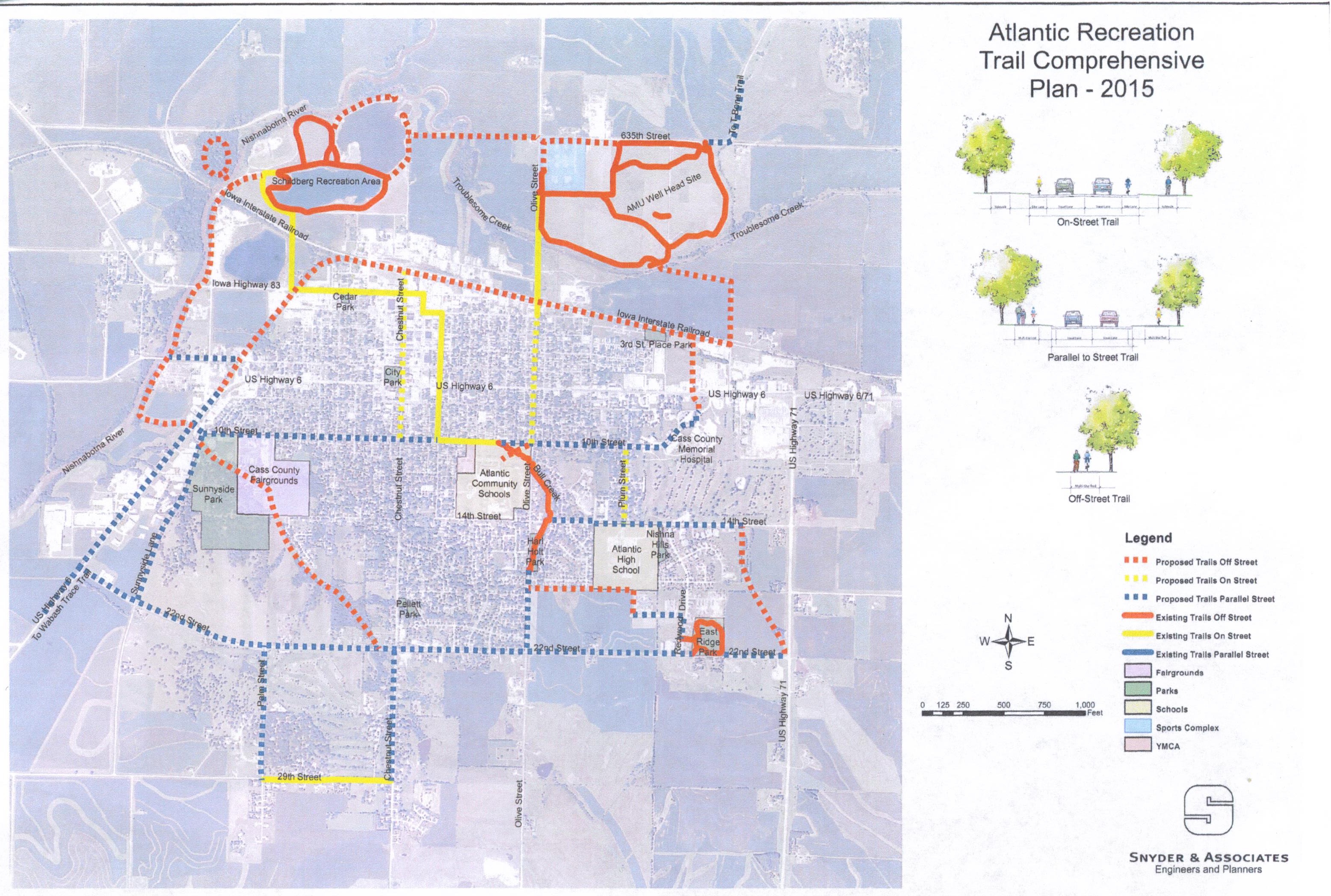
The latest Atlantic Recreational Trail Comprehensive Plan. (click on image to enlarge)
Chase provided the Council with an updated Comprehensive Trails Plan, which, during his last report was still in the process of being updated. Chase said “The trail system is coming together in increments.” The Council’s agenda had included an “Order of Support” of the group in its efforts to get up to $80,000 from the Surface Transportation Program (STP), but Chase asked for that to be removed, because “Involving federal funds in this project would involve requirements and red tape that would put our program back six-months, and it would also require some wage and hour considerations [involving the contractor] which might increase the cost of the project.”

This is what the pedestrian bridge over Troublesome Creek will look like when it is installed.
Chase said there is momentum and interest for the project, and to date, the group has raised and committed $364,500 toward their $600,000 goal. The group has raised money thanks to grants from the Cass County Community Foundation, and fundraisers or donations from the Lions, Kiwanis, more than 110 separated individuals and donors, and more. The Cass County Supervisors and City of Atlantic have also agreed to provide financial support.
There are also grant applications pending amounting to another $138,500, which if approved, would add up to $503,000, leaving them $97,000 short. Even so, Chase said they have other ideas about how to raise the balance of the funds, and they ready to begin”Pulling the Trigger,” on project by not only accepting bids, but hiring a Project Manager.
Since all the grant funds will flow through the City, Snyder and Associates Engineers will present to the Council a Project Manager Contract at the May 20th meeting. Chase has been working the Snyder’s Dave Sturm and Atlantic City Manager John Lund to accomplish that next step. Bid letting is still to come this spring, with construction completed on the trail by the fall.
DES MOINES, Iowa (AP) — Iowa agriculture officials say five additional commercial chicken farms show signs of the presence of bird flu and a backyard duck flock near a previously confirmed case also has tested positive. The new chicken cases are on Sioux County farms. Two had a total of 200,000 chickens. Estimates were not immediately available for the remaining three farms. The backyard ducks are on a farm in O’Brien County.
The new cases raise Iowa’s total number to 34 cases in 11 counties. About 21 million of Iowa’s chickens will be affected if the latest cases are confirmed. The number of turkeys to be lost is approaching 500,000. More than 100 farms in the Midwest have the bird flu virus with more than 28 million birds affected.
DES MOINES, Iowa (AP) – Iowa agriculture officials say three additional Iowa poultry farms show signs of the presence of bird flu including two more turkey farms in Buena Vista County, raising the number in the county to 10. A Sioux County egg-laying operation with 60,000 chickens also appears to have the virus. Testing is underway to confirm the disease. The farms experienced an unusual number of bird deaths, prompting an initial test which indicated presence of the H5N2 virus.
The new cases raise Iowa’s total number to 28 cases in 11 counties. More than 20 million of Iowa’s chickens will be affected if the latest cases are confirmed. The number of turkeys to be lost is approaching 500,000.
DES MOINES, Iowa (AP) — Ideal weather last week enabled Iowa farmers to make progress planting their corn and soybean crops. The U.S. Department of Agriculture says as of Sunday, farmers had planted 68 percent of the state’s corn crop and 11 percent of the soybean crop. Both figures are better than the five-year average.
The USDA says 84 percent of farmland had adequate topsoil moisture, with 11 percent short and 5 percent in surplus. Farmers reported 82 percent of subsoil moisture was adequate. The state agriculture department says half of Iowa’s corn acreage was planted last week.
DES MOINES, Iowa (AP) — Officials say the bird flu virus has been found in four more locations in Iowa, bringing the total number of poultry that must be killed in the state to more than 19 million. The Iowa Department of Agriculture and Land Stewardship announced Monday that new cases were reported at an egg-laying operation in Wright County with 2.8 million chickens and at three turkey farms. Two of the turkey farms are in Buena Vista County and one is in Cherokee County.
State officials didn’t release the number of birds at the turkey operations. The addition of the Wright County chicken farm brings the total number of poultry that must be killed to 19.3 million birds. The birds are killed in an effort to halt the spread of the virus.
For the 20th consecutive year, West Central® Cooperative is awarding its’ Excellence in Agriculture scholarships for area seniors pursuing agriculture-related post-secondary education. This year, seven students have each been awarded $1,500.
West Central’s president and chief executive officer, Milan Kucerak, said “This year’s seven winners are excellent examples of the bright future of agriculture. These scholarship winners are hard-working, talented young people.”
West Central’s 2015 Excellence in Agriculture winners are:
WC’s Excellence in Agriculture program has been in place since 1994, awarding scholarships to high school seniors interested in pursuing an education in an agriculture related field. The program is open to students who are –or have parents that are – voting members in good standing of West Central (at the time of the scholarship application deadline). Applicants must have a cumulative high school GPA of 2.5 or better on a 4.0 scale.
DES MOINES, Iowa (AP) — It’s been five months since the H5N2 bird flu virus was discovered in the U.S., and producers have lost more than 21 million birds in the Midwest alone. Yet, researchers with federal agencies acknowledge they still know little about the virus’ origin and how it spreads, especially with heightened biosecurity measures at commercial poultry farms and the apparent lack of widespread deaths in largely unprotected backyard flocks.
A leader with the federal Centers for Disease Control and Prevention says not much is known about the virus because it only surfaced in the U.S. in early December. Unanswered questions include how exactly the virus finds its way into sheltered commercial chicken and turkey flocks and if wild birds spread the virus why more backyard flocks haven’t died.


 Facebook
 Twitter
 YouTube
 RSS
RSS