

CLICK HERE for the latest market quotes from the Iowa Agribusiness Network!
CLICK HERE for the latest market quotes from the Brownfield Ag News Network!


CLICK HERE for the latest market quotes from the Iowa Agribusiness Network!
CLICK HERE for the latest market quotes from the Brownfield Ag News Network!
DES MOINES, Iowa (AP) – Four more Iowa farms are testing positive for bird flu.
The Iowa Department of Agriculture says an egg-laying farm and a turkey farm in Buena Vista County bring to 15 the number of cases in that county in northwest Iowa. A broiler farm in Osceola County is the state’s first indication of the disease on a farm raising chickens for meat. Officials said Tuesday the farm has 700 birds. Most of Iowa’s affected chickens are egg layers.
Lyon County also has its first case. It’s on an egg farm.
Iowa has 49 cases of bird flu in 13 counties. More than 26 million birds will die.
Minnesota and Wisconsin have no new cases but Nebraska reported its first on a farm with 1.7 million chickens.
In carnivals, a carny might tempt take your money and offer a prize for guessing your weight correctly. In the Audubon County town of Ross, you may rewarded for guessing the weight, of the last wooden grain elevator, and help to save it. Bob and Janet Nelson, owners of the 130 year old elevator have been raising money to help restore what appears to be the oldest wooden elevator still standing, in Iowa.
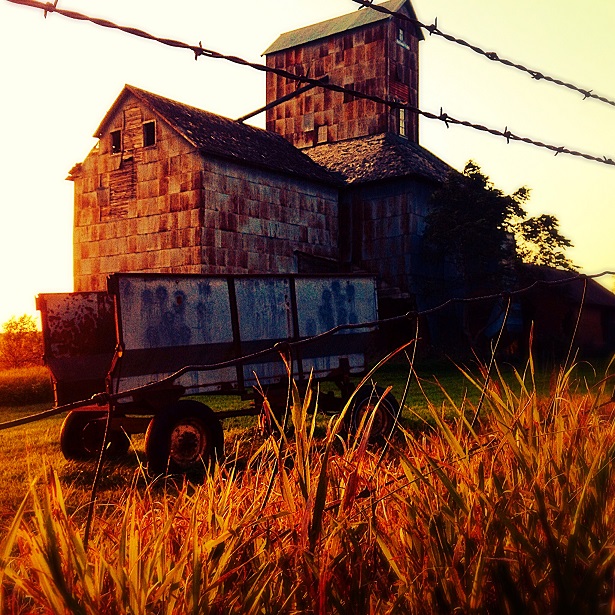
Photo from www.saverosselevator.com.
Bob Nelson says the elevator in Ross was built in the early 1880’s by Civil War veteran, Capt. Charles Stuart, who also founded Stuart, Iowa. Nelson says a family who has owned the elevator since the 1930’s, offered him the chance to buy the structure with hopes that it would be restored to the best possible condition. The elevator came about when the railroads were built, shortening the length of time it took to get crops to market, and making a spot where people could gather to socialize.
Wooden elevators typically were built to last 40-years, but more often than not, they were destroyed by fires created by sparks from passing railroad steam engines. They usually lasted no more than 10-years. A fundraising effort has allowed enough money begin the process. The effort began, according to Nelson, after they received a $25,000 grant from the Iowa Barn Foundation. The grant required matching funds, which Nelson has been able to accomplish.
He says they won’t be enough to completely cover the cost of restoration, so a contest is being held to guess the weight of the structure as it’s lifted off the limestone foundation, which has collapsed on three-sides. The foundation is the first thing set to be restored. The weight of the elevator roughly 25-by-30-to 60-feet high elevator will be measured by specially calibrated heavy-duty equipment.
Guess3 :16 Q:”…May 18th.”
(Nelson says people that want to guess the weight of the elevator can do so by donating when they log-on to www.saverosselevator.com. The structure is scheduled to be lifted-off the foundation next week, weather permitting. The person with the closest guess will have a plaque with their name displayed inside the elevator, once restoration work is completed.
DES MOINES, Iowa (AP) — Iowa agriculture officials say bird flu will claim an additional 4 million Iowa egg-laying chickens on two more farms in a county already hit by the disease. Officials are waiting for preliminary tests on two farms in Wright County to be confirmed. The county earlier reported a farm with 2.8 million chickens affected. Iowa’s chicken loss is approaching 25 million, more than 40 percent of the state’s egg-laying flock.
Officials on Friday also announced detection of the virus on five more turkey farms, including one with 42,000 birds. That brings the state to 44 cases in 12 counties. Minnesota and Wisconsin, two other states hit hard with the disease, reported no new bird flu cases Friday. The virus has spread to well over 30 million birds in 13 states.
DES MOINES, Iowa (AP) – Officials have found emerald ash borders in Polk County, home of the state capitol in Des Moines. A news release from the Iowa Agriculture Department said Friday that the tree-killing pests were found in Urbandale and West Des Moines. The department says the confirmation brings to 22 the number of Iowa counties where the insects have been found.
The larva of an emerald ash borer cuts off an ash tree’s flow of nutrients when deposited below the bark. Once infected, trees typically die within five years. The insects are native to Asia and were first spotted in the U.S. in 2002, when they showed up in the Detroit area. They devastated ash trees in Michigan and have spread to at least 21 other states.
A site in Mills County could become the final resting place for millions of chickens, turkeys, and at least one flock of ducks who have been killed for having the H5N2 Avian Bird flu. State Senator Mark Costello and Representative David Sieck, of Glenwood, both told the Council Bluffs Daily NonPareil, the birds could end-up at the Loess Hills Regional Sanitary Landfill, near Malvern. The officials have been in talks with the United States Department of Agriculture and the Iowa Department of Natural Resources about the matter.
At least 20 million chickens, 750,000 turkeys and a herd of ducks are among the dead. Turkeys may be disposed of by letting them decompose in piles inside a barn, which creates heat to kill the virus. Chickens would be placed in bags and heated to about 150-degrees to kill the germs before the birds are buried. Composting the remains is also a possibility, but incinerating all of the birds isn’t possible, according to Sieck, because there isn’t enough equipment for the job.
Four Iowa landfills are in talks with the USDA to handle this responsibility. The Mills County landfill is privately owned, which means it can move faster to execute the operation.The landfill has clay liners and gravel underneath, to prevent the spread of remains from leaking out.
So far, none of the dead birds have been moved from their quarantine zones.
DES MOINES, Iowa (AP) – Millions of dead chickens and turkeys lie in stinking, fly-swarmed piles near dozens of large Iowa farms due to the H5N2 bird flu virus.
Neighbors say they understand the challenge in disposing of more than 20 million bird carcasses, but are eager for quick action, especially as temperatures rise and create more decomposition odor and flies.
Iowa Department of Natural Resources environmental supervisor Ken Hessenius says the state must look at “all methods of disposal” and called the virus a “crisis.” Some of the birds are piled up and covered with dirt or other material, turkeys are often composted inside barns and at least one chicken farm is burying them in trenches. Portable incinerators have been set up and state officials are working with landfills.
Spring in Iowa means planting fields and gardens, outdoor recreation, warm days, cool nights and, as a reminder from the Iowa Department of Public Health (IDPH), it also means the start of tick season. IDPH encourages Iowans to enjoy the many opportunities to be active outdoors, while remembering to protect against ticks. Ticks can carry the organisms that cause Lyme disease (the most common tick-borne disease), Rocky Mountain Spotted Fever, and Ehrlichiosis. In 2014, there were 194 confirmed and probable cases of Lyme disease in Iowa; so far this year, there have been two cases.
IDPH Public Health Veterinarian & Deputy State Epidemiologist, Dr. Ann Garvey says “The best way to prevent tick bites is to avoid wooded and tall grassy areas, where ticks are usually found.”. If you do spend time in these areas:
Not everyone who gets Lyme disease will have the same symptoms, but the best and earliest sign of infection is a rash that may appear within a few days to a month, usually at the site of the tick bite. The rash will first look like a small, red bump, then expand until it begins to look like a bull’s eye, with a red center and a red ring surrounding a clear area. It is important to contact your health care provider immediately if you develop this type of rash.
The Iowa State University Medical Entomology laboratory conducts tick surveillance across the state and encourages Iowans to send in tick samples for identification. For more information, visit http://bit.ly/1F5Zloa or call 515-294-0581. To learn more about Lyme disease, visit http://bit.ly/1FPGoEN.
The Nishna Valley Trails (NVT) group is very close to meeting their goal of raising enough funds for the Troublesome Creek Connector Trail to the Schildberg Quarry. The NVT’s Dave Chase appeared before the Atlantic City Council Wednesday night not to ask for money, but to instead provide an update on a project that has been in the works since 2010.
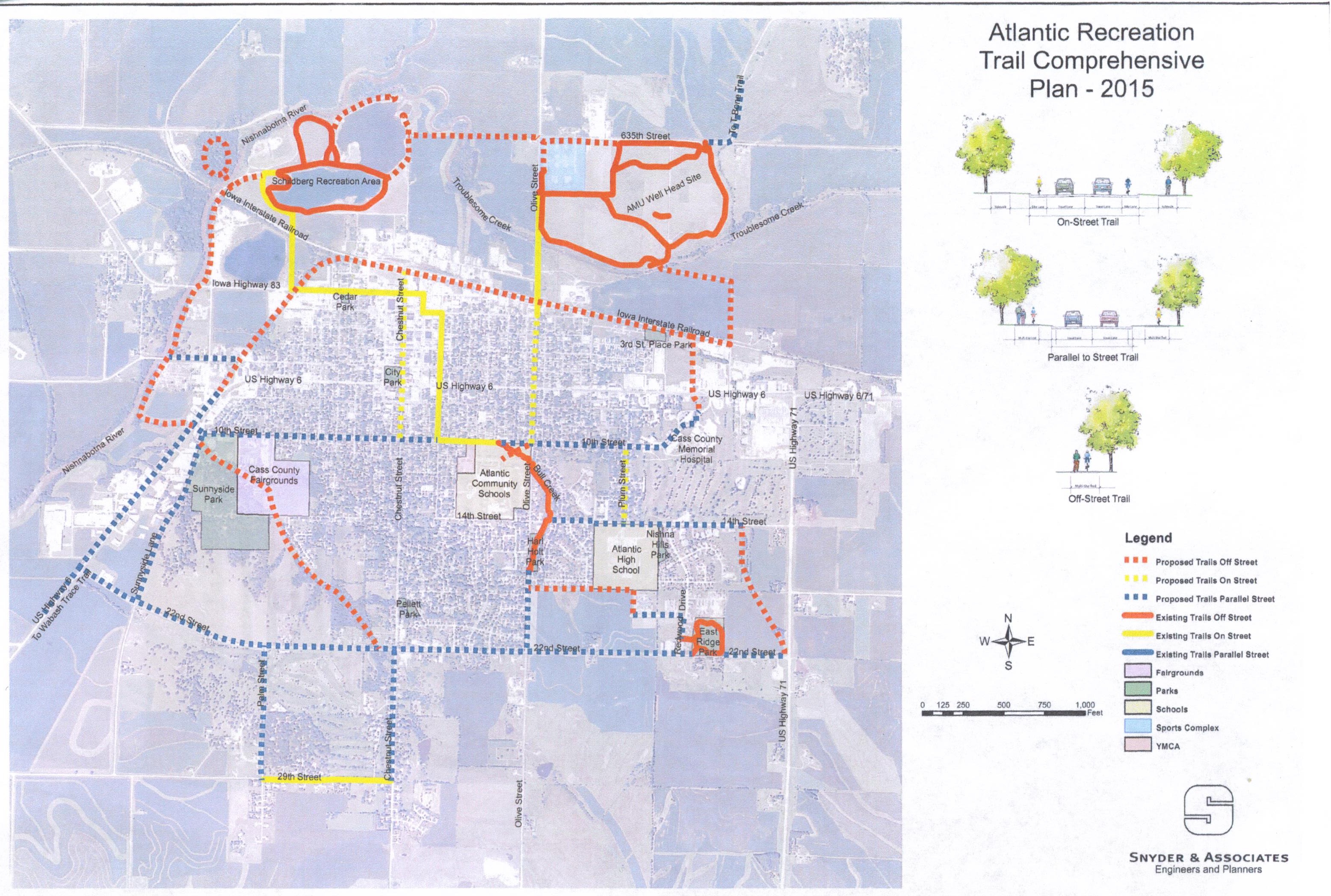
The latest Atlantic Recreational Trail Comprehensive Plan. (click on image to enlarge)
Chase provided the Council with an updated Comprehensive Trails Plan, which, during his last report was still in the process of being updated. Chase said “The trail system is coming together in increments.” The Council’s agenda had included an “Order of Support” of the group in its efforts to get up to $80,000 from the Surface Transportation Program (STP), but Chase asked for that to be removed, because “Involving federal funds in this project would involve requirements and red tape that would put our program back six-months, and it would also require some wage and hour considerations [involving the contractor] which might increase the cost of the project.”
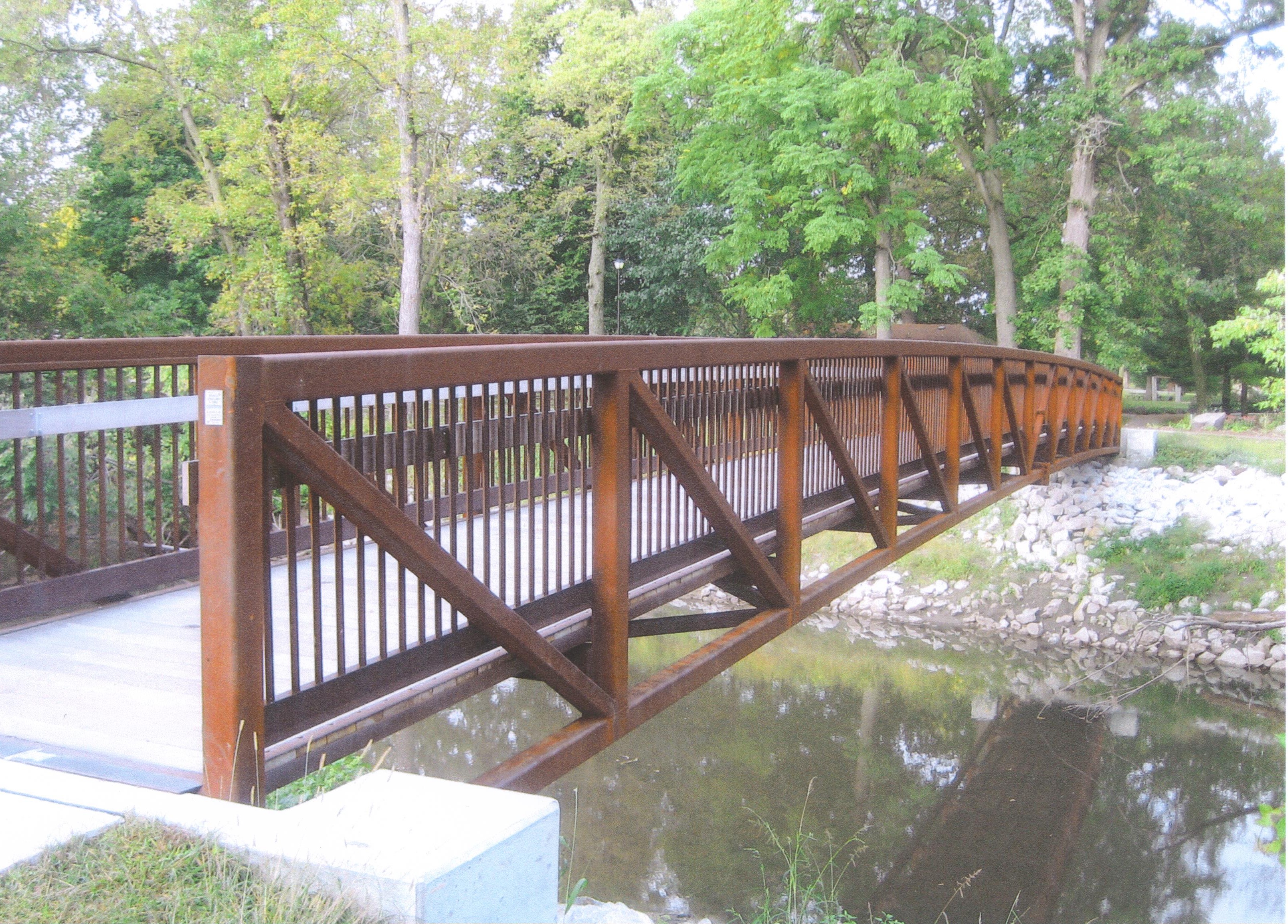
This is what the pedestrian bridge over Troublesome Creek will look like when it is installed.
Chase said there is momentum and interest for the project, and to date, the group has raised and committed $364,500 toward their $600,000 goal. The group has raised money thanks to grants from the Cass County Community Foundation, and fundraisers or donations from the Lions, Kiwanis, more than 110 separated individuals and donors, and more. The Cass County Supervisors and City of Atlantic have also agreed to provide financial support.
There are also grant applications pending amounting to another $138,500, which if approved, would add up to $503,000, leaving them $97,000 short. Even so, Chase said they have other ideas about how to raise the balance of the funds, and they ready to begin”Pulling the Trigger,” on project by not only accepting bids, but hiring a Project Manager.
Since all the grant funds will flow through the City, Snyder and Associates Engineers will present to the Council a Project Manager Contract at the May 20th meeting. Chase has been working the Snyder’s Dave Sturm and Atlantic City Manager John Lund to accomplish that next step. Bid letting is still to come this spring, with construction completed on the trail by the fall.
DES MOINES, Iowa (AP) — Iowa agriculture officials say five additional commercial chicken farms show signs of the presence of bird flu and a backyard duck flock near a previously confirmed case also has tested positive. The new chicken cases are on Sioux County farms. Two had a total of 200,000 chickens. Estimates were not immediately available for the remaining three farms. The backyard ducks are on a farm in O’Brien County.
The new cases raise Iowa’s total number to 34 cases in 11 counties. About 21 million of Iowa’s chickens will be affected if the latest cases are confirmed. The number of turkeys to be lost is approaching 500,000. More than 100 farms in the Midwest have the bird flu virus with more than 28 million birds affected.


 Facebook
 Twitter
 YouTube
 RSS
RSS