

CLICK HERE for the latest market quotes from the Iowa Agribusiness Network!
CLICK HERE for the latest market quotes from the Brownfield Ag News Network!


CLICK HERE for the latest market quotes from the Iowa Agribusiness Network!
CLICK HERE for the latest market quotes from the Brownfield Ag News Network!
MISSOURI VALLEY, Iowa (AP) — All of the DeSoto National Wildlife Refuge is opening for the summer season this weekend. The refuge’s auto tour road, nature trails, bird watching and mushroom hunting areas are now open for the season. Fishing and boating will also be permitted as long as anglers have a valid license from either Iowa or Nebraska. Spring archery turkey hunting begins on Monday.
The refuge is located north of Omaha, Nebraska, along on U.S. Highway 30 near Missouri Valley, Iowa. An entrance permit is required to enter the refuge. For more information, call 712-388-4800.
Two students from the Atlantic High School will be honored Monday afternoon, in Ames. Seniors Haley Carlson and Aubrey Schwarte will be part of an historic event where Iowa will be the first state in the nation to conduct a Letter of Intent to Teach Agricultural Education. The goal is to recognize young people who are committed to pursuing teaching as a career. The ceremony honoring Carlson and Schwarte will take place on the ISU Campus at Hilton Coliseum in Ames, beginning at 3:10-p.m.
Dale Gruis, Ag Ed Consultant for the Iowa Department of Education, and State FFA Advisor, says nationally, the number of college students pursuing degrees to teach K-12 is down 30-percent. In Iowa, there are currently about 20 teaching positions that remain unfilled in Agricultural Education (grades 5-12). While southern states have had Ag Ed instructor shortages for many years, the 2015-year was the first such shortage, in Iowa. Gruis says in addition, 25-percent of high school Ag Ed instructors are eligible to retire by 2018.
Agricultural Education is linked with the FFA, the largest student-led organization in the world. Gruis says students can only become members of the National FFA if they are first enrolled in Ag Ed courses.
The population of monarch butterflies that overwintered in Mexico is said to be more than three times larger than what was seen last year. It’s exceptional news for conservationists in Iowa and elsewhere who are trying to restore the monarch population which has dropped 80-percent in the past 20 years. Sue Blodgett, who chairs the Department of Entomology at Iowa State University, gives some of the credit to Iowans who are planting milkweeds by the thousands.
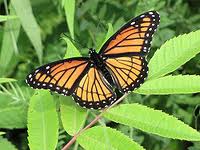 “I think that’s probably helping,” Blodgett says. “Of course, there’s other factors, too, the lack of any drought where the monarch have to migrate through, there’s several factors that contribute, but certainly, the efforts we are making here in Iowa are part of that picture.” The orange-and-black insects are a key factor in providing pollination services to agriculture that are estimated to be worth three-billion dollars a year. Blodgett says they’re an important insect.
“It’s iconic and it also is a really good indicator of habitat,” Blodgett says, “and not just habitat for the monarch but habitat for other pollinators, birds and other wildlife that we value.” The World Wildlife Fund reports that this winter’s survey found adult butterflies covered about ten acres of forest in Mexico. During the last three winters, overwintering butterflies occupied three or fewer acres. Blodgett says the goal is to see a sustained monarch population of about 15 acres, or 225-million butterflies through domestic and international efforts.
“In the past, there’s been some big storms or frosts or freezes that have gone through Mexico that have devastated the population,” Blodgett says. “Because of that migration, there’s a lot of weather factors involved that can influence that population.” One way Iowans can help in their back yards or on larger pieces of property is by planting milkweed, which monarch caterpillars love.
“Right now, we have nine different species of milkweeds planted at all of our Iowa State University research and demonstration farms around the state,” Blodgett says, “to show people what they look like and to also see how they persist, how they grow and to look at how the larvae develop on those.” The Iowa Monarch Conservation Consortium was established last year to enhance monarch reproduction and survival in Iowa through collaborative and coordinated efforts of farmers, private citizens and their organizations.
Learn more at: http://monarch.ent.iastate.edu
(Radio Iowa)
DES MOINES, Iowa (AP) – Des Moines-based MidAmerican Energy Company says it plans to spend $3.6 billion on a wind turbine operation that will generate up to 2,000 megawatts of electricity. Bill Fehrman, the utility’s CEO and president, announced the project Thursday at an event in Des Moines attended by Gov. Terry Branstad and other state officials. Officials say the wind farm will be the largest economic development project in the state’s history.
Fehrman says when the project is completed, the utility will generate wind energy that equals 85 percent of its annual customer sales in Iowa. MidAmerican is the state’s largest utility. MidAmerican didn’t release where the new turbines would be erected but says the utility will finalize locations while the Iowa Utilities Board considers the project.
A grant from the Iowa Farm Bureau Federation (IFBF) is providing the eight fire and rescue departments in Cass County with supplemental grain bin rescue tools. Stacie Euken, President of the Cass County Farm Bureau, says the County Farm Bureau Board applied for the grant from the IFBF to purchase grain bin augers and drills to run the augers, to aid in the rescue of persons trapped in grain bins.
All of the fire departments in Cass County are already equipped with lightweight grain bin rescue tubes, constructed to fit around the victim trapped in grain. The tubes are designed to stop the flow of the grain toward the victim, while at the same time relieving the pressure grain may place on the victim by rescuers attempting to save them. The rescue auger is designed to quickly remove grain from around the victim while they are in the rescue tube. It’s powered by a one-half inch cordless drill.
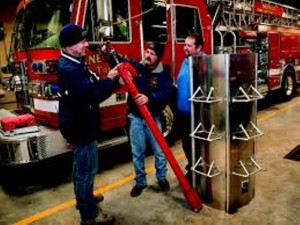
Grain bin rescue auger (red device in the center) & a type of rescue tube (on the right). (Photo from the IA Farm Bureau.com website)
A normal grain bin rescue takes about three and one-half hours. In December, 2015, a 39-year old Creston man died in a grain bin, west of Murray. Iowa is one of two states with the highest number of documented grain entrapment incidents, according to a 2013 report by Purdue University in Indiana, which is the other state with the highest number of incidents.
There were four grain entrapment incidents in Iowa last year. Nationwide, there were 38 documented grain entrapments resulting in 17 deaths in 2014, up from 33 entrapments and 13 deaths in 2013. From 2000 to 2010, 17 Iowans died after being trapped in grain, according to the University of Iowa College of Public Health.
The nearly $9,000 IFBF grant will pay for the augers and drills, which are being provided by Cappel’s Ace Hardware in Atlantic, and the Anita Supply Company. Fire department representatives will receive their Rescue Auger and drills during a ceremony Monday evening at the Iowa Farm Bureau Office, in Atlantic.
The Trevor Frederickson Memorial Fund recently donated $2,500 to the organization Friends of the Outdoor Classroom. Trevor’s mom/fund spokesperson Melanie Petty, says the funds are expected to finish up the kitchen in the 12×20 addition that has recently been added on.
For the last 20 years the Outdoor Classroom has been an educational experience for students at CAM and other Cass county students. Along with the expanded shelter the 87 acre area also has a quail habitat and a butterfly garden.
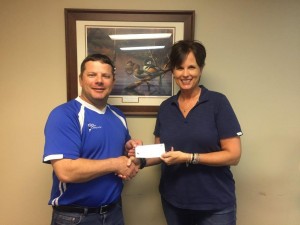
Fritz Baier, Board Member of the Friends of the Outdoor Classroom and Melanie Petty
Petty reminds you, that the Frederickson Fund’s annual golf tournament will be held August 13th, 2016 at Nishna Hills Golf Club. All monies raised are given out through the year to various non profit organizations that meet the fund’s mission statement of giving back to things that Trevor cared about and was a part of. Scholarships for graduating AHS Seniors will be handed out May 11th at their Senior Night.
Trevor lost his life tragically in a house fire on June 18, 2009. The family and community has since given back more than $120,000 to the community that Trevor loved. Petty says they look forward to continuing giving back for many years to come.
Some legislators are balking at the idea of continuing to provide state tax dollars to the World Food Prize Foundation. Representative Larry Sheets, a Republican from Moulton, sits on the subcommittee that drafts the budget where 700-thousand dollars has been tentatively set aside for the World Food Prize. He suggests at least half of that should go to the Iowa Economic Development Authority instead.
“I represent Appanoose County and part of Wapello County and two others,” Sheets says. “Appanoose and Wapello are in dire need of economic development.” The World Food Prize was established in 1986 and is awarded each fall. It has been called the Nobel Prize for those who’re working to end world hunger. Republican Representative Mary Ann Hanusa, of Council Bluffs, isn’t calling for cancelling all state support of the World Food Prize either. But Hanusa says the state’s economic development agency is being asked to cut its budget by 400-thousand dollars — and it may be time to ask the privately-run World Food Prize to do more private fundraising.
“It does seem that for an organization that is well-established world wide and has multiple sources of funding this might be an areas where, perhaps, they could also step up,” Hanusa says. Senator Bill Dotzler, a Democrat from Waterloo, says Republican Governor Terry Branstad and top leaders in the legislature are in favor of giving the World Food Prize about a million dollars.
“Maybe our leadership’s commitment should be readjusted,” Dotzler says. But Dotzler says he’s willing to include money for the World Food Prize in the legislature’s “economic development” budget. Dotzler says otherwise policymakers may dip deeper into the account reserved for constructing and maintaining state-owned buildings. For example, the House voted Monday night to withdraw five-MILLION from that fund for water quality projects.
(Radio Iowa)
The Iowa DNR says it will hold its 2016 spring auction on May 21st, at Pioneer Livestock Pavilion on the Iowa State Fairgrounds, in Des Moines. Doors will open at 6:30 a.m., and the auction will begin at 8-a.m. The public may view the items for sale and pre-register for the auction from 4- to 6-p.m., on May 20th. There will not be any buyer’s premium fee added to the sale. Items up for auction include about 520 firearms, bows, gun barrels, scopes, tree stands and other assorted equipment. The items are sold “as is” with no guarantee or warranty.
Any person interested in purchasing a firearm at the auction must have either a valid Iowa permit to acquire pistols or revolvers, a federal firearms license, or a professional or non-professional permit to carry concealed weapons. The Iowa permit to acquire can be obtained from a sheriff’s office. Allow two to three weeks to receive the permit.
Payment must be made on auction day. All sales are final. All items must be removed from the site within one half hour after the sale completion. The Iowa DNR reserves the right to reject any bids and withdraw any item from the sale at any time.
A sale bill is available online at http://www.iowadnr.gov/Hunting and will be updated if inventory is added. The DNR will not be mailing any sale bills.
You can put them on your pizza, toss them in your salads or fry them in butter and serve as a side dish. For many people, morel mushrooms are some of the tastiest wild foods in Iowa. The season for hunting morels is underway, but Annette Whitrock with the Wapello County Conservation Board says the weather hasn’t cooperated so far this year. “Depending on where you are, it would be late March until I guess the season’s over through April, sometimes into May, just depending on weather,” she says. “You really need temperatures for the soil probably in the 60 degree area and you can’t be down lower than 40 degrees at night for them to grow. We haven’t had that yet.”
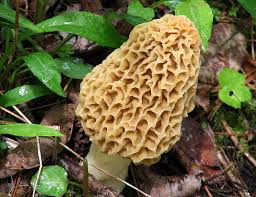
A Morel mushroom (ISU Extension photo)
Soil temperature maps provided by Iowa State University show soil temperatures around 45 degrees for most of Iowa. Overnight temperatures dipping into the 20’s and 30’s are also preventing morels from popping up. Even when they do pop up, morels are some of the most elusive foods to find. Hunting them requires hiking trips through the woods and it takes a sharp eye to spot them. Whitrock says there are some urban legends on the best places to look.
“I’ve been told dead elm trees are the place to look, ash trees, oak trees, old apple orchards or where the May apples are blooming, so it really depends on who you talk to,” Whitrock says. “I think if you find a spot, you find a spot.” Whitrock suggests being wary of all the advice, as people may be trying to drive you away from their best spots. Whitrock says in the early hunting season, morels grow mostly on south facing slopes because that ground is warmer. But be careful, because Whitrock says the inexperienced morel hunter can be fooled or even poisoned.
“There’s some false morels out there and some morel look-alikes that can, depending on how you react to it, I guess they could give you symptoms like cramps,” Whitrock says. “some of them, if you react to them poorly, could kill you.” Whitrock says it’s fairly easy to tell if what you’re looking at is a true morel or an impostor.
“Morels have a darker cap that is pitted, for lack of a better word, and is connected to the stem and I guess the best thing to look for is a hollow stem,” Whitrock says. “If your mushroom doesn’t have a hollow stem, chances are it’s not a true morel — probably don’t want to eat it.”
Whitrock cautions Iowans to make sure they have permission to hunt for morels on property they don’t own. You can find out if you can hunt on public properties by contacting your local conservation board or the Iowa Department of Natural Resources.
(Radio Iowa)


 Facebook
 Twitter
 YouTube
 RSS
RSS