

CLICK HERE for the latest market quotes from the Iowa Agribusiness Network!
CLICK HERE for the latest market quotes from the Brownfield Ag News Network!


CLICK HERE for the latest market quotes from the Iowa Agribusiness Network!
CLICK HERE for the latest market quotes from the Brownfield Ag News Network!
The City of Atlantic’s Community Protection Committee Tuesday evening voted to recommend the Atlantic City Council order a resident who is keeping a pot bellied pig on their rental property, to remove the animal as required by City Code. Their decision came in a brief meeting, during which a neighbor complained about the smell and a terrible problem with flies attracted by the animal.
Rebecca Sponsler, who lives next door to the property in the 800 block of Chestnut Street, told the Committee the animal doesn’t look like a pot bellied pig. Instead, she said it looks a like a farm pig.

Rebecca Sponsler
She said also she has “A huge fly problem,” to the extent that they are “Killing hundreds a day,” at her home. She also said when the wind carries a horrible smell when it shifts toward her home. Sponsler said she doesn’t want it next door to her anymore. Sponsler also said she can’t sell her house because prospective buyers are turned-off by the smell and appearance of the adjacent property.
Atlantic Animal Control Officer Kris Erickson said they have received other complaints about the animal and the property itself. The Committee said the owner of the pig could approach the City Council about a permit to keep the animal, but the Committee will recommend against issuing that permit, per City Code, which states “It is unlawful for a person to keep livestock within the City except by written consent of the Council or except in compliance with the City’s Zoning Ordinances.”
Livestock is defined in the City Code, as “An animal belonging to the bovine, caprine, equine, ovine or porcine species…” as defined in the Code of Iowa.
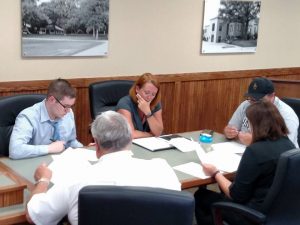
Community Protection Committee (Foreground: Councilpersons Dana Halder and Ashley Hayes); background: City Admin. John Lund, Animal Control Officer Kris Erickson; right – Councilman Chris Jimerson.
The owner of the pig did not appear at Tuesday evening’s meeting at City Hall to offer comment about the animal or address the neighbors’ concerns.
The Iowa Department of Natural Resources reports the DNR plans to begin de-watering Three-Mile Lake in Union County, starting August 29th, in preparation for the fish renovation planned for the third week in September. The fish renovation will eradicate the yellow bass and common carp that have contributed to the declining water quality and sportfish quality in the lake. The DNR will begin restocking this fall after the renovation is complete.
The lake will be lowered up to 17 feet from normal pool for the fish renovation. Users should expect low water levels during the Labor Day holiday weekend. Access to some boat ramps may be limited due to the low water level. Boaters should use extreme caution as potential hazards such as tree stumps, cedar tree brushpiles, and underwater reefs may be at or near the water’s surface.
WATERLOO, Iowa (AP) — John Deere has announced more layoffs at two eastern Iowa plants. Company spokesman Ken Golden said Monday that 115 workers in Waterloo will be laid off effective Sept 23 and 30 in Davenport effective Sept. 30.
UAW Local 838 shop chairman Tim Niedert told the Waterloo-Cedar Falls Courier that the layoffs came as no surprise. On Friday the Moline, Illinois-based company announced its 10th consecutive quarter of year-over-year earnings declines, citing continuing downturns in the agriculture sector.
Golden says about 870 people are working at the Davenport plant and about 2,930 at the Waterloo plant. Those figures don’t reflect the layoffs. He says the Waterloo plant makes larger farm tractors. The Davenport plant makes construction and forestry equipment,
WINTERSET, Iowa (AP) – Authorities have seized 36 head of neglected cattle from a farm near Winterset in Madison County. The cattle were seized Sunday night and taken away for food, water and medical care. Authorities also found cattle carcasses on the property. No arrests have been reported. The Sheriff’s Office says charges are pending.
Kim Weaver, the Democratic candidate in Iowa’s fourth congressional district, says voters shouldn’t believe her opponent, Republican Congressman Steve King, when he says he’d be able to work with Hillary Clinton if she’s elected president. “He’s the least effective member of congress, so he can’t even work with fellow Republicans,” Weaver says. “How’s he going to work with Hillary?”
Weaver made her comments during a speech this weekend on The Des Moines Register’s Soapbox at the Iowa State Fair. Weaver called for a higher minimum wage, help for student debt and immigration reform. Weaver also supporting legalizing industrial hemp as a way to improve water quality. “We’re not talking pot. We’re not talking marijuana. We’re talking industrial hemp,” Weaver said. “Industrial hemp can be planted in marshy areas. It’s very good at mitigating nitrates as well as because of the way the root system it helps avoid soil erosion.”
Weaver says she’s ready to debate King this fall. King is seeking an eighth term in congress and he has not always agreed to debate his Democratic opponents.
(Radio Iowa)
Harrison County Extension & Outreach will be hosting a free, open to the Public Emerald Ash Borer informational meeting on Wednesday August 24th. This event will be held at the Rand Community Senior Center at 100 S 4th St, Missouri Valley, IA. The presentations will start at 6:30 pm with Mike Kintner from the Iowa Department of Agriculture and Land Stewardship talking about hosts, history and current distribution. Followed by Lindsey Barney, area DNR State Forester, speaking on ash tree identification and alternate species to replace the ash tree. Lastly, Dr. Donald Lewis from Iowa State University Extension will speak about Emerald Ash Borer treatment options and if your tree would be a good candidate for treatment. The speakers will be available for questions following the presentations.
The Cass County Soil and Water Conservation District will be accepting application for cover crops till Friday, September 9th, 2016. Cover Crops are used to reduce soil erosion and capture residual nutrients to protect our soil resource and water quality. Producers will be able to sign up for 20 acres maximum at a rate of $20 per acre. Applications will be approved on first come-first serve basis till the funds are exhausted. Producers should stop by the district office located at 503 W. 7th Street, Ste 1, Atlantic, Iowa 50022 to make application.


 Facebook
 Twitter
 YouTube
 RSS
RSS