

CLICK HERE for the latest market quotes from the Iowa Agribusiness Network!
CLICK HERE for the latest market quotes from the Brownfield Ag News Network!


CLICK HERE for the latest market quotes from the Iowa Agribusiness Network!
CLICK HERE for the latest market quotes from the Brownfield Ag News Network!
Shelby County Emergency Management officials today (Thursday), upgraded the County Fire Danger Index to “High.” Precipitation at the start of the week had caused the field and grassland fire danger to be reduced to “Moderate,” but now, with the killing frost and drying conditions increasing rapidly, the potential is increasing for any controlled burns to spread rapidly out of control.
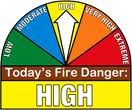 When the Fire Danger rating is “High,” burning of any kind is restricted in Shelby County unless approval is received from local Fire Chief. Controlled burns that are not reported will result in Fire Department being dispatched, and Fires extinguished if determined to be un-safe. Please call 712-755-2124 with questions
Authorities in Iowa today (Thursday) say the Emerald ash borer (EAB), an invasive beetle that attacks and kills ash trees, has been confirmed in Adair and Adams Counties. EAB is now present in 28 states after being discovered in Detroit, Michigan in 2002. EAB is native to Asia. Adair and Adams Counties join the growing list of confirmed counties where EAB has been detected in Iowa. Nine counties have been added to the list this year. Iowa first confirmed the presence of this destructive pest in 2010.
The recent discoveries took place at Lake Orient Recreation Area (Adair County Conservation Board) in Adair County and a rural area north of Cromwell in Adams County.
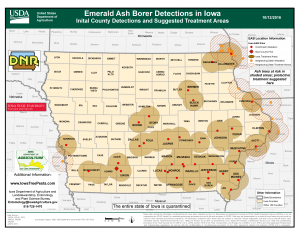
IA EAB Positive sites Oct. 12 2016
Insect larvae were taken from both sites and later positively identified by federal identifiers as EAB. Mike Kintner, Iowa Department of Agriculture and Land Stewardship EAB and gypsy moth coordinator, says “It is particularly difficult to battle an invasive species like emerald ash borer. One thing people can do to help with this effort is avoid transporting firewood.”
The Iowa EAB Team strongly urges Iowans to use locally sourced firewood, burning it in the same county where it was purchased. Firewood is a vehicle for the movement of EAB. The adult beetle also can fly short distances, approximately 2 to 5 miles.
The adult beetle is metallic green and only about one-half inch long. The larval stage of this wood-boring insect tunnels under the bark of ash trees, disrupting the flow of water and nutrients, ultimately causing the tree to die. EAB-infested ash trees display canopy dieback beginning at the top of the tree and progressing downwards, S-shaped feeding galleries under dead or splitting bark, D-shaped exit holes, water sprouts (along the trunk and main branches), and increased woodpecker activity to the bark.
At this calendar date, the window for all preventive treatments has closed. If a landowner is interested in protecting a valuable and healthy ash tree within 15 miles of a known infestation, he or she should have landscape and tree service companies bid on work, review the bids this fall/winter, and treat beginning spring 2017 (early April to mid-May).
The State of Iowa will continue to track the movement of EAB on a county-by-county basis. Before a county can be officially recognized as infested, EAB must be collected by a member of the Iowa EAB Team and verified by USDA entomologists. To learn more about EAB and other pests that are threatening Iowa’s tree population, please visit www.IowaTreePests.com.
CEDAR RAPIDS, Iowa (AP) – A northern Iowa farmer has been given six months in prison for selling corn that was pledged as collateral on federal Farm Service Agency loans of more than $196,000. Fifty-nine-year-old Leroy Jones, of Floyd, was sentenced Wednesday in U.S. District Court in Cedar Rapids. The judge ordered Jones to pay nearly $138,000 in restitution.
Jones pleaded guilty to one count of conversion of property pledged to the agency. Jones admitted during his plea hearing to removing or converting nearly 90,600 bushels of corn that he’d pledged as collateral. Jones said he sold the corn for nearly $333,000 from Dec. 1, 2014, through Sept. 30, 2015.
A Fort Dodge man who is the last of 10 people from Iowa and Nebraska charged in a nine-month poaching investigation by the Iowa Department of Natural Resources has pleaded guilty. Twenty-three-year-old Kyle Alstott of Fort Dodge pleaded guilty to numerous charges. Iowa conservation officer Matt Bruner says the investigation started when he noticed online videos from Fort Dodge-based hunting and filming company A-T-M Outdoors. Bruner recognized Alstott from a previous encounter.
“He’d been charged in the past with a deer-hunting violation and it peaked my interest and we dug into it a little bit deeper,” Bruner says. Alstott co-owns the company with 22-year-old Roman Thompson of Omaha, Nebraska and they had several photos and videos of deer, deer hunts, fishing and other outdoor activities on their website. “We started comparing pictures and stories and hunts with licenses that were issued with the Iowa and some of the surrounding states to match up whether…these hunts had been done legally,” Bruner explains. “We discovered that there were some discrepancies and the fueled our investigation…to get several search warrants for that information.” The search warrants led to the eventual charges.
He says the search open up a treasure trove of other information on illegal hunting activities. Bruner says the investigation led to the 10 people being charged with numerous violations. “Hunting deer, hunting turkeys without valid licenses…or using licenses issued to other hunters who were not there. We had issues of the illegal use of bait to attract the animals in illegally, also using a spotlighting to lure them in at night, using illegal weapons and those types of violations,” Bruner says. He says it appeared they wanted to show the hunts online and sell videos of them.
He says the end goal would have been to sell the videos of the hunt, but they never got that far as things stopped with the investigation. Officers collected phones, computers, video equipment, deer and turkey mounts, meat and equipment used to harvest the game animals when they executed the search warrants. The 10 individuals were charged in December 2015 and plea deals began in January.
Kyle Alstott pleaded guilty to unlawful possession of illegally killed whitetail buck deer, hunting deer with aid of bait, hunting with the aid of artificial light, unlawful use of two-way radio transmitter while hunting, making false claim for hunting license/tag by non-resident, failure to tag harvested deer, failure to report harvested deer, hunting deer without a valid deer tag, taking whitetail buck without a valid tag, unlawful possession of illegally killed whitetail buck deer in 2014 season and unlawful possession of illegally killed wild turkey in 2014 season. He was fined 19-hundred dollars and assessed four-thousand dollars ($4,000) in liquidated damages and restitution.
Roman Thompson pleaded guilty to hunting without a nonresident hunting license and habitat fee, hunting without a nonresident antlered deer tag, unlawful use of another’s deer tag, unlawful use of two-way radio transmitter while hunting, and unlawful possession of illegally killed whitetail buck deer in 2014 season. Thompson was fined 17-hundred-60 dollars and assessed two-thousand dollars ($2,000) in liquidated damages plus 80 hours of community service.
Forty-four-year-old Michael Alstott of Fort Dodge pleaded guilty to making a false report, hunting deer without a valid license or tag, unlawful use of two-way radio transmitter while hunting, unlawful tagging of illegally killed buck deer, unlawful transportation of deer without tag, taking doe deer without valid license or tag, and unlawful use of out of county deer tag. Michael Alstott was fined 15-hundred-57 dollars.
Fifty-three-year-old Randy Vaught of Algona, pleaded guilty to hunting with aid of artificial light, shooting/discharging rifle over highway, and failure to report harvested deer. Vaught was fined 369 dollars and assessed two-thousand dollars ($2,000) in liquidated damages plus 80 hours of community service.
Twenty-year-old Tanner Dawson of Fort Dodge, pleaded guilty to unlawful taking and possession of whitetail doe deer and failure to report harvested deer. Dawson was fined 282 dollars and assessed 15-hundred dollars in liquidated damages. Twenty-two-year-old Mariah Thompson of Omaha, Nebraska pleaded guilty to hunting deer without a valid non-resident license or tag. Mariah Thompson was fined 667 dollars. Forty-four-year-old Matthew Alstott of Fort Dodge, pleaded guilty to aiding and abetting a non-resident taking deer unlawfully and unlawful use of deer tag by another and was fined 390 dollars. Forty-five-year-old Travis Miller of Monroe pleaded guilty to hunting with the aid of artificial light and unlawful transportation of illegally taken deer and was fined 390 dollars. Thirty-one-year-old Brendon Nicholas of Fort Dodge, pleaded guilty to unlawful tagging of whitetail buck deer and failure to report harvested deer and was fined 282 dollars. Thirty-six-year-old Mike Kenyon of Clare, pleaded guilty to failure to report harvested deer and was fined 87 dollars.
Kyle Alstott, Roman Thompson, Michael Alstott, Randy Vaught and Tanner Dawson all face license suspension in Iowa and 44 other states that are part of the wildlife violator compact. Roman and Mariah Thompson are also facing charges in Nebraska.
The Iowa D-N-R worked in conjunction with the Webster County Attorney’s Office, Boone County Attorney’s Office, Nebraska Game and Parks, Kansas Department of Wildlife, Parks and Tourism, South Dakota Game, Fish and Parks, Missouri Department of Conservation, Minnesota Department of Natural Resources, and the U-S Fish and Wildlife Service.
(Radio Iowa)
STORM LAKE, Iowa (AP) — A federal judge has rejected Tyson Foods’ request for a new trial in a case that awarded $5.8 million to thousands of employees at the company’s pork plant in Storm Lake, Iowa. The Sioux City Journal reports that Tyson lawyers filed a brief in June saying a new trial was necessary to address liability and damages issues and ensure workers included in the suit are entitled to a share of the award.
Storm Lake employees sued Tyson in 2007 to collect pay for the time they spent putting on and taking off protective work clothes and equipment before and after their shifts. U.S. District Judge John Jarvey said in his ruling Thursday that the payment method ensures workers not entitled to damages won’t receive a portion of the award.
The Supreme Court upheld the award in March. Tyson spokeswoman Caroline Ahn declined to comment.
DES MOINES, Iowa (AP) — Iowa farmers are a little behind getting corn and soybeans out of fields because rain has caused soft ground and in some cases muddy conditions, slowing their progress. The U.S. Department of Agriculture says in its weekly crop update released Tuesday that 19 percent of the state’s corn is harvested, about three days behind last year and a week behind the five-year average.
Soybean farmers have managed to get 43 percent of the crop harvested, about three days behind last year’s pace. The USDA says 81 percent of corn and soybean crops are rated good to excellent.
The Cass County Conservation Board says it’s time once again for the annual Trumpeter Swan arrival contest. Trumpeter Swans have visited the Schildberg Quarry for, at least, seventeen out of the last eighteen winters. When do you think the first Trumpeter Swan will arrive at the Schildberg Quarry?
You can call in your prediction (by November 11th) to the Conservation Board at 712-769-2372, leave a message and return phone number if they are not in. Duplicate dates will not be allowed. For example, if a caller predicts November 25th, no one else will be allowed to predict that arrival date. So, call anytime until November 11th to make your prediction!
One prediction per family, please. The sponsors of this contest will determine the official arrival of the swans. The winner will receive a Trumpeter Swan 8×10 print from the Cass County Conservation Board. Sorry, this contest is only for residents of Cass County.
*************************
Previous Arrival and departure dates of the swans have been as follows:
1997/1998 December 18 – January 2
1998/1999 Nothing on record
1999/2000 December 25 – February 15
2000/2001 November 23 – March 6
2001/2002 December 25 – February 24
2002/2003 November 23 – March 15
2003/2004 November 26 – March 21
2004/2005 November 25 – March 18
2005/2006 November 17 – March 5
2006/2007 October 30 – March 9
2007/2008 November 22- February 14
2008/2009 November 18- March 12
2009-2010 November 19 – January 5
2010-2011 November 5 – February 10
2011/2012 November 17 – February 21
2012/2013 November 24– March 4
2013/2014 November 12- April 7
2014/2015 November 11- April 6
2015/2016 November 22- March 24


 Facebook
 Twitter
 YouTube
 RSS
RSS