

CLICK HERE for the latest market quotes from the Iowa Agribusiness Network!
CLICK HERE for the latest market quotes from the Brownfield Ag News Network!


CLICK HERE for the latest market quotes from the Iowa Agribusiness Network!
CLICK HERE for the latest market quotes from the Brownfield Ag News Network!
A Guthrie County farmer’s passion for telling the story of Iowa agriculture, and his involvement in the community, has earned him an award and prizes from the Iowa Farm Bureau Federation.
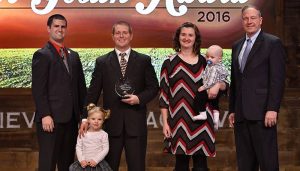
Adam & Mary Ebert and family
Coon Rapids area farmer Adam Ebert was presented with the Bob Joslin Excellence in Agriculture Award during the IFBF’s 98th Annual Meeting in Des Moines this week.
The award, presented by IFBF, honors a young farmer, under 35 years old, who demonstrates outstanding leadership in Farm Bureau, agriculture, and their community. The award is named in recognition of Bob Joslin, IFBF president from 1986-1987, who was well known for his support and encouragement of young farmers.
Six years ago, the Eberts started farming in Guthrie County, where he and his wife Mary grow corn, soybeans, and hay, in addition to raising hogs and cattle. Mary also works for the local ISU Extension.
As the Joslin Award winner, Ebert receives a $1,500 Home and Workshop certificate from John Deere, the award sponsor, a 90-day no-payment and no-interest (NPNI) John Deere Financial Certificate up to $5,000, a $750 FAST STOP gift card from GROWMARK, and expense-paid trips to the 2017 American Farm Bureau Federation (AFBF) Annual Convention in Phoenix, and the 2017 GROWMARK annual meeting in Chicago in August.
Former Iowa Governor Tom Vilsack plans to “run through the tape” when his eight-year tenure as U.S. Secretary of Agriculture draws to a close. Vilsack’s the only member of President Obama’s cabinet who remains in the office where he started in January of 2009. “One of the reasons why I stayed in the job that I stayed in for as long as I did, which is unusual in this day and age, is because of the people I worked with and the people I worked for,” Vilsack says.
Vilsack made two speeches in Des Moines yesterday (Wednesday). He addressed delegates at the Iowa Farm Bureau’s annual convention. Vilsack referred to the 1986 shooting at a city council meeting that killed the mayor and wounded two others. “A tragedy actually almost 30 years to the day in my small hometown of Mount Pleasant created an opportunity for me to get in public service,” Vilsack said. “You all have given me just an incredible opportunity. You’ve allowed me to realize every dream I ever had as a kid. You didn’t have to do that. You didn’t have to give a guy from Pennsylvania the opportunity to be a mayor…to be a state senator. You certainly didn’t have to give me the opportunity to be the govenror of this great state for eight years and because of that I had the opportunity to serve you as the secretary of agriculture for eight years.”
Vilsack also was honored Wednesday by the Des Moines-based World Food Prize. The Norman Borlaug Medallion is awarded to individuals and institutions which cannot win the World Food Prize. Both Vilsack and the U-S-D-A were presented with medallions. Borlaug is the Iowa native who won the Nobel Peace Prize for his pioneering work in plant genetics. Vilsack salutes Borlaug’s vision of “using science in order to improve the lives of all people.”
“Norm was about feeding people. Norm was about helping people,” Vilsack says. “And he never stopped.” Vilsack, who will turn 67 on December 13th, isn’t planning to retire after he leaves the U-S-D-A in January, but Vilsack told reporters yesterday that he has no firm plans yet. “I want to be involved in one way, shape or form of advocating for agriculture, for rural America and I have, obviously, an affinity for young people so it’s an opportunity potentially for Christie and me to team up with some young folks,” Vilsack says.
The Vilsacks have two married sons — one in Iowa, the other in Colorado. The former governor says “family is important” and he and his wife want to “spend time” in both states with their four grandchildren.
(Radio Iowa)
The Cass County Board of Supervisors today (Wednesday) tentatively set next Wednesday, Dec. 14th, at 9-a.m., as the date and time for a Public Hearing on a development proposal for the Elite Octane Ethanol plant in Cass County. The hearing is contingent upon lawyers for both the County and Elite Octane reaching an agreement on the County’s financial obligation to help make the plant possible.
Elite Octane’s Nick Bowden said “Time is of the essence,” in reaching an agreement and getting the plant constructed. He said that’s because they have bids for major pieces of equipment and vendor supplies on hold for twice the length of time they would normally be able to hold those bids viable.
Bowden said also President Elect Donald Trump’s policies may also impact on the amount of construction labor that’s available. He says they need to move forward in the very near future to have certainty on the construction price. Every day that goes by without an agreement, he says results in a risk to both the County and Elite Octane, that they can’t hold the construction budget together.
A question was raised about what happens if the company goes out of business after it’s constructed, and how it would affect the county. Bowden said the company has a huge incentive to continue paying the property taxes. If taxes aren’t paid on a regular home, the County files and lean to take over the property. The same is true for Elite Octane’s 101.6 acres which is which be valued at more than $100-million.
The Supervisors were asked if the County and Elite Octane are close on an agreement. Board Chair Gaylord Schelling said he can’t give a definite answer to that at this time.
Bob Bebeensee and DNR Conservation officer Grant Gelle talk about all things outdoors including the opening of shotgun season for deer.
Podcast: Play in new window | Download (1.2MB)
Subscribe: RSS
The first shotgun deer season opens today (Saturday) with thousands of hunters expected to head out into the woods. D-N-R deer biologist Andrew Norton says it’s important for hunters to make sure they can be seen by others. “The most important thing is obviously trying to cover up with a lot of orange, real solid orange so you are not breaking up your outline,” Norton says. He be sure to review your hunting plan to keep everyone safe.
“Just being really cognizant of where you are shooting. Making sure you are taking a safe, ethical shot at a deer. Just always remembering that a deer is certainly not worth putting someone’s life at risk, so just trying to keep that in mind while you are out there,” Norton says.
Here are some other hunting tips from the D-N-R:
Winter Weather Factors:
Agricultural industry officials in Iowa who are struggling to find workers are being encouraged to reach out to veterans. Lori Culler, founder of the company Ag Hires, says there’s a shortage of farm-related labor across the country and veterans can fill many of those open positions.
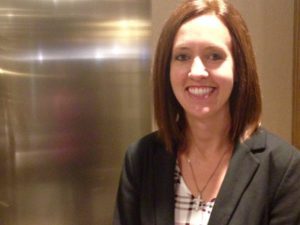
Lori Culler
“We are seeing a huge trend for farms and agribusinesses wanting and looking for military…veterans who have the skills and abilities they’re looking for. There’s a big match here,” Culler said. Veterans who are looking to work in agriculture need to value what they learned during their service, according to Culler.
“I think often, for veterans, maybe they don’t put as much value on what they learned for leadership, communication skills, structure and process. All of those great things about the military are so applicable,” Culler said. Culler encourages employers to have an open mind about applicants who may not have past experience in agriculture but want to be part of the industry.
Culler made her comments this past week at the National Farmer Veteran Coalition Conference in East Lansing, Michigan.
(Reporting by Nicole Heslip, Brownfield Ag News)
Planned improvements to the Union County Fairgrounds, in southwest Iowa, received a big boost this week. Ben Adamson, Vice President of the Union County Fair Board, says the Dekko Foundation has pledged up to half-a-million dollars in support for the construction of two new buildings and other facelifts to fairgrounds in Afton. The money is contingent on a successful fundraising campaign.
“If we’re successful in raising the first $100,000, then they will award us $100,000. Then, we need to raise the remaining funds of about $1 million and they will kick in the remaining $400,000 to finish the project,” Adamson said. The Indiana-based Dekko Foundation was launched in 1981 by Chet Dekko, who made his fortune with a manufacturing business. The foundation has a strong focus around the education of youth and Adamson says one of the biggest reasons for the fairground upgrades is growing participation in the county’s 4-H and FFA programs.
“They liked our proposal, so they’re willing to step up with a pledge,” Adamson said. “Now it’s up to the fair board to go out to the community and raise the funds needed.” The total budget for the entire project is $1,545,000. Adamson is hoping construction will start after the 2017 Union County Fair. Dekko has given the fair board until December 31, 2017 to raise the funds in order to receive the full pledge funding.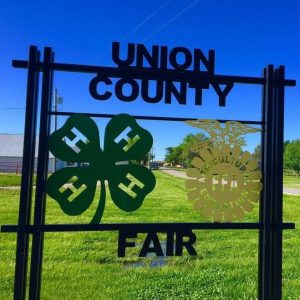
(Radio Iowa)
Iowa waterfowl refuges are closed to all access until the day after duck season closes. This year the duck season closes later than previous years and the later season dates may impact some deer hunters who have hunted the areas in the past.
Iowa is divided into three waterfowl zones – the north zone, south zone and the Missouri River zone. Duck season closes on Dec. 4 in the north zone, Dec. 15 in the south zone, and Dec. 18 in the Missouri River zone.
These waterfowl refuges are always closed to duck and goose hunting but hunters are allowed to hunt non-waterfowl species in waterfowl refuges after the duck season has closed. Hunters with questions should contact their local wildlife biologist or conservation officer.
(IA DNR Press Release)
The Shelby County Emergency Management Agency has discontinued the seasonal field/grassland Fire Danger notices. Local fire departments and businesses with the Fire Danger warning signs may move them in the “Low” category.
Shelby County Emergency Management Coordinator Bob Seivert says thanks those who posted Fire Danger Boards and the media, for emphasizing, the potential fire danger in Shelby County. “Public awareness, reminding citizens of the danger associated with open burning, and the availability of their Local Fire Chief to help them assess, and, plan safe burns” he says, “benefits all of us.”
Seivert says “Twice a week (During the planting and harvest season) we ask our Local Fire Chiefs to move or change the local fire danger boards. These are volunteers, and it shows their dedication, to prevent fires, as well as respond to them.”
The Fire Danger program will resume next Spring.

 Facebook
 Twitter
 YouTube
 RSS
RSS