

CLICK HERE for the latest market quotes from the Iowa Agribusiness Network!
CLICK HERE for the latest market quotes from the Brownfield Ag News Network!


CLICK HERE for the latest market quotes from the Iowa Agribusiness Network!
CLICK HERE for the latest market quotes from the Brownfield Ag News Network!
Iowa Secretary of Agriculture Bill Northey today announced that the Iowa Department of Agriculture and Land Stewardship is accepting applications for grant funding through the Specialty Crop Block Grant program. The grants are available to support projects that enhance the competitiveness of specialty crops grown in Iowa.
The final funding level for the 2017 Iowa Specialty Crop Block Grant Program is yet to be announced by the USDA Agricultural Marketing Service that administer the Specialty Crop Block Grant Program, but is expected to be similar to last years $244,352.23 funding.
“The Specialty Crop Block Grant funds can support food safety, research and marketing efforts that encourage Iowans to choose the products that are produced right here in our state,” Northey said. “Specialty crops are a very important part of Iowa agriculture as they allow farmers to diversify and give customers access to locally grown products.”
Grant funds shall be used for projects that benefit the specialty crop industry as a whole and will not be awarded for projects that directly benefit a particular product or provide a profit to a single organization, institution, or individual.
Iowa agencies, universities, institutions, and producer, industry, and community based organizations are all eligible to apply for funding. In addition, organizations, institutions, and individuals are encouraged to participate as project partners.
Grant awards will be considered up to a maximum of $24,000 and projects can have a duration of up to 30 months (2 ½ years). “Specialty Crops” that are eligible under this program are fruits and vegetables, tree nuts, dried fruits and horticulture and nursery crops, including floriculture. Both fresh and processed specialty crops are eligible.
Proposals must be received by IDALS on or before 4:00 p.m. on Monday, April 3, 2017. For more information visit the IDALS Specialty Crop Block Grant program at the Department’s web site at www.IowaAgriculture.gov/Horticulture_and_FarmersMarkets/specialtyCropGrant.asp.
The Department is also again establishing a Review Committee to help review, evaluate, and make recommendations on grant proposals submitted to the Department. Those interested in participating in the Review Committee should have knowledge of specialty crops, and/or grant writing or grant management experience, and the ability to devote the necessary time to complete the review process. Additional information about reviewer responsibilities, meeting dates and an application form can also be found at www.IowaAgriculture.gov/Horticulture_and_FarmersMarkets/specialtyCropGrant.asp.
Applications to participate in the Reviewer Committee are due Friday, March 17, 2017 by 4 p.m. To ensure that funds are used in the most efficient manner possible, the Department is asking specialty crop stakeholders and organizations to submit public comments on program priorities. The comments will help the Department identify priorities; establish the criteria used to evaluate the projects proposed for funding, and to determine how the reviews are conducted.
Iowans interested in submitting comments about the program can do so online by emailing HorticultureAndFarmersMarkets@IowaAgriculture.gov or by mail to Horticulture and Farmers Market Bureau, Iowa Department of Agriculture and Land Stewardship, 502 East 9th, Des Moines, Iowa, 50319. Comments received by April 3, 2017 will be presented to the review committee to assist in prioritizing projects.
“The Specialty Crop Block Grant program has been a tremendous benefit to Iowa and it is important we understand the priorities of the specialty crop producers as we consider this year’s applications,” Northey said. “The public comments will allow us to hear from all segments of Iowa’s specialty crop industries and give them a means to participate in the decisions surrounding this program.”
(Press Release)
As we get deeper into January, some Iowan’s thoughts are turning to coyotes. Iowa Department of Natural Resources state furbearer biologist Vince Evelsizer says there’s a continual season on coyotes — but these winter days tend to get more hunters seeking the animal. “There’s more focus this time of year because there’s typically snow cover, a lot of the other hunting seasons are closing down after January 10th, and so some of the outdoors folks devote their time and attention to the coyote,” Evelsizer explains.
Another draw is the price paid for the fur of the animals. “Pelt value has remain decent for coyotes,” Evelsizer says, “mostly because of the trim trade where the coyote pelts are utilized in the hood of coats and jackets and that sort of thing.”
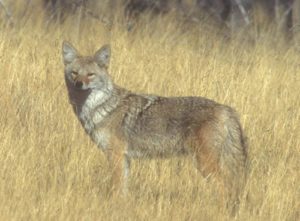
IA DNR photo
He says Iowa pelts can bring between 15 and 25 dollars, depending on their quality. In Iowa you can trap coyotes during the trapping season, or you can hunt them with a gun. Evelsizer says the method used to catch a coyote varies based on personal preference. “Some guys do very well calling in coyotes. Other guys do well working together in groups of hunters and getting them that way. Whereas some trappers do well trapping them, so it just kind of depends,” he says.
Evelsizer says the state population of coyotes has been steady to increasing, with the western and southwestern areas seeing more of the animals than in the eastern part of the state. “For the past couple of years we’ve had record harvests. It varies from year-to-year, but lately it’s been from 12 to 15-thousand coyotes harvested annually,” Evelsizer says.
There are fewer rules in hunting these animals. You can use predator calls, hunt day or night, use high powered rifles, hunt over bait and use groups of hunters and or hounds to round them up. There is no bag limit and coyotes. Evelsizer says the rules are more liberal for hunting coyotes because they are very good at avoiding detection. And they are very resilient in adapting to their habitat.
“Coyotes have the ability to compensate with liter size. Meaning that, in years when their numbers are down, the average litter size is typically higher because there is more food available. It’s sort of their way of rebuilding their numbers,” according to Evelsizer. “In years when coyote numbers are higher, the average liter size may be lower.”
While there are fewer regulations to hunt coyotes — Evelsizer says hunters need to take some precautions. “An adult coyote typically weighs around 35 to 40 pounds — but that can vary a little bit — so they are typically about the size of a dog,” Evelsizer says. “The number one thing for hunters is to be sure of their target so that they don’t mistake it for some sort of hybrid dog, coyote or a wolf for that matter. So, we just encourage hunters be sure of their target.”
He says there has been an increase in the number of reported wolf sightings over the years as they may’ve migrated in from Wisconsin or Minnesota. There have been at least four wolves shot by coyote hunters during the last two years. Wolves are protected in Iowa and there is no open season You can tell the difference between the two, as coyotes have a pointed snout and their ears are larger proportionally to their body. Wolves are taller than coyotes and have long front legs and a heavier, squarer frame. You can find out more about coyote hunting on the D-N-R’s website, http://www.iowadnr.gov/ .
(Radio Iowa)
Are you a farmer or are you involved in the agriculture industry? Are you curious where the ag markets might be headed this year? If yes, plan on attending Iowa State University Extension and Outreach – Shelby County’s Farmer’s Coffee January 31st at 9:30 a.m. ISUEO Farm Management Specialist Shane Ellis will be presenting a market outlook for both crops and livestock. Low commodity prices are impacting both producers and other industries related to agriculture. Knowing what to expect in the near future will help to make good management decisions for the future. 
Please join us at the Shelby County Extension Office 906 6th Street for hot coffee and refreshments, catch up on the latest ag news, bring your questions, and visit with others and Shane about what the new holds for agriculture. There is no cost. This informational meeting is for anyone who is involved in the agriculture industry! Please call the Shelby County Extension and Outreach Office at (712)755-3104 for more information.
There’s growing concern by some in the ag industry that President-elect Donald Trump has not announced his choice for secretary of agriculture. It was a popular subject of conversation at the American Farm Bureau Federation convention that wrapped up Tuesday in Phoenix, Arizona. Iowa Farm Bureau President Craig Hill attended the convention and said most of the names being mentioned for the top post at the USDA are people who are very well qualified
“I’m hoping for a farmer. That would be nice,” Hill said. “But, it kind of looks like Sonny Perdue, the former governor of Georgia…there are some others, but I’ll just look forward to finding out when we can.” Former Iowa Governor Tom Vilsack has served as the U.S. Ag Secretary since January of 2009. He was nominated for the post in mid-December of 2008, shortly after Barack Obama was elected president.
Hill said he would prefer if Vilsack’s replacement was also from the Midwest. “You know, Iowa is a state that became number two in the country in terms of agricultural receipts. We overtook Texas. We may volley back-and-forth over time with that distinction, but agriculture production in the Midwest is strong and it drives our economy. We need representation from the Midwest,” Hill said.
Last week, Agri-Pulse reported Tom Vilsack is expected to take over as CEO of the U.S. Dairy Export Council once he leaves office. However, Vilsack told Brownfield Ag News that he has NOT made final plans for the future and he’s solely focused on his remaining days at USDA.
(Thanks to Ken Anderson, Brownfield Ag News)
Iowa landowners have the opportunity to enroll land in the Continuous Conservation Reserve Program (CRP) into special targeted areas for wildlife. D-N-R wildlife biologist Todd Bogenschutz says more C-R-P land is now eligible for what’s called the State Acres For wildlife Enhancement or SAFE program. “Basically what they’ve done, nationwide there’s two-point-five million acres coming out — some of them are continuous, most of them are general. They made this announcement that they are going to target 700-thousand of those acres toward the state safe practices,” Bogenschutz says. “That was great for Iowa because we have a couple of safe requests in. They basically gave us acres for all three of them.”
He says the SAFE program is designed to help particular species of wildlife. “It’s basically where there’s threatened and endangered species, a species that is declining significantly, or a species that’s economically important. States can come up with a targeted C-R-P practice to address one of those concerns, or any of those concerns,” Bogenschutz says.
He says Iowa has had success with its SAFE programs. “We have a gaining ground SAFE — which is targeted at grassland birds and pollinators — we have a pheasant recovery SAFE, and we just submitted a new quail SAFE — and they gave us additional acres for all three of those,” Bogenschutz says.
He says until the recent announcement they didn’t know if any new C-R-P acres would be allowed to go into the program. “Because we were at the cap people weren’t sure what was going to happen this coming year. If they were just going to have another sign up. SAFE’s been popular, but we can’t put any more in because the acres are all gone,” Bogenschutz says. “Now with this announcement people have an opportunity to get into SAFE. If you ‘ve got a contract that is expiring this year, you can re-enroll in that, which is going to probably make it better habitat than it was.”
The sign up is underway and Bogenschutz urges you to not delay in getting signed up. “Many people are expecting that these acres could be gone within a couple of weeks. There’s a lot of interest in C-R-P, a lot of people want to be in C-R-P and they can’t now that they’ve lowered the cap. So we expect it’s going to be very competitive, so if folks are interested in C-R-P I recommend they get right into their local U-S-D-A office, or contact one of our private land staff to get more info,” according to Bogenschutz.
The Iowa D-N-R has created a web page for landowners to learn more about federal and state programs available to them. The web page includes a list of D-N-R staff who are experts at connecting landowners with programs and writing land management plans that benefit the landowner, wildlife and improve water quality. There is also a link to F-S-A where landowners can find information about their local F-S-A office. The landowner assistance webpage is at www.iowadnr.gov/crp.
(Radio Iowa)
Cass County Auditor Dale Sunderman reports a Public Hearing will be held next week on the designation of a 2017 Cass County Agribusiness Urban Renewal Area, and on a proposed Urban Renewal Plan and Projects. The Hearing will be held Jan. 18th at 8:45-a.m., at the Cass County Courthouse.
The hearing is on the question of designating as the 2017 Cass County Agribusiness Urban Renewal Area (the “Urban Renewal Area”), pursuant to Chapter 403, Code of Iowa, the property situated in Cass County, Iowa described as follows:
Certain real property situated in Cass County, Iowa bearing the following Cass County Property Tax Parcel Identification Numbers as of January 1, 2017:
(A More detailed description of the parcels is available from the Cass County Auditor’s Office) The subject matter of the public hearing will also include a proposed urban renewal plan (the “Plan”) and project for the Urban Renewal Area identified above, pursuant to Chapter 403, Code of Iowa, a copy of which plan is on file for public inspection in the office of the County Auditor.
The general scope of the proposed Plan, as more specifically described therein, includes the following:
At the hearing any interested person may file written objections or comments and may be heard orally with respect to the subject matter of the hearing.
OMAHA, Neb. (AP) – Officials in Omaha and Council Bluffs, Iowa, are taking different approaches toward handling an expected infestation of an ash tree-killing insect. The Omaha World-Herald reports Omaha plans to treat up to 5,000 of its 11,000 ash trees and to remove the rest.
In Council Bluffs, officials plant to treat most of the 1,260 ash trees on city property, then evaluate the situation in 10 years. Crews removed 30 unhealthy trees last year and treated 200 trees. Workers will treat about 1,000 trees this spring.
At the University of Nebraska-Lincoln, workers will treat about 10 percent of the 368 ash trees on campus. Officials must take action because of the emerald ash borer. Since being found in 2002 in Michigan, the insect has killed millions of trees across the country.
The Iowa Corn Promotion Board is releasing a series of videos touting the state’s top crop featuring an actor known as the Iowa Nice Guy. Board president Larry Klever, of Audubon, says the videos are being posted on the Iowa Corn YouTube website. “We’re always looking for new ways to get our message out and we decided to team up with Scott Siepker and use his fun and energetic way of telling stories to help us out.”
Siepker made a name for himself several years ago with his snarky videos promoting the state of Iowa and catapulted onto national sports T-V programs with further commentary. Klever says the new videos will educate consumers about the different ways corn is used, from food to fuel. “We talk about what is E-15 and high-fructose corn syrup, how it’s similar to cane sugar,” Klever says. “Also, your lawns versus our fields, water quality and sweet corn versus field corn.”
There are five videos produced in the series so far. If they’re a success, Klever says there will be more coming.
(Radio Iowa)


 Facebook
 Twitter
 YouTube
 RSS
RSS