

CLICK HERE for the latest market quotes from the Iowa Agribusiness Network!
CLICK HERE for the latest market quotes from the Brownfield Ag News Network!


CLICK HERE for the latest market quotes from the Iowa Agribusiness Network!
CLICK HERE for the latest market quotes from the Brownfield Ag News Network!
DES MOINES, Iowa (AP) — Sen. Charles Grassley of Iowa, a leading supporter of corn-based ethanol, says he’ll call for Environmental Protection Agency Administrator Scott Pruitt’s resignation if Pruitt doesn’t work to fulfill federal ethanol mandates. Grassley is showing frustration with Pruitt’s lack of action to uphold the Renewable Fuel Standards law. On a conference call with agriculture reporters Tuesday Grassley said Pruitt had better follow through with ethanol mandates or “I’m going to be calling for Pruitt to resign because I’m done playing around with this.”
Grassley says President Donald Trump has committed to upholding 15 billion gallons of ethanol to be mixed into the nation’s fuel supply but Pruitt has been allowing refineries to evade some of that commitment by issuing waivers. Grassley says that has reduced ethanol content to 13.8 billion gallons.
Some Iowa farmers are making good planting progress — while others continue to be hampered by wet conditions. The latest U-S-D-A crop report shows corn planting has advanced from 40 to 65 percent complete in the last week. The soybean planting doubled from 11 percent to 22 percent. The report says northwest and north-central Iowa continue to be plagued by wet conditions — with just 26 percent of the corn in the ground in north-central Iowa and only three percent of the soybeans. While in the southeast part of the state the corn planting is close to being wrapped up, with 91 percent in the ground and the beans at 65 percent.
(Radio Iowa)
A man from Adams County is running in the June Primary for Iowa Secretary of Agriculture. Ray Gaesser, a Republican from Corning, announced his intentions to run back in January. Since then, he’s gathered more than the required number of signatures to be placed on the ballot, along with current Iowa Republican Ag Secretary Mike Naig, three other Republicans, and one Democrat. Gaesser stopped by the KJAN studios this (Tuesday) morning, to explain what separates him from his fellow Republicans. He says he’s a life-long farmer. The sole income for himself and his wife comes from agriculture. They’ve been farming near Corning for about 40-years. He says he’s done a lot of work over the years developing policy for agriculture and Iowa agriculture, along with developing, opening and creating markets around the world and much more, all as a volunteer, not a professional politician.
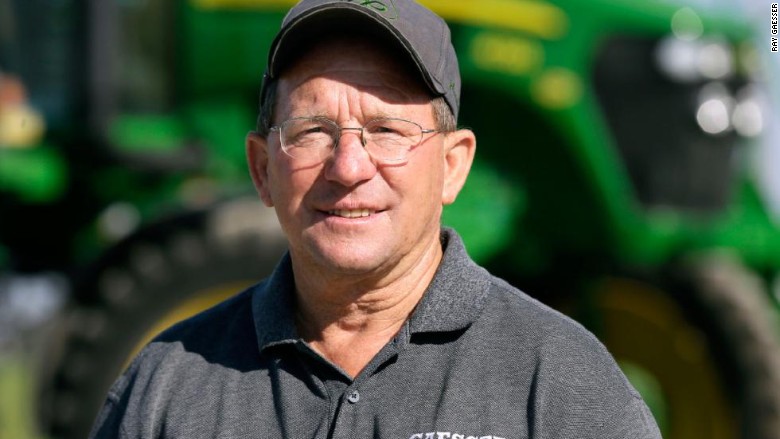
Ray Gaesser
Before he farmed in Iowa, he worked on his parents’ farm in Indiana, along with his mom and younger siblings. He says he learned a lot about farming and personal responsibility after his father passed, when Gaesser was 15. He says the Sec. Of Agriculture needs to be personally responsible and lead by example, something he’s done his whole life. Gaesser was asked about activists calls for a ban on factory farms. He says “animal agriculture is an important way for Iowa to increase value in everything that we grow. It’s also a great opportunity for young people to get into agriculture. He says it’s a serious investment.
He says it bothers him when people talk about CAFO’s – factory farms – because in most Iowa cases, a factory farm is really a family farm that hasn’t told their story, because it is the family members [who] are caring for [the animals]. That’s how their family makes a living, and maybe allowing the next generation to come into the farm, which is all important to the future of Iowa. He believes it’s an investment in Iowa’s future. He acknowledges that we can do better and are using more technology to reduce the smell and apply animal nutrients at the right place, time and position.
Gaesser says agriculture is the circle of life, with just about everything created being recycled and used in many ways. He said there are ways using technology, of helping to prevent nutrient run-off into the waterways, which is a big concern for cities tapping rivers for their drinking water.
Ray Gaesser asks for your vote June 5th, because of his experience in trade, farm policy and actual hands-on farming.
(Learn more at www.gaesserforiowa.com)
A coalition of state and national groups are calling for a ban on so-called “factory farming” in the United States. Adam Mason of Iowa Citizens for Community Improvement says large-scale livestock confinements have “decimated” family farms. “Thinking back to the late ’70s, there were over 80,000 family farm operations raising livestock across this state. Today, we have 10,000 factory farms,” Mason said. “That ain’t right.”
Bill Stowe is C-E-O and general manager of the Des Moines Water Works, which is among the 100 largest water utilities in the country. “At Des Moines Water Works, our mission is to provide safe, affordable, abundant drinking water for half a million Iowans,” Stowe says. “It’s a job that becomes increasingly difficult, unfortunately, because Iowa’s surface waters are filthy.”
The Raccoon River has pollution levels today that exceed federal standards, requiring additional and expensive treatment before it can be used as drinking water. Stowe says there’s “no question” what he calls “industrial farming” upstream is contributing to the pollution. “With bacteria, with soils, with chemicals and a growing concern for us is blue green algae and cyanotoxins,” Stowe said.
Stowe and the others who spoke at a midday news conference would like city and county officials to have the authority to regulate farming operations. Stowe says corporate interests ruined states like West Virginia and Iowa should take a different path.”We are not going to find ourselves left in a bone pile, a remanent of a failed industrial system like coal mining, because industrial farming and dirty agriculture is heading us on that same path,” Stowe said.
A national group called “Food and Water Watch” has released a report critical of the impact “massive amounts of manure” from livestock operations are having on the environment.of so-called factory farms. A spokesman for the Iowa Pork Producers Association says any moratorium on the pork industry “would greatly stifle rural Iowa economic activity” and limit entry into farming for the next generation. The pork association’s spokesman says modern Iowa pig barns “are designed to contain all manure” and “protect water quality.” He also noted there already are more than 200 pages of state regulations for the pork industry.
(Radio Iowa)
Officials with the Iowa Corn Growers Association said Friday, that the Harrison/Crawford County Corn Growers Association will host an Iowa Secretary of Agriculture Candidate Forum on May 23, from 7until 9-p.m., at the Boulders Conference Center at 2507 Boulder Drive, in Denison. The event will provide a special opportunity for a question and answer panel discussion with all six of the candidates vying for the Iowa Secretary of Agriculture position.
Those six candidates in alphabetical order include:
The discussion will be moderated by veteran Farm Broadcaster and former Iowa Corn District 4 Field Manager Bruce Gaarder. Th candidate forum is free and open to the public. It will provide a unique opportunity for the citizens of West Central Iowa to hear from all six candidates in one location, helping them decide who to vote for in the upcoming primary on June 5 and ultimately the general election this coming November.
East Pottawattamie sixth grade youth and home schooled youth, were invited to participate in the fourth annual Farm Safety Day, on May 8. The event was sponsored by East Pottawattamie Farm Bureau, East Pottawattamie Soil and Water Conservation, and East Pottawattamie 4-H, with donations, and presentations from area businesses. The event featured twelve Farm Safety learning stations including Animal Safety by Perdue Farms, Emergency Weather Safety by Pottawattamie County EMT Crew, Grain Safety Tug of War by Riverside FFA, Emergency Rescue Safety by Carson Fire Rescue Team, ATV Safety by AHSTW FFA, Hearing Safety by UNMC Education Team, Basic First Aid by Visiting Nurses Association, Power Take Off Safety by Avoca Titan Machinery and Colin Applegate, Electrical Safety by Nishnabotna Valley REC, Fire Extinguisher Safety by Horizon Equipment, Sun and Skin Safety by CHI Cancer Education, and Chemical Safety by Heartland Coop. The learning stations were hands-on, interactive, and full of information to make a lasting impression.
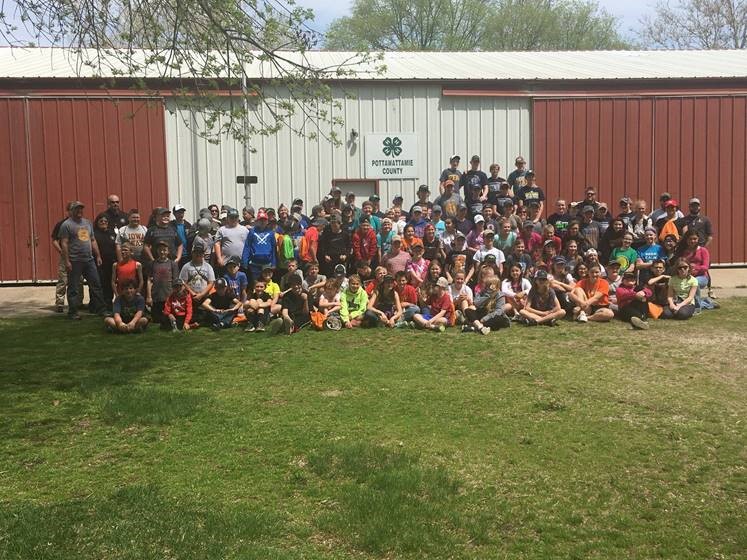
2018 Farm Safety Day
The event focused on sixth grade youth, because at this age many become more responsible on the family farm. Presenters also feel it is important to teach safety to those not living on the farm, as they visit family and friends and need to learn to recognize the dangers present. Many general topics were covered that kids can use every day. Lunch was provided to the youth and volunteers through many local donations. Participants took home a farm hat donated by area businesses that they got to wear for the event in addition to a draw string bag donated by UNMC Education Team. Special appreciation goes out to AHSTW FFA and Riverside FFA for providing leadership to our youth groups throughout the day.
“The impact of this great event shows the desire for a community to support its kids,” said Jamie Meek, East Pottawattamie Soil & Water Conservation Educator. “The willingness for individuals and businesses to give their time, dollar, and knowledge to our youth is what makes an event like this, not only successful, but outstanding.”
(From the East Pott. County Extension Office)
The Shelby County Emergency Management Agency reports the Local Fire Danger index will remain Moderate, through Monday. Officials say with the incoming rain, they expect to discontinue the Spring Fire Danger posting next week, due to increased green up, and more moisture predicted.


 Facebook
 Twitter
 YouTube
 RSS
RSS