

CLICK HERE for the latest market quotes from the Iowa Agribusiness Network!
CLICK HERE for the latest market quotes from the Brownfield Ag News Network!


CLICK HERE for the latest market quotes from the Iowa Agribusiness Network!
CLICK HERE for the latest market quotes from the Brownfield Ag News Network!
(Radio Iowa) — The cost Iowans pay for an annual hunting or fishing license would rise from $17 to $20 under a proposal from the Iowa Department of Natural Resources. Joe Larscheid, chief of the Iowa DNR’s Fisheries Bureau, believes the fee increases are long overdue.
“It’s been 14 years for most licenses and some licenses, it’s been over 20 years since they’ve been raised,” Larscheid said. Revenue from the sale of hunting and fishing licenses is deposited into the Fish and Wildlife Trust Fund, which receives no tax payer money from the state general fund. This would be the first increase in the price of a hunting license since 2002 and the first increase of a fishing license since 2004.
“Really, the modest increase we’re talking about – which is about a 17-percent increase – doesn’t even keep up with the cost of inflation since the last time the fees were raised,” Larscheid said. “What we’re going to be able to do with this increase is keep the programs we have going now and hopefully add back some programs that were reduced or actually cut in recent years.” According to Larscheid, even with the proposed increase, Iowa’s hunting and fishing license fees would remain lower than most other Midwest states.
“With the caveat that some states, such as Missouri and Minnesota, receive a lot of general funding from different initiatives that have passed over the years and not just license revenues that run the state’s trust fund programs,” Larscheid said. Until recently, hunting and fishing license fees were controlled by state lawmakers. The Iowa Legislature and Governor Reynolds approved a bill last year that shifted the authority to the Iowa DNR and the Natural Resource Commission.
“It puts it on us, the DNR and the Natural Resource Commission, to adjust the fees more often – hopefully – than in the past,” Larscheid said. “So, instead of going for a 17-percent or 30-percent increase, maybe a two-to-five-percent increase every couple of years, which I think would be more acceptable to most people – because people understand, you know, inflation happens.”
Full details on the proposed license fee increases are on the DNR’s website ( www.iowadnr.gov/hunting ) and Iowans can provide feedback either online or at “listening sessions” scheduled for August 21 from Noon until 2-p.m. One of the sessions is in Lewis.
Harlan, Iowa – Four Shelby County residents have been appointed to the Iowa State University Extension and Outreach council nominating committee. The committee is charged with nominating candidates for the five vacancies on the council before Aug. 29, 2018. Committee members selected to nominate extension council candidates for the 2018 election are Darren Goshorn, Cindy Hanson, Klare Veath and Joel Wahling.
By law, the nominating committee must include two women and two men and cannot include any current member of the council. The committee is required to take county geography into consideration when nominating candidates. Terry Maloy, director for the Iowa Extension Council Association said “Serving as an extension council member is one way to give back to your community. If you believe local educational opportunities are vital to the community’s well-being, then you should consider running for council. It is rewarding to know that people are able to improve their lives, farms, businesses and communities because of ISU Extension and Outreach’s education and information.”
Candidates nominated by the committee must submit petitions containing the names of 25 qualified voters to the county election commissioner by 5 p.m. on Aug. 29, 2018. Additionally, individuals may petition to have their names placed on the ballot through a self-nominating process by submitting petitions with 25 names to the election commissioner. Petition forms are available from the election commissioner and at the county extension office.
Voters will cast ballots for the nominees in the Nov. 6, 2018, general election. Successful candidates will serve four-year terms beginning in January 2019.
DES MOINES – Iowa Secretary of Agriculture Mike Naig today encouraged Iowans to take advantage of fresh fruits and vegetables available at the more than 200 farmers markets in Iowa as part of National Farmers Market Week, which runs from Aug. 5 to 11. “Farmers markets are a great place to find Iowa grown fruits, vegetables, meats and other products,” Naig said. “This is the time of year when our markets are packed with fresh, delicious, local foods. I encourage everyone to participate in National Farmers Market Week by visiting one of the markets in our state and supporting the farmers who are there.”
Donna Brahms, President of the Iowa Farmers Market Association also encourages everyone to visit their local farmers markets. “Iowa’s farmers markets continue to have great success, and many local markets are holding special events during National Farmers Market Week. The Iowa Farmers Market Association encourages everyone to visit and shop their local farmers markets,” she said. As part of National Farmers Market Week, Naig highlighted the WIC Farmers Market Nutrition and Senior Farmers Market Nutrition Programs. These programs provide eligible low-income seniors as well as women and children in Iowa with checks that can be redeemed for fresh, locally grown produce at authorized farmers markets and farm stands from June 1 through October 31, 2018.
The Iowa Department of Agriculture and Land Stewardship administers the programs in partnership with the Iowa Department of Public Health and Iowa Department on Aging. For more information contact Stephanie Groom, Program Administrator, at 515-725-1179 or at Stephanie.Groom@IowaAgriculture.gov. Naig also encouraged Iowans to take advantage of the Department’s online Iowa Farmers Market Directory and Iowa Farmstand Directory. Both directories provide detailed information on market and farmstand locations, dates and hours open, links to websites, and details on FMNP check acceptance. The directories can be found here.
General questions on farmers markets and farmstands can be directed to the State Horticulturist, Paul Ovrom at paul.ovrom@iowaagriculture.gov or 515-242-6239.
DES MOINES – Mile-a-minute weed, an invasive weed from eastern Asia has been found for the first time in Iowa. Prior to this, mile-a-minute weed was known to be in the mid-Atlantic states, but only as far west as Indiana and Kentucky, and an outlier in Oregon. A concerned landowner in Marion County requested identification assistance with a vine that was growing on the edge of a wooded area surrounding his well-kept garden. Representatives from the Iowa Department of Agriculture and Land Stewardship and Iowa State University Extension and Outreach visited the site. ISU weed scientist, Bob Hartzler, and a field agronomist identified the plant as mile-a-minute weed (Persicaria perfoliata).
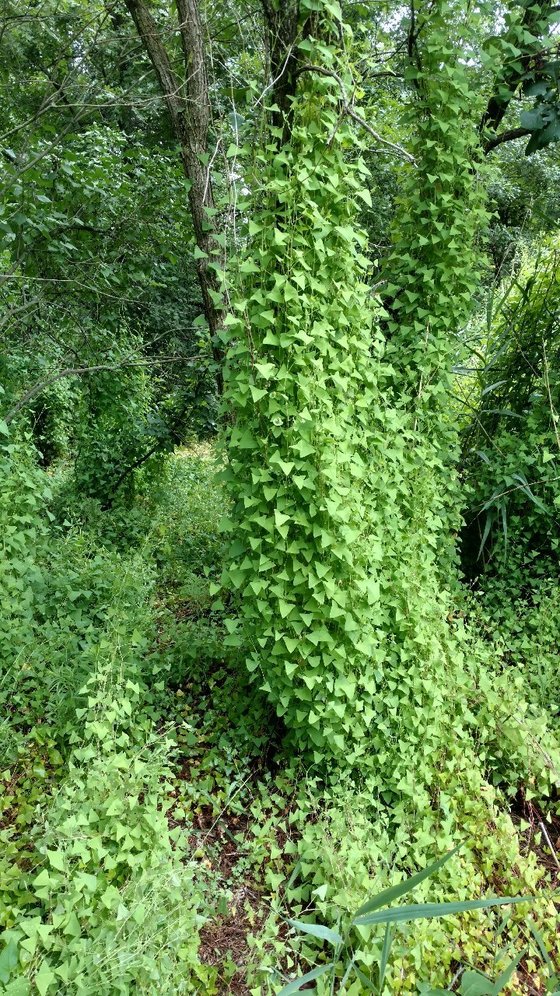 It is unknown how widespread this invasive vine may be across the state. Iowans who think they have an infestation are encouraged to contact Bob Hartlzer at ISU at hartzler@iastate.edu or 515-294-1164, or Lane Kozel, deputy weed commissioner for the Iowa Department of Agriculture and Land Stewardship, at Lane.Kozel@IowaAgriculture.gov or 515-725-1468 for assistance with identification. Mile-a-minute weed is an invasive species in the Polygonaceae (smartweed) family. It is a herbaceous annual vine that can grow up to 20 feet long; has light green, triangular leaves; many sharp, downward curving spines on the stem, petiole and main leaf veins; a saucer-shaped sheath (ochrea) that encircles the stem at the nodes; and round, iridescent blue fruit about 0.25 inches in diameter borne mid-July until frost.
“Although this was my first encounter with mile-a-minute weed, it was easy to see why the plant is considered a threat,” according to Bob Hartzler. “This infestation was less than a quarter acre in size, but it was crowding out existing vegetation. The weight of the plant was pulling down a stand of miscanthus, a species known for establishing monocultures.” Mile-a-minute weed grows best in moist, sunny locations with an abundance of plant material such as leaves, duff, or brush on the soil.
Seed can be spread birds, rodents, and humans. Seeds can also move with water, especially from infestations along a stream. Human-assisted movement can deliver seeds to new sites with alarming speed. Movement of soil containing seeds via potted plants or equipment with soil attached is common in infested states. There is no easy method for eradicating invasive species, and mile-a-minute weed is no different. It appears this infestation had been present for at least five years, thus there will be a large seedbank present. Studies have shown seed can survive for at least eight years, and management will take a long-term commitment.
Herbicides can be effective, but multiple applications will likely be necessary during the growing season. Nonselective herbicides will damage other plants in the area, opening the site up for invasion of other weeds or new flushes of mile-a-minute weed. The plant has a small root system, so hand pulling is a relatively easy (gloves are recommended due to the spines) and effective way to remove plants. The Forest Service has worked on the biocontrol of mile-a-minute weed since 1996. Iowa officials are now investigating the potential for using a weevil that is host-specific to the invasive vine. The weevil has been released in other states since 2004, with success tied to weather conditions. “We are looking into the details associated with possible weevil releases to help control mile-a-minute weed,” said Kozel.
(Radio Iowa) — A delegation of Iowa Soybean Association members spoke with reporters from Europe Wednesday, where they are on a trade mission to sell more of their product. The trip includes stops in Ireland (Dublin and Belfast), Denmark, Hungary and Austria. I-S-A president Bill Shipley of Nodaway, says talks have been positive — but they haven’t talked about numbers. “They would like to increase their inputs from the United States — but nothing specific,” Shipley says.
Dave Walton of Wilton says recent talks between the administration and the European Union have helped with the discussion of soybeans. “I think the sense that we’ve gotten from this side is that trade has always been open. They have sourced South American beans in the past and now it makes more economic sense to bring them in from the United States,” Walton says. “The agreement to continue to talk about some of the trade issues bewteen the E-U and the U-S has kind of eased some of those trade issues. I think in general we are going to see more trade between the U-S and E-U.”
The delegation was asked if they think the E-U can make up the deficit if the trade war with China continues. Grant Kimberly says there is good demand worldwide for soybeans — and that will help. “China of course is by far and away the largest buyer, and its hard to completely offset all that if we were to need to offset a majority of that,” Kimberly says. “So, I guess time will tell. It’s just too early in the process to see where this will all go.”
They were asked if there was any talk of the administration’s actions on trade. Shipley says he was surprised that it wasn’t a big point of discussion. “There’s a few comments made which we all expected that. We expected a lot worse if you want to know the truth,” Shipley says.
He says things have gone pretty well as they have talked about the basics of getting more soybeans into the European market. The delegation met with representatives of the Irish Grain & Feed Association, Northern Ireland Grain Trade Association, Denmark Ministry of Foreign Affairs, Danish Agriculture & Food Council, Budapest Ministry of Agriculture Department and International Relations, Hungarian Grain and Feed Association, as well as several farm visits across the countries.
DENVER (AP) — A recently released undercover video showing pigs being abused at a supplier to the world’s largest meat producer also highlights practices that are still common but slowly being changed in the pork industry.
The video shows pregnant female pigs confined to metal cages barely bigger than their bodies and piglets squealing while being castrated. Los Angeles-based Mercy for Animals released it in the hopes pushing Brazilian-based JBS to prohibit the practices.
Ten states have passed laws that either ban the use of or phase out the use of gestation crates or stalls, which are used on estimated 75 percent of pig farms in the United States. Among them is California, where voters this fall will be asked to ban the sale of pork from pigs confined to the crates or their offspring. Massachusetts voters passed a similar ban in 2016 that will take effect in 2022.
Gestation stalls are intended to minimize fighting among hierarchical sows and protect workers from the pregnant animals, which can weigh between 350 and 450 pounds, according to Sarah Crawford, assistant vice president of animal welfare for the National Pork Board in Des Moines, Iowa. She said the stalls are long enough for the animals to lie in, and research has shown some will choose a stall over living in a group. “The good thing is farmers have the choice to decide what fits best for their farm,” she said.
Temple Grandin, an animal science professor at Colorado State University and consultant on livestock treatment, said confined pregnant pigs lack the space to turn around, and compared the experience to humans having to spend their lives in an airline seat.
LIME SPRINGS, Iowa (AP) — Some northern Iowa residents have banded together to fight what they call pollution of their water and air after several failed attempts to thwart the rise of hog confinements. The Waterloo-Cedar Falls Courier reports that the Northeast Iowans for Clean Air and Water has organized an agreement with Howard County residents to form a covenant not allowing manure to be placed on their land. Manure becomes more toxic with a large number of hog confinements.
The covenant is comprised of about 43 families, with 63 separate properties between four townships. The properties together span more than 5,500 acres. The Iowa State University College of Veterinary Medicine says swine manure can generate toxic chemicals, including ammonia, hydrogen sulfide, carbon monoxide, carbon dioxide and methane.
Wind energy projects do -not- lower surrounding property values, according to a study being released by the Center for Rural Affairs. Center policy associate Lu Nelsen says opponents of wind power development who speak out at public meetings typically make the claim, but there’s no evidence to support it. “There’s a lot of questions about, ‘What could this do to my property values?’ and how should that affect citing requirements,” Nelsen says. “At least if we look at some of the research that’s been done on this issue, there’s no clear link between any harm to property values and wind energy systems.”
Iowa is one of the nation’s leading states for wind power generation, with more than one-third of our electricity coming from the wind. Iowa’s goal is 40-percent by 2020. Nelsen says other types of development often -do- have a negative impact on land values. “It’s less from the actual wind turbine itself, it could be from other what are called disamenities,” Nelsen says. “That could be anything from if an area isn’t restored properly from construction, it could be from something entirely unrelated to a wind farm, a confined animal feeding operation or a wastewater treatment plant.”
Nelsen says local officials and wind power developers need to be clear about what will happen with any new project, especially in regard to the land’s appearance post-construction. “Making sure you control for things like damages to roads,” Nelsen says, “to make sure there is actual restoration after construction of an area so it isn’t torn up or it doesn’t look the way it would’ve looked if there had been no construction.”
The wind industry employs some 7,000 Iowans. The study was conducted by the Lawrence Berkeley National Lab and the Universities of Rhode Island and Connecticut. The Center for Rural Affairs is based in Lyons, Nebraska.
The Annual Local Food and Farm Celebration will be held Saturday and Sunday August 4 & 5th at farms near Atlantic and Elk Horn. The event is being held for the third year for local communities to experience the diversity of agriculture in the region. It offers a chance to experience the farms, meet the farmers and allow the kids to get up close and personal with soil, veggies and animals.
You are welcome to bring your family and friends to visit farms north and west of Atlantic. Farms include organic and conventional practices including vegetable fields, fruit trees, and row crops. The tour also includes beekeeping and livestock. The event is free!
Visit the farms between 1:00pm and 5:00pm. Each of the farms will offer guided tours at 1:00, 2:00, 3:00, and 4:00, but come any time. Produce or other goods may be available for purchase. Displays and food-related activities may be part of the respective open house events. If you’re curious about your food or just looking for a fun family outing, you are invited to the third annual Local Food and Farming Celebration, August 4 & 5th, 1 PM-5 PM.
Farms participating include:
Alan and Linda Robinson – featuring Beef
Harrisdale Farmstead – Fruit, vegetable and permaculture practices
Rolling Acres Farm – Community Supported Agriculture (CSA), organic vegetable, greenhouse and high tunnel production
Pace Poultry and Produce – Vegetables and poultry
Kevin Petersen – Organic Row Crop
Danish Countryside Wines and Vines – Grape production and wine fermentation
Brun Ko Farm – Pastured beef and pork production
Exhibits include:
DezaRae Farms – Goat milk products and goats
Natural Resource Conservation Service – Soil Health
Smith Generation Farms – Cover crops
Wallace Foundation
The farms are located between Atlantic & Elk Horn, along Hwy 173 & Littlefield Drive. Look for a map in the event photos and, on August 4th & 5th, look for signs along the Highway.

 Facebook
 Twitter
 YouTube
 RSS
RSS