

CLICK HERE for the latest market quotes from the Iowa Agribusiness Network!
CLICK HERE for the latest market quotes from the Brownfield Ag News Network!


CLICK HERE for the latest market quotes from the Iowa Agribusiness Network!
CLICK HERE for the latest market quotes from the Brownfield Ag News Network!
ESTHERVILLE, Iowa (AP) — Eight northwest Iowa families are fighting a company they blame for not doing enough to address the smell of dead, rotting hogs from a nearby rendering plant. The Des Moines Register reports that an attorney for the Estherville families filed a motion this week pushing for Emmet County leaders to take stronger action against Central Bi-Products, a Minnesota-based company.
The families say the county isn’t doing enough to ensure the problem gets fixed after three years of “extremely noxious, highly objectionable odors.”
The families’ attorney filed a motion to intervene in an Emmet County petition that seeks $4,750 from Farmers Union Industries, the parent of Central Bi-Products, for violating its conditional-use permit. The plant’s owner has said it’s making improvements that should reduce the odor.
(Radio Iowa) — A top U-S-D-A official suggests President Trump will have to referee a dispute within his administration about federal payments to partially cover farm losses due to the trade war. U-S Deputy Secretary of Agriculture Stephen Censky was in Iowa yesterday (Thursday), meeting with commodity group representatives. A SECOND round of direct payments to farmers was discussed. “We have been having a little bit of a disagreement with a few others, our budget office within the government — our Office of Management and the Budget,” he said. “Of course, their job is to control spending and to say, ‘No.’ We’re saying that the need is there. The circumstances haven’t changed and so Secretary Perdue plans on visiting and taking the issue to the president.”
This summer, the Trump Administration announced 12 billion dollars in federal aid would compensate farmers who Censky says have been “at the tip of the spear” when it comes to retaliatory tariffs. This fall, four-point-seven billion dollars’ worth of checks were sent to eligible farmers who had completed their harvest. Censky says trade disputes are still causing financial harm on the farm and it’s time to release another six BILLION in payments. “We know that farmers are going to be starting to visit with their bankers to talk about financing for next year coming up either now or right after the first of the year,” Censky said, “and so the time is now to make that announcement and get those payments made.”
China purchased a million ton of U.S. soybeans this week, but Censky is making it clear the U-S-D-A does not consider that the end of trade woes for farmers. “That’s a drop in the bucket compared to the 30 to 35 tons that we regularly export to them and so even if we see some very much robust purchases well beyond the million tons, farmers have still been impacted,” Censky says. Censky grew up on a corn and soybean farm in Minnesota and served two decades as C-E-O of the American Soybean Association. He delivered the keynote address Thursday, at the Iowa Soybean Association’s annual policy conference.
(Radio Iowa) — The new Iowa State University Land Value Survey released today (Wednesday) shows a small drop in land values. Iowa State University economist Wendong Zhang says values dropped just under one percent (.08). He says that puts the average values of an acre of land in the state at to seven-thousand-264 dollars. That’s 62 dollars an acre less than last year’s survey. Zhang says farmland prices peaked in 2013 at a just above 87-hundred dollars an acre ($8.716).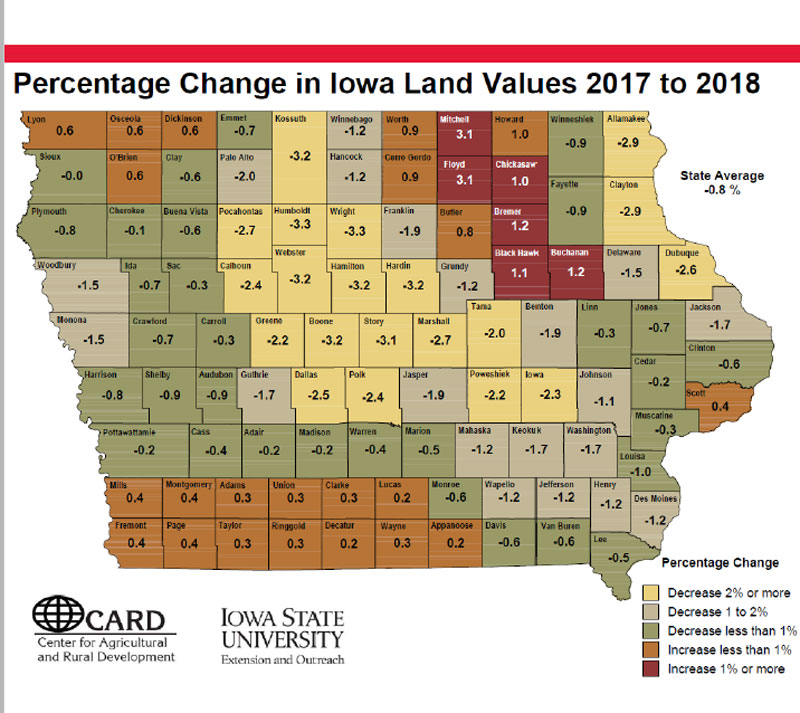
“For the last five years we have seen four declines — despite last year in 2017 there was a two percent increase — we have seen a steady decline off the peak,” Zhang says. Zhang says he has been asked repeatedly in the last five years if there is a concern about another collapse in values like we saw in the 1980’s. He says he is not concerned. “Overall I think the key message from this survey is ‘yes we are seeing downward pressure we are seeing a modest pressure, but overall we are seeing stabilizing land markets,” Zhang says. “There is no sign of sudden collapse. Overall, when you are looking at the district and county line changes — the county that declined the most only declined by about three percent
Humboldt and Wright Counties reported the largest percentage decrease in value at three-point-three percent. Zhang says there has been a drop in farm income that’s led to the drop in land values brought on in part by big crops. He says we’ve seen the six and seventh largest crops in the last six or seven years and he says there’s also been a rebound in the beef and pork markets, as well as an increase in pork processing. Zhang says the cost of money is another issue driving land prices.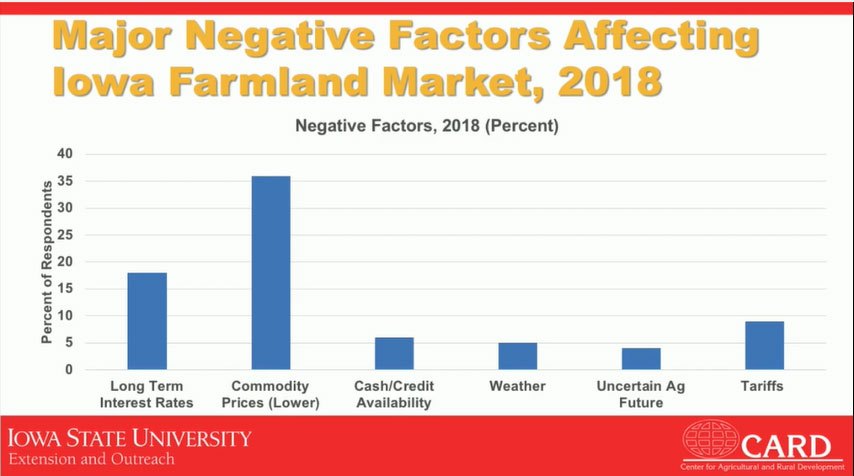
“The second largest factor that people mention is a higher interest rate,” according to Zhang. “Over the last year, over the last three years actually, the Federal Reserve has been raising the interest rates.” He says the trade wars have also played some role. “The impacts of the tariffs on the economy is felt more by the agricultural states like Iowa,” Zhang explains. He expects land values to see another small dip next year — as he says new tariffs and other factors take some time before they are felt in land values.
“Typically its an income decline last year that affects this year’s land values. So it takes some time for the land markets to fully capitalize what’s happening in commodity prices…and the Federal Reserve interest rate hikes are a key factor in this,” Zhang says. Zhang says a trade deal with China could have some impact. “If you look at the commodity markets, just the sign that the two sides are talking gave a 50 cent bump in the commodity futures market,” Zhang says. He says that bump eventually went back down, but he says it shows the impact potential that is there.
Scott and Decatur counties held onto the highest and lowest farmland value spots for the sixth straight year. Decatur County had a value of three-thousand-488 dollars ($3,488) an acre. That’s an increase of eight dollars. Scott County reported a value of ten-thousand-537 ($10,537) dollars, which was an increase of 40 dollars an acre. The south-central district reported the largest percentage increase of three-point-eight (3.8) percent. The central and southeast districts reported decreases of two-point-four (2.4) percent and three-point-six (3.6) percent, respectively. The northeast and southwest districts reported no notable change in value.
(Radio Iowa) — Iowa’s two U.S. Senators parted ways in Tuesday’s approval of a new five-year Farm Bill. Joni Ernst voted in favor of the compromise bill, which now goes to the House. Chuck Grassley was one of just 13 Republicans voting against the bill. “It’s the small and medium-sized farmers that needs the help from the government. Not these big, big farmers and corporate farmers that we’re going to end up helping the way this bill is written,” Grassley, a farmer from New Hartford, said on the floor of the Senate.
Grassley’s payment limitation amendment was removed from the Farm Bill in conference committee. He’s fought for years to place “hard caps” on subsidies from the government, saying the largest ag operations and even non-farmers are benefiting the most. “I’m more than just a little disappointed,” Grassley said. “Especially when the impact of large farmers being allowed to manipulate the system is that young and beginning farmers face even larger hurdles.”
Grassley said farm policy should be “a limited safety net” to help farmers recover from natural disasters and other “unforeseen challenges.” This bill, he said, goes well beyond that. “Today, we have a Farm Bill that is intentionally written – and I want to emphasize intentionally written – to help the largest farmers receive unlimited subsidies from the federal government,” Grassley said. Senator Joni Ernst served on the conference committee that drafted the compromise. In a prepared statement, she praised the bill as “farmer-focused” and said it includes her provisions to reform the Conservation Reserve Program and provide “critical mental health support” through the FARMERS FIRST Act.
(Radio Iowa) — Ethanol industry leaders defended the Renewable Fuels Standard at a hearing Tuesday before the House Energy Committee. At issue is the recently released draft of the 21st Century Transportation Fuels Act, which aims to sunset the RFS. Emily Skor, CEO of Growth Energy, called the RFS an overwhelming success, despite years of mismanagement. “Repealing the RFS is unnecessary and will further destabilize a struggling farm economy and ethanol sector. Moreover, the draft does nothing to stop the EPA’s continued misuse of the small refinery exemption authority,” Skor said.
Geoff Cooper, CEO of the Renewable Fuels Association, said ending the RFS by 2022 would reduce ethanol demand. “We simply cannot support the RFS program as the draft envisions without a much stronger signal to the market that ethanol’s role in our fuel supply will continue to grow,” Cooper said. Wesley Spurlock, former president of the National Corn Growers Association, said the RFS benefits farmers, consumers, and the environment – noting corn-based ethanol has 43-percent lower Greenhouse Gas emissions than gasoline. Iowa is the nation’s top producer of ethanol.
Firefighters from Audubon and Exira responded to a hog confinement operation fire this (Tuesday) morning, about three-miles east of Ross. The incident at the Lawrence Handlos farm at 1599 Mockingbird Avenue was reported at around 10:15-a.m., according to the Audubon County Sheriff’s Office. Audubon Fire Chief Tyler Thygesen told KJAN News the first crews arrived around 12 minutes later, and found the flames confined to the southwest part of one of the confinement buildings and got the flames knocked down.
A firewall operated as it should and kept the damage to that part of the building, still the structure contained a significant amount of interior damage. The fire was declared under control at around 11:25-a.m. Audubon firefighters remained on the scene overhauling the site until around 12:45-p.m.
Thygesen said Exira Fire provided extra water to fight the flames, and everyone worked well together, including the owners, who worked to shut-off the power and gas. The cause of the fire remains under investigation. All the confinements were empty fortunately, so no animals died, and no firefighter injuries were reported.
East Pottawattamie County 4-H’ers held a Gingerbread House Decorating Contest yesterday (Sunday), at the Oakland Community Center. The event was for youth in grades K-12. 16 teams made up of 1-5 youth worked together to create and decorate their gingerbread houses. 6 teams of kindergarten –3rd graders were given a pre-assembled gingerbread house to decorate, while 4th – 12th graders were given the pre- baked gingerbread house ready to assemble and decorate.
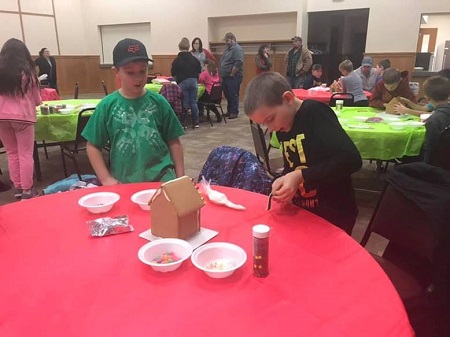
Graden Keiser and Grant Bane decorating their gingerbread house.

Madison Baldwin and McKenna Sick working on building and decorating their gingerbread house.
All teams were provided with frosting and candy decorations and were given the option to bring in their own additional tools and candy decorations. Teams were given an hour and half to work together to complete their houses. All completed gingerbread house photos were taken and are posted on the East Pottawattamie County 4-H Facebook page, where voting will take place throughout the week. The gingerbread house in each age group (Clover Kids, Juniors, Intermediates, Seniors) with the most Facebook “likes” by 12pm noon on Thursday, December 13, 2019 will win a prize. Winners will be announced Thursday afternoon.
You’re asked to stop by the East Pott. 4-H Facebook page and like all your favorite houses.
(Radio Iowa) — Leaders in northwest Iowa’s Great Lakes area are enlisting the help of a University of Iowa scientist to study ways to manage flooding. Heavy rains this past summer caused shoreline erosion and temporarily shut down the region’s lakes. Bill Van Orsdel, with the Iowa Great Lakes Association, says closing the lakes causes serious economic damage to a community that thrives on recreation. “It’s devastating to the homeowners, to the residents and to the vacationers,” Van Orsdel says.
Scientists project that over time, these rains will get heavier and the risk of flooding will increase, so the association wants to do something about it. Larry Weber, a U-I Professor of Civil and Environmental Engineering, is working with a team using computer models to estimate how much the Lower Gar Lake will rise with different amounts of rainfall. Flood control measures include adding more channel structures called culverts, or using a bridge or dam that could handle water flow differently. “We want to make sure we design something that has the utility and lifespan of many decades,” Weber says. “So we want to make sure we think of increasing intensity of rainfall in the future.”
Weber and his team plan to continue to look at different rainfall conditions and will share results with Iowa Great Lakes officials and residents in early 2019.
(Thanks to Katie Peikes, Iowa Public Radio)
A man from Madison County was hospitalized Sunday after he was accidentally shot while hunting. The Madison County Sheriff’s Office received a 911 call reporting that a hunter had been shot near Macksburg. Deputies identified the hunter as Ronald Butler, of Macksburg. Investigators said Butler was with two other adults when the shooting happened. They say he apparently dropped his shotgun as he got out of a vehicle, causing it to discharge.
Butler was taken to the Madison County Hospital, then flown to a Des Moines hospital for additional treatment for his injuries. He was conscious at the time of the shooting, though his condition was unclear as of Sunday night.
And, the Iowa Department of Natural Resources is investigating a fatal hunting incident in eastern Iowa’s Marion County. The incident happened late Sunday afternoon, just north of Lake Red Rock. One person died, but their name and the circumstances surrounding the incident remain unclear. No other details were immediately available.


 Facebook
 Twitter
 YouTube
 RSS
RSS