

CLICK HERE for the latest market quotes from the Iowa Agribusiness Network!
CLICK HERE for the latest market quotes from the Brownfield Ag News Network!


CLICK HERE for the latest market quotes from the Iowa Agribusiness Network!
CLICK HERE for the latest market quotes from the Brownfield Ag News Network!
Officials with the Montgomery County Emergency Management Agency report shortly before 4-p.m. Monday, the Red Oak Fire Department and other first responders were paged to United Farmers Cooperative in Red Oak for a man that was trapped up to his waist in grain.
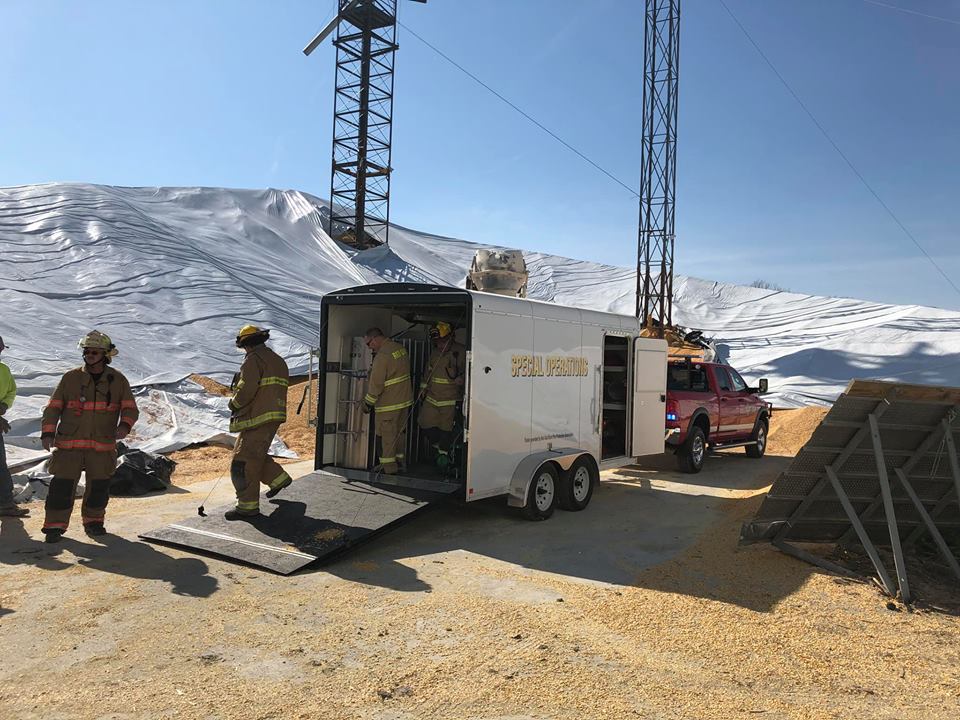
Photo via MCEMA Facebook page
EMA Coordinator Brian Hamman said without the specialized equipment that had been purchased and donated by many donors, the rescue would have been challenging and difficult to say the least. The subject was extricated and able to walk out under his own will and was taken to MCMH for further evaluation.
Hamman added that “While we all train for the worst and hope we never have to use certain equipment and our training, it’s a blessing when we have a positive outcome.”
Spring is in the air, and plans are underway for gardening projects in Cass County. Local groups planning community gardening, beautification or education programs will again be eligible for assistance from the Cass County Master Gardeners. The group is offering grant money to be used in the 2019 growing season, to encourage gardening to grow food for education or donation, and/or improve local communities.
The money may also be used for gardening education purposes. The Cass County Master Gardener Memorial Grants are offered in remembrance of the many years of service to the community provided by long-time Master Gardener volunteers who have passed.
 Any Cass County not-for-profit group may apply. Schools, churches, libraries, 4-H clubs, Scouts, or other organizations/individuals working to improving their communities can apply for money to begin or improve gardens or landscaping for community benefit, or to provide education for their members or the public.
To ensure the money is helping a wide variety of community organizations, those who were funded by 2018 grants will not be eligible to apply in 2018. Each grant has a maximum value of $300. Applications must include plans for teamwork and sustainability. Consideration for the environment is also an important factor in selection.
Applications must be received by Wednesday, April 24 for consideration. They may be submitted by mail or email. Grant recipients will be informed of their selection by May 6. For more information, or with questions, call the Cass County Extension office at 712-243-1132, email keolson@iastate.edu, or stop by the Extension Office at 805 W. 10th St in Atlantic. You may also contact Master Gardener Donna Reimers. Application forms can be picked up at the Extension Office, or printed from the Cass County Extension website- www.extension.iastate.edu/cass.
The Master Gardener program trains volunteers to develop their knowledge and skills in horticulture. These volunteers then give back to their communities through gardening service and education. The program is available in all 50 states and Canada through land grant university Extension programs such as Iowa State University Extension. Education courses are available throughout Iowa on a regular basis. For more information on the program, contact Cass County Extension Program Coordinator Kate Olson, at 712-243-1132 or keolson@iastate.edu.
(Radio Iowa) — As floodwaters slowly fall in many parts of the state, Iowa farmers are getting back onto their properties to survey the damage and to prepare for spring planting, if possible. Iowa State University Extension farm management field specialist Steve Johnson says farmers who had grain in bins will need to see if that grain got wet. “When we saw a lot of this water inundate a lot of grain being held in on-farm storage, that corn, those soybeans, those are adulterated crops,” Johnson says. “Those can’t be fed. Those can’t be shipped into the system.”
Growers need to be aware that federal crop insurance doesn’t cover grain that’s been soaked by floodwaters. “It’ll have to be covered under some sort of a farm policy. They’re not covered by crop insurance because those bushels were already harvested,” Johnson says. “Here in Iowa, the Department of Natural Resources is involved and they have places where farmers can go with that adulterated crop.”
The adulterated or lesser quality grain won’t necessarily need to be thrown out, but it shouldn’t be used as feed for cattle, hogs or chickens. “You better be careful about feeding any of this adulterated crops that were in storage,” Johnson says. “Just a real caution because that can really trigger other issues regarding livestock and livestock health.” Johnson says producers who need information on resources to deal with grain damage can go to the ISU Extension website: www.extension.iastate.edu.
(Radio Iowa) — Democratic presidential candidate Amy Klobuchar visited flooded areas of southwest and northwest Iowa this weekend, emphasizing the need to improve flood protection measures and make “climate smart” infrastructure choices. Klobuchar has unveiled a TRILLION dollar plan to improve the nation’s infrastructure. It includes expanding rural broadband service and Klobuchar went to the Farmer Mutual Telephone Company office in Stanton to meet with local officials and business owners. “Kids that grow up in rural Iowa — and southwest Iowa — should be able to live here,” Klobuchar said. “And the only way you can do that these days is if you have the internet.”
Klobuchar made the same point Saturday during an appearance at the “Heartland Forum” in Storm Lake. Klobuchar says there are a host of issues Democrats can and should address that are important to rural America. “There is rural housing. There is rural child caare and there is, of course, this connectivity and broadband, then this issue of monopolies and anti-trust,” Klobuchar said. “When you talk to people who live in the rural areas, they’ll often mention the Farm Bill, but they’ll talk about a whole lot of other things.”
Klobuchar proposes repealing some Trump-era tax cuts to invest in critical infrastructure. She says Americans — no matter where they live — care about upgrades to municipal water supplies and inland waterways as well as mass transit and rural broadband. “I think people want to be able to get out of traffic jams. I think a lot of people would like to work at home more, no matter where they live,” Klobuchar said. “I think that people want to get on subways that aren’t broken down and it’s just a fundamental bread-and-butter issue.”
Three other presidential candidates — Massachusetts Senator Elizabeth Warren, former Maryland Congressman John Delaney and former San Antonio Mayor Julian Castro — also appeared at the ag-issues forum in Storm Lake Saturday.
(Radio Iowa) — The former Iowa Secretary of Agriculture says he was in disbelief when he surveyed flood damage in southwest Iowa and northwest Missouri. “One of those common questions is: ‘Is it as bad as it looks?’ And I’d say: ‘It’s worse than it looks in pictures.’ Even the pictures I took from an airplane doesn’t look like it feels when you look out the window of an airplane and every place you look is water.”
Bill Northey — now an Undersecretary in the U-S-D-A — spoke with producers at a town hall meeting in Malvern late Friday afternoon. Northey fielded a number of questions from area farmers on how they could recover from the second major flood to hit the region in a decade. While saying the federal government can’t cover all the losses, Northey says there are U-S-D-A programs to soften the blow — like the Emergency Conservation Program. It will pay for three-quarters of the cost of repairing fences and moving sand and silt off fields. “A producer still has to come up with 25 percent of something a month ago they didn’t think they were going to have to do and they probably won’t get all their acres back either. When you move sand around, it certainly doesn’t get as productive as it was before the storm,” Northey said, “so these producers are in a really challenging situation.”
Northey also cites the federal crop insurance program’s coverage of prevented planting acres that could help farmers recoup a portion of lost revenue. “It’s a limited amount of payment compared to what full coverage would be or what a full crop would be definitely,” Northey said. “But it’s something that kind of pays for a little bit of the cost of the land value of that farm.” Northey says all the stored grain in bins that’s been ruined by flooding will have a big impact on the farm economy. In most cases, that grain is uninsured. “We don’t have a program right now that addresses that,” Northey said. “I think that’s one of the things that congress is going to look at.”
The U-S-D-A does have a program that pays farmers for livestock lost during a natural disaster.
(Radio Iowa) — Iowa Senator Chuck Grassley says the Army Corps of Engineers should give flood control a higher priority in its management plan for the Missouri River. Grassley spoke with a crowd of farmers and others from the agriculture industry at a town hall in Malvern late Friday afternoon. “The environmental issues worry more about animals than you do people. I think people ought to be the prime concern of the federal government,” Grassley said and the crowd applauded.
Grassley says the dams along with Missouri River were funded by a 1944 federal law called the Flood Control Act. “Now you’ve got 10 other things they take into consideration and flooding — I don’t even know whether it’s the primary one,” Grassley said. “…We spent three years after the 2011 flood (addressing Army Corps-related issues) and it looks like we accomplished nothing.”
Grassley spent Friday touring flood damage in southwest Iowa with USDA Under Secretary Bill Northey and Iowa Agriculture Secretary Mike Naig.
STORM LAKE, Iowa (AP) — Democratic presidential contenders Elizabeth Warren and Amy Klobuchar expressed support Saturday for strengthening antitrust laws and enforcement to break up big agriculture monopolies. “You’ve got these giant corporations that are making bigger and bigger profits … and they’re putting the squeeze on family farms and small farms,” Warren said at the Heartland Forum, which was focused on rural issues.
The U.S. senator from Massachusetts called for breaking up some of the biggest farming corporations “so that they not only do not have that kind of economic power, so that they’re wiping out competition, so they’re taking all the profits for themselves … but also so that they don’t have that kind of political power.”
While supporting an antitrust approach, Klobuchar, a senator and Minnesota Democrat, also proposed putting a fee on corporate mergers to help investigate noncompetitive practices. “If we stifle competition through monopolies, we’re not just going to bring up the prices for consumers, we’re going to stifle entrepreneurship,” she said.
Targeting monopolies was a key part of the agriculture policy Warren rolled out this week, which included a handful of proposals aimed at helping family farmers compete in a market increasingly saturated by major corporations. Klobuchar and former Maryland Rep. John Delaney, another White House hopeful who attended the forum, also rolled out rural-focused policies this week.
Klobuchar announced a $1 trillion infrastructure plan that would help expand access to rural broadband and strengthen roads and bridges. Delaney offered a comprehensive rural plan that included proposals to strengthen family farmers and rural infrastructure. Other White House contenders at the forum were former Housing and Urban Development Secretary Julian Castro and Ohio Rep. Tim Ryan, who is considering launching a bid.
The attention on agricultural communities and issues is the result of a recognition that Democrats need to do more to win over rural voters, especially in places like Iowa. The state has long been a presidential battleground, but Iowa has trended more solidly Republican over the past two election cycles, a troubling sign for Democrats seeking to oust President Donald Trump.
OMAHA, Neb. (AP) — In the wake of disastrous flooding in eastern Nebraska and western Iowa earlier this month, officials have created an on-demand webinar to help people deal with the serious health dangers that remain after major flooding.
The Central States Center of Agricultural Safety and Health at the University of Nebraska Medical Center College of Public Health collaborated with the AgriSafe Network to create the webinar.
Major safety concerns include chemicals released from barns, homes and other on-farm sources and businesses; contaminated well water; human and animal communicable diseases; and mold.
More farm and ranch flood-related resources are available on the Central States Center website.


 Facebook
 Twitter
 YouTube
 RSS
RSS