

CLICK HERE for the latest market quotes from the Iowa Agribusiness Network!
CLICK HERE for the latest market quotes from the Brownfield Ag News Network!


CLICK HERE for the latest market quotes from the Iowa Agribusiness Network!
CLICK HERE for the latest market quotes from the Brownfield Ag News Network!
A reminder: The Produce in the Park online store is now open! Market Manager Brigham Hoegh says “Customers who place orders through the store by Tuesday night will get to pick up their orders drive-through style on Thursday (June 4), from 3:40-to 6-p.m. Hoegh says “This is a great opportunity to keep physical distance and still support local food.”
 The online store can be found at www.produceintheparkatlanticiowa.com or by visiting @ProduceInThePark on Facebook. This new purchasing option allows customers to spend time browsing items and pick up purchases without coming into contact with other customers. This feature is being implemented to help customers keep distance during COVID-19. Produce in the Park has historically served as a community-gathering place, providing live music, activities, yard games with Parks & Rec, and more. However, in order to mitigate the spread of COVID-19 the Governor has prohibited Iowa farmers markets from allowing musical performances, children’s activities, contests and other entertainment, or organized activities. Common seating areas are also prohibited, and customers and vendors must follow public health guidelines regarding distancing and hygiene.
In addition to the online pre-ordering system, Produce in the Park is introducing a number of changes to keep customers and vendors safe, and to comply with the Governor’s requirements for farmers markets. Produce in the Park is requesting customers’ patience and support in keeping the market as safe as possible for all customers and vendors.
Customer Requests:
• If you are ill or have been in the past three days, PLEASE DO NOT attend the market.
• Masks are strongly encouraged.
• Only 1 person per household should attend the market.
• Please maintain a distance of six feet between yourself and all other people at the market.
• Please do your best to make arrangements for children under the age of 16.
• No pets (service animals exempt).
• You will not be able to handle products. Please maintain 6 foot distance from vendors & other customers, and
point to what item you would like. The vendor will select and bag for you.
New Market Set Up:
In order to keep customers and vendors safely distanced, Produce in the Park is rearranging vendors such that all
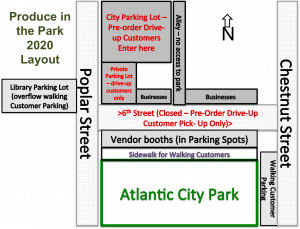
vendors will be set up along 6th Street between Poplar and Chestnut. Pre-order drive-through customers will enter the
market from Poplar Street, and walk-up customers are asked to park along the East side of the park on Chestnut street.
Produce in the Park Dates and Times:
• Produce in the Park is open Thursdays from 4:30-6:30 PM in the Atlantic City Park, 10 W 7th Street. From June 4
through September 24.
• Pre-market drive-up shopping is available for at-risk customers from 3:30 to 4:30 PM. During this hour,
customers at high risk of COVID-19, who are unable to shop online, can drive through the market and pay with
cash or check without leaving their vehicles. This service will be offered first come first served.
DES MOINES, Iowa (AP) — Meatpacking plants that had to briefly close due to coronavirus outbreaks have been back up and running for weeks, but production backlogs are forcing farmers to euthanize thousands of hogs that can’t be processed, drawing complaints from animal welfare advocates. The preferred methods of euthanizing hogs include gunshots or electrocution, but when thousands must be destroyed en masse, producers shut off the ventilation, causing heat to build up in barns and kill them.
Animal welfare groups say that is inhumane and should be stopped. An estimated 2.5 million hogs are backed up on farms nationwide.
(Radio Iowa) — Iowa Senator Joni Ernst toured the Green Plains ethanol plant in Shenandoah Thursday to discuss biofuels-related issues with company officials. Ernst says the E-P-A Administrator’s responses during a Senate committee hearing on COVID-19’s impact on the ethanol industry has renewed the fire in both her and Senator Chuck Grassley’s office to push the E-P-A on ethanol issues. “Since hearing the really unsatisfactory answers that Andrew Wheeler gave us on the non-progress coming out of E-P-A, we now go back and push him on these issues,” Ernst said. “We need him to explain clearly to me why we don’t have those tanks re-labeled. Why is this not happening? Just simply stating, ‘we haven’t had time,’ that’s not a good enough answer.”
Ernst got to look at a new portion of the facility that produces a higher protein animal feed from the spent corn kernel. Green Plains C-E-O Todd Becker says the product is more sought after than the traditional dried distillers grain that comes out of ethanol facilities. “It’s filling this hole between soybean meal and fish meal, between 48 and 60 percent protein,” Becker says. “Nothing really exists of that high quality out there — so that’s what we’re making out there — and we are sold out. It’s a ready-made pet food today. Everything we make out there is going into products like that, which would never happen in distillers grains, ever.”
The new system is part of a 38 million dollar investment the company has made in the Shenandoah location, which includes a research facility to develop feed for the aquaculture industry. Becker says the expansion means more jobs for the area. “It starts with construction jobs and from there it starts with operator jobs and management jobs. They are all high-paying jobs in an ethanol plant — they just are. In the aquaculture, there’s P-H-Ds out there,” according to Becker. “We’re attracting people into the county here that would have never thought about coming to Iowa, number one, and Shenandoah, number two.”
He says this is the start of a process that is going to grow. “We’re doing things out here that have never been done in ethanol plants. This is going to be a model for what we roll out across the country,” Becker said. The first shipments of the new high-protein feed left the Shenandoah facility in April averaging about 20 percent more protein than traditional distillers grain.
(Radio Iowa) — Animal rights groups are criticizing the methods used by Iowa pork producers to euthanize the animals that they are not able to take to the packing plant. Coronavirus shutdowns slowed production and Ag Secretary Mike Naig says no producer wants to destroy animals. “As it relates to some of the activist activity in the state, I think it is disgusting,” Naig says. He says hog farmers hate this more than anyone. “I think that our producers are experiencing and unprecedented disruption in their business and their way of life. And we’ve got folks with a clear agenda that are kicking our farmers while they are down,” he says.
Naig says producers follow specific guidelines. “The facts are that producers work with their veterinarians. Veterinarians follow the American Vet Med Association’s guidelines for euthanasia– humane euthanasia, even in constrained situations like we are in today,” according to Naig. “That’s the guidelines, those are the best practices that producers will use. No producer wants to be in this situation.”
Naig says the backup of hogs will reduce as meat processing plants get back up to full production — but it will still take some time to catch up.
(Radio Iowa) – Tyson Foods has decided to temporarily halt operations at its pork processing plant in Storm Lake. The company indicated the closure is due, in part, to a delay in COVID-19 testing results and team member absences related to quarantine and other factors. Tyson will idle harvesting animals and finish processing over the next two days. Additional deep cleaning and sanitizing of the entire facility will be conducted before resuming operations later next week.
State officials confirmed a COVID-19 outbreak was confirmed at the Storm Lake Tyson pork plant on Thursday.
(Radio Iowa) — More Iowans are buying food directly from farmers during the pandemic, with Facebook groups and other social media connecting producers and customers. Jenna Anthofer, of Breda, started the group I-A Farm 2 Table on Facebook May 10th and now has more than two-thousand people signed on from Iowa and neighboring states. She says the group is strictly for direct-to-consumer sales of farm products and is her reaction to the challenges COVID-19 has thrown at farmers.
“I really just wanted to help offset that, if possible, by hooking up farmers and producers with consumers,” Anthofer says. “I’m actually in a larger nationwide farm-to-table group and they had suggested that each state have their own sort of offshoot branch.” Anthofer says it’s easy enough to find buyers for vegetables, eggs, honey and processed meat, while she says many people are newly-interested in buying meat directly from farmers.
“Not everybody feels confident buying a whole pig and then having to process it themselves,” she says, “although I’ve tried to put some resources in the group for people. It’s not that hard to break down a hog, here’s a video to show you how to do it.”
Across the Midwest, people are using websites, Reddit, op-ed pieces and other tools to spread the word about buying food directly from farmers. Reddit users compiled a list of “farms that are delivering” and launched a U-R-L with that name.
(By Amy Mayer, Iowa Public Radio)
(Radio Iowa) — The Iowa Department of Agriculture has launched a program to help pork producers deal with hogs they can’t take to market after coronavirus shut downs at packing plants. Ag Secretary Mike Naig says it’s something no producer wants to deal with. “Farmers are doing everything they can to avoid having to take the step of euthanizing and disposing of animals,” Naig says.
“They are finding alternate ways to market, they are selling direct to consumers, they’re changing their feed ration to slow down the rate of gain — they are doing everything they can. This truly is an action, a decision of last resort.” The Ag Department is offering producers 40 dollars for each animal to help cover some of the disposal costs for market-ready hogs. “It won’t cover all costs, but it is a part of the cost that they’ll incur to euthanize and dispose of animals,” he says.
Naig says they are still hoping for federal help to cover the loss of revenue from the hogs. Iowa State University estimates that by mid-May there were approximately 600-thousand pigs in Iowa that were unable to go to the packing plants. Iowa producers were faced with killing thousands of chickens and turkeys during the bird flu outbreak five years ago — and Naig says they learned some things then. “One of the key learnings from that was to really empower producers to make decisions and to take control of the situation,” according to Naig. ”
They know their operations better than anyone else. And they also know the resources at their disposal better than anyone else. We learned that back in 2015.” He says they will hand out the funding in at least three rounds. “The first round closes Friday of this week, and farmers will need to reach out to our office. They can call the main number or they can go to IowaAgriculture.gov, and there is a way to apply there. And then we will subsequently roll out rounds two and three,” Naig says.
Naig says this will help producers deal with the short-term problem. In the long-term, he says they need to continue to get making the packing plants safe for workers. He says that it will allow the employees to confidently show up and know that they can work safely. “That’s ultimately what it takes to return to full processing capacity. Today in Iowa we are running at about 75 percent of our normal processing capacity — an again that number steadily improves each day,” Naig says.
He says this could continue to be a problem throughout the summer. Each applicant who is approved will receive funding for at least one-thousand animals and up to 30-thousand each round, depending on the number of applicants. The money comes from federal coronavirus relief funding.
JOHNSTON, Iowa (AP) — Health officials are confirming another coronavirus outbreak in an Iowa meatpacking plant on the same day that the number of residents who have died from the virus topped 500. Of more than 2,500 employees tested at the Tyson pork processing plant in Storm Lake, 555 have tested positive.
Department of Public Health Deputy Director Sarah Reisetter said Thursday that businesses in Iowa are not required to report outbreaks, and state law only requires disclosure of a business name when it’s necessary to protect the public.
Produce in the Park begins it’s four-month run in Atlantic on June 4th. Market Manager Brigham Hoegh says “There are a lot of changes this year to keep folks safe.” Hoegh says also, “We are very excited to introduce an online pre-order system with drive-through pickup. (This has worked great for other markets across the state, and is hopefully going to help us get local food to lots of people safely.)”
 Hoegh says “Recognizing the changes needed for a successful market season in 2020, Produce in the Park’s theme for 2020 is “Romaine Calm and Carrot On.” The market is introducing a number of changes to keep customers and vendors safe, and to comply with the Governor’s requirements for farmers markets this season.
 Iowa Governor’s farmers market proclamation summary from the Iowa Department of Ag and Land Stewardship:
1. Musical performances, children’s activities, contests and other entertainment or organized activities are
prohibited.
2. Common seating areas, picnic tables or dining areas are prohibited.
3. There must be at least six feet between vendors’ booths.
4. Customers and vendors must follow social distancing, hygiene and public health guidelines.
Customer Requests:
Produce in the Park is requesting customers’ patience and support in keeping the market as safe as possible for all customers and vendors.
• If you are ill or have been in the past three days, PLEASE DO NOT attend the market.
• Masks are strongly encouraged.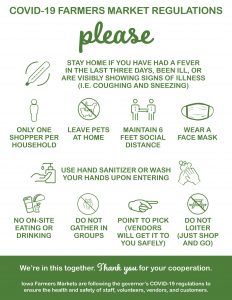
• Only 1 person per household should attend the market.
• Please maintain a distance of six feet between yourself and all other people at the market.
• Please do your best to make arrangements for children under the age of 16.
• No pets (service animals exempt).
• You will not be able to handle products. Please maintain 6 foot distance from vendors & other customers, and point to what item you would like. The vendor will select and bag for you.
New Online Pre-Orders with Drive-Through Pick-Up:
For the first time, Produce in the Park is offering an Online Pre-Order system with drive-through pick-up from 3:30 – 6:00 PM. The online ordering system will officially open for orders on Sunday, May 31 and can be found at www.produceintheparkatlanticiowa.com or by visiting @ProduceInThePark on Facebook.
Produce in the Park is following other markets around the state in implementing this option, and feedback from other markets has been very positive. Market managers across the state have shared that customers are asking for the service to continue even after COVID-19. Hoegh says “We are really excited to offer this safe, convenient service to market customers during a time when physical distancing is important for everyone’s health.”
New Market Set Up:
In order to keep customers and vendors safely distanced, Produce in the Park is rearranging vendors such that all vendors will be set up along 6th Street between Poplar and Chestnut. Pre-order drive-through customers will enter the market from Poplar Street, and walk-up customers are asked to park along the East side of the park on Chestnut street.
Updated Market Days and Hours:
• Produce in the Park is open Thursdays from 4:30-6:30 PM in the Atlantic City Park, 10 W 7th Street. From June 4 through September 24.
• This year, pre-market drive-up shopping is available for at-risk customers from 3:30 to 4:30 PM. During this hour, customers at high risk of COVID-19, who are unable to shop online, can drive through the market and pay with cash or check without leaving their vehicles. This service will be offered first come first served.
Thank you to the community for understanding, and support. Thank you to 2020 sponsors 1st Whitney Bank and Trust, Cass County Health System, Deter Motors, Cass County Tourism, Atlantic Community Promotion Commission, the Atlantic Area Chamber of Commerce, and Lindeman Tractor.
Contact Produce in the Park:
Email: produceintheparkatlanticiowa@gmail.com; Market Manager Phone: Brigham Hoegh 712-249-5870
(Radio Iowa) — Iowa’s two U-S senators are asking the Food and Drug Administration to clarify its policies on making alcohol-based hand sanitizer during the pandemic. Iowa ethanol producers were initially given the go ahead to use some of their ingredients to make sanitizer, but Senator Chuck Grassley says the F-D-A later changed its guidelines. Now, it’s unclear if ethanol can be used in the process. “Ernst and I want clarification from FDA so that people that are involved in this good faith effort to help out during the pandemic,” Grassley says. “I’d suggest they can’t be making much money at it, just a good faith effort.”
Ethanol producers got involved with the sanitizer to both provide a valuable commodity during the health crisis and also to have a marketable product, since fuel sales dropped dramatically with so many people staying home. Grassley says the F-D-A’s revision of guidelines left many in the industry mystified about what standards need to be met for hand sanitizer. “We’re in a situation where there’s questionable activity going on but that nobody has ill intent,” Grassley says. “We’re trying to clarify things so that people can continue to do their good work in good faith and not get in trouble for it.”
As the economy slowly reopens, Grassley notes the need will continue to grow for hand sanitizer at schools, restaurants, churches, factories, and other locations. Iowa is the nation’s number-one biofuel producer with 43 ethanol plants and 11 biodiesel plants supporting 43,000 jobs throughout the state’s economy.


 Facebook
 Twitter
 YouTube
 RSS
RSS