

CLICK HERE for the latest market quotes from the Iowa Agribusiness Network!
CLICK HERE for the latest market quotes from the Brownfield Ag News Network!


CLICK HERE for the latest market quotes from the Iowa Agribusiness Network!
CLICK HERE for the latest market quotes from the Brownfield Ag News Network!
(Radio Iowa) — The president of the Iowa Pork Producers Association says legal experts are confident the latest agricultural protection legislation to come from the Iowa statehouse will survive any potential new court challenges. Mike Paustian says the change is much needed as it will penalize people who trespass on farm property and harm livestock or crops. “This comes down to a food safety issue,” Paustian says. “Besides trying to make sure that people aren’t trying to cause harm on producers’ farms. That’s the last thing producers should have to worry about.”
The measure that toughens penalties for those who trespass at a “food operation,” including livestock confinements and meat packing plants. It was designed to protect farmers and ranchers from undercover videos and activists’ attacks. “As I read the law,” Paustian says, “it’s really just slightly increasing the seriousness of the charges if someone were to be trespassing on a farm or a food production facility.” The bill enhances the penalty for trespassing on farms and “food operations” to an aggravated misdemeanor. A second offense would be a Class D felony. Paustian thinks the legislation will hold up and really isn’t what some call an “ag gag” law.
“The lawyers that have looked at it think this is a different approach that wouldn’t be subject to the same legal challenge that some of the other legislation has been experiencing,” Paustian says. “A lot of times, this gets painted as ‘ag gag’ and how producers are trying to hide something, and of course, that’s not true.” Paustian says if visitors call ahead and then follow proper bio security, they’re usually welcome on livestock production facilities. “Certain rules have to be followed just to keep everyone safe and to protect the health of the animals,” Paustian says. “It’s just unfortunate that we have these situations where folks, in some cases, are caught trespassing on a farm and as soon as they’re released from custody, they go right back and trespass again.”
Paustian says most pork producers have gone through pork quality assurance training and practice the “We Care” principles as outlined by the National Pork Producers Council, stating that they care humanely for their animals.
DES MOINES — The Iowa DNR reports the agency is working with stakeholders and agencies from across the Missouri River basin to identify problem areas and potential solutions for flood impacts along the lower Missouri River. The study will use existing data and hydraulic models, along with stakeholder input, to define existing conditions and develop conceptual-level solutions for identified problem areas, and to develop a flood risk management plan.
In 2019, runoff from the Missouri river basin was at near-historic levels all year. This unprecedented amount of runoff resulted in the lower Missouri River staying above flood stage at multiple locations for nearly nine months, causing billions of dollars of damage to homes, businesses, agricultural production, levees and natural resources across five states, including Iowa. The historic nature of the 2019 flood, in addition to severe flooding over the past decade, served as a catalyst for the governors of Nebraska, Iowa, Kansas and Missouri to come together to discuss solutions for improving the resiliency of the lower Missouri River basin.
Once problem areas have been identified by state partners and stakeholders, a set of criteria will be developed to rank and prioritize them. That prioritized list, along with any other relevant background information and ideas for potential solutions, will be provided to the U.S. Army Corps of Engineers for further analysis. The information gathered and analysis completed will be documented in a flood risk management plan for the entire lower Missouri River, which can be used at the state and local level to help inform flood risk management decisions moving forward.
To kick off the first phase of the study, the Iowa DNR is releasing a short introductory video to introduce the study in further detail and outline the schedule for seeking stakeholder input on additional problem areas. A series of virtual meetings is anticipated for late July. The project is a partnership between the Nebraska Department of Natural Resources, the Missouri Department of Natural Resources, Kansas Water Office, and the Kansas City and Omaha districts of the U.S. Army Corps of Engineers.
For more information, contact Tim Hall, Iowa DNR’s Hydrology Resources Coordinator, at tim.hall@dnr.iowa.gov.
The Atlantic Chamber Ambassadors were hosted by Atlantic Parks & Recreation on Thursday, June 25th. The Ambassador’s viewed a new bath house that was constructed last year and officially opened this spring. The bath house also has a concession stand area that can be rented out for parties, family reunions, etc. A playground was also built last fall that is now available for use. Both projects were built with funds from a grant. Bryant Rasmussen, Parks & Rec Director, stated new entry signage has been placed at the parks using signage found from 30 years ago that was refurbished.

Ambassador’s Pictured Left to Right: Sue Muri, Steve Anderson, Debbie Leistad, Jim Kickland, Michelle Heath, Rich Perry, Dolly Bergmann, Kerry Jepsen, Bill Saluk, Colt Doherty, Bryant Rasmussen, Dawn Marnin, Jennifer McEntaffer, Jessi Klever, Kennedy Plowman and Lana Whestphalen. (photo submitted)
The edible, public gardens are beginning to produce product. Bryant mentioned they have implemented a new biking program for community members and visitors to utilize. They currently have nine bikes that can be rented to use around town. Their plans for the rest of the year are to catch up on maintenance and implement more native grasses and wildlife areas at their parks.
For more information regarding parks or to make reservations at park shelters or the campground, contact 712-243-3542 or visit www.atlanticiowa.com.
(Radio Iowa) — The company that owns meat processing plants in Council Bluffs, Marshalltown, Ottumwa is making a five MILLION dollar donation for coronavirus response and other initiatives in those three cities. J-B-S U-S-A operates pork plants in Ottumwa and Marshalltown and has two facilities in Council Bluffs that process sliced and cooked meats that are sold in stores. According to a news release from J-B-S U-S-A, the five MILLION dollars will be used to support COVID-19 emergency response and relief efforts, to address food insecurity and to strengthen long-term community infrastructure in the three cities.
J-B-S representatives will work with local officials to identify projects and all funds will be committed by December 31st. J-B-S employs more than 48-hundred people at its four plants in Iowa. According to the company, it pays local pork producers nearly one-point-seven BILLION dollars for hogs that are slaughtered at the plants in Ottuwma and Marshalltown.
IOWA CITY, Iowa (AP) — Iowa’s workplace safety agency says an inspection didn’t uncover any violations at Tyson Foods’ largest pork processing plant, where several employees died after contracting the coronavirus.The Iowa Occupational Safety and Health Administration closed its investigation into the Tyson plant in Waterloo earlier this month without sanctioning the meat company.
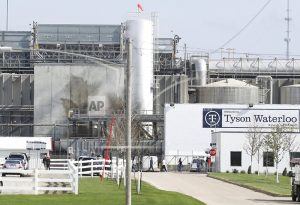
Tyson’s Fresh Meat workers file in for a tour of safety measures put into place after the plant had to shut down due to a Covid 19 outbreak, Wednesday, May 6, 2020, in Waterloo, Iowa. On Tuesday, state officials announced that nearly 1,400 workers at three Tyson Foods pork processing plants in Iowa had tested positive for the virus. (Brandon Pollock/The Courier via AP)
County officials and workers have alleged that in March and early April, Tyson workers did not have adequate personal protective equipment to stop the spread of the virus and were not social distancing. The company says it has taken numerous safety steps since then. Black Hawk County has said more than 1,000 of the Waterloo plant’s 2,800 workers had tested positive for the virus or antibodies by early May.
(Radio Iowa) — A small stretch of cold weather is going to keep sweet corn from being available by the Fourth of July this year for one grower who often has the first corn on the market. Mike Penick grows corn near Carlisle and has this assessment of how the crop is doing…”Well, that’s an open-ended question there,” he laughs, “some if looks excellent. Some of it because of the yearly growing conditions — the corn looks okay — we are just kind of thin on population. We just don’t have as much out there as we would like.”
Penick says his first sweet corn will likely be ready the week after the holiday. “Somewhere between the 8th, tenth, twelfth of July, somewhere right in the. It’s kind of open to how the heat comes along,” Penick says. He says the Fourth of July delivery date is what they hope for, but don’t get every year. “I’ve got about 20 years of records and about 50 percent of the time we get it ready by the Fourth of July,” Penick says. He says everything was going good for earlier harvest until one setback.
“The cold we had in late April and May. It just sit there and done nothing for the longest period of time,” according to Penick. Penick says the growing conditions had been pretty good since that slowdown. “We’re actually sitting in a pretty garden spot for rainfall and so we haven’t gotten the big rains either. So it’s growing extremely fast right now, but it just got cut back so much from the early cold,” he says. Penick was planting another round of corn when he talked with Radio Iowa about the season. He tries to stagger planting to keep corn available throughout the season.
“We try to sell for about 60 days — so this corn I’m planting right now will come roughly about Labor Day or such a matter,” Penick explains. Penick says his other vegetables have been doing well too — including tomatoes. “I waited on the tomatoes until after the frost that came there in May and they took right off and have tomatoes…I have no greenhouse vegetables, everything is outside. They’re progressing pretty good,” Penick says.
Wet conditions delayed the sweet corn last year and the first corn was on the market at about the same time Penick predicts for this year.
(Radio Iowa) – Some county fairs in Iowa have canceled this year’s events due to COVID-19, while others are still on, but in a reduced fashion. In Page County, the Fair Board has canceled everything except for 4-H and F-F-A events at next month’s fair in Clarinda. Page County Youth Coordinator Lexy Davies says it was a difficult decision, but one they are comfortable with. “I’m really proud of the Page County Fair Board and Page County Extension council,” Davies says. “Everybody has been able to work together and come up with a really good plan for our 4Hers and FFA exhibitors.”
Davies says they’re still giving 4-Hers and F-F-A members an opportunity to show their projects and animals at the fair, which was the number-one priority when it came to decision making.
“We know our 4H and FFA members work really hard,” Davies says. “They spend a lot of time working on projects and livestock. They deserve not only the chance to show off their talent and hard work, but to be recognized for what they have done.”
The first event of the fair will be the static livestock judging on July 21st. The swine shows will take place on July 22nd. Horse, sheep and goat shows will be July 23rd followed by poultry and rabbit showings on July 24th. The beef and pet shows will be on July 26th.
(Radio Iowa) — Warm weather that’s good for the crops is expected to return for the rest of the week after rain cooled things off. National Weather Service Meteorologist, Cory Martin, says it won’t be anything too overbearing for now. He says we are looking at high temperatures in upper 70’s to low 80’s and then next week back into the upper 80’s with a return of the humidity. Martin says the humidity will let us know next week that we are moving into July. And he says the crops will add to the mugginess. “We get into July and the corn starts feeding into that humidity as well,” Martin says.
The corn planting finished ahead of the last several years and the new crop report out Monday shows it is doing well with 85 percent rated in good to excellent condition. The soybeans are following right along with 96 percent emerged — which is 16 days ahead of last year and one week ahead of the five-year average. Soybean condition rated 84 percent good to excellent.


 Facebook
 Twitter
 YouTube
 RSS
RSS