

CLICK HERE for the latest market quotes from the Iowa Agribusiness Network!
CLICK HERE for the latest market quotes from the Brownfield Ag News Network!


CLICK HERE for the latest market quotes from the Iowa Agribusiness Network!
CLICK HERE for the latest market quotes from the Brownfield Ag News Network!
(Radio Iowa) – A study of drinking water systems shows communities in Iowa and four other Midwestern states have legal but potentially worrying levels of nitrates. The Environmental Working Group found nitrate levels in Iowa, Illinois, Kansas, Nebraska and Oklahoma are trending up. Report author Anne Schechinger says spikes can occur after heavy rains and she found nitrate problems are more frequent in smaller communities.
“Small systems are more likely to be rural and they’re more likely to be ground-water systems,” Schechinger says, “and a third point, these smaller systems are way less likely to have nitrate removal treatment systems.” Schechinger says proximity to farm fields is also a factor. The report analyzed water data from ten states and praised Hastings, Nebraska, for building a system that removes nitrates before they enter the drinking water supply. Hastings’ environmental director Marty Stange says the innovative system is working well.
“We’ve actually seen it clean up that area that we’re getting our water from,” Stange says. “It’s actually cleaned up slightly faster than what we anticipated.” Stange says preventing nitrates from getting to the water is far cheaper than building a system to remove the pollutant once it’s there. Elevated nitrate levels can cause blue baby syndrome and more recently have been associated with upticks in colorectal cancer and certain birth defects.
(By Amy Mayer, Iowa Public Radio)
IOWA CITY, Iowa (AP) — One influential pork company has received the vast majority of payments from an Iowa program designed to support farmers who euthanized their hogs after the coronavirus devastated their industry. Newly released data shows that Christensen Farms has received $1.86 million from the Iowa Disposal Assistance Program. That’s 72% of the $2.6 million the program has paid to date. Christensen Farms is one of the nation’s largest family-owned pork producers, The Sleepy Eye, Minnesota-based company has received reimbursement payments for disposing of 46,599 euthanized hogs. The 15 other companies and farmers who have received payments reported euthanizing about 18,000 hogs combined.
Cass County ISU Extension officials today (Friday), released the names of Dog Show award winners from the 2020 Cass County Fair.
Award class or category Exhibitor’s name & Club (Parents) – Trophy Sponsor(s)
Other Fair Results can be found HERE
ORIENT – The Iowa Department of Natural Resources says Iowans interested in the results of a DNR study to improve water quality in Orient Lake in Adair County can view a presentation on the Iowa DNR’s YouTube channel. Orient Lake is on the state’s list of impaired waters for high levels of algae, turbidity, and pH. The current study, or DNR water quality improvement plan, shows how these problems are caused by too much phosphorus in the lake. The problems impact recreation on the lake and aquatic life.
 The plan explores the amounts and sources of phosphorus entering the lake and offers potential solutions to reduce those levels and work toward fixing the problem. The document is designed as a guide for local resource agencies, partners, stakeholders and residents to improve the lake. The presentation is available now at youtube.com/iowadnr through Aug. 31. The full document can be downloaded on the Iowa DNR’s website at the following: http://www.iowadnr.gov/Environment/WaterQuality/WatershedImprovement/WatershedResearchData/WaterImprovementPlans/PublicMeetingsPlans.aspx.
Public comments on the plan must be submitted by Aug. 31 to the following:
E-mail: jeff.berckes@dnr.iowa.gov or Mail: Jeff Berckes, care of Iowa DNR, Wallace State Office Building, 502 E. Ninth St., Des Moines, Iowa 50319.
After gathering Iowans’ comments, the DNR will forward the final plan, also called by its technical name of Total Maximum Daily Load (TMDL), to the U.S. Environmental Protection Agency for approval.
(Radio Iowa) – The new report from the U-S Drought Monitor shows more counties now showing dry conditions. The Iowa D-N-R’s Tim Hall says the negative outweighs the positive in the report. “We had a little bit of improvement in one part of the state — but mostly we had degradation or increasing drought in other parts of the state,” Hall says. He says the driest area continues to be in western Iowa. “It’s centered around Carroll, Greene, Guthrie and Audubon County and then in the partial counties around there,” Hall says. “Kind of that part of the state, there’s a little bit of D-two drought in Plymouth County up in northwest Iowa. So, those two areas together are the worst parts.”
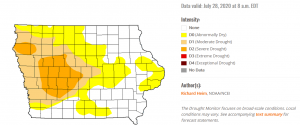 Hall says the dry conditions have started to spread to the east. “Now there’s exceptional dryness as far east as Linn County, and then also along the river,” according to Hall. “So we’ve got about half the state, a little over half the state is shown in some form of dryness and drought.” Hall says the impact of the dry areas can also be seen in satellite images of the crops. “There’s a tool out there called VegDRI — which also comes from the drought monitor folks — and they’re actually looking at visual indications of stress in vegetation. And that VegDRI map lines up pretty closely with where we’ve seen the precipitation deficits,” Hall says.
He says the good news for the western areas that are dry is the impact right now isn’t hitting water supplies.”I think because of the exceptionally wet couple of years we had coming into this year we’re still doing okay on the groundwater side. Right now it’s primarily an agricultural surface water phenomenon,” he says. Hall says the precipitation deficit is a concern because we are soon going to be heading out of the wettest months of the year, and could be behind in groundwater going into the winter.
The Cass County Auditor’s Office reports Marcy Jo Dorsey has filed her candidacy papers for the Cass County Ag Extension Council. There are four positions available. Currently Marcy Jo Dorsey and Darrin Petty are the only persons that have filed for the Council. Candidates have until August 26th to file for the position on the General Election Ballot.
Tyson Foods says it plans to administer thousands of coronavirus tests per week at its U.S. facilities under an expanded effort to protect its workers. The Arkansas-based company will randomly test employees who have no symptoms, as well as those with symptoms. The tests are on top of daily screenings when workers arrive at Tyson’s 140 U.S. production facilities. Meatpacking plants have been particularly susceptible to the coronavirus because of their often crowded conditions.
The United Food and Commercial Workers International Union, which represents many of Tyson’s 120,000 U.S. workers, says other meat processing companies should follow Tyson’s lead.
FFA Awards:
4-H Awards
All results from the Swine Program can be found HERE
Other results from the 2020 Cass County Fair can be found HERE.


 Facebook
 Twitter
 YouTube
 RSS
RSS