

CLICK HERE for the latest market quotes from the Iowa Agribusiness Network!
CLICK HERE for the latest market quotes from the Brownfield Ag News Network!


CLICK HERE for the latest market quotes from the Iowa Agribusiness Network!
CLICK HERE for the latest market quotes from the Brownfield Ag News Network!
DES MOINES, Iowa, January 10, 2022 – Iowa agricultural operations have been significantly impacted by recent tornadoes and severe storms that occurred in early December 2021. The U.S. Department of Agriculture (USDA) has technical and financial assistance available to help farmers and livestock producers recover. Robert Bonnie, Under Secretary for Farm Production and Conservation (FPAC), said Monday (today), “Production agriculture is vital to Iowa’s economy, and USDA stands ready to assist in the recovery from tornadoes and severe weather. USDA employees are working diligently to deliver USDA’s extensive portfolio of disaster assistance programs and services to all impacted agricultural producers.”
USDA Disaster Assistance
Producers who experience livestock deaths may be eligible for the Livestock Indemnity Program (LIP). Livestock producers who are contract growers – poultry and swine, for example – should work closely with their local Farm Service Agency (FSA) office to determine LIP eligibility. Meanwhile, the Emergency Assistance for Livestock, Honeybees, and Farm-Raised Fish Program (ELAP) provides eligible producers with compensation for feed and grazing losses. For ELAP, producers will need to file a notice of loss within 30 days; notices of honeybee losses must be filed within 15 days.
Additionally, eligible orchardists and nursery tree growers may be eligible for cost-share assistance through the Tree Assistance Program (TAP) to replant or rehabilitate eligible trees, bushes or vines lost. This complements Noninsured Crop Disaster Assistance Program (NAP) or crop insurance coverage, which covers the crop but not the plants or trees in all cases. For TAP, a program application must be filed within 90 days. “It is imperative that producers reach out to their local FSA office to report all crop, livestock and farm infrastructure damages and losses as soon as possible,” said Matt Russell, state executive director for the FSA in Iowa. “To expedite FSA disaster assistance, you will likely need to provide documents, such as farm records, livestock inventory, receipts and pictures of damages or losses.”
FSA also offers a variety of direct and guaranteed farm loans, including operating and emergency farm loans, to producers unable to secure commercial financing. Producers in counties with a primary or contiguous disaster designation may be eligible for low-interest emergency loans to help them recover from production and physical losses. Loans can help producers replace essential property, purchase inputs like livestock, equipment, feed and seed, cover family living expenses or refinance farm-related debts and other needs. Farm Storage Facility Loans are also available for producers needing to build, rebuild or upgrade facilities to store commodities.
Risk Management
Producers who have risk protection through Federal Crop Insurance or FSA’s NAP should report crop damage to their crop insurance agent or FSA office. If they have crop insurance, producers should report crop damage to their agent within 72 hours of damage discovery and follow up in writing within 15 days. For NAP covered crops, a Notice of Loss (CCC-576) must be filed within 15 days of the loss becoming apparent, except for hand-harvested crops, which should be reported within 72 hours. “Crop insurance and other USDA risk management options are there to help producers manage risk because we never know what nature has in store for the future,” said Pamela Stahlke, director of RMA’s regional office that covers Iowa. “The Approved Insurance Providers, loss adjusters and agents are experienced and well trained in handling these types of events.”
Conservation
The Emergency Conservation Program (ECP) and Emergency Forest Restoration Program (EFRP) can assist landowners and forest stewards with financial and technical assistance to restore fencing, damaged farmland or forests. ECP can also cover costs associated with hauling debris and its disposal. FSA is also considering other flexibilities for ECP and site inspections. USDA’s Natural Resources Conservation Service (NRCS) is always available to provide technical assistance in the recovery process by assisting producers to plan and implement conservation practices on farms, ranches and working forests impacted by natural disasters. The Environmental Quality Incentives Program (EQIP) can help producers plan and implement conservation practices on land impacted by natural disasters.
“NRCS can be a very valuable partner to help landowners with their recovery efforts,” said Jon Hubbert, state conservationist for NRCS in Iowa. “Our staff will work one-on-one with landowners to make assessments of the damages and develop approaches that focus on effective recovery of the land.”
Assistance for Communities
Additional NRCS programs include the Emergency Watershed Protection (EWP) program, which provides assistance to local government sponsors with the cost of addressing watershed impairments or hazards such as debris removal and streambank stabilization. Eligible sponsors include cities, counties, towns, or any federally recognized Native American tribe or tribal organization. Sponsors must submit a formal request (by mail or email) to the state conservationist for assistance within 60 days of the natural disaster occurrence or 60 days from the date when access to the sites become available. For more information, producers should contact their local NRCS office.
“EWP provides immediate assistance to communities to mitigate potential hazards to life and property resulting from disasters and particularly the severe erosion and flooding that can occur following severe weather,” Hubbert said. “We can work with a local sponsor to help a damaged watershed so that lives and property are protected while preventing further devastation in the community.”
More Information: On farmers.gov, the Disaster Assistance Discovery Tool, Disaster Assistance-at-a-Glance fact sheet, and Farm Loan Discovery Tool can help producers and landowners determine program or loan options. For assistance with a crop insurance claim, producers and landowners should contact their crop insurance agent. For FSA and NRCS programs, they should contact their local USDA Service Center, or call the FSA call center at 877-508-8364.
Chris Parks and Cass/Adair County Conservation Officer Grant Gelly talk about all things outdoors in the first show of the new year.
Podcast: Play in new window | Download (10.8MB)
Subscribe: RSS
ANKENY, Iowa (KCCI)— Another big cat has been seen in Iowa. Officials with the Iowa Department of Natural Resources confirmed a photo taken in Ankeny by Randy Johnson, was a mountain lion. The picture was taken where Johnson lives, just west of the John Deere plant. The last time a confirmed mountain lion was seen, was in a video taken in Des Moines, by a home security system last October.
At that time, the Iowa DNR said mountain lions are occasional visitors to the state, but there are no breeding populations in Iowa. South Dakota and Nebraska are home to small breeding populations of the big cats. They said on occasion, young males will get chased from their home territories by older males and make long treks searching for new territory.
(Radio Iowa) – A district court judge says he’ll rule soon on a lawsuit challenging a state permit for a feedlot with 11-thousand-six-hundred cattle near a prized trout stream in northeast Iowa. The Iowa Chapter of the Sierra Club sued last September after Supreme Beef won permission to put the open feedlot near the headwaters of a stream that’s in the environmentally sensitive Driftless region. During a virtual hearing Thursday, Assistant Iowa Attorney General David Steward represented the D-N-R and asked the judge to dismiss the suit.
“In the present action Sierra Club’s petition points to no evidence that a harm has ever occurred, that there is any perceptible present or eminent harm,” he said. “Furthermore, allegations of increased risks of environmental harm are by Sierra Club’s own admission based on speculation.” Attorney Wally Taylor, who represents the Iowa Sierra Club, says the lawsuit seeks to prevent a major pollution event. “When is the appropriate time? Do we have to wait until manure is applied?” he asked during yesterday’s hearing. “We don’t even know when it’s going to be applied because we don’t have access to the application records or anything like that.”
The lawsuit claims the D-N-R approved Supreme Beef’s application despite receiving calculations that the feedlot’s manure management plan was flawed.
(Reporting by Iowa Public Radio’s Grant Gerlock)
DES MOINES — Gov. Kim Reynolds, Thursday, signed a proclamation that temporarily suspends regulatory provisions of Iowa law pertaining to hours of service for crews and drivers hauling propane.
The proclamation is effective immediately and expires on February 5, 2022, at 11:59 p.m.
The proclamation can be found here.
(Iowa DNR News) – The recent blast of arctic air is growing ice on lakes and ponds over much of Iowa. Anglers are ready to get out for the popular early ice fishing season. “Many of us can’t wait to get out on the ice each winter,” said Joe Larscheid, chief of fisheries for the Iowa Department of Natural Resources (DNR). “Ice fishing is a fun, inexpensive activity for anglers of all ages to get outdoors and avoid cabin fever.” The DNR recommends a minimum of four inches of clear ice for fishing and at least five inches for snowmobiles and ATVs.
“Check ice thickness as you make your way to your favorite fishing spot,” Larscheid said. “Ice conditions change constantly and its thickness can vary across the lake. Trust your instincts – if the ice does not look right, don’t go out.” 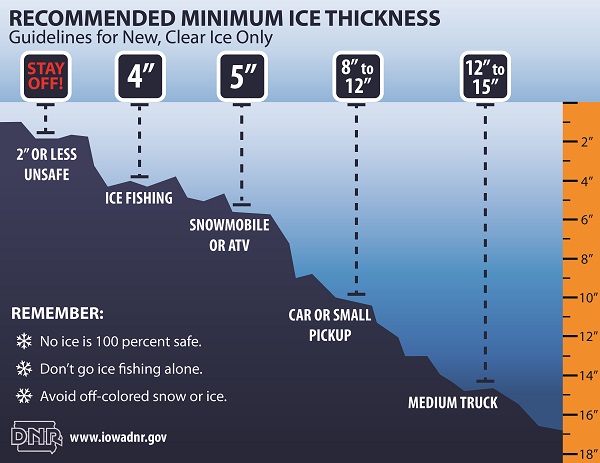
A blanket of snow on top of an ice-covered lake insulates the ice, slowing the growth of ice and hiding potential hazards or weak spots. River ice is 15 percent weaker than lake ice. Ice with a bluish color is safer than clear ice. Avoid slushy or honey-combed ice and stay away from dark spots on the ice. Don’t walk into areas where the snow cover looks discolored.
Safety Tips on the Ice
(Radio Iowa) – While many of the state’s leaders are crowing over income tax reforms they’ll propose in the legislative session that will open next week, Iowa’s Secretary of Agriculture Mike Naig says lower taxes would certainly benefit farmers, but that’s far from his only priority. Naig says, “We’re also looking at how can we continue to advance and strengthen renewable fuels, particularly around ethanol and biodiesel but really, all forms of renewable energy in Iowa.”
The state ag department is also working on efforts to expand agricultural markets and to protect the mainstay markets that are driving the state’s economy. “Whether that be expanding small and mid-sized meat processing or doing more to connect local and regional foods to consumers,” Naig says. “Those are positives. Those are things we get to look at to expand our marketplace.”
Naig says much of the heavy lifting has been done on water quality and the state’s initiative, but they will continue to build on water and soil conservation efforts and rewarding producers for climate-smart practices. “We’re always going to be focused as we go into the session on looking at how do we further strengthen our efforts around foreign animal disease prevention and preparedness,” Naig says. “That includes things like making sure we have a world-class vet diagnostic lab at Iowa State University.”
The 2022 Iowa legislative session opens Monday.
(Radio Iowa) – Iowa’s largest manufacturing employer is using this year’s Consumer Electronics Show to introduce its first autonomous tractor. Quad Cities-based John Deere put on an hour-long, multi-media presentation Tuesday, showing off the tractor that’ll be available later this year. Deere’s Deanna Kovar says autonomous tractors will help farmers do their difficult, time-consuming jobs.
“I like to think of this autonomous 8R tractor as one giant robot,” Kovar says. “It goes through the field autonomously, within an inch of accuracy, and it’s able to perform its job without human intervention.” Farmers can operate and monitor the tractor from their smartphone, tablet or computer, and she thinks it’ll give them more time — to run their farms and to spend with their families.
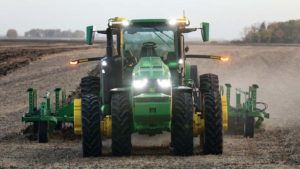
Deere photo of autonomous tractor.
Deere’s presentation featured Doug Nimz, a corn and soybean farmer from Minnesota, who’s shown in the video operating a tractor with his phone. “The thing that excites me the most about autonomy is not being locked in the tractor cab all day. It will just allow me to run my business better because I can just pay closer attention to other tasks,” Nimz says. “Now I’ll be doing the jobs we always wanted to get done but never had time to because we were in the cab all the time.” Nimz says farmers are traditional as a rule, but he believes they’ll soon accept autonomous tractors, adding, “It will be a life changer for me.”
(Radio Iowa) – With the approach of the one-year anniversary of the January 6th attack on the U-S Capitol, Iowa Senator Chuck Grassley says he’s satisfied with his safety in the building and he has no fears there will be any sort of repeat attempt to storm the capitol on Thursday. “I feel very secure,” Grassley says, “and I don’t expect anything to happen because of the increased security and particularly bills that have been passed where very quickly, National Guard can be called out.”
A U-S Attorney’s Office report says that over the past year, more than 725 people were charged with participating in the riot, several of them from Iowa. The incident left four rioters dead and more than 150 law enforcement officers hurt. One officer died of a stroke shortly after the riot while several more took their own lives in the following weeks.
Senator Grassley is applauding Biden Administration efforts to combat anti-competitive practices in the meatpacking industry. Up to 800-million dollars in loans and grants will aid small-scale beef, pork and poultry plants while setting up a new hotline for whistleblowers. Grassley, a Republican, says his response to the move is “Hallelujah.” “The big four packers control 85% of the daily slaughter,” Grassley says. “They can and, in fact, do abuse the market power while the retail price of meat has gone up, independent producers are getting less and less.”
Grassley says he fully supports administration efforts to bring fair prices to both producers and consumers, though he recognizes it will also take legislation. Grassley says he has a bi-partisan bill in the works. “It’s called the Cattle Price Discovery and Transparency Act,” Grassley says. “It’ll create fair market conditions for independent producers and reign in some of the bad behavior of the big packers.”
If the administration wants a solution for small producers and for consumers, Grassley says the president should endorse the bill and lobby for its swift passage.


 Facebook
 Twitter
 YouTube
 RSS
RSS