

CLICK HERE for the latest market quotes from the Iowa Agribusiness Network!
CLICK HERE for the latest market quotes from the Brownfield Ag News Network!


CLICK HERE for the latest market quotes from the Iowa Agribusiness Network!
CLICK HERE for the latest market quotes from the Brownfield Ag News Network!
(Radio Iowa) – Officials in 44 Iowa counties have now taken action to express concerns about the three proposed carbon pipelines. In the last week, the Adair and Floyd County Boards of Supervisors have sent letters to state regulators. Floyd County Supervisor Linda Tjaden says the proposed Summit and Navigator pipeline routes pass through Floyd County.
The letters express concern about training for emergency crews who’d have to respond to pipeline ruptures, as well as potential construction damage to land and drainage tiles. The letter about the Summit route also mentions it would pass through the Avenue of the Saints Development Park in Charles City and the pipeline could damage electrical, water and sewage utilities in the area.
The letter from the Floyd County supervisors also expresses concern about the use of eminent domain for a private purpose. State law allows pipeline developers to apply for eminent domain authority to gain access to properties where landowners have refused to grant voluntary easements.
The Adair County Board of Supervisors has sent the Iowa Utilities Board a letter, saying the board is not oppose to the purpose or construction of the pipeline, but is opposed to eminent domain being used as a way of achieving it. None of the three proposed pipeline routes run through Adair County, but there are nearby ethanol plants in Menlo and Corning. If those facilities are connected to a carbon capture pipeline in the future, the route would likely pass through Adair County.
(Radio Iowa) A judge has struck down a state law that enhanced the penalty for trespassing at an ag-related business if the person took pictures or recorded video that was shared. Animal welfare groups had sued the state over the law aimed at those who’ve used undercover video of livestock confinements and dog breeding facilities to allege the animals were being mistreated. Two previous state laws with the same goals have been blocked by federal courts. Critics say the laws could be used to shield unsafe working conditions or animal neglect. Supporters of the law say farmers are being smeared and hurt financially by unfounded accusations. The Iowa Capital Dispatch was first to report that a federal judge ruled that private property rights are an important governmental interest, but taking photos and recording videos is protected speech under the First Amendment.
 ATLANTIC, IA – The Atlantic Lions Club is back at Produce in the Park this week with free putt-putt golf. People of all ages are invited to enjoy mini golf, but you don’t have to play to enjoy it. It is a treat to see all the clever ways kids use the golf clubs to hit the ball and their persistence and concentration while
the work to get a hole in… 20?
In addition to free mini golf, this week at the market in the park visitors will find live music, a guest chef, visiting organizations providing helpful information and activities, and lots of delicious, fresh, local produce. Free taste tests of snack peppers will be offered to all. Snack peppers are sweet, crunchy peppers that come in a variety of colors and take almost no preparation—a win for anyone. While many shoppers are most familiar with green peppers, many folks find yellow, orange, or red peppers to be their favorites. As long as they aren’t specific hot pepper varieties, yellow, orange, and red peppers tend to be sweeter. Thursday is a great chance to taste tests peppers at the park. Cooler weather is on its way, and produce shoppers are reminded to get peppers, tomatoes, cucumbers, and green beans while
they’re still in season.
This week’s food trucks are Pim’s Thai and Zipp’s Pizzeria. Zipp’s will be taking orders for both whole pizzas and individual slices all evening (earlier in the season Zipp’s only offered whole pizza orders at the end of the market). Zipp’s will be offering their full menu of whole pizzas and will also be bringing frozen
pizzas to the park this Thursday.
All visitors to the park age 18+ are encouraged to enter this week’s free drawing. In addition to a dozen farm-fresh eggs sponsored by the Cass County Local Food Policy Council, one lucky winner will receive six cupcakes from Frosting Inc. Both prizes will be redeemed at next week’s October 6 Produce in the Park.
Survey information released from the U-S-D-A shows a big increase in farmland values and cash rent. Iowa State University livestock economist, Lee Schulz, says the cropland increased 19-point-seven percent.
Schulz says this is one set of numbers in the overall picture.
He says high commodity prices are one of the big drivers of land values.
Schulz specializes in livestock and says that industry is having an impact on pasture land values.
He says as the commodity prices rise there’s competition for that land. The Fed Reserve recently raised interest rates again and Schulz says that is going to continue to impact land values along with the other factors.
Iowa State releases its annual land value survey in December.
 Atlantic has entered the Iowa Cities Walking Challenge as part of Iowa’s October 5 Healthiest State Walk. However, to be counted in the challenge, all walk participants must be registered by midnight, Tuesday, September 27. To register for a walk visit http://www.iowahealthieststate.com/events/annual-walk/. To incentivize walk participation and registration, area businesses and organizations are donating door prizes. Winners will be drawn from all people who have registered for the walk by midnight, Tuesday, September 27.
All people participating in walks in Atlantic will be counted towards Atlantic’s Cities Walking Challenge, which provides funding to the cities with the most walk participants. A walk Atlantic-area residents may be particularly interested in joining is the walk from the Nishna Valley Family YMCA to Harl Holt Park and back on Wednesday, October 5 at 9:30 AM.
Participants will walk approximately two miles (there and back) along the newly renovated Bull Creek Pathway, learn about area recreational opportunities and trails, and enjoy refreshments from Hy-Vee and Fareway of Atlantic. A few lucky walkers will take a door prize, such as $25 gift cards from Brown’s Shoe Fit of Atlantic.
The Healthiest State Walk is a state-wide initiative that encourages people to “Walk More. Connect More.” Anyone can register a walk, and workplaces, schools, churches, and other organizations are encouraged to register a quick 30-minute walk anytime on October 5. For more information visit http://www.iowahealthieststate.com/events/annual-walk/.
The Healthiest State Walk is spearheaded by Iowa’s Healthiest State Initiative, a nonpartisan, nonprofit organization with the goal of making Iowa the healthiest state in the nation. On their blog, Iowa’s Healthiest State Initiative shares many benefits to walking including increased energy levels and better sleep, as well as increased blood flow that leads to better cognitive functioning, improved memory, and reduced anxiety and depression.
What: Help us celebrate the renovation of Bull Creek Pathway trail in Atlantic! We’ll walk from the Nishna Valley Family YMCA north parking lot to Harl Holt Park and back. Expect information on outdoor activities and trails in the area, as well as refreshments and a good time!
Where: Nishna Valley Family YMCA (1100 Maple Street, Atlantic, IA 50022). North parking lot.
Rain location: inside the YMCA
When: Wednesday, Oct. 5, 9:30-10:30 AM
Who: Anyone is welcome!
Cost: No cost! Free giveaways will be provided to participants. Door prizes will be drawn from
participants who have registered online by midnight, Tuesday, Sept. 27 at http://www.iowahealthieststate.com/events/annual-walk/.
Iowa State University researchers are part of a multi-state effort to map out where a rare type of bumble bee lives and to figure out what sorts of habitat it prefers. I-S-U grad student Erika Ibarra-Garibay says they’re assembling clues about the genetic diversity and overall health of what’s known as the rusty patched bumble bee.
Teams from I-S-U surveyed 50 sites across Iowa twice in recent months and they only found the rusty patched bumble bee at four locations — in Ames, Brushy Creek State Recreation Area near Fort Dodge, and two locations near Dubuque and Yellow River State Forest.
Another I-S-U grad student and team member, Kelsey Shepherd, says the findings could help wildlife managers and land stewards reverse the decline of bee populations and support other pollinators more broadly.
The I-S-U teams are also collecting data on the threatened American bumble bee. Once widespread across the eastern U.S. and Upper Midwest, the number of rusty patched bumble bees has plummeted nearly 90% since the 1990s.
While the rusty patched bumble bees were only found at four of the 50 Iowa sites, they were abundant in a few of those sites. Team leaders say that suggests there are survivor populations out there and it’s not too late for conservation action in Iowa.
(Radio Iowa) – Negotiators returned to the bargaining table this week, hoping to find an agreement that will end the strike at a southeast Iowa plant that makes Case I-H and New Holland equipment. About 430 United Auto Workers members employed at the C-N-H Industrial facility in Burlington went on strike May 1st. Paul Iverson of the Labor Center at the University of Iowa says manufacturing workers nationwide who stayed on the job in the pandemic’s early days seem to approach contract talks differently. “Workers in organized and unorganized ways have gotten together and said that, you know, we’re just not going to take the labor relations that existed before COVID,” Iverson says.”…It seems in some of these negotiations it seems that it’s taking employers to get that realization.”
John Deere and the United Auto Workers came to agreement last year that ended a five-week strike. It was the first strike at Deere in 35 years. The strike at the Burlington and Racine, Wisconsin C-N-H Industrial plants is nearing the end of its 20th week. Iverson says that’s not necessarily a surprise. “Case New Holland has had a more contentious relationship with its union over time than John Deere has,” Iverson says.
In early May, C-N-H Industrial released a statement saying the U-A-W’s decision to strike creates high anxiety among employees, customers and the community. C-N-H made a contract offer in mid-May that it said provided significant economic improvements for employees. The union called the offer subpar, with very little increase in pay and a downgrade in health benefits. The company says it’s committed to reaching an agreement and will continue to negotiate in good faith.
(Radio Iowa) – This is the first full day of fall and Iowans are already starting to see the leaves on a few trees turning red, yellow and orange. Joe Herring, a forester with the Iowa Department of Natural Resources, says Iowa’s trees are facing a long list of challenges this season, including the emerald ash borer, storms, and drought, in addition to just their sheer age. “Two out of every three trees are big trees, and that means only about one out of every three is a young replacement that’s gotten a start to provide for the next generation, the shade and all the other benefits,” Herring says. “Those old trees are great. We want to keep them around as long as we can, as long as they’re upright and strong and sturdy, but they are more susceptible to things like drought or storms.” 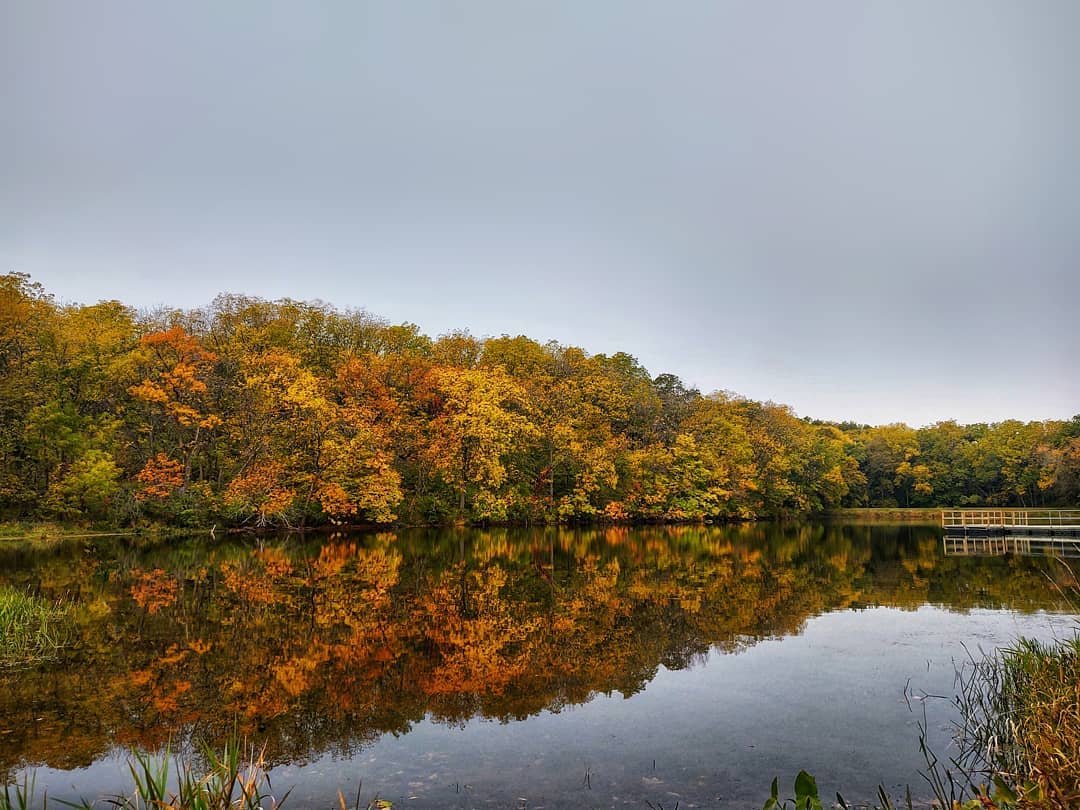
Herring, who’s based in Iowa Falls, says Iowans can likely expect a decent showing of fall colors in the coming weeks. “We didn’t have a ton of rainfall which promotes a lot of fungal diseases on the leaves every spring and that can affect the fall colors later on,” Herring says. “But with the drought conditions, we may have some early change. I don’t think that’s the worst thing for fall color and maybe it extends the season a little bit and we just hope we don’t get too early of a frost that was blacken and brown up the leaves.”
The D-N-R says fall colors typically start to appear across Iowa’s northern third next week through the second week of October, with the state’s central section seeing the best color the first through the third weeks of October, and southern Iowa the second week of October through Halloween.
(Radio Iowa) – A northeast Iowa native has been nominated to help lead U.S. Department of Agriculture efforts to expand and promote exports of agricultural commodities and products. Alexis Taylor has been nominated to serve as undersecretary for trade and foreign agricultural affairs. Taylor promises to work to remove trade barriers and ensure countries adhere to science-based regulations.
“Expanding and maintaining diversified market opportunities, rebuilding strong and reliable trading relationships, and and holding our trading partners accountable is essential,” Taylor says. Taylor expects part of the job will be dealing with the growing food security crisis caused by Russia’s invasion of Ukraine. “The United States plays a critical role in combating food insecurity and working to protect the most vulnerable,” Taylor says.
Taylor testified before the U.S. Senate Agriculture Committee yesterday (Thursday). “I would not be here today without the support of my family, including my mother Carol, who’s watching from home in Iowa,” Taylor said. “…I am also thankful for the first and most influential farmer in my life, my father Joe.

Alexis Taylor (USDA photo)
Although he has passed, there’s not a day that goes by that I do not call upon the lessons that I learned on the farm from him.” Taylor grew up near Holy Cross, a small town in Dubuque County, on a farm that’s been in her family for over 160 years.
“I learned many things growing up on my family’s farm, from the hard work and long hours our producers put into raising a crop or keeping livestock healthy to the challenges that unpredticable weather and volatile markets can bring, but one of the most to important things that was instilled in me as a child was a desire to give back to my community,” Taylor said. “…It drew me to a career in public service, working to advance the interests of the community I grew up in — U.S. agriculture.”
Taylor graduated from Iowa State University in 2005 with a degree in political science. She served in the Army Reserves and did a tour of duty in Iraq. Taylor oversaw the U.S. Department of Agriculture’s Farm and Foreign Agricultural Services before being appointed director of the Oregon Department of Agriculture in 2016.


 Facebook
 Twitter
 YouTube
 RSS
RSS