

CLICK HERE for the latest market quotes from the Iowa Agribusiness Network!
CLICK HERE for the latest market quotes from the Brownfield Ag News Network!


CLICK HERE for the latest market quotes from the Iowa Agribusiness Network!
CLICK HERE for the latest market quotes from the Brownfield Ag News Network!
(Radio Iowa) – On issues ranging from electric cars and ethanol to farm subsidies for billionaires, Iowa Senator Joni Ernst questioned U-S Secretary of Agriculture Tom Vilsack today (Thursday) during a hearing before the Senate Ag Committee. Ernst, a Republican, says it’s hard to understand why the largest ten-percent of farms are raking in 70-percent of commodity payments, and she says critical reforms are needed in how the U-S-D-A decides who gets the cash.
“Thus far, grants totaling $157 million have been awarded,” Ernst says. “Three of the largest grants total $69 million, which comprise nearly half of the funds awarded, three projects who are privately owned by some of the wealthiest people in the United States.” Vilsack, a Democrat and a former Iowa governor, says proper procedures are being strictly followed with regards to the millions of dollars in agricultural grants that are being awarded.
“The level of investment is based on the application that people have submitted,” Vilsack says. “Some of these plants are very small. The Charles City plant, for example, is very small. It needed $8 million and we provided it. The Cherokee plant needed several million dollars, we provided it. So Iowa has received several grants already and I anticipate and expect they’re going to receive at least one more.” Ernst says recent recipients of the U-S-D-A grants include a man who’s on the Forbes billionaires list, as well as a South Carolina family that owns major production facilities in five states.
“I have no objection to families succeeding and owning a lot of businesses and I wish them great success,” Ernst says, “but what I find problematic is that taxpayer dollars are being doled out as free grants to billionaires, while applications from farmer-owned startups like Cattlemen’s Heritage in southwest Iowa are deemed unworthy through these grants.” Cattlemen’s Heritage promises to be a regional cattle processing plant that’s planned for the Council Bluffs area. Owners say they’ll hire 800 workers who will process up to two-thousand head of cattle per day when the plant opens, tentatively in late 2024. Vilsack says he’s well aware of the endeavor.
“The Iowa project you mentioned is actually on the list that’s currently under review,” Vilsack says. “We’re in the process of finishing the environmental review that is required under NEPA, before grants can be issued. So, just be patient. I think you’re going to find that that is a project that merits additional investment.” Ernst applauded the U-S-D-A’s efforts to promote green energy, but denounced what she called an “ardent push toward electric vehicles,” calling Iowa-made, corn-based ethanol a ready-made resource that’s a cheaper energy solution and that’s “very beneficial for our farmers.”
Vilsack didn’t address those comments directly.
(Massena, Iowa) – The Cass County Conservation Board is hosting an Introduction to Turkey Hunting program this Saturday, at the Outdoor Classroom shelter, located at 76977 Tucson Road, Massena, IA. (Two-miles south and two-miles east of Massena. Two-miles east of Highway 148 on Tucson Road, on the south sign….just look for the sign. The program begins at 10-a.m. Cass County Conservation Director Micah Lee says turkey hunting remains popular.
Lee explains there is a big difference in hunting for pheasant and turkey: the time of year.
This Saturday’s program will focus on “Becoming a Turkey Hunter,” for first-timers and can serve as a refresher for those who may be a bit rusty where their hunting skills are concerned. CCCB employees will talk about scouting, calling, and equipment needed as well as different techniques and equipment used by successful turkey hunters.
This program will be great for someone who wants to start turkey hunting or those with more experience. The CCCB will have examples of calls, decoys, blinds and other tools used in the turkey woods. And, as with last year, there will be a drawing for a prize at the end of the event.
Bring a notepad to take notes, if you want, otherwise just show-up at the Outdoor Classroom this Saturday, March 18, 2023 at 10:00-a.m., to learn a few things and get started on your turkey hunting adventure. Micah reminds you, that we’re about three-weeks away from Youth Turkey Hunting Season.
(Massena, Iowa) – The Cass County Conservation Board is holding Vermicomposting (Worm Composting) Workshop. Cass County Naturalist Lora Kanning says the program will be held at the Outdoor Classroom shelter, located at 76977 Tucson Rd, Massena, IA on Saturday March 25th 2023, 1 PM, all ages are welcome to attend.
Kanning says “Let worms EAT your kitchen waste! All types of composting will be discussed as well!” There is an option, she says, to make and take your own worm bin, for a suggested donation of $25/bin. 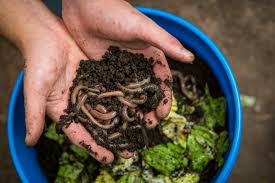
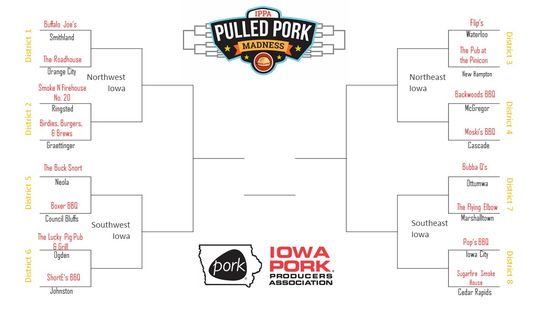
(Clive, Iowa) – March Madness tips off this week with college basketball teams battling for the No. 1 spot in the nation. But you don’t have to live and breathe hoops to cheer on restaurants vying for Iowa’s best pulled pork sandwich. Every March, the Iowa Pork Producers Association searches for Iowa’s best pulled pork sandwich. Nominations were accepted from March through the 10th. Voting is now open until 10-a.m. March 17th, for the “Elite 8,” from the “Sweet 16” nominations. A vote for the “Final 4” will be held from 5-p.m. March 17th until 10-a.m. March 22nd. The event wraps up with the “Final 2, and a vote for the Champion on March 31st.
The winning restaurant receives $250, a plaque, and the honor of being this year’s Pulled Pork Madness CHAMPION!!! Past winners cannot be nominated. Pulled pork must be from a restaurant that is typically open year-round with regular hours. Food trucks, concession stands, seasonal establishments, and catering businesses are not eligible. No email or social media nominations will be counted. 
(Iowa DNR) – Channel catfish move close to shore and are eager to bite in many lakes and the large reservoirs across Iowa just after the ice is gone. The bite starts sooner in southern Iowa impoundments since they lose ice a week or two before northwest Iowa natural lakes.
After eating light during the winter, channel catfish put the feed bag on in early spring cleaning up small fish that died over the winter. Search for actively feeding fish on windblown shorelines and points where dead fish are piled up and the shallow water warms quickly. Keep the wind in your face and move often until you find actively feeding fish.
Use cut bait or shad sides fished on the bottom. To keep the bait on the hook, try using a 1/0 to 3/0 bait holder hook and enough weight (3/8- to 1/2-ounce) to cast into the wind. Bring along disposable latex gloves to handle the bait and help keep the smell off your hands.
Ice-out catfishing can be good in any lake that has an abundant catfish population. Iowa’s flood control reservoirs, Rathbun, Red Rock, Coralville and Saylorville usually offer the best action. Try catfishing in the natural lakes, like Storm Lake, North Twin, Tuttle, East Okoboji, Little Wall Lake, or Black Hawk Lake in northwest Iowa soon after the ice is gone. Small impoundments, like Don Williams, Big Creek, Volga Lake, Diamond Lake, Mormon Trail Lake, Greenfield City Reservoir, or Lake Icaria, also offer good early spring catfishing.
Catfish can be found in almost every body of water across Iowa. Check the weekly fishing report to find out where catfish are biting.
Kellerton, Iowa – The first rhythmic and haunting cooing begins as the night sky fades and sunrise begins. The short grass prairie booming grounds prepares for a display found nowhere else in Iowa. This is prairie chicken country and April 1 will be Prairie Chicken Day at the Kellerton Wildlife Management Area, in Ringgold County. Activities originate from the viewing platform on 300th Avenue, southwest of Kellerton. The bird’s annual ritual begins as early as mid-March and lasts through April. Male prairie chickens meet at the booming grounds every morning to display, spar and fight with other males trying to catch the eye of the females watching nearby.
“They will be out there until 8 in the morning or so, when they begin to slow down,” said Stephanie Shepherd, wildlife biologist with the Iowa Department of Natural Resources’ Wildlife Diversity Program. Prairie chickens will display each morning regardless of the weather. The area has an elevated viewing platform to help see all the action. “Some mornings you can hear them and some you can’t. They are out there every day, but are less active if it’s raining or really cloudy,” Shepherd said. While there will be some spotting scopes available to use, attendees are encouraged to bring their own or a set of binoculars.
The prairie chicken population at Kellerton has benefited from a collaboration between the states of Iowa, Missouri and Nebraska, and the Nature Conservancy, Blank Park Zoo and the Ringgold County Conservation Board. The collaboration extended to area producers who help to manage 30 percent of the grasslands through grazing. Some of the partners captured and relocated prairie chickens from Nebraska to the Kellerton area and the Dunn Ranch in northern Missouri to increase bird numbers and introduce new genetics to the population. While others worked to reestablish the rolling grasslands in the area.
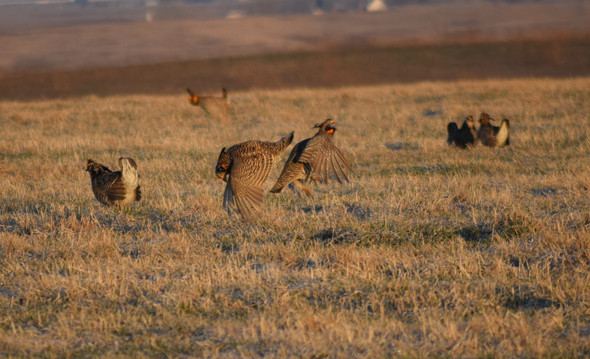
From mid-March through the end of May, male prairie chickens meet at the booming grounds every morning to display, spar and fight with other males trying to catch the eye of the females watching nearby. Photo courtesy of the Iowa DNR.
“There has been a lot of collaboration to improve the landscape across the state line to recreate 160,000 acres of rolling hills of grass with few trees,” Shepherd said. “This partnership benefits not only the prairie chicken, but other grassland species as well.” This year, in addition to prairie-chicken viewing, the Iowa Ornithologist’s Union will lead a birding field trip, starting at 8 a.m. All birding experience levels are welcome and the plan will be to bird around Kellerton, Ringgold and Mount Ayr wildlife areas. Target birds include northern bobwhite, red-shouldered hawk, loggerhead shrike and northern mockingbird.
Participants can meet field trip leaders at the prairie chicken viewing platform area at 8 a.m. and can direct any questions to Dennis Thompson at cndthomps@gmail.com.
(Radio Iowa) – The Iowa Utilities Board heard from the attorneys representing two companies which hope to build carbon dioxide pipelines today (Tuesday) as they try to work out scheduling issues for their permit requests. I-U-B chair, Geri Huser asked Wolf Carbon Solutions attorney, Amanda James, if they still plan to request a hearing on the project in the second quarter of 2024. “At this time it’s too early to be able to tell when we would like to schedule our hearing. They’re just getting out in the field now, and so they’re working with landowners, property owners,” she says. “To be able to say when we want a hearing, we just don’t have that information yet for a defined route.” Huser told James the Board does not believe there needs to be oral arguments on the location of the hearing — which is required to be near the middle of the area where the pipeline will be built.
“We agree and we thought that maybe just written comments if there’s any ideas on how to determine the location or midpoint,” James says. Navigator Ventures attorney, Samantha Norris was also asked about the timeline for the hearing. “We are requesting a hearing in the first quarter — we’ll plan on requesting a hearing in the first quarter of 2024. We would ideally like to finish that hearing before spring planting commences,” Norris says. Norris says they would like to start construction in the first half of 2024 if approved. She was also asked about taking oral arguments on the proposed site for the hearing on the pipeline.
“At this point, we don’t know that oral arguments are necessary. But because we have a number of interested stakeholders. And because our the layout of our line differs somewhat from Summit’s and from Wolf’s we think that it should be briefed at least so that all parties have a chance to say what location they think or multiple locations may be compliant with the statutory requirements,” Norris says. Summit Carbon Solutions is the third company proposing a pipeline — with a public hearing on the project set for October.
(Radio Iowa) – An Iowa State University study finds the size and number of small farms in Iowa is dwindling, while the size and number of commercial farms is exploding. Professor David Peters, an extension rural sociologist at I-S-U, defines a small farm as being about 300 acres. Those small farm numbers are down 27-percent and the acreages farmed by those small operators shrunk by nearly 50-percent.
As for large commercial farms, of between two- and four-thousand acres, their numbers doubled while the farmland that they operated expanded by some 75-percent. Peters says whether that’s a good thing or a bad thing depends on your point of view. Larger farms tend to be more efficient and produce large amounts of commodities at relatively better prices, but he says Iowa is in danger of losing its agricultural legacy.
(Radio Iowa) – The Iowa Department of Natural Resources has finalized its state drought plan. D-N-R hydrology coordinator, Tim Hall, says the plan is a resource for state, county and local use. “We think it’ll give us a better opportunity to stay in front of drought conditions,” Hall says. The Iowa Department of Homeland Security and Emergency Management and the Iowa Agriculture Department helped develop the plan. Hall says the plan also draws from the longtime U-S Drought Monitor and provides a more localized version of that national program. “The drought plan also provides schedules and structure for having discussions and meetings and providing information to local decision makers during times of drought,” Hall says. “So we think it’s going to be a good tool to both prepare for and respond to drought conditions.”
State climatologist Justin Glisten is one of the primary contributors of Iowa information to the U-S Drought Monitor — and Hall says he’s helped develop the components of this state plan. “For example, in northwest Iowa stream level stream flows are very important for groundwater resources. So we’ve got the ability to look at statistical analysis of streamflow around the state to help us be better prepared for drought conditions,” he says. The plan divides the state into five regions, and will provide information on the drought status in each area. “Right now there are eight counties in northwest Iowa that are in our drought region one that we classify as being in drought watch. So it’s the lowest level of drought situation in the state,” Hall says. “So we do recognize that that corner of the state does still have some drought challenges.”
Hall says they will tweak the state drought plan as needed. “We’re going to spend the next this next year using the drought plan — and I suspect we’re going to learn quite a bit as we put it into practice,” he says. “We anticipate issuing a new version of the drought plan in about a year based on experience we get here in this first year.” You can see the full Iowa Drought Plan at the D-N-R’s website: iowadnr.gov.


 Facebook
 Twitter
 YouTube
 RSS
RSS