

CLICK HERE for the latest market quotes from the Iowa Agribusiness Network!
CLICK HERE for the latest market quotes from the Brownfield Ag News Network!


CLICK HERE for the latest market quotes from the Iowa Agribusiness Network!
CLICK HERE for the latest market quotes from the Brownfield Ag News Network!
(Radio Iowa) – Iowans are being encouraged to make plans to spend some time on New Year’s Day in the state’s great outdoors by taking part in any of two dozen First Day Hikes, hosted by the Iowa Department of Natural Resources. Sherry Arntzen, chief of the D-N-R’s State Parks, Forests, and Preserves Bureau, says this is the 13th year the state’s offered these free, brisk treks on trails through state parks and forests on January 1st.
“We have nearly 20 state parks that are participating in staff-led or friends group-led hikes,” Arntzen says. “We do have some other parks that have self-guided hike opportunities that you can do at any time on January 1st, so we’re really excited to be able to offer this again.” The rationale is, if folks start off their new year getting out and into nature, being physical, soaking in some sunshine and fresh air, maybe it’ll be the beginning of a healthy habit.
“First Day Hikes are a great way for everybody to get outside, get some exercise, enjoy our wonderful natural resources that we have,” Arntzen says, “and it’s a great way to welcome in the new year with family and maybe even meet a new friend or two.” Some of the hikes will include wildlife viewing opportunities and hot beverages and snacks afterwards. The hikes will average one to two miles, or longer, depending on the location.
“We do have a number of wonderful vistas or scenic views on our trail system,” Arntzen says, “so if we have guided hikes there, they’ll talk a little bit about it. They’ll talk about the resource and of course, it’s always a treat to see the different kinds of wildlife: birds, deer, turkey, that you’ll see when you go on the hikes.”
The hikes on January 1st of 2024 will also mark the start of the 100th anniversary years for two Iowa state parks: Ledges and Pilot Knob. Find details about each hike at the website: www.iowadnr.gov/firstdayhikes
Here’s the list of parks with events:
• Backbone State Park
• Bellevue State Park
• Cedar Rock State Park
• Dolliver Memorial State Park
• Elk Rock State Park
• Gull Point State Park
• Honey Creek State Park
• Lacey-Keosauqua State Park
• Lake Anita State Park
• Lake Darling State Park
• Lake Wapello State Park
• Ledges State Park
• Maquoketa Caves State Park
• Mines of Spain State Recreation Area
• Palisades-Kepler State Park
• Pikes Peak State Park
• Pilot Knob State Park
• Pleasant Creek State Recreation Area
• Prairie Rose State Park
• Shimek State Forest
• Springbrook State Park
• Waubonsie State Park
• Wildcat Den State Park
• Yellow River State Forest
(Radio Iowa) – A couple of donations will allow the Iowa Department of Natural Resources to build out a wildlife tracking system across the state. D-N-R Avian Ecologist, Anna Buckardt Thomas, says the system called Motus is a series of antennae stations and tracking tags that emit a radio signal. “And if they go by a station that’s listening on that same frequency, that station can detect those wildlife. And so we can build a really large scale understanding of movements of these wildlife,” she says.
There are currently 18 stations in Iowa and the 120-thousand dollars in donations will allow them to expand that by 20 stations to create a corridor from east to west across the center of the state. “And then stations bordering the Mississippi and Missouri Rivers. And so that way, we’ll be able to understand bird movement along those major river corridors and that movement as well,” Thomas says. “And then, because we’ll have that fence through the middle of the state, we’re likely to detect pretty much any tagged wildlife that would come to Iowa.”
The tags are put on smaller migratory birds and insects like butterflies and dragonflies. The tags vary in size based on what’s being tagged, and that also dictates how long its battery will last. “For something like an insect, that tag lasts maybe a handful of weeks or a month. And for something like a small bird, it might last six months in a large bird, you might get a tag that can last over a year,” she says.
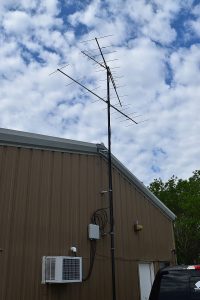
Motus tower station at the Iowa DNR’s Black Hawk Unit office, near Early. Photo courtesy of the Iowa DNR.
Thomas says different groups tag different species based on what they want to research, and she says there is always some sort of tagging going on. She says the stations all over the western hemisphere and Iowa provide a variety of information that the D-N-R can review. “So if we can learn about particular pathways or particular habitats that are really important for these migratory species, we can help inform our conservation and management of those areas,” Thomas says. The information is also available to the public at the website motus.org.
“And you can explore a map of all the existing stations, you can click on a station and learn about what animals have flown by or moved by and then detected by that station,” she says. “You can look up what species of wildlife are being tagged on the system. You can look up a specific tagging project if you’re aware of it, though. There’s a lot of really cool data to explore.” Thomas says you can also build maps of individual birds or collections of birds to see where they’re being detected as they move during migration periods.
The D-N-R hopes to add the additional sites in the next five years.
(Atlantic, Iowa) – You’re invited to join Cass County Conservation Department Staff at Atlantic’s Schildberg Recreation Area- Lake number 4, on Saturday, January 6, 2024 for “Soiree with the Swans.” Conservation Dept. Staff will be giving ten-minute presentations regarding the Trumpeter Swans every half-hour, beginning at 11-a.m., with the last one presented at 2-p.m.
There will also be time to view the swans through spotting scopes and witness random swan feeding sessions. Hot chocolate, cookies, and other snacks will be provided free of charge with donations being accepted (for swan care).
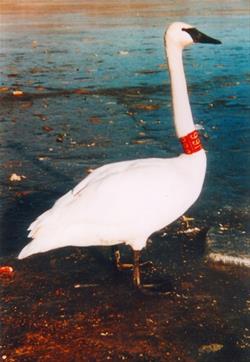 The Schildberg Recreation Area is located on the northwest edge of Atlantic, Lake 4 is on the north side of Highway 83. Atlantic is celebrating 24 winters of the Trumpeter Swans wintering here.
This event is not to be missed! IF THE WEATHER IS “BAD” OR THE SWANS ARE NOT AT THE PARK…the program will be at the Atlantic Public Library from 12:00 p.m.-1:00 p.m. with hot chocolate, cookies, and other snacks available. The event is being sponsored by the Cass County Conservation Board, Atlantic Parks and Recreation, and the Iowa Department of Natural Resources.
(Des Moines, Iowa; USDA News) — USDA’s Natural Resources Conservation Service (NRCS) obligated a record $85.8 million in conservation practice funding to Iowa farmers in fiscal year 2023, through 1,628 conservation program contracts that will help treat natural resource concerns such as soil erosion and water quality on 386,736 acres. Conservation program contracts typically run three to five years, depending on the program. The obligated funds are nearly $3 million more than the prior record of $83 million in fiscal year 2021, and $16 million more than the prior five-year average.
IRA Funding
NRCS State Conservationist Jon Hubbert says a major reason for the increase in conservation funding is the Inflation Reduction Act (IRA), which helped NRCS provide $18.6 million to Iowa farmers in 2023. Hubbert says the IRA offers unprecedented funding for several existing programs. “We are using IRA funds to provide direct climate mitigation benefits to Iowa landowners and expanding access to NRCS assistance to increase conservation on Iowa’s private lands,” he said.
IRA funding is targeted to support climate-smart agriculture mitigation and help farmers build resilience in their operations. Examples of eligible practices include cover crops, no-till farming, nutrient management, prescribed grazing, and tree planting. “Many of the conservation efforts Iowa producers are adopting through IRA offer stacked benefits,” said Hubbert. “They are also benefitting soil health, water quality, wildlife habitat and protecting other resource concerns.”
Hubbert says IRA funding will increase over the next few years. “This is a great opportunity for Iowa landowners to address resource concerns on their farms,” he said. “The support for voluntary conservation at the local and national level has never been greater.”
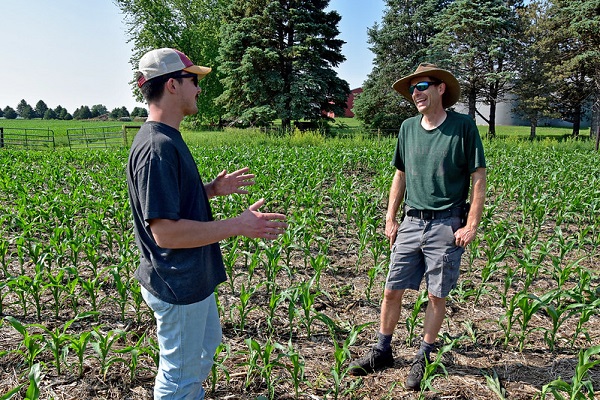
WelchBakehouse – Iowa farmers like Jon Bakehouse (right) of Mills County are utilizing USDA-NRCS conservation programs to diversify their operations while simultaneously protecting and enhancing their natural resources, such as soil health, water quality and wildlife habitat.
Program Breakdown
NRCS provides conservation funding through four primary programs authorized through the Farm Bill: Conservation Stewardship Program (CSP), Environmental Quality Incentives Program (EQIP), Agricultural Conservation Easement Program (ACEP), and Regional Conservation Partnership Program (RCPP).
Conservation Stewardship Program (CSP): CSP helps farmers build a customized plan to meet their conservation goals and needs. Iowa NRCS obligated about $22.2 million through new and renewed CSP contracts during the past year to 557 Iowa landowners who signed five-year CSP contracts to treat natural resource concerns on their land. The CSP contracts will cover 267,103 acres.
Statewide leaders in CSP:
Environmental Quality Incentives Program (EQIP): NRCS contracted about 45 percent of new federal conservation funding in Iowa through EQIP – a voluntary program that promotes agricultural production and environmental quality, where farmers can choose from a conservation practice list developed at the county level to treat local resource issues. Through EQIP, NRCS obligated $39.1 million covering 93,717 acres through 840 contracts. For the second consecutive year, cover crops, brush management, prescribed grazing, and no-till were the most adopted practices by Iowa farmers.
Statewide EQIP highlights:
Regional Conservation Partnership Program (RCPP): Iowa NRCS provided more than $10.5 million to Iowa farmers in 2023 through RCPP projects that will help treat natural resource concerns on more than 24,000 acres. NRCS assisted producers through eight RCPP partnership agreements and 207 contracts. RCPP promotes coordination between NRCS and its partners through agreements and program contracts. The eight RCPP projects in Iowa focus primarily on improving water quality and soil health.
Easements: Through ACEP, NRCS helps landowners, land trusts, and other entities protect, restore, and enhance wetlands, grasslands, and working farms through conservation easements. Overall, there are 1,722 conservation easements in Iowa covering 198,407 acres. During fiscal year 2023, Iowa NRCS obligated $14 million by helping landowners to place agricultural land into 12 new conservation easements. They include:
Iowa NRCS staff also obligated $13.7 million to historically underserved producers through 278 contracts, covering 30,295 acres. Historically underserved producers include beginning farmers, military veterans, limited resource producers, and socially disadvantaged farmers. NRCS staff wrote 12,753 conservation plans during fiscal year 2023, which covers more than one million acres. Conservation plans help producers target and address natural resource concerns such as soil erosion, water quality, and wildlife habitat, in addition to addressing climate change and improving soil health.
For more detailed Iowa NRCS program results and information, go to https://www.nrcs.usda.gov/sites/default/files/2023-11/2023At-A-Glance.pdf.
(Radio Iowa) – Despite drought conditions, a five-acre operation at the Johnson County Historic Poor Farm wrapped up the growing season by reporting record production. Grow Johnson County produces fresh fruits and vegetables, 100-percent of which is donated to 16 local emergency food organizations. Program manager Claire Zabel) says they produced 40-thousand pounds of fresh food this year, the farm’s highest-ever yield.
Zabel says the season’s production increase is due, in part, to increased staffing this year.
Some 83-percent of Iowa is experiencing drought conditions. The U-S Drought Monitor says more than a quarter of the state is in exceptional drought. Historically, that has significantly impacted row crop yields.
(Radio Iowa) – The Iowa State University Farmland value survey shows a record price once again, but the increase is less than last year. I-S-U’s Rabail Chandio oversees the survey, and says the average price for an acre is 11-thousand-835 dollars. “This is a three-point-seven percent (3.7%) increase from last year, and a 424-dollars increase from last year,” she says. The single digit increase comes after two straight years where land values went up by double-digits. “Last year, we saw an increase of 17 percent…, and before that the increase was 29 percent So we’re still seeing an increase, but it’s a lot more modest and has slowed down,” Chandio says. She says the current land value trend appears to be following what happened about ten years ago when land values rose, and then there were minor adjustments without a crash in the market.
“And we’re seeing kind of a similar thing here. Right now we’re seeing we were at a quite a high value during the last couple of years, which is decreasing. And we’re hoping again, that it won’t really crash but we’ll see a soft landing,” Chandio says, “as is happening in the broader economy, we avoided a recession we hope to see kind of same thing happen in the land markets.” Chandio says the slowdown led to one of the nine land districts seeing a drop in overall values for the first time in several years.
“This year the northwest (district) saw a decrease of zero-point-eight percent. All of the other crop reporting districts show and increase in the land values, with the highest being the south-central and the southeast at 12-point-eight percent and nine-point-six percent,” she says. Chandio says it appears the southern district was lagging a little behind the others in their increases, and that could be why they are showing the higher values in this report.
(Radio Iowa) – Leaders of the Iowa Bicycle Coalition are on a road trip this week with the goal of visiting 99 Iowa bike shops, giving a nod to Iowa’s senior U-S senator in calling this a “Full Grassley Tour.” Coalition executive director Luke Hoffman says they’re striving to highlight and support local bike shops and their economic impact while generating interest in cycling, even as winter looms. “The Iowa Bicycle Coalition, being the statewide nonprofit organization around bicycle advocacy and shared safe roadways,” Hoffman says, “we, to that end, want to talk to cycle groups, bike shops, bike-friendly businesses about how we can be building community together.” As part of the tour, Hoffman says they’re meeting with cycling enthusiasts, which includes those who love riding in the cold weather with specially-equipped winter bikes. All of the visits center around local bike dealers and mechanics.
“It’s about doing local bike rides, visiting the bike shops,” he says, “and then talking to those business owners about how they can be part of our advocacy work, as well, in the legislative session.” Hoffman says the coalition is working to promote safe and accessible bicycling in Iowa through education, events, better policy, and growing a community of supporters. He says this week-long tour is part of that vision, to make bicycling in Iowa safe, enjoyable, and accessible for all.
“We’re doing it because we want to start something new and unique and that’s Support Your Local Bike Shop,” Hoffman says. “This time of the year is a time where bike shops typically see a little bit of a dip in business just because it’s not the summer months, it’s not close to RAGBRAI. So we want to show them some love ahead of the holiday season and let people know they can support their local bike shop this time of the year.”
The annual Iowa Bike Expo is scheduled for next month at the Iowa Events Center in Des Moines, one of the Midwest’s largest one-day bike shows. Later that same day, January 27th, will be the RAGBRAI Route Announcement Celebration.
(Atlantic, Iowa) The City of Atlantic’s Board of Adjustment, Monday evening, denied a conditional use permit request from the owner of the Cass County Animal Clinic.
The permit would have allowed Dr. Erin Conrad-Schwarte to build a vet clinic at 2309 Whitney Street (an East 22nd St. Parcel). Dr. Schwarte purchased the Cass County Animal Clinic from Dr. Larry Victora in May, 2020. Since then, she has provided veterinary services for all sorts of animals. She wanted the parcel to board dogs and cats and for an outdoor dog run that would have been used during business hours. Schwarte told the Board any livestock visiting the clinic would have been contained within the fenced area on the south side of the clinic and within the clinic, and they would not normally be housed on the property overnight.
The proposed project, however, would have been in a low-density, single-family residential district. The fact that the area is zoned residential, prompted many residents in the area to attend the meeting and voice their opposition to the permit, citing safety and comfort concerns.
Taking those concerns into consideration, the Board moved to decline the conditional use permit.
(Radio Iowa) – A veteran central Iowa beekeeper will offer a free, online course in beekeeping starting next month for Iowa youth between the ages of 13 and 16. Julia McGuire heads the Des Moines Backyard Beekeepers and she has ten hives in Madison County. McGuire says the live course in Beekeeping 1-0-1 will start January 30th, teaching all about these important pollinators and how to care for them.
“We’ll cover basic bee biology, and it goes through site location for your beehive, the confluence of the beehive,” McGuire says, “and then we spend a lot of time learning how to work the bees once they arrive in April.” McGuire has kept bees since 2011 and has taught beekeeping for 11 years. The course will run every Tuesday for six weeks.
“There’s also a couple opportunities where we will go and meet in person, so we can work with bees all together,” McGuire says, “so I think a lot of the success in beekeeping is that hands-on work that you might get with a mentor.” For many, beekeeping is a hobby, but McGuire says it can also become a profitable business. She sells honey from her hives, but says there’s another important component to beekeeping — saving swarms.
“I get a lot of swarm calls every April and May from people who have a swarm of bees, or bees actually living and have been in the side of their house or whatever for years,” McGuire says. “I get a lot of phone calls like that. There’s just more demand than there is supply of people who can go get those.” She estimates it may cost around 500-dollars to start a basic hive. In addition to the free Beekeeping 101 course, there’s a youth bee camp planned for May of 2024.
The deadline to sign up for the course is December 31st at: https://forms.gle/h3Lh2zvkwRgwNZnY7


 Facebook
 Twitter
 YouTube
 RSS
RSS