

KJAN News can be heard at five minutes after every hour right after Fox News 24 hours a day!
Keep up-to-date with Fox News Radio, Radio Iowa, Brownfield & the Iowa Agribusiness Networks!

KJAN News can be heard at five minutes after every hour right after Fox News 24 hours a day!
Keep up-to-date with Fox News Radio, Radio Iowa, Brownfield & the Iowa Agribusiness Networks!
(Radio Iowa) – Two scientists who helped create an international seed vault received the World Food Prize last week in Des Moines, spotlighting the importance of seed banks, including one in northeast Iowa. The Seed Savers Exchange, based in Decorah, is a collection with more than 20-thousand heirloom varieties of fruits, vegetables, flowers and grains. The non-profit’s development director Cindy Goodner says it’s one of the largest non-governmental seed banks in the U.S. “Our collection of home-grown seeds is really deemed as being globally significant,” Goodner says. She notes the Seed Savers’ mission is to build a community of people who safeguard heirloom seeds for the future.
Goodner says this year’s World Food Prize, often dubbed the Nobel Prize of food and agriculture, elevates the importance of protecting crop diversity. Mike Bollinger, executive director of the Seed Savers Exchange, says home gardeners and small-scale farmers who save and share heirloom seeds are also vital links to maintaining diversity in our crops. “No matter how you’re looking at it, you need crop diversity,” Bolinger says. “It is really the foundation of our agricultural food system, and so it’s important to preserve that.” Bollinger says he was happy to see the World Food Prize awarded to scientists in this field. He says it brings attention to seed banks and their role in food security, especially in the face of climate change.
The World Food Prize went to Geoffrey Hawtin and Cary Fowler, who helped start the Svalbard Global Seed Vault in Norway in 2008. It’s a backup for more than 100 seed banks around the world, including the Seed Savers Exchange.
(Iowa Capital Dispatch) – Though many Americans are eagerly awaiting an end to the 2024 election season today (Tuesday), national and state officials say to be prepared to not get final results tonight. In Iowa, voters have been participating through early and absentee voting since Oct. 16 — and many more will go to polling places to vote in person today. Voters have an 8 p.m. deadline — with precinct locations open until 8 p.m. and absentee ballots due to local county auditor’s offices by 8 p.m. to be counted.
Though there will be unofficial results available tonight, Election Day is just the beginning of the process for counting and confirming votes in the path that leads to elected officials taking their positions in January. Iowa Secretary of State Paul Pate said in a statement Monday that Iowans should remember election night results are unofficial — results are only official and final after being certified by the county and state boards of canvass on Dec. 2.
That does not mean Iowans will not know the outcomes of many races tonight. Once polls close, unofficial results are submitted by local county auditors, Pate said, adding that “county commissioners are to remain on duty until all election results have been reported from all of their precincts, including absentee ballots.” Election results, and breakdowns by precinct and county, will be available on the Secretary of State’s website. Races will also be called by the Associated Press tonight as unofficial results are posted.
However, if margins are extremely tight in specific elections, a winner may not be called in some races. A recent example in Iowa is U.S. Rep. Mariannette Miller-Meeks’ first election to Congress in 2020, winning the 2nd Congressional District race against Democrat Rita Hart. The race was considered too close to call on election night, Nov. 3, 2020. Through the recount and eventual certification process by the state Board of Canvass, Miller-Meeks’ victory came down to six votes.
Even after Miller-Meeks was declared the winner following recounting and canvassing, the Republican was seated provisionally in Congress due to a legal challenge posed by Hart. The challenge was not withdrawn until March 2021.
Miller-Meeks was not the only race being contested long after Election Day in 2020. Results in the race between former President Donald Trump, who is again the Republican presidential nominee in 2024, and President Joe Biden also took time to be finalized in states like Nevada and Georgia. In the months and years following, Trump has falsely claimed the 2020 election was stolen from him. These claims, in part, led to the Jan. 6 Capitol insurrection and heightened distrust of U.S. elections, as well as an increase to threats to election officials and poll workers.
Election officials said in interviews with States Newsroom to expect similar challenges and disinformation about results to come in the 2024 general election, where Trump faces former Vice President Kamala Harris. Already, there have been hundreds of lawsuits filed before the election, mainly by Republicans, challenging election integrity in various states as well as alleging non-citizens are illegally voting in federal elections. These challenges could cause delays to final election results.
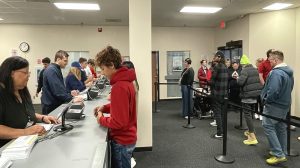
Voting at the Polk County Auditor’s Office. (Photo by Clark Kauffman/Iowa Capital Dispatch)
Iowa has also seen concerns about non-citizen voting in recent weeks. Pate issued guidance to county auditors throughout the state to challenge the voting credentials of people identified by the state as potentially non-citizens. While many of these individuals are understood to be naturalized citizens who have the legal right to participate in elections, a federal judge ruled Sunday in favor of letting the guidance stand, as at least a portion of the individuals listed currently do not have citizenship status.
As concerns about election integrity mount, the National Association of State Election Directors and the National Association of Secretaries of State issued a joint statement Monday assuring voters that there are countless safeguards in place, and warning people to be aware that problems may still occur.
“As with any Election Day, it is important to note operational issues may arise: for example, voting locations could open late, there could be lines during busy periods, or an area could lose power,” the organizations said in the statement. “These are inevitable challenges that will arise on Election Day, but election officials have contingency plans for these and other scenarios. Americans can have confidence the election is secure, and the results will be counted accurately.”
After voting concludes in Iowa, there will be automatic post-election audits in all 99 of the state’s counties to ensure votes have been counted accurately. Additionally, candidates have the ability to request recounts in their races — Iowa law allows candidates to request a recount by 5 p.m. on the third day after a county’s canvass of the election. Pate asked for Iowans’ patience while awaiting election results.
“We understand that Iowans are excited to see the results, and local election officials do their best to report results quickly and accurately,” Pate said. “Our goal is to get the correct results, and while we aim to do it as quickly as possible, we prioritize accuracy over speed.”
MARSHALLTOWN, Iowa – The Iowa Department of Corrections, Monday, said 26-year old Antwane Dwayne Lee Jr., who was convicted of Robbery 2nd Degree in Story County, failed to report back to the Marshalltown Residential Center as required, Sunday.
Lee is a six-foot tall, 250-pound black male. He was admitted to the work release facility on June 20, 2024. Persons with information on Lee’s whereabouts should contact local police.
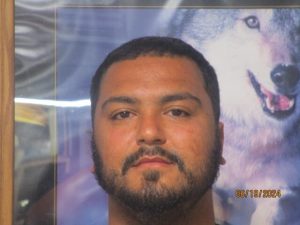
Antwane Dwayne Lee Jr.
(Monroe County, Iowa) – A pedestrian crossing a road in southern Iowa Monday evening was struck and injured by a pickup truck. The Iowa State Patrol reports the pickup, driven by 57-year-old Andrew Alan Hackett, of Albia, was eastbound on 3rd Avenue west in Albia, when the vehicle struck a pedestrian on the west side of the intersection with Highway 5. The pedestrian was traversing across the eastbound lane of 3rd Avenue west, when they were struck. The accident happened at around 5:10-p.m.
Hackett, and 67-year-old Sue E. Henderson, of Albia, were injured in the collision. Hackett refused transport to the hospital. Henderson was transported by Monroe County Ambulance to Methodist Hospital.
The collision remains under investigation.
(Radio Iowa) – The State Appeals Board has approved a three-point-four MILLION dollar settlement with the mother of a resident at the state-run Glenwood Resource Center who died after inadequate care at the facility
Thirty-year-old Joshua Ramspott had cerebral palsy and had lived his entire adult life at the facility in Glenwood, which provided care to residents with profound intellectual and physical disabilities. He died in a Council Bluffs hospital in early 2022. Two state investigations concluded Glenwood staff failed to provide Ramspott with extra fluids after a kidney infection and he died several weeks later of sepsis.
The Glenwood Resource Center was closed this past June. Two U-S Justice Department Investigations concluded the facility provided inadequate care and subjected some residents to unethical experiments.
(Radio Iowa) Precincts around the state are open from 7 a.m. ’til 8 p.m. and Iowa law requires voters to show a photo I-D, like a driver’s license, in order to cast a ballot. Iowans who’ve moved will have to provide proof of their new residence with a utility bill or some other document that shows their new address. There’s curbside voting for Iowans with mobility issues.
Two poll workers, one from each political party, will deliver voting materials outside so the person can mark their ballot while sitting inside their vehicle.
Voters are allowed to take selfies with their ballot, with the emphasis on the word selfie. Including someone else in the picture or having someone take a picture of you with your ballot is not permitted.
(Radio Iowa) – Voters in 59 counties are deciding bond referendums in this year’s election. Iowa Western Community College president Daniel Kinney says his school is presenting voters with a 55 million dollar plan that does not raise taxes, but maintains a current property tax levy. The plan would expand Iowa Western’s dual enrollment program, so more students could earn college credits while they’re still in high school. It also would double student slots in key transportation-related programs on the Council Bluffs campus and expand other training options.
“The ability to really look and focus on career and technical education programs such as diesel tech, auto tech, welding, our CDL program, H-VAC,” he says, “all those type of needed skills that every one of our rural communities need.” Expiring bonds would be replaced with new bonds financed under current tax rates in the community college district. “This would allow us to just basically hold our tax levy rate at the current rate we’re at,” Kinney says.
If the plan’s approved, a Transportation Building on Iowa Western’s Council Bluffs campus would be built to house a new transportation logistics program as well as diesel, automotive and C-D-L training programs. Industrial training labs also would be created and other facilities in Atlantic, Clarinda and Council Bluffs would be renovated. Kinney says the over-arching goal is to respond to gaps in Iowa’s workforce.
“Somebody to come in and fix your car or fix your tractor and stuff like that,” Kinney says. “…CDL — I mean having the drivers out there to get the products into our communities, but also having our product outside what’s being manufactured in our local communities.”
Thirty-one public school districts have bond issues on this year’s General Election ballot. A 165-million dollar plan would consolidate Waterloo’s two high schools. Residents in five counties and nine cities will also decide bonding for local projects, including a new fire station in Fort Madison, a recreation complex in Boone, and a new county jail in Sac County.
(Radio Iowa) – Iowans may need another cup of coffee before heading home this evening, after Daylight Saving Time ended over the weekend. While we set the clocks back an hour, our bodies need a week or so to properly adjust to the shift.
AAA-Iowa spokeswoman Brynna Knapp says sunset is at five minutes after five o’clock tonight, so many Iowans will be driving home in the dark. “You can’t always tell that you’re too tired to drive, right?” Knapp says. “Really, the only safe bet is to make sure you’re getting enough sleep, and if you don’t, you’re likely to engage in drowsy driving.”
Before you get behind the wheel at any time of the day, it’s important to get a good night’s sleep, and Knapp suggests we could all benefit from a review of our driving habits. “We’ll all be adjusting and likely driving in the dark daily for the foreseeable future here in the winter,” she says, “and it really can have a negative impact on energy levels.”
Knapp says this is a good time of year to get an eye exam for the six-out-of-ten drivers who wear glasses or contacts.
(Radio Iowa) – Iowa State University is “restructuring” a campus L-G-B-T-Q center to comply with a state law that will go into effect next summer that prohibits state universities from funding Diversity Equity and Inclusion offices and programs. A report released last week detailing D-E-I university changes says the center will be open to all students as a general reservation space and study center. Erin O’Brien is a part of I-S-U Students Against S-F-24-35 and says the change is redundant.
“It’s always been available to all students,” O’Brien says. “In Senate File 2435, it specifically defines a diversity equity and inclusion effort as something that shows preferential treatment to certain groups, but it’s really not preferential. Anybody can show up at any time.” Other changes include changing the job description of two staff members. The center also cannot host its own events anymore and student groups can reserve the space for events. O’Brien, a junior at I-S-U, says the changes show that the L-G-B-T-Q community in Ames is “expendable.”
“It is an area I can go to and be absolutely certain that I will be fine, which helped a lot, especially in my freshman year, when I was way less confident in myself,” O’Brien says. “It’s led to me meeting some of my best friends, and now that chance is sort of being taken away.”
The facility’s full name is the Center for LGBTQIA+ for Student Success at Iowa State University. It’s not clear when the changes will go into effect, but the report says all D-E-I changes should be done by the end of the year. Republicans in the legislature say the offices pursued what they consider a woke agenda and were designed to indoctrinate students into a partisan ideology.
(Radio Iowa) – Voters in a dozen Iowa counties are deciding whether to raise local taxes to support emergency medical services. Page County’s referendum would raise property taxes to support the six ambulance services in the county. One of them is in Shenandoah, where Ty Davison is Emergency Medical Services director.
“A long time ago legislation came down and deemed law enforcement and fire protection an essential service,” he says. “…EMS has been excluded from that and therefore we receive zero tax funding or assistance in order to operate and respond to calls and emergencies every day.” That state law was adjusted three years ago, so county-wide referendums may be held to establish a property tax levy that supports emergency medical services. Davison says Shenandoah’s ambulance service assists small volunteer departments in the county.
“EMS is not a profitable money maker service,” he says. “…We do bill insurance agencies, however on average we are only reimbursed at a 35% rate.” Since 2022, state records indicate voters in 11 counties and parts of Worth County have passed E-M-S referendums. State law requires 60 percent approval to raise local property taxes and E-M-S referendums have failed in a few counties.
In November of 2022 voters Jones, Kossuth, Osceola, Pocahontas, and Winnebago Counties passed EMS referendums. In November of 2023, voters in Cedar, Benton, Ida, and Shelby Counties approved EMS property taxes. In March of THIS year, Louisa County voters approved an EMS measure and in September, voters in Henry and parts of Worth County did so as well. The following counties have referendums on this year’s General Election ballot: Appanoose, Buchanan, Butler, Cass, Floyd, Guthrie, Hamilton, Jefferson, Page, Sac, Tama, Taylor.
 Facebook
 Twitter
 YouTube
 RSS
RSS