

KJAN News can be heard at five minutes after every hour right after Fox News 24 hours a day!
Keep up-to-date with Fox News Radio, Radio Iowa, Brownfield & the Iowa Agribusiness Networks!

KJAN News can be heard at five minutes after every hour right after Fox News 24 hours a day!
Keep up-to-date with Fox News Radio, Radio Iowa, Brownfield & the Iowa Agribusiness Networks!
(Des Moines, Iowa) – U.S. Rep. Zach Nunn said at a press conference Wednesday he was working with JBS USA and Iowa communities following the revocation of visas from about 200 employees at the JBS plant in Ottumwa. As previously reported, in mid July, Ottumwa’s mayor notified city council members that about 200 employees at a JBS USA meatpacking plant there had been informed their work visas were revoked, according to the Des Moines Register. The affected workers were from Haiti, Cuba, Venezuela and Nicaragua. The U.S. Supreme Court ruled in May that the Trump administration could remove Biden-era deportation protections from nationals from these countries.
The Iowa Capital Dispatch reports Nunn said Wednesday these workers had “extended beyond their time in country” and that JBS could no longer legally employ them. “The good news is we’re working with JBS,” Nunn said. “We work very closely to make sure that there is no slowdown in production, either for the sellers who are taking their meat to market, or for the buyers.”
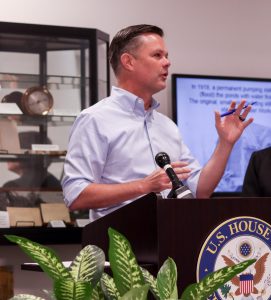
U.S. Rep. Zach Nunn speaks at a press conference in Des Moines on July 30, 2025. (Photo by Cami Koons/Iowa Capital Dispatch)
He said this immigration crackdown from the current administration was a way of “right sizing” the Biden administration’s immigration policy. Nunn said the president and relevant members of his cabinet are all “on board” with fixing the visa programs so that ag workers, students, nurses and more “get the opportunity to stay here.”
During his visit to Iowa, President Donald Trump said he wanted to find a way for farmers to vouch for some workers who were not in the country legally. Gov. Kim Reynolds expressed interest in working with the administration on this front, but details have not yet been revealed. Nunn said he was working with community members in Perry, where JBS recently announced a new sausage making facility, about similar concerns.
(Des Moines, Iowa) – U.S. Rep. Zach Nunn announced legislation Wednesday to assist communities with the replacement of lead service lines, including the more than 20,000 lines in Des Moines. The Iowa Capital Dispatch reports Nunn made the announcement during a news conference at Des Moines Water Works in his home district. The city’s utility also announced the start of its lead service line replacement program, the first phase of which will tackle connections at about 400 homes in the Drake neighborhood. Nunn’s bill aims to make previously allocated funding for lead service line replacement more accessible to communities in need. Newly appointed CEO of Des Moines Water Works Amy Kahler said this will make it “easier to replace these lines with fewer financial impacts to customers.”
Kahler said without federal support, it would cost Des Moines Water Works an estimated $200 million to replace all of the lead service lines in the metro, which would increase utility rates for customers by around 30%. The Biden administration dedicated $15 billion to replacing lead service lines via the Bipartisan Infrastructure Law. In October 2024, the U.S. Environmental Protection Agency issued a final rule that required drinking water systems to identify and replace all lead pipes within a 10-year span.

U.S. Rep. Zach Nunn announces a bill to help remove lead pipes from residences. He was joined by Des Moines Mayor Connie Boesen (left) and Des Moines Water Works CEO Amy Kahler (right). (Photo by Cami Koons/Iowa Capital Dispatch)
The funds were allocated to the Drinking Water State Revolving Fund from which states, with a 20% match, would receive a 30-year loan to replace the lead service lines. Disadvantaged communities would have 40 years to repay the loans, according to information from the U.S. Environmental Protection Agency. Nunn’s bill would allocate these funds to disadvantaged census tracts via grants or forgivable loans and without some of the required local matches. Nunn introduced a similar bill last year, also in collaboration with Democratic Rep. Emilia Sykes from Ohio, which did not advance.
Across the U.S., there are an estimated 9.2 million lead service lines. According to a 2023 EPA report, Iowa has an estimated 90,000 service lines with lead in them. Exposure to lead in drinking water is especially harmful to children and infants, according to the U.S. Centers for Disease Control and Prevention and can lead to decreased cognitive performance or developmental issues. Service lines connect from water mains to an individual property. These lines are not owned by the city or utilities, which means property owners are usually responsible for the often costly burden of replacing the pipes.
Nunn also commented on the recent attention to high concentrations of nitrate in the water supplies in Iowa and said it is important to not put the “blame just on ag.”
(Greenfield, Iowa) – Adair County Engineer Nick Kaufmann, Wednesday, presented his weekly report on Adair County Secondary Roads projects and maintenance activities.
Kaufmann reports one of their bridge projects is finished, and other developments.
And, as we previously mentioned, Kauffman presented for the Board’s approval and Chair Nathan Baier’s signature, contracts for three projects: North 11 Lincoln Bridge (and a related performance bond); A right-of-way contract in the amount of $449.04, for the West 18 Harrison bridge; and a Contract to the low bidder, GovCo Construction, for the North 27 Lincoln bridge project.
The contract amount was for $287,880.25. The engineer’s estimated cost for the project was $200,000.
(Radio Iowa) – A long-time manufacturer of socks in northern Iowa will be closing later this year. According to the Iowa Workforce Development’s Workforce Adjustment and Retraining Notification website, Fox River Mills is planning to close on October 10th, impacting 105 workers. The company filed the notification with Iowa Workforce Development on Tuesday.
Fox River Mills has been making socks since 1900 and at one point employed as many as 150 people at their Osage facility. The company in 2016 was sold to a private equity firm, a move that marked a significant shift in its business trajectory. 
The company was known for its annual “Fox River Sock Sale”, which would bring thousands of customers to the Mitchell County Fairgrounds in Osage.
(Radio Iowa) [updated] – Studies find many elementary school teachers have had little-to-no preparation in how to effectively teach handwriting, and a University of Iowa special education professor has developed a free tool to help teachers everywhere teach cursive. Professor Shawn Datchuk is director of the UI-based Iowa Reading Research Center and developed what’s called CLIFTER, the Curriculum-Based Letter Instruction for Fluency and Efficiency with Repetition. “It has an e-learning module, and that’s on-demand, evidence-based descriptions on what are effective ways of teaching cursive handwriting,” Datchuk says. “And then the second pillar would be an actual free online application that educators can log on, click what letters they’re interested in teaching, and there’s video models that teachers can present on screen.” There are also worksheets that can be downloaded and customized for any curriculum.

Prof. Shawn Datchuk (UI photo)
Datchuk is introducing CLIFTER this week as the center hosts the annual Science of Reading Summit in Cedar Rapids. “We have over 650 educators coming together to learn about evidence-based practices for not only reading, but also writing,” Datchuk says, “and the response has been incredibly positive for CLIFTER and different ways of applying evidence-based techniques in the classroom.” About a decade ago, schools in Iowa and in many other states shifted away from teaching cursive, yet in recent years, some have returned. Cursive instruction was reintroduced to Iowa’s Academic Standards in 2024, and as of this year, only around half of U.S. states require some instruction in the skill.
Datchuk says it can be easy to think of handwriting as antiquated and unimportant, but he assures that’s not the case. “Handwriting, even in this age of technology, remains critically important for committing to memory writing skills such as letter formation, but also spelling, sentence writing,” Datchuk says, “but then also the juicy bits of reading that underpin our ability to read words accurately, or entire sentences, are closely connected with writing.”
While much of the modern world uses keyboards to communicate, he says handwriting is still vital, especially for young students who are just learning the art. Datchuk says he’s gratified to see schools swing back to teaching cursive. “That has been a large shift in how we think about teaching reading as, ‘Oh, maybe writing is separate,’ but what we’re finding is, is that it is not. It is closely connected together,” Datchuk says. “If you want to help students become proficient readers, writing can be an effective pathway to accomplishing that.”
He says CLIFTER gives students the building blocks they need to become proficient writers — and readers.
(Creston, Iowa) – An Audubon County man was not injured, but a grave headstone sustained an estimated $2,000 damage, during an accident Sunday afternoon in Creston. According to the Union County Sheriff’s Department, 88-year-old Raymond Vais, of Exira, was driving through the Calvary Cemetery at around 4-p.m., Sunday, when the accident occurred.
Authorities say Vais was looking at relative graves, and was unaware the row of graves went over to the south fence of the cemetery. He told deputies that he got off the driving paths located in the cemetery and was driving in the grassy area due to not being able to walk very well.
Vais said he tried to get his pickup turned around in the tight area by the fence, and accidentally struck one of the headstones labeled “McManus.” The headstone was knocked-off its concrete base and laid on its side. A Union County Sheriff’s Deputy said he was unfamiliar with the name on the headstone, and unable to make contact with any family member in reference to the accident.
As university budgets continue to swell, some members of the Iowa Board of Regents are concerned about a lack of scrutiny into the dollars and what is being done to save them, especially with current uncertainty and future changes to funding streams. According to a report by the Iowa Capital Dispatch, Barker said he felt there wasn’t enough information provided on risks with certain areas of the budget and contingency plans in case dollars dry up for projects or programs. Despite a past directive from board president Sherry Bates to universities to renew efforts in finding areas where greater efficiency can be attained, Barker said he saw little evidence of it in the budget documents.
General education budgets at Iowa’s public universities are set to grow once again in fiscal year 2026, according to budget reports, mainly due to increases in tuition revenue from both rate hikes and higher expected enrollment. The total budget for the whole regents system sits at $8.4 billion for the fiscal year. Hensley said Gov. Kim Reynolds spoke with her about the university budgets and said she “was not happy about” the fact that they had a higher percentage increase than the 2% “state approved” increase.

(From left) Regents David Barker and Christine Hensley attend an Iowa Board of Regents meeting Feb. 27, 2025. The board voted at its July 30 meeting to approve fiscal year 2026 budgets. (Photo by Brooklyn Draisey/Iowa Capital Dispatch)
UNI is the only university to report decreased revenue from tuition for the fiscal year, but indirect cost recoveries and other income still have the overall budget rising by $400,000 to $174.4 million. The UI reported a projected tuition revenue increase of more than $51 million, offset by a reduction of $3.2 million from reductions in federal funding and indirect cost recoveries, bringing its general education funding to $871.2 million.
ISU’s fiscal year 2026 general education budget is projected to total nearly $767 million, with tuition revenue coming in at $44.1 million and revenue from indirect cost recoveries dropping by around $2.7 million due to “federal grant and recovery rate uncertainties.”
One area Barker said did go into adequate detail about the future and the problems it poses was ISU’s athletic department budget. In the budget proposal, the university stated it expects to see around $30 million in “recurring annual financial repercussions” starting this year and continuing in years to come. The university foundation provided a one-time allocation of funds to the department to fill gaps this year, but the document stated this will not be viable in the future.
The board’s investment finance committee meet within the next month to take another look at the budgets and come up with recommendations for how the process could change.
DES MOINES, Iowa — The Iowa State Fair has announced its list for Iowans of the Day for the 2025 fair. It’s a collection of individuals who have shown the best sides of Iowa through hard work, integrity and an unwavering commitment to their communities. One of those individuals is from southwest Iowa and will be honored on Tuesday, August 12th: Ruby Thomas of Coin.
Ruby Thomas works full time in Clarinda but makes time to volunteer as the Coin City Council cemetery sexton. In this role, she has transformed the Elmwood Cemetery in Coin. What started as a cemetery in disrepair became a place other sextons study.
Through a local fundraising campaign, Ruby raised over $11,000 for cemetery renovations. This total increases today. Ruby’s projects include fixing damaged headstones, resetting tombstones and maintaining the grounds. Ruby’s work touches families who have loved ones buried at Elmwood.
The Iowan of the Day program was founded in 1997 by the Blue Ribbon Foundation to honor outstanding Iowans who have made a difference in their communities, according to a press release from the foundation.
Winners are selected by committee after a nomination process and receive one day of recognition during the fair. Each day at noon on the Anne and Bill Riley Stage, they are presented as the Iowan of the Day. Each winner is also awarded accommodations at the Des Moines Marriott Downtown, four Iowa State Fair admission tickets, four Grandstand show tickets, use of a golf cart, VIP parking and $200 cash.
Others who were named Iowans of the Day at the State Fair include, on:
Thursday, Aug. 7: Brenda DeVore of Promise City
Friday. Aug. 8: Emily Grell of Danbury
Saturday, Aug. 9: Barb Runneberg of Algona
Sunday, Aug. 10: Donna Koch of Cedar Rapids
Monday, Aug. 11: Roger & Mary Sue Chatfield of Keokuk
Wednesday, Aug. 13: Donna Brown of Cedar Falls
Thursday, Aug. 14: Peggy Smith of Baxter
Friday, Aug. 15: Jean Saveraid of Huxley
Saturday, Aug. 16: Lou Sipolt Jr. of Altoona
(Anita, Iowa) – The CAM School District’s Board of Education will hold a Special, Electronic Meeting 7-p.m. Thursday, July 31st, via Zoom. The only item on their agenda is approval of a bid for Emergency Drain Repair at the MS/HS Building.
(Radio Iowa) – Iowa’s attorney general has reached a settlement with a southwest Iowa business for a fertilizer spill that killed hundreds of thousands of fish. The spill originated at NEW Cooperative in Red Oak when a valve on a fertilizer tank was left open during a weekend in early March of last year.
Over 250-thousand gallons of liquid nitrogen wound up in the East Nishnabotna River. Iowa officials estimate more than 750-thousand fish were killed downstream.

New Cooperative spill
The Nishnabotna River drains into the Missouri River and the Missouri Department of Conservation reported a near total fish kill in the roughly 10-mile stretch in northwest Missouri.
The coop has agreed to pay a 50-thousand dollar penalty and pay 50-thousand dollars to the Montgomery County Conservation Board for an environmental project.
 Facebook
 Twitter
 YouTube
 RSS
RSS