KJAN Programs

Two bills addressing more carbon pipeline concerns clear Iowa House subcommittees

Ag/Outdoor, News

February 20th, 2025 by Ric Hanson

(Radio Iowa) – New requirements for the company that has a permit to build a carbon pipeline and for the state regulators that granted the permit have cleared initial review in the Iowa House. One bill would require Summit Carbon Solutions to show it has enough insurance to cover all damages from a pipeline rupture. Cynthia Hansen’s family owns land in Shelby County that’s in the pipeline’s path. “We already have our letter from our insurance company saying that we cannot get liability insurance on this piece of ground if this pipeline goes through because (liquified carbon) is considered a pollutant, so that puts us at great risk if the pipeline would rupture,” Hansen said. “I mean, we would go bankrupt.”

Representative Steven Holt, a Republican from Denison, says the cost and liability if there’s a rupture would hit property owners as well as local governments who’d have to respond to the disaster. “It is the local county supervisors, law enforcement, EMT personnel, fire fighters that will be responsible for the safety of their citizens,” Holt said, “and it also appears that counties will be left holding the bag, (along with) landowners, should something go wrong.” A spokesperson for Summit Carbon Solutions says in order to secure its pipeline permit, the company was required to have at least a 100 MILLION dollar insurance policy and the ability to compensate landowners for damages from construction. The other bill would require members of the Iowa Utilities Commission to attend the commission’s hearings and informational meetings.

Holt says House Speaker Pat Grassley attended a public meeting scheduled by the agency, but no one from the commission was there to hear comments from the public. “This was confirmed for me when we had an informational meeting in Holstein, in Ida County. I was there. No commissioners were there,” Holt says. “Unfortunately, this seems to fit the pattern of arrogance toward property owners that has been on display throughout this entire process by the Iowa Utilities Commission when the leadership changed.” Governor Kim Reynolds replaced the commission’s chairman and appointed another new member to the panel in April of 2023.

Jessica Mazour is conservation program manager for the Sierra Club’s Iowa chapter. She says the new commissioners have been disrespectful toward property owners who object to having the pipeline on their land. “Not showing up to meetings, not listening — I mean we’re talking about people who put their lives on hold for four years to protect their property from a company that’s coming in to take their land, endanger their families,” Mazour said, “and they don’t even have the ability or the care to show up and listen to them.” Peg Rasmussen owns land in Montgomery County where Summit Carbon Solutions plans to extend its pipeline during phase two of the project. She says one commission member was at the informational meeting she attended. “I’m sure that there was bias in terms of how they interpreted the meeting,” Rasmussen said, “so having multiple ears there hearing could related to better understand what the public really was saying.”

Similar bills have been filed in the Iowa Senate, but no subcommittee hearings on either senate bill have been scheduled.

Bill shielding pesticide companies from some lawsuits advances in Iowa Senate

Ag/Outdoor, News

February 20th, 2025 by Ric Hanson

(Des Moines, Iowa) – A bill that would shield pesticide companies from label-related lawsuits, provided the company adhered to federal label regulations, advanced from the Senate Judiciary Committee Wednesday. According to the Iowa Capital Dispatch, Senate Study Bill 1051 passed 11-7, with opposing senators arguing the bill protects companies rather than Iowans.  Sen. Mike Bousselot, who chaired the bill’s subcommittee, said the bill was a “common sense” piece of legislation.

“It is the simple premise that someone should not be allowed to sue someone else … for failing any duty to warn, when that manufacturer followed every federal rule and regulation required to warn,” Bousselot said. Similar legislation has cropped up in states across the country, and is pushed by the Modern Ag Alliance, a grouping of agriculture groups and Bayer, a biotech company and manufacturer of the common pesticide, RoundUp.

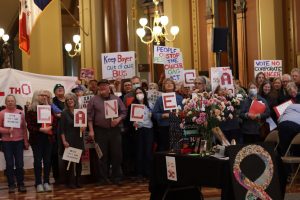
Iowans protest a Senate bill on Feb. 10, 2024, that would shield pesticide companies from certain lawsuits. (Photo by Cami Koons/Iowa Capital Dispatch)

Bayer has spent more $10 billion on lawsuits, across the county, with plaintiffs claiming the product failed to warn them that the chemical glyphosate was a carcinogen. Bayer and the U.S. Environmental Protection Agency, which regulates pesticides, hold that glyphosate is not cancer causing.

The bill advances to the Senate floor. Sens. Bisignano, Quirmbach, Mark Lofgren, Janet Petersen, Jeff Taylor, Cherielynn Westrich and Janice Weiner voted no.

Proposal would close conservation and outdoor recreation fund, shift to property tax relief

Ag/Outdoor, News

February 20th, 2025 by Ric Hanson

(Radio Iowa) – A proposed constitutional amendment would do away with a voter-approved fund for conservation and outdoor recreation projects — and direct part of any future sales tax increase to property tax relief. Sixty-three percent of Iowa voters approved a constitutional amendment in 2010 that created the fund, but it has no money because it’s only to be filled if the state sales tax is raised. Mike Shannon, a biologist with Ducks Unlimited, opposes elimination of the fund.

“The Natural Resources and Outdoor Recreation Trust Fund is not about water quality,” he said. “I mean, it’s about quality of life for Iowans.” Brett Hayes, a farmer from Mills County, supports the proposed amendment because it shifts the focus on property taxes. “Property taxes for farmers are a cost of doing business that keeps going up even when the farm economy’s struggling,” he said.

The proposed constitutional amendment is co-sponsored by 17 of the 34 Republicans in the Iowa Senate. It would have to be approved by the Senate and the House by 2026, and then again sometime in 2027 or 2028 before it could go before voters in 2028.

Two Iowans among laid off federal workers appealing to get their jobs back

Ag/Outdoor, News

February 20th, 2025 by Ric Hanson

(Radio Iowa) – A recent Iowa State University graduate says after starting his dream job at the U-S-D-A’s National Laboratory for Agriculture and the Environment in December, he is among the federal employees who were laid off last Friday. Logan Conner had worked at the U-S-D-A lab on the Ames campus for two and a half years and was named student employee of the year in 2022. He’s filed an appeal, through government’s Merit System Protection Board, to try to get his job back.

“We were doing a lot of different research on ways to mitigate nutrient runoff without affecting yield,” he said. “There have been numerous people who have been laid off because of this decision. There is research that isn’t going to be able to be done.” Conner spoke during a news conference organized by the Iowa Democratic Party. Terri Wollenberg, another speaker at the online forum, worked in the reception area at a Veterans Affairs office in Cedar Rapids that provides mental health services to veterans. She is joining a class action lawsuit to challenge her firing.

“I’m a 32 year veteran of both the Navy and Army and I just got a start in the federal workforce,” she said. “I don’t have a job, so what do I have to lose?”

The U-S Department of Agriculture announced this week it plans to rescind the firings of several people working on the federal government’s response to the current outbreak of bird flu in poultry and cattle.

Atlantic & Creston selected to receive grants to plant trees

Ag/Outdoor, News

February 19th, 2025 by Ric Hanson

CEDAR RAPIDS, Iowa (February 19, 2025) – Alliant Energy has named 32 Iowa communities, including Atlantic and Creston, to receive grants totaling nearly $134,000 through the company’s Community Tree Planting program, part of its One Million Trees initiative. Atlantic received $2,840 toward the proposed planting of 22 trees. Creston received $5,000 to also plant 22 trees. (View the complete list of cities and grants awarded, HERE)

May Farlinger, President of Allliant Energy’s Iowa energy company and vice-preisdent of energy delivery said Wednesday, “Our commitment to supporting the communities we serve is unwavering. The Community Tree Planting program grants advance our commitment to environmental stewardship and, more importantly, help these Iowa communities achieve tree restoration goals, improve energy efficiency and provide environmental benefits for generations to come.”

Alliant Energy partners with Trees Forever to help communities develop, select and plant a diverse mix of trees. A tree expert works with the communities to select the best species for their areas and create care and maintenance plans to ensure the new trees have long, healthy lives.  

Since 1990, Trees Forever and Alliant Energy have awarded over $8 million in grants and planted more than 1.1 million trees through their partnership and programs in Iowa and Wisconsin. 

Across Iowa, communities are eligible to apply for grants up to $5,000 to fund new trees. 

Gov. Reynolds announces disaster proclamation for highly pathogenic avian influenza in Sac County

Ag/Outdoor, News

February 19th, 2025 by Ric Hanson

DES MOINES— Gov. Kim Reynolds today authorized a disaster proclamation for Sac County, Iowa effective immediately through March 21, 2025. The USDA has confirmed a positive case of highly pathogenic avian influenza (HPAI) in a commercial turkey flock.

This proclamation allows state resources from Iowa Homeland Security, the Iowa Department of Agriculture and Land Stewardship, and other agencies to assist with tracking and monitoring, rapid detection, containment, disposal, and disinfection. The proclamation also waives regulatory provisions related to commercial vehicles responding to affected sites.

The recent HPAI detections in birds do not present an immediate public health concern, and it remains safe to eat poultry products. If producers suspect signs of HPAI in their flocks, they should contact their veterinarian immediately.

As some Iowa evergreens turn brown, are they dormant or dying?

Ag/Outdoor, News

February 19th, 2025 by Ric Hanson

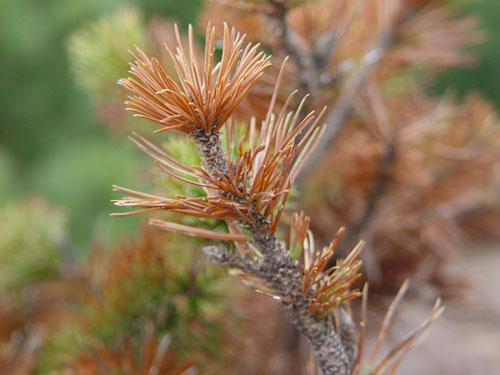
(Radio Iowa) – While many Iowans enjoyed those spurts of warm weather we had during January, the temporary respites from winter may have killed some of our trees now that we’re back in the deep freeze. Tivon Feeley, the Iowa DNR’s forest health program leader, anticipates moderate to severe winter burn damage statewide to conifers, like white pines. Feeley says the January thaws forced some trees to use the water reserves in their needles.

“So even though the ground is frozen, the ambient temperature above is warm, and the conifers are tricked, especially the non-native conifers, when they think that it’s springtime: ‘Let’s start using up the water reserves,’ but the root system is still frozen,” Feeley says, “so they can’t get more moisture up into that tree, and so they dry out, and that’s what winter desiccation is.”

The symptoms include browning or bleaching of the needles, trees losing needles, and eventually, tree death. Feeley says we may not see the full impact of the winter burn until much warmer weather sets in, like in late May or early June. “You look at our eastern red cedar right now. They’re brown. They’re dormant. They’ve evolved in our climate. They know what to expect, and they’re going to stay brown until we get all that spring rain, and then they’ll start to green up late,” Feeley says. “Our non-native conifers are not used to that, so as soon as it’s warm, they think it’s spring, and they’ll start trying to use water up that they don’t have.”

Photo courtesy of ISU Extension and Outreach

There’s really nothing Iowa homeowners can do at this point in the year to save the trees if they’re burned, but Feeley says to remember this situation in several months when autumn returns. “The best thing to do to prevent this is to mulch around the base of your tree, and if we’re dry in the fall, which is pretty common in Iowa, and you have non-native conifers, to water that all around them to get an ample moisture built up to carry it through these warm days,” Feeley says, “because later this week, it looks like we’re going to warm up again, so it could be another situation where we’re set up for this winter desiccation.”

If needles on the tree are dead but the buds are alive, he says new plant foliage will regrow to replace the winter-burned foliage. If both the buds and needles are dead, Feeley says the tree will not recover.

Discounted trees available at distribution events this spring

Ag/Outdoor, News

February 19th, 2025 by Ric Hanson

(Des Moines, Iowa) – The Iowa Department of Natural Resources (DNR), through a partnership with Alliant Energy, is offering a mixture of hardwoods, low-growing ornamental and evergreen tree species for $25 each. Alliant Energy customers can purchase up to two trees to be picked up at the following locations:

  • Tuesday, April 22, 4-6 p.m., Chuck Gipp Decorah Fish Hatchery (2321 Siewers Spring Rd, Decorah)
  • Thursday, April 24, 4-6 p.m., USDA Service Center Parking lot (300 Chamber Drive, Anamosa)
  • Tuesday, April 29, 4-6 p.m., 205 SE 2nd St, Greenfield
  • Tuesday, May 6, 4-6 p.m., Calkins Nature Center (18335 135th St, Iowa Falls)
  • Thursday, May 8, 4-6 p.m., Westbrook Park (520 Westbrook Drive, DeWitt)

Submit an order form, available online at  www.iowadnr.gov/trees, to reserve your trees.

Ag ed organization members mark FFA Week through community projects

Ag/Outdoor, News

February 18th, 2025 by Ric Hanson

(Radio Iowa) – From tractor parades to helping feed the needy through Meals from the Heartland, Iowa’s FFA members are celebrating the agricultural education organization this week through participating in a host of events. Taylor Adams, an instructor with the Webster City FFA chapter, says she’s long had an interest in the group.

“I’ve wanted to be a teacher since I was little, and once I got involved in FFA and ag throughout my high school career,” Adams says, “I knew that I wanted to continue to share my passion and teach my potential students in the future.”

The chapter’s president, Ethan Harms, says one of the false myths about FFA is that it’s only open to students who live on farms. Harms notes there are plenty of chapters in big cities and each member takes on what’s known as a Supervised
Agricultural Experience, or SAE. “FFA is for all. Everybody has an SAE project, no matter how big or small in our ag classes,” Harms says. “It can range from managing your household pets to managing 100 head of livestock. Everybody has an SAE project.”
There are 20,000 FFA members in Iowa, with more than a million nationwide. FFA will mark its centennial in 2028.

Iowa grain indemnity bill advances from committee

Ag/Outdoor, News

February 18th, 2025 by Ric Hanson

(Des Moines, Iowa) – A bill to update Iowa’s grain indemnity fund with increased capacity and to include farmers with credit-sale contracts passed the Iowa House Agriculture Committee Tuesday.  The Iowa Capital Dispatch reports committee members approved an amendment to House Study Bill 131 to clarify definitions of deferred-payment contracts and credit-sale contracts, the inclusion of which have been the dividing issue on the bill, and the reason it stalled in the Legislature last year.

Rep. Norlin Mommsen, R-DeWitt, said Tuesday, and in the subcommittee hearing Feb. 11, the bill was a compromise from his previous opinion that credit-sale contracts should be excluded. Deferred-payment contracts, which allow the price of grain on a sale to be determined after it has been delivered, are excluded from the fund. The bill would increase the indemnity fund minimum from $3 million to $8 million and the maximum from $8 million to $16 million to help cover farmers’ losses when their buyers go broke.  Mommsen, who has led the bill, said the basics of the existing grain indemnity fund are solid, but need to be updated to reflect the current ag industry.

A combine in a corn field along west-bound Interstate 880. (Photo by Cami Koons/Iowa Capital Dispatch)

For example, he said the price of corn when the original grain indemnity fund started in 1986 was around $2 a bushel.  “I sold corn the other day for $5,” Mommsen said. “So that shows the need to kind of upgrade stuff.” The amendment would also increase the bond amount required to be a grain dealer from $100,000 to $250,000, which Mommsen said, was just bringing the bill up to “today’s dollars.”

The bill moves next to the House floor.