

Burn Ban in effect for Mills County
February 28th, 2025 by Ric Hanson
(Glenwood, Iowa) – A ban on open burning is in effect until further notice for Mills County. See the press release below from the Mills County Emergency Management Agency:
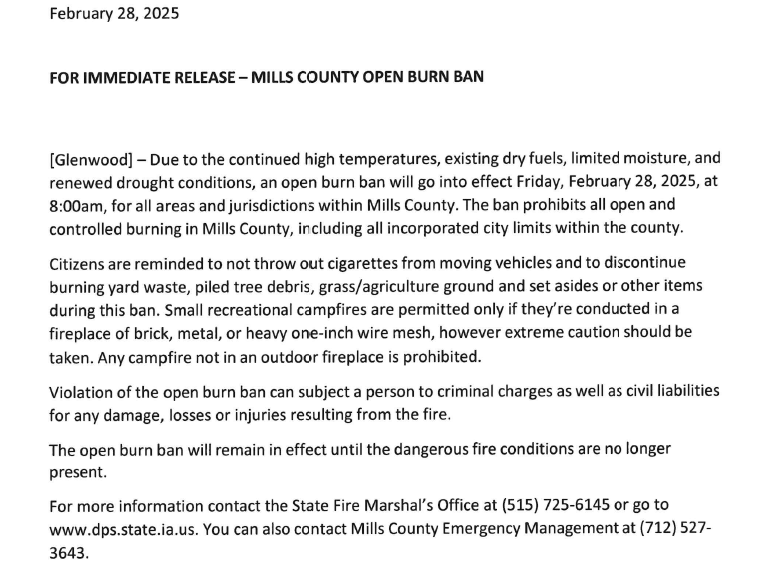

(Glenwood, Iowa) – A ban on open burning is in effect until further notice for Mills County. See the press release below from the Mills County Emergency Management Agency:
(Radio Iowa) – Most of Iowa is under a Red Flag Warning from noon today (Friday) through six o’clock tonight, as open burning is strongly discouraged. National Weather Service meteorologist Brooke Hagenhoff says there’s a critical risk as any fires that develop will likely spread rapidly. “For today, we’ve got warm conditions in the upper 50s to low 60s. We’ve got really dry fuels out there, because it’s so early in the season that nothing’s growing, so all the grasses and things are dry,” Hagenhoff says, “and then on top of that, we’ve got really strong winds gusting 45 to 50-plus miles per hour.” The warning covers 91 of Iowa’s 99 counties, all but the far northeastern corner of the state. Hagenhoff says the warm temperatures, strong winds and dry vegetation will create a serious hazard. 
“That combination is going to make it really dangerous for any kind of burning that goes on,” she says, “so we definitely want to take care and delay any burning until later this weekend or next week.” More big dips are coming in the weather rollercoaster Iowans have been riding lately. The forecast calls for high temperatures across much of Iowa’s southern half to be in the 60s today, while highs tomorrow may only be in the 30s. “Those ruthless winds are ushering in that cooler air with this cold front that’s going to be coming across here later on this evening, so that’s really the big push,” Hagenhoff says. “So, if you want to enjoy some of the warmer weather, get out there today and do that. It’ll be a little cooler on Saturday.”
The state Fire Marshal’s office shows active burn bans in only five counties, Mills County in the southwest, and four in eastern Iowa: Clinton, Linn, Muscatine and Scott.
(Radio Iowa) – Maple syrup season gets underway this weekend at the Indian Creek Nature Center near Cedar Rapids. Center spokesman Eric Hart says they began preparations last month. “We put in over 100 spires on February 15th, and then once the weather warmed up this past week, the sap has started flowing,” Hart says. Volunteers and staff collect the tree sap and to start the process of boiling down into maple syrup. Hart says the weather conditions play a big part in how much sap they can collect. “This time of year is usually really good for it, but it kind of does depend on what kind of weather we get,” he says. “Usually, temperatures during the day that are above freezing, around 40 degrees, and then temperatures at night below freezing, make it ideal for that sap to start flowing.”
Hart says you can come out starting this weekend to learn about the process. “They just have to register for one of our ‘It’s Maple Syruping Programs.’ These are open to the public, they’re five dollars per person, and we host multiple ones throughout the month of March that happened before the maple syrup festival.” This 42nd Maple Syrup Festival wraps up the syrup season on March 29th and 30th. Hart says 2023 was one of their better years for collecting sap and making syrup. “We collected one-thousand-927 gallons of sap, and then we that got boiled down into 46 gallons of maple syrup,” he says. Hart says you can see the process at their events and festival, and also get a taste of the syrup.
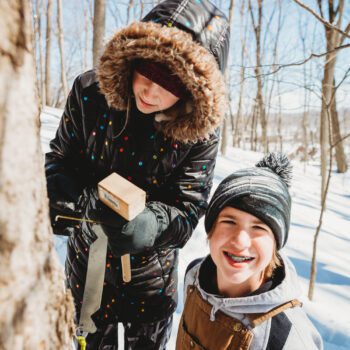
Collecting maple syrup. (Indian Creek Nature Center photo)
“It really reveals how nature can provide so many things for us, and opens people’s eyes to how processes in nature can be used to create all kinds of things, including something as sweet as maple syrup,” Hart says. “And that’s one thing we try to bring into all of our events and programs, is that element of nature, and getting people outside to kind of they can get hands on.”
Find out more about the maple syrup events at: indiancreeknaturecenter.org.
(Des Moines, Iowa) – An Iowa House subcommittee advanced a bill Thursday that would require water use permits be evaluated on a case-by-case basis in terms of “beneficial use.” According to the Iowa Capital Dispatch, Representatives and supporters of the bill cited the depletion of the Ogallala Aquifer in Kansas, and the associated hardships, as a reason for the bill.
Rep. Cindy Golding, who helped author the bill and chaired the subcommittee, said the past four years of drought conditions in Iowa and the things she has heard from friends and family in Kansas, showed her that water use in Iowa needed to be addressed. “Water is a real problem,” Golding, a Republican from rural Linn County, said. “And not wanting Iowa to get (like Kansas), I’d like us to have a process in place before we get there.”
House File 480 would remove the definition of beneficial use from current code and redefine it so the Department of Natural Resources would determine beneficial use in a “case-by-case basis” that is not based on the applicant’s category of use. Iowa Code holds that beneficial use includes that “waste or unreasonable use” of water resources be prevented and the “conservation and protection” of water resources is “required.”
The DNR’s interpretation of beneficial use has been central to an ongoing fight between water advocates and landowners in northeast Iowa over a water use permit renewal for a cattle operation near Bloody Run Creek. In November, an administrative law judge remanded the DNR’s decision to renew the permit and said the department needed to evaluate quality, as well as quantity when determining beneficial use.
Wally Taylor, legal chair of the Iowa Chapter of Sierra Club, said Iowa Code as written has “conflicting definitions of beneficial use” but that the bill would clear up the definition to be in the interest of the people. Iowa’s relation to groundwater was an issue at the Statehouse last year as well, when the Legislature voted to allocate $250,000 to research the condition of the state’s aquifers.
The proposal advanced with unanimous support. Other lobbyists registered, including DNR, took an undecided stance.
(Radio Iowa) – Construction will start in a few weeks on an Agricultural Learning Center on the Hamilton County Fairgrounds in Webster City, only the second facility of its kind in the state. Gene Gourley, a fifth-generation farmer from Webster City, says the plans for this ag education center have long been in the works. Gourley says donations for the center are continuing to come in and the work will begin this spring — as soon as it’s warm enough — and it should be complete by July 1st for the fair.
Webster City F-F-A advisor Kurt Veldhuizen says the state-of-the-art facility will let students see an actual representation of true industry and animal science. The first classes at the center are scheduled for late August. This is the second such center in Iowa. Muscatine is the home to the first.
(Radio Iowa) – Iowa Secretary of Agriculture Mike Naig says he’s encouraged by the announcement of a plan by the U-S Ag Secretary to address Highly Pathogenic Avian Influenza. Naig says it is a five-pronged plan. “To say, what more can we do? And how can we try to get ahead of this? Of course, that’s important for producers, but also for consumers,” he says. “Obviously, we see the price of eggs and after three years of high path affecting production, now’s the time to look at some different strategies.” He says the plan has some new things and some that have been already in use. “Some additional focus on biosecurity, some more support for farmers, more compensation for some of their losses, and also now a bringing a focus to potentially bring vaccine into the picture,” Naig says. Naig says the biosecurity would help keep the disease from getting into facilities.
“U-S-D-A has had a pilot that was developed to allow for some biosecurity audits on farms. It was being piloted, and some folks in Iowa were making use of that. And I think what you saw was them saying, the pilot has worked, let’s make that nationwide, and so to provide biosecurity audits to commercial poultry producers,” he says. “And then actually, U-S-D-A has indicated they will pay some cost share on improvements to facilities that may, in fact, help to improve that biosecurity.” Naig says the use of vaccines has some issues that would have to be worked through. “Different sectors of the industry view it differently, but certainly for egg producers, vaccine makes all kinds of sense. There’s still research and development that’s needed. There’s strategies that need to be developed, trade negotiations that need to occur. So it’s not a silver bullet, and it’s not an easy answer,” Naig says.
Naig says the bird flu has taken a large toll on Iowa poultry producers. “There is some compensation paid to producers, but it’s nothing like the losses that they’re experiencing. And so that is challenging. Of course then consumers are seeing the impact as well in terms of reduced availability while demand is high. And so that’s crunching as consumers as well,” he says. He says the impact producers goes well beyond the monetary impact. “It’s quite a stressful event to go through. It’s emotionally draining. It’s very challenging. These folks, they get up every day and care for animals, to have to see them sick and disposed of is very troubling. So our hearts go out to them,” Naig says.
Naig says Ag Secretary Brook Rollins has pledged 500 million dollars to support on-farm biosecurity assessments and cost-share funding, which will help farmers make necessary infrastructure improvements. The plan also commits 400 million dollars to update indemnity tables to ensure farmers are receiving fair market rates for birds that have to be destroyed.
(Radio Iowa) – Iowa’s been on a weather roller-coaster lately, with wind chills of 40-below zero last week, followed by highs in the 60s this week. Despite the current warming trend, the experts say most Iowans should keep their kayaks and canoes in the shed for now. Todd Robertson, the river programs outreach coordinator for the Iowa D-N-R, says paddlers ought to wait for steady warmth to allow water temperatures to rise, and that could be mid-May — or longer.
“The problem is, we haven’t had enough of these warm, consistent days to heat up the water. This is going to take several weeks,” Robertson says. “So between now and then, it’s not that people can’t go paddling, it’s that you have to know your skill level. You have to be fully prepared for immersion. You have to wear the right gear. You have to know how to read a river.” That also means never paddling alone. He says water temperatures in most areas of Iowa are in the low to mid 40s right now. 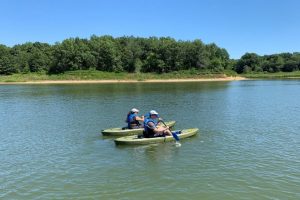
“When the temperature of the water is 60 degrees or below, you are automatically at risk for hypothermia if you become wet,” Robertson says. “That’s a ways off before that water reaches a safe level. That’s why if I go out and paddle, I’m at least bare minimum wearing my full-body wet-suit or better yet, a dry suit, because I need that extra protection to buy me time to get out of the water.” Air temperatures have been all over the map lately, but large bodies of water take time to warm up, so it may be a month or two before it’s safe for lesser experienced paddlers to load up their boats.
“We may have this roller-coaster for a while,” Robertson says. “I would say, especially if you’re not experienced out on the water, just wait a little while. We’ve got plenty of time. It’s great weather to go ride your bike and then you can go paddle later, but we got to let that water heat up.” Cold water shock and hypothermia can set in quickly, Robertson says, if you fall into the water at current temperatures.
Whatever the weather, he recommends paddlers always wear a life jacket, let a friend or loved one know where you’re going and when you’ll be back, and bring a dry bag with extra clothing to change into should you get wet.
(Iowa News Service) – Iowa farmers and their advocates want Congress to approve a measure to require beef raised and produced in the United States to be labeled as such, saying it would be better for ranchers and consumers. The U.S. used to require country-of-origin labeling but did away with it when Canada and Mexico complained the rule was unfair to imported products.
Barb Kalbach of Dexter, a fourth-generation farmer and member of the Campaign for Family Farms and the Environment, wants the Senate to approve the American Beef Labeling Act. She said it would allow those who raise beef and pork in the U.S. to be fairly compensated for their products and let shoppers know where their food was raised.
“I would like to know where my meat comes from,” Kalbach asserted. “If I’m shopping and I’m looking at meat to buy and it said ‘produced in the United States,’ and so I know that it was grown and produced here and processed here, I may want to go ahead and purchase that meat just so I’m supporting my family farmers.”

Young Black Angus cow standing atop a small grass hill with blue sky and clouds behind. The yearling animal is looking at the camera. Photographed in Iowa.
Previous Farm Bills required fruits and vegetables, seafood, meat and poultry, and some nuts to include country-of-origin labels. But in 2015, the World Trade Organization repealed it for beef and pork. Kalbach noted while it is important for U.S. consumers to know where their products are coming from, she thinks country-of-origin labeling could have far-reaching financial implications for Iowa farmers, too. “If people discover maybe they like the flavor of Iowa meat, they’re excited to buy it, then that just helps you be able to maintain economic viability,” Kalbach added.
Kalbach and other advocates for country-of-origin labeling hope it winds up in the next Farm Bill, which is being discussed in Washington, D.C.
DES MOINES, Iowa – More than 3,100 acres of Iowa land in 24 counties with an estimated value of more than $7.6 million was permanently protected through donations for conservation. The donors associated with 23 donations of land or land value will be recognized during a ceremony on March 13, from 2 to 3 p.m., in the first floor rotunda, at the State Capitol, in Des Moines.
Landowners who are in attendance will be honored individually for their donation. For more information about individual donations, visit the DNR website at www.iowadnr.gov/landdonors.
(Atlantic, Iowa) – The Cass County 4-H Endowment committee will host their annual 4-H Endowment Pancake Supper on Thursday, March 13 from 4:30-p.m. until 7:30-p.m. at the Cass County Community Center in Atlantic. The Pancake Man will be dishing up fresh pancakes while 4-H members serve sausage, milk, juice, and coffee. Supporters can enjoy all you can eat pancakes, cost is $8/adult and $6/youth 10 & under.
A silent auction will take place throughout the evening. Local 4-H clubs in Cass County as well as additional friends of 4-H and local business supporters, can donate items. If a community business is interested in supporting the Pancake Supper with a Silent Auction donation, please contact the Extension Office. Baskets need to be at the office by Friday, March 7th at 4:30-p.m. Cass County Youth Coordinator Katie Bateman says “The silent auction is a really fun added activity to the event. I love to see the little competitions that get started as well. When we make final announcements about closing down bidding, people and pens really get to moving!” Bateman added, “We will be featuring different baskets on our Cass County 4-H and Extension social media pages the first weekend of March. Be sure to check out the previews and find a favorite to bid on!” 
Proceeds from the 4-H Pancake Supper directly benefit the Cass County 4-H Program. All funds raised go to the Cass County 4-H Endowment. There is a committee that distributes money to cover the 4-H Program Development Fee for all Cass County 4-H and Clover Kid members, financial aid for out of county events, senior scholarships, and start-up dollars for innovative youth programs.
The 4-H Program Development Fee is $40 per youth each year to enroll. Instead of having individual 4-H’ers and families take on that expense, the Cass County Extension Council and the 4-H Endowment Committee pick up this cost for our members. Katie Bateman says “We are very fortunate in Cass County that our 4-H Endowment covers this cost for all members. That would not be possible for us to continue without the outstanding support from our community.”
The Cass County 4-H Endowment also offers grants for youth to attend 4-H camps or conferences outside of Cass County, encouraging them to take their 4-H experience to the next level. They also offer scholarships to graduating senior 4-Hers.

Members of Pleasant Noble United helping serve butter, silverware, and sausage at the 2024 Annual Cass County 4-H Endowment Pancake Supper. Left to Right: Hunter Wise, Gage Ritter, Emma Ritter. (Photo courtesy Katie Bateman)
For more information on the Pancake Supper, Cass County 4-H Endowment or how to join 4-H, contact Katie Bateman, Cass County Youth Coordinator, at 243-1132 or kbateman@iastate.edu.
 Facebook
 Twitter
 YouTube
 RSS
RSS