

CLICK HERE for the latest market quotes from the Iowa Agribusiness Network!
CLICK HERE for the latest market quotes from the Brownfield Ag News Network!


CLICK HERE for the latest market quotes from the Iowa Agribusiness Network!
CLICK HERE for the latest market quotes from the Brownfield Ag News Network!
(Radio Iowa) – A tax credit for biodiesel production expires at the end of this year and Senator Chuck Grassley says congress is unlikely to address the issue in December.
However, early next year Republicans in congress are hoping to extend a package of tax cuts approved in 2017 and Grassley says it’s possible the biodiesel production tax credit could be inserted in that bill.
Iowa is the largest U-S producer of biodiesel. The state’s nine biodiesel plants produced about 350 million gallons of the soybean-based fuel last year. The biodiesel tax credit was established in 2005 and has been extended several times. Grassley says the U-S Treasury Department and Environmental Protection Agency rulings on the scope of other tax breaks for renewable fuels should have been made long ago.
In February, the E-P-A approved the sale of a 15 percent ethanol blend at gas pumps in Iowa and seven other Midwest states year round, but the higher blend of ethanol still cannot be sold in other states during the summer months. The agency has long cited concerns that E-15 can cause smog during hotter weather.
(Radio Iowa) – Iowa law changed in 2023 to allow for a continuous open season on raccoons after concerns about an increase in their numbers and reports of them being a nuisance. Iowa furbearer biologist Vince Evelsizer says he doesn’t know yet how the law has impacted the animals.
The extended season allows people to use two kinds of raccoon traps.
The law change also simplified the process for nuisance animals.
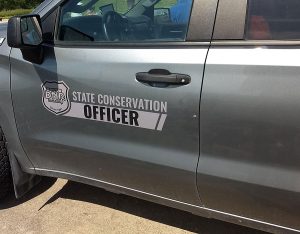 You can find more about the rules regarding raccoons and other animals on the D-N-R’s website.
(Iowa DNR News) – Pheasant hunting has been as much a part of the Thanksgiving holiday for generations of Iowans, as cranberries and stuffing. And with a weather forecast that will likely put birds in cover, this would be a good year to continue that tradition and get back to the fields. Todd Bogenschutz, upland wildlife biologist with the Iowa Department of Natural Resources (DNR), says “It’s a good opportunity for hunters to get out with less competition. Would also be a good time to invite someone new along and pass along that tradition.”
The Iowa DNR offers an apprentice license that allows someone to give hunting a try under the supervision of an adult mentor without completing hunter education. This license may be purchased twice in a lifetime before the individual is required to complete a hunter education course. Iowa’s pheasant population is down slightly from last year when hunters bagged the highest number of roosters since 2007. According to the August roadside survey, the regions with higher pheasant counts are north of Interstate 80. “The harvest is following what the roadside counts showed – better hunting in northern Iowa with lots of young birds out there,” Bogenschutz said. Last year, more than 83,000 hunters harvested over 590,000 roosters, providing an estimated economic impact of $180 million in Iowa.
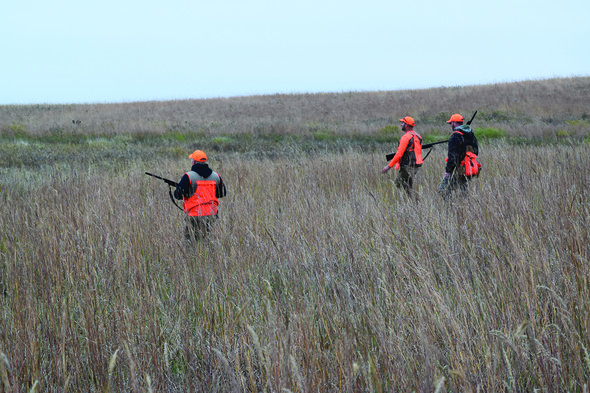
Photo courtesy of the Iowa DNR.
The Iowa DNR and Pheasants Forever are celebrating 100 years of pheasant hunting in the Hawkeye State. The first season was held Oct. 20-22, 1925, when 13 counties in north central Iowa were opened to pheasant hunting. Hunters were allowed a three-rooster limit, for a half-day of hunting. An estimated 75,000 hunters participated.
Information on places to hunt, the August roadside survey results and more is available online by clicking the 100 Years of Pheasant Hunting graphic at www.iowadnr.gov/pheasantsurvey.
(Radio Iowa) – Iowa Governor Kim Reynolds pardoned two turkeys from a farm in Manson today (Tuesday) named Caitlin and Clark. The turkeys strolled quietly on the grass at the Terrace Hill Governor’s mansion as the governor read the proclamation. “Now therefore I Kim Reynolds, governor of the state of Iowa, do hereby proclaim Caitlin and Clark as symbols of Iowa’s great turkey industry, they are free to roam this Thanksgiving Day, and they’ve got a lot of ground to do it on,” she says. Governor Reynolds talked about the importance of the holiday.
“I always look forward to this time of the year. It’s not only is it a time for us to really recognize our farmers and producers and all that they do to feed the world, but it’s kind of a kick off to the holiday season,” she says. She says the first recognition of turkey producers came from then Governor Robert Ray back in 1976. “Now, at that point, they didn’t pardon the turkeys. They sent them back to the farm, so I can’t say, what happens after that,” Reynolds says. “But we didn’t start pardoning the turkeys until 1989.”

Turkeys Caitlin and Clark roam the grounds of Terrace Hill. (RI photo)
The two birds came from Golden Prairie Turkeys for the second year in a row. The farm is owned by Brad and Kelly Moline. Brad is the president of the Iowa turkey producers and his daughter Ava was on hand to help with the birds. “It’s just fun because it’s a tradition that goes on for years and years, and it’s just something that we get to do for the turkeys,” she says. Ava wants to become a veterinarian, and is an Iowa State fan, but she is okay with naming the birds after the Hawkeye great. “She’s a great athlete, and I would like to be a great athlete like her. And turkeys are great for protein for athletes. So I think it was just fitting,” Moline says.
Governor Reynolds says she bought a 23-pound turkey from the farm that she will cook for her family along with a ham and all the sides for Thanksgiving.
(Ag News) – Thanksgiving remains one of the most widely celebrated holidays in the United States, with over 90% of Americans observing the tradition each year. For many, it ranks as a favorite holiday, bringing together family and friends around a meal that often centers on one iconic dish: roast turkey. Yet, few people consider the agricultural effort behind this holiday staple. Each year, an estimated 46 million turkeys are consumed on Thanksgiving alone, with production largely concentrated in a handful of states. More than 85% of U.S. turkey production takes place in just 13 states, with North Carolina and Minnesota leading as the top producers. Together, these two states contribute more than 30% of the nation’s total turkey output.
Outside of North Carolina and Minnesota, Indiana is a major producer, contributing 11.9% of U.S. turkey production by weight, followed by Arkansas at 7.8% and Iowa at 7.3%. In general, turkey production is largely concentrated along or east of the Mississippi River, although California stands out as a notable exception. To determine the top turkey producers, researchers ranked states based on 2023 total turkey production, measured in pounds. Some national and Iowa statistics:
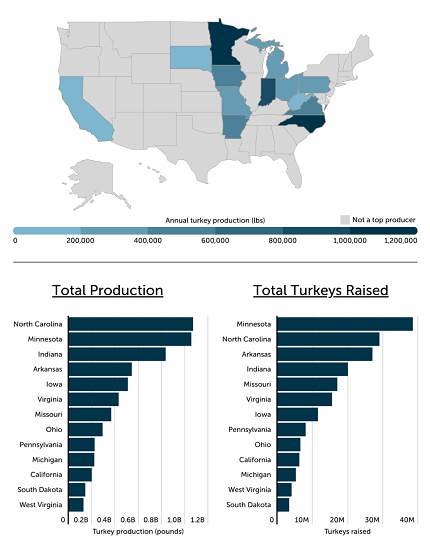
Here is a summary of the data for Iowa:
The analysis was conducted by Trace One—a company specializing in regulatory compliance for the food and beverage industry—using data from the U.S. Department of Agriculture (USDA).
(Radio Iowa) – Iowa State University researchers say an earlier planting date for soybeans in the spring takes better advantage of nitrogen left behind from corn production. I-S-U agronomy professor Michael Castellano says it would help reduce nitrous oxide emissions.
“Forty percent of the emissions from a two-year sequence — or rotation we might call it — of corn and soybeans comes during the soybean part of the crop rotation that doesn’t receive nitrogen fertilizer,” Castellano says. “…This was a big surprise and really required rethinking of approaches to reduce nitrous oxide emissions from crop production.” Crop rotation – planting corn in a field one year and soybeans the following year — already reduces emissions by 50 percent.
Castellano says most research has focused on reducing the amount of nitrogen applied to help corn grow, which also reduces farm chemical costs. Castellano says this new research finds that once nitrogen for corn production is reduced to the optimum level, the main way to cut nitrous oxide emissions is to move up the planting date of soybeans.
“It takes better advantage of the nitrogen being produced by the microbes in the soil, so the plants use it and less of it is lost to the atmosphere as nitrous oxide,” Castellano says. “Simple, practical, scalable solutions to help reduce nitrous oxide emissions from crop production that we may not often hear about.” Nitrous oxide is the primary source of greenhouse gas emissions from crop production. Nitrous oxide is the byproduct of microbial activity in soil that is essential for growing grain.
Castellano says farmers tend to focus on getting corn in the ground early because it’s a more expensive crop to grow, but moving up the soybean planting date is likely to result in higher soybean yields because the plants have a longer growing season. “Springs are getting warmer in Iowa and another real challenge, though, is that the spring are getting wetter, too,” Castellano says, “and so it’s going to require farmers to think about opportunities to manage their soil and their cropping systems.” Castello and another I-S-U researcher worked on this project, which dramatically increased the amount of time plants are growing on farmland.
Cover crops were planted after the beans were harvested. “And also got reductions in nitrous oxide as well as nitrate leaching,” he says, “so water quality benefits as well.”
The study was published in the November issue of a scientific journal called “Nature Sustainability.”
ATLANTIC, IA (November 23, 2024) – Produce in the Park’s Harvest Market is this Monday, November 25 from 3-6 PM at the Cass County Community Center, 805 W. 10th Street in Atlantic. Local shoppers are invited to pick up food and decorations for their thanksgiving celebrations and get a head start on holiday gift shopping when they browse the wide variety of locally grown and home-made items.
This year, everyone 18 and older who attends Harvest Market can enter a free drawing for a $100 gift card to spend at the upcoming Christmas Market in December. Produce in the Park Board President Bailey Smith explained the drawing is designed to encourage people to visit Harvest Market and bring awareness to Christmas Market. “We’re hoping that the chance for a $100 gift card encourages more people to check out our amazing Harvest Market. Additionally, folks love Christmas in Atlantic, and we want everyone to remember that the Christmas Market is part of that.” Produce in the Park’s Christmas Market will be held on Saturday, December 21 from noon to 3:00 PM at the Nishna Valley Family YMCA in Atlantic. 
Harvest Market is always held the Monday before Thanksgiving so shoppers celebrate with local foods, gifts, and decorations. This year’s Harvest Market is expected to offer a plethora of local vegetables including greens, tomatoes, sweet potatoes, potatoes, and squash, along with local meats, desserts, pastries, baked goods, honey, eggs, jams, jellies, syrups, popcorn, and more.
In addition to local foods, Harvest Market offers an opportunity to purchase local and handmade holiday decor and gifts. Shoppers can expect to find evergreen decorations, candles, soaps, crocheted toys, earrings, artwork, lavender products, wood crafts, seasonal hand towels, and more.
This year’s Harvest Market also includes a soup supper for those wanting a warm bite to eat before or after shopping. Imagine Gifts and Greenhouse will be selling Chicken Noodle, Vegetable Beef, and Loaded Baked Potato soups by the cup or bowl for dine-in or carry-out. Lastly, as is common for Produce in the Park farmers markets, local organizations will be in
attendance providing information and resources to the public. Visitors to Harvest Market can expect to find information on Cass County Tourism, Healthy Cass County, and the Cass County Grow Another Row program.
Harvest Market 2024 is sponsored by Atlantic Area Chamber of Commerce, Cass County Tourism, Cass Health, City of Atlantic, First Whitney Bank & Trust and Nishna Valley Family YMCA. For the latest information on Harvest Market, and all Produce in the Park markets, follow Produce in the Park on Facebook (www.facebook.com/ProduceInThePark) or Instagram
(https://www.instagram.com/produceintheparkatlanticia/).
Produce in the Park continues to accept vendor applications for Christmas Market, and additional holiday markets planned for winter 2024-2025. Vendor applications can be found online at www.ProduceInTheParkAtlanticIowa.com; printed copies of the application are available at the Atlantic Area Chamber of Commerce (102 Chestnut St., Atlantic, IA 50022). Produce in the Park seeks vendors selling handmade or homegrown products, including local foods, as well as beauty products, candles, crafts, art, and decorations.
Re-Shows must be scheduled by December 18 in Cass County
The Cass County Extension office is again hosting continuing instructional courses (CICs) for local commercial pesticide applicators, but wants to remind anyone who has yet to attend the training that all CIC training must be completed by the end of December to keep a license current. To avoid conflicts with year-end scheduling, Cass County Extension is requiring that all training dates be scheduled by Wednesday, December 18th.
‘Year end is a busy time for all, but we don’t want anyone to miss the opportunity to attend their annual required training, as time to meet those annual requirements is getting short,” according to Kate Olson, Cass County Extension Director. “We do offer trainings on a first-come, first-serve basis, and our hours will be slightly different during the holidays, so we’d like to remind folks to call and get their classes scheduled before our year-end calendar fills up.”
According to Olson, reshow dates can occur after December 18th, as scheduling allows, but they must be on the calendar before then to be honored. To ensure a spot on the training schedule, applicators needing to complete CIC for the year are asked to call as soon as possible if they have a preferred training date, but no later than Wednesday, December 18th at 4:30 PM. Applicators calling after this date will NOT be placed on the training schedule. Training dates can be scheduled locally by calling the Cass County Extension office at 712-243-1132 or by emailing Office Manager Lori Anderson at lander@iastate.edu. For more information on the Commercial Pesticide Applicator program or the CIC classes, please visit www.extension.iastate.edu/psep/.
(Red Oak, Iowa) – Officials with ISU Extension and Outreach in Montgomery County say 4-H members, their families, and community members gathered November 17, 2024, for the annual Montgomery County 4-H Awards Night. The program was hosted by the 4-H County Youth Council, a group of 4-H members from across the county ranging in age from high school freshmen to seniors.
This year’s county council has nine members: Pace Chaillie (Grant Spitfires), Kennedy DeVries (Stennett Panthers), Oliver Dykes (Stanton Strivers), Landon Gigstad (Stennett Panthers), Kyla Hart (Stanton Strivers), Victoria McFarland (Stanton Strivers), Grace Nippert (East Sunrisers), Will Pollock (Stennett Panthers), and Delaney True (East Sunrisers). The council honored 4-H members and clubs from the past year for their hard work as well as outstanding program sponsors and extraordinary volunteers. 2024 Awards Night PR
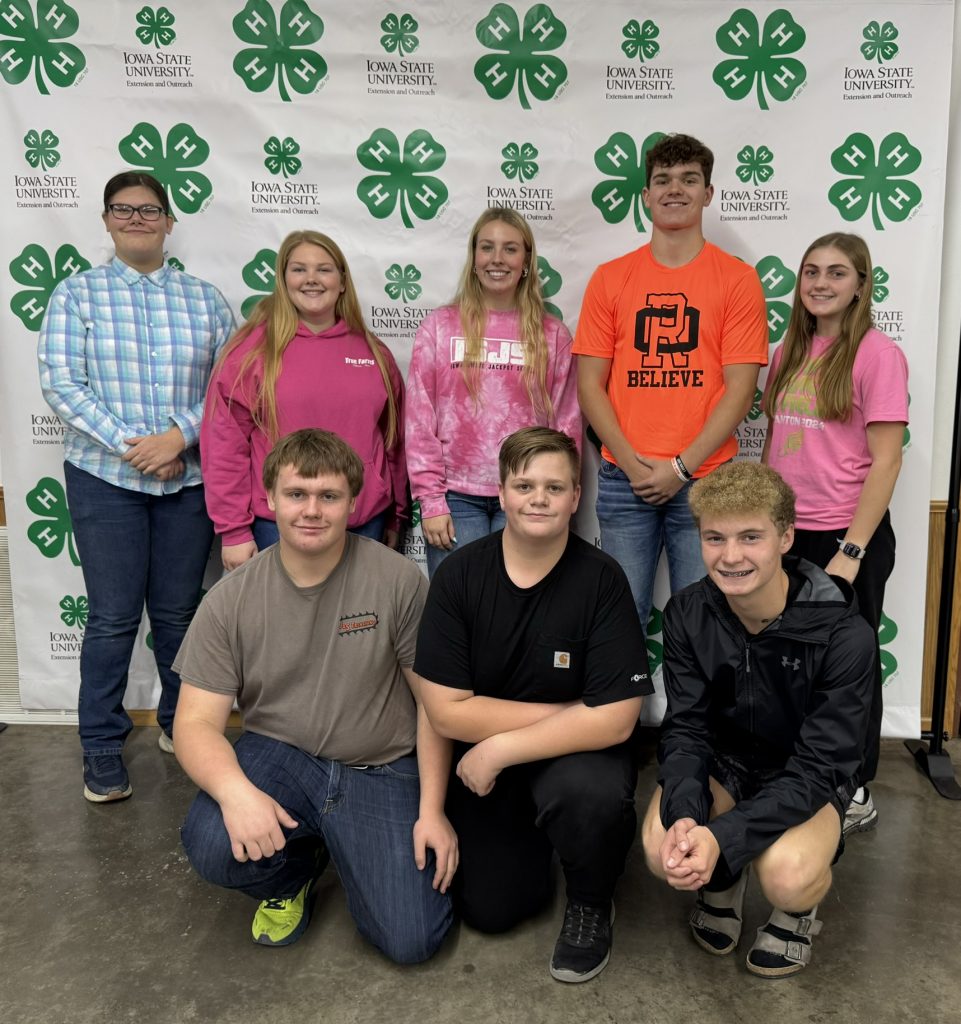
2024-25 Youth County Council: Pace Chaillie (Grant Spitfires), Kennedy DeVries (Stennett Panthers), Oliver Dykes (Stanton Strivers), Landon Gigstad (Stennett Panthers), Kyla Hart (Stanton Strivers), Victoria McFarland – not pictured (Stanton Strivers), Grace Nippert (East Sunrisers), Will Pollock (Stennett Panthers), and Delaney True (East Sunrisers).
Four awards are given to adult volunteers, community members, or businesses who support and make positive impacts on the Montgomery County 4-H program. The Friend of 4-H award was given to Farm Credit Services of America. The Montgomery County Ag Society received the Honorary Award. The 2024 Outstanding 4-H Alumni was given to Jenny Ellis and Stephanie Vinton-Pollock of the Stennett Panthers and Red Oak Clover Kids was presented the 2024 Outstanding Leader award.
Volunteers are presented with tenure awards for every five years of service. Those honored on Nov. 17th were:
In addition to adult and community awards, youth members received awards for submitting their yearly record books and submitting their officer books. Members receiving an award for their record books were:
Junior Record Books: The Outstanding Junior Record Book was awarded to Reese Herzberg. Loryn Anderson, Lyssa Anderson, Anna Chaillie, Payton Doyle, Carter Taylor, Zane Johnson, and Lauren Ferree received certificates of completion.
Intermediate Record Books: The Outstanding Intermediate Record Book was awarded to Dalton Ferree.
Senior Record Books: The Outstanding Senior Record Book was awarded to Joshua LeRette. Receiving certificates of completion and senior project area awards: Lilly Anderson (Rabbit), Pace Chaillie (Sheep), Landon Gigstad (Dog), Joshua LeRette (Woodworking), Grace Nippert (Poultry), Alyssa Strebe (Photography).
Two clubs received awards for turning in their officer books. Grant Spitfires received a certificate of completion for their Secretary’s book, and Outstanding Historian Book and Treasurer’s book. Stanton Strivers received Outstanding Secretary’s Book.
Six senior 4-H members received additional awards based upon their 4-H participation and project involvement. To be eligible for a senior award, members must turn in a record book as well as meet other award specific criteria.
Service: Pace Chaillie & Grace Nippert
Livestock Achievement: Lilly Anderson
Achievement: Landon Gigstad
Danforth Award: Alyssa Strebe
Hall of Fame: Joshua LeRette
Congratulations to all the 4-H members and community partners who received an award! (See more pictures on the Montgomery County-IA Extension Facebook page)
(Article submitted by Katie Hart, Montgomery County ISU Extension/Outreach)
(Radio Iowa) – Iowa’s busiest and largest hunting seasons will be kicking off shortly, as the first of the state’s two shotgun seasons for deer will open in about two weeks. Nate Carr, an Iowa D-N-R conservation officer, says deer hunting is extremely popular. “We see roughly 100,000 hunters get out and participate in those two seasons, and during that time, we harvest about half of the total deer harvest in Iowa within a relatively short period of time,” Carr says. “So it’s a really effective way to manage our deer herd across the state, but also see a lot of good hunter participation.”
The first deer shotgun season runs December 7th through the 11th, while the second season runs December 14th through the 22nd. Deer hunters harvested about 60-thousand deer in Iowa last year, and Carr anticipates this year’s harvest will round out roughly the same. “Eastern, southern Iowa, we have really strong numbers and tend to have strong harvest, and so that kind of makes up for the lower population on the western side of the state right now, so it kind of balances out,” Carr says. “I think we’ll see decent numbers. Hopefully, we’ll get colder temperatures. That tends to get deer on their feet and motivate hunters to get out and pursue them.”
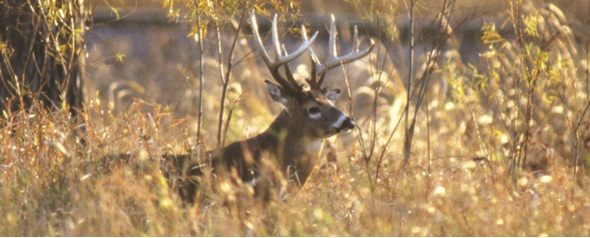
Iowa DNR photo
There have already been several smaller deer hunting seasons held in the state, and this year’s hot, dry weather may have been something of a hindrance. “We’re still seeing pretty decent harvest numbers. I think we’ve harvested around 25,000 deer throughout the youth season, in this early split of the archery season, as well as early muzzleloader, so we’re we’re on track,” Carr says. “We’re down a little bit, and you could probably attribute that somewhat to temperature, a little bit of hemorrhagic disease, which we’ve seen impact central Iowa quite a bit this year.”
Find much more information on the hunting seasons ahead at iowa-d-n-r-dot-gov.


 Facebook
 Twitter
 YouTube
 RSS
RSS