

CLICK HERE for the latest market quotes from the Iowa Agribusiness Network!
CLICK HERE for the latest market quotes from the Brownfield Ag News Network!


CLICK HERE for the latest market quotes from the Iowa Agribusiness Network!
CLICK HERE for the latest market quotes from the Brownfield Ag News Network!
(Iowa Capital Dispatch) – Students and leaders at the University of Iowa are helping a nonprofit map public spaces across the state developed with accessibility in mind, in order to ensure people of all abilities can enjoy Iowa’s parks and other public areas. The Iowa Initiative for Sustainable Communities at the UI, headed by director Travis Krause, partnered with Pathfinders Resource Conservation and Development to help expand its map of accessible public spaces in Iowa and launch a survey for the public to inform them of the accessibility of nature areas, cultural sites and more. Krause said with the survey having launched in December, the project is off to a good start. “Our success really hinges on the help of people across the state providing us the information through this survey tool …,” Krause said. “So we will be successful if people are using the tool and participating, and we’re going to continue to keep pushing that out.”
The goal behind the Iowa Initiative for Sustainable Communities is to connect university staff, students and resources to organizations and community partners in order to help develop and complete projects that meet their needs, Krause said. The initiative has worked with Pathfinders, an Iowa nonprofit focused on helping revitalize communities through conservation and economic development, on many projects in the past, and Krause said its accessibility map is a perfect fit for a project.
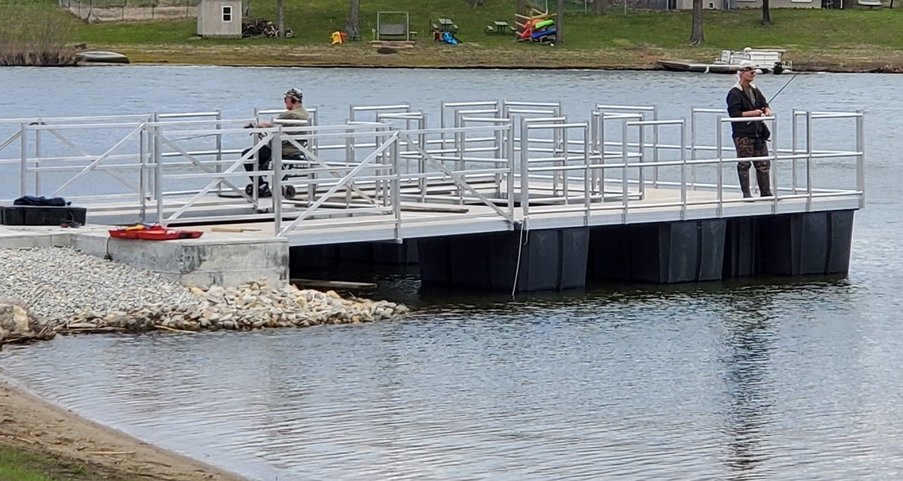
The Iowa Initiative for Sustainable Communities is working with an Iowa nonprofit to expand its accessibility map. (Photo by Brooklyn Draisey/Iowa Capital Dispatch)
The nonprofit’s accessibility map mainly covers south-central Iowa, and Krause said the survey and other efforts will help expand it to the whole state. It includes museums, trails, campgrounds and other spaces that are partly or fully accessible. Students in the university’s Iowa Community Integrated Geography Organization, or ICIGO, worked with the initiative and nonprofit to use GIS and other mapping tools to display the information for the accessibility map, Krause said, and he and his graduate assistant, Jessica Monday, worked on the survey. Monday, who is seeking a master’s in public affairs, said she helped craft survey questions after going over research literature about accessibility in public spaces. So far they’ve received 16 responses, she said, and are hoping for more as the survey is distributed by Pathfinders and others.
Krause said the project has been fun so far, with everyone, including him, learning new things. Monday said she’s learned about new technologies and areas of accessibility that she previously didn’t think about, like having adult changing tables available in park restrooms.
The survey has no closing date, Krause said, so people can keep responding well into the future, with updates to the map coming afterward. A possible next phase of the project could be asking people about what areas need to see improvements in their accessibility and map those as well.
(Radio Iowa) – Going after the paddlefish on the Missouri and Big Sioux rivers was once banned, but the populations came back enough to restart the paddlefish season. The D-N-R is hoping for similar success in bringing the paddlefish back at two popular lake areas. D-N-R Western Regional Fisheries Supervisor Chris Larson says West Okoboji is one area they have targeted. “They used to migrate up the little Sioux River out of the Missouri River and get into the big, great lakes up there, but now there’s barriers to keep them from doing that. And so we’re trying to experimental stocking at West Okoboji, where we reintroduced paddlefish this past fall,” Larson says. Two years ago they were stocked at Rathbun Lake as Larson says the paddlefish were native to the Cherokee River.
“I think they radio tagged about 25 of them, and they lost a few after that initial stocking. But they’re still swimming around in Rathbun and surviving,” he says. “So we assume that a majority of those fish survived and are growing. And it’ll take a number of years before it’ll create a fishable population.” He says it takes come time for the paddlefish to grow to a size that can be caught. “They get stocked at about 12 inches, and it might be six or seven years before you see a ten pound plus paddlefish in Rathbun but they’ll eventually, hopefully show up,” Larson says. The fish have a big paddle that sticks out in front of their face called a rostrum and they use it to help them navigate and find the plankton they eat. Larson says they are hoping to have the same success with paddlefish that other states have had.
“They’re very popular fisheries when you get down into the Missouri, the Ozarks, and into Oklahoma, they do paddlefish snagging in the large reservoirs there. These fish grow quite large — up to 100 pounds plus,” he says. Larson says the paddlefish like deeper areas of water that have some movement to them, and don’t like stagnant backwater.
EDDYVILLE, Iowa (KCRG) – Some Cargill workers in southeast Iowa will be out of a job by the beginning of February. KCRG-TV reports the plant in Eddyville is letting go 29 people on Feb. 5th. They are some of the first cuts to employees in Iowa after the company announced earlier this month that they would be letting go five percent of its workforce.
The Minnesota based company employs about 160,000 employees worldwide. A five percent cut in their workforce would equate to around 8,000 jobs. It’s not clear yet if additional Cargill jobs are at risk in eastern Iowa.
(Radio Iowa) – The Iowa D-N-R has captured its second gray fox and outfitted it with a tracking collar as part of its study to figure out why the animal’s numbers have fallen. Wildlife biologist Vince Evelsizer says the loss of the woodland habitat and competition for den sites with other wildlife may be one of the causes. There have been fewer than 10 confirmed gray fox sightings in Iowa. Wildlife research technician, Dave Hoffman, says the G-P-S collars paired with trail cameras, will give them a lot of data to help them learn a lot of things about the wolves that they’ve never studied before in Iowa.
(Radio Iowa) – Four northwest Iowa organizations are co-sponsoring a “Winter Women in Nature Day.” Amy Heibult of the Dickinson County Nature Center says the event is scheduled for Saturday, January 11th.
One of the morning sessions is about something that comes from North American maple trees.
In the afternoon, participants can choose from one of two outdoor activities.
Registration for the event closes next Wednesday, January 8th. It’s sponsored by the county conservation boards in Clay and Dickinson County, the Iowa Lakeside Lab and I-S-U Extension. According to the Outdoor Recreation Association, 55 percent of Americans over the age of four engaged in some outdoor activity last year — an all-time high.
(Panora, Iowa/Iowa Capital Dispatch) – A science class for middle school students at Panorama Middle School commonly involves a trek out to the prairie behind the school, a sketch of native seeds under the microscope or a homework assignment to track the progress of a backyard bluebird from its birdhouse. Teacher Mark Dorhout created an outdoor education program at the middle school in Panora to “connect (students) to the natural world,” foster environmental stewardship, and give students a real-world application to the science they learn in the classroom. Dorhout, who has a degree in wildlife and fisheries sciences, spent the majority of his career teaching or administering at middle schools and has been teaching sixth through eighth grade science at Panorama Middle School for four years. He started the outdoor education program by taking students out to a recently restored prairie behind the school, and using the school’s backyard in his lessons as much as possible.
“This has been a long-standing passion of mine that has become more and more apparent as we move along in this society,” Dorhout said. “And really the main thrust to that is that kids are out less and less into this environment.” Now the class and its non-traditional classroom has a reputation among the middle schoolers — all of whom will go through the project, make a birdhouse, and get to meet Dorhout’s Labrador retriever, which never misses a field day. Dorhout said he’s thankful the school district has been very supportive of the program and works with him to supply materials and promote the course in newsletters to parents. “They get it,” Dorhout said of his district. “They understand the value of a program like this.”
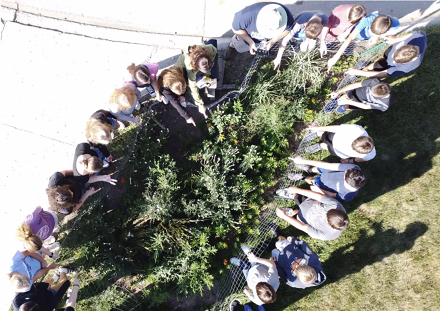
Students observe a “pocket prairie” installed by teacher Mark Dorhout who leads an outdoor education program at the middle school in Panora. (Photo courtesy of Mark Dorhout)
Dorhout said the 11-acre prairie behind the school has been there for over 20 years but really fell out of use until seven or so years ago when the local members of the Izaak Walton League worked to “grub out” some of the trees that had overtaken the area, and replant it to prairie. Each grade has a different project. Seventh graders build either a bluebird or a wren box that they take home, hang on a tree, and monitor through the rest of their time in middle school. “They never knew that there was the whole other thing going on … and then all of a sudden they’ve started paying attention to the birds in the neighborhood,” Dorhout said. Eighth grade students get to work in the greenhouse as part of their curriculum on genetics and climate change. Last year he added sixth graders to his docket and uses the prairie for their lessons in water quality and chemistry. Dorhout said going out and conducting water quality tests gives the students a real life application of the chemistry they learn in the classroom.
And all of the students get about 50 field days over the course of their time in middle school. Throughout the program, Dorhout has his students gather seeds, add plants into the prairie and analyze what makes one section of the prairie better than another. All of it leads to pretty “rich conversations” around soil quality and biodiversity. “Kids that you wouldn’t think would like doing prairie work, just totally get into it,” Dorhout said.
Dorhout spoke about his class during a Watershed Talk with the Iowa Division of the Izaak Walton League of America Dec. 17.
(Atlantic, Iowa) – You are invited to join Cass County Conservation Staff at Atlantic’s Schildberg Recreation Area- Lake number 4 this Saturday, January 4th, 2025 for “Soiree with the Swans.” Conservation staff will be giving ten-minute presentations during the event, with regard to the Trumpeter Swans, every half-hour beginning at 11-a.m., with the last presentation at 2-p.m.
There will also be time to view the swans through spotting scopes and witness random swan feeding sessions. Hot chocolate, cookies, and other snacks will be provided free of charge with donations being accepted (for swan care). 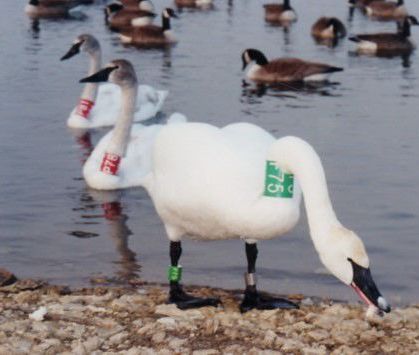
The Schildberg Recreation Area is located on the northwest edge of Atlantic, Lake 4 is on the north side of Highway 83. Atlantic is celebrating 25 winters of the Trumpeter Swans wintering here. The Conservation Department says “This event is not to be missed!”
IF THE WEATHER IS “BAD” OR THE SWANS ARE NOT AT THE PARK…the program will be held at the Atlantic Public Library, from Noon until 1-p.m., Saturday, with hot chocolate, cookies, and other snacks available. The event is sponsored by the Cass County Conservation Board, Atlantic Parks and Recreation, and the Iowa Department of Natural Resources.
(Radio Iowa) – Some Iowa families have a tradition of taking down the Christmas tree tomorrow (Tuesday), on the last day of the year, in order to start the new year out fresh. Horticulturist and extension educator John Fech says don’t just toss the tree to the curb, but find a way to repurpose it. “Recycling it, reusing it, thinking of it again as a resource or an asset,” Fech says. If you’re crafty, trim the branches to make a fragrant sachet, wreath, or garland to enjoy in the weeks ahead. Laying small limbs over tender perennials provides them with some protection against fluctuating winter temperatures. He says a couple of layers of cut stems, applied in a criss-cross fashion, should offer adequate air penetration, yet keep them cool enough to reduce injury from warm and cold cycles.
Fech says mulching is another option. “Do that yourself with a hatchet or you could have it run through a chipper,” Fech says. “Many of the cities do that for their parks and then they use that for trail cover around city parks and hospitals and places like that.” Another idea is to return the tree to the great outdoors for wildlife to use as shelter. He likes to call it tree-cycling. “Also, it could just be songbird habitat,” Fech says. “Set it near the bird feeder so birds have a place to get out of the wind and have a little bit of refuge from predator birds.”
If mulching the entire tree is too much work, just using the needles can be an effective mulch on perennial plants, in your garden, and to keep weeds in check.
(Radio Iowa) – Former Iowa Governor Tom Vilsack — leaving his role as U-S Agriculture Secretary in three weeks — will have the second-longest tenure as the nation’s top ag official. “It’s been a tremendous honor and privilege to have had nearly 12 years as the secretary of agriculture,” Vilsack said. “It is an extension of work actually that began in a small town in southeast Iowa as a small town lawyer representing farmers during the Farm Crisis. It really sort of gave me a direction to my life which has ultimately ended up with me in this office.” Vilsack grew up on the east coast and, after graduating from law school, Vilsack moved to his wife’s hometown of Mount Pleasant. He was elected as the town’s mayor, then as a state senator before he won two terms as Iowa’s governor. Vilsack was Secretary of Agriculture during the Obama Administration and President Biden asked him to return to the role four years ago.
“As a mayor, as a state senator, as a governor and as secretary I’ve had the opportunity to be involved in, to encourage and support programs that will advance opportunities for farmers, ranchers and producers,” Vilsack says, “because I remember the pain of the Farm Crisis of the ’80s.” Vilsack says one of the highlights of his second run as U-S agriculture secretary has been seeing an uptick in the number of farms in Iowa. “In 1981, during the (Farm) Crisis, we had about 115,000 farms in Iowa,” Vilsack said. “Today we have 86,911 farms according to the census, but that number’s up over a census that was several years ago, so we’re headed in the right direction and I think a lot of it has to policies that we put in place to provide assistance and help, so I feel pretty good about it.” The U-S-D-A conducts a census every five years. The last census in 2022 found the number of farm units in Iowa had increased by about one percent the number of farmers had increased seven percent from 2017.

Ag Secretary Tom Vilsack (photo from Ag Secretary’s office)
Vilsack says the commodity-based system has rewarded size and he’s proud of programs at the U-S-D-A that helped increase the number of Iowa farms operating on fewer than a thousand acres. “I hope that I’m able to continue focusing on ways in which I can showcase the work of American agriculture, that I can showcase opportunities to expand rural economies and the farm economy to give small and mid-sized producers a chance,” Vilsack said. “I also have been working extraordinarily hard on nutrition and food security issues both domestically and globally.”
Vilsack is not planning to retire. “My hope is I get a chance to figure out ways in which I can continue to make a contribution,” Vilsack says. “I don’t think I’m ready for retirement and I don’t think I’d be very good at it.” Vilsack turned 74 on December 13th.
The only other person who has served longer than Vilsack as the nation’s secretary of agriculture is former Iowa Congressman James “Tama Jim” Wilson. He was ag secretary for 16 years and served three presidents.



 Facebook
 Twitter
 YouTube
 RSS
RSS