

CLICK HERE for the latest market quotes from the Iowa Agribusiness Network!
CLICK HERE for the latest market quotes from the Brownfield Ag News Network!


CLICK HERE for the latest market quotes from the Iowa Agribusiness Network!
CLICK HERE for the latest market quotes from the Brownfield Ag News Network!
(Radio Iowa) – John Deere has notified state officials it will lay off 75 workers from its Ottumwa plant next month. Last year, Deere offered early retirement to over 100 employees at the Ottumwa facility and, in November, Deere announced it would temporarily close the plant in December, due to reduced customer demand for its products. Hay balers and mowers have been produced in Ottumwa.
Deere is moving mower production from Ottumwa to Mexico. Monday was the last day of work for 80 employees at Deere’s Davenport facility and for 112 workers at Deere’s Waterloo factory where tractors are produced.
Deere executives have cited weak demand for farm equipment as the primary factor in several waves of layoffs over the past year.
(Radio Iowa) – When the winter winds are howling, some Iowans take solace in dreaming of the coming warmth of spring and working in their green backyard gardens. Iowa State University Extension and Outreach is launching its free Home Gardening Webinar series this week. Alicia Herzog coordinates the master gardener program and says this year’s topics will include soil health, identifying edibles, and more. “Many of our master gardeners will use this webinar series for continuing education, but it’s also free and open to the public,” Herzog says, “so it’s a really great series for anyone who’s interested in gardening and horticulture and just wanting to have a better yard or lawn or grow better vegetables.” The first webinar is scheduled for Thursday night.
“This is a weekly series,” she says. “It goes for 10 weeks. It’s every Thursday, from January 9th through March 13th, and it’s at 6 PM from six to seven.” While there are a couple of online options, Herzog says the webinars will also be offered at many I-S-U extension offices throughout Iowa. “Some extension offices across the state will be offering live streaming in the office,” Herzog says. “So if people prefer to go in person, or maybe they don’t have internet at their house, or they just want to get out and socialize, they should call their extension office and double check with them, as not all extension offices will be offering it.”
There’s also the option of joining via computer using Zoom, or by going to the livestream on the extension’s Facebook page.
(Iowa Capital Dispatch) – Corn farmers in Iowa, and across the country, will have “full and fair” access to markets in Mexico after a United States-Mexico-Canada Agreement, or USMCA, panel found Mexico’s bans on genetically engineered corn were against USMCA commitments. The U.S. brought forward seven claims under the trade agreement in 2023 and on Dec. 20, 2024, the USMCA panel sided in favor of the U.S. claims, according to the U.S. Department of Agriculture. Under a 2023 presidential corn decree, Mexico initiated a ban on GE corn in dough and tortillas and called for the gradual elimination of GE corn from other food sources and from animal feed.
Iowa Secretary of Agriculture Mike Naig called the bans “baseless” and “rooted in politics” rather than science, according to a news release. “This dispute resolution case reinforces the value of securing free trade agreements with key partners around the globe,” Naig said in a statement. “These agreements not only secure markets for Iowa-grown products, they also outline a fair, transparent and binding dispute resolution process.” According to USDA, Mexico is the largest corn export market for the U.S. and accounted for nearly $5 billion worth of exported corn from January through October in 2024.
Iowa Corn Growers Association President Stu Swanson called Mexico a “key trade market” for corn growers, in a press release from Iowa Corn that said farmers and leaders must work with the incoming administration to enforce the ruling. “Iowa’s farmers rely heavily on trade and corn exports to Mexico,” Swanson said in the statement. “That’s why we joined other state and (National Corn Growers Association) grower leaders in pushing USTR to challenge this ban.”
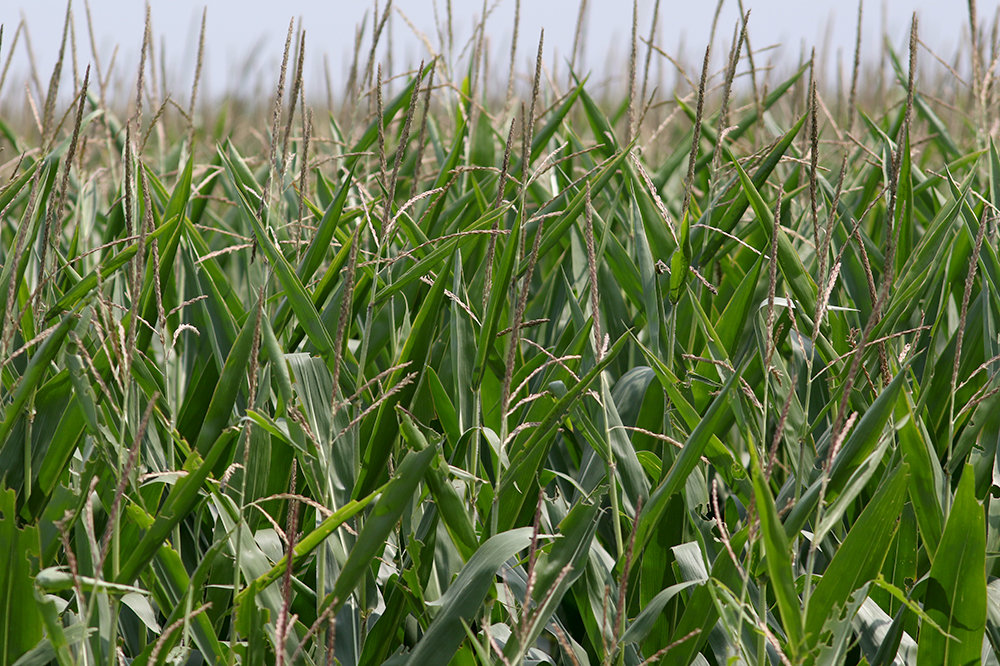
Corn growing in a western Iowa field in August 2023. (Photo by Jared Strong/Iowa Capital Dispatch)
USDA data on genetically engineered crops in the country show 95% of Iowa corn planted in 2024 was genetically engineered, which is consistent with rates in other corn production states across the country. U.S. Secretary of Agriculture Tom Vilsack said in a statement the USMCA panel decision affirms U.S. allegations that Mexico’s policies were “counter to decades’ worth of evidence.” “This decision ensures that U.S. producers and exporters will continue to have full and fair access to the Mexican market, and is a victory for fair, open, and science- and rules-based trade, which serves as the foundation of the USMCA as it was agreed to by all parties,” Vilsack said.
According to USDA, Mexico has 45 days from the final report (issued Dec. 20) to comply. The panel, in its final report, acknowledged Mexico was “seeking to address genuine concerns in good faith” but it recommended the country do so instead with “measures based on scientific principles” and “in dialogue” with USMCA parties.
(Radio Iowa) – The Iowa State Extension survey found that average price of an acre of farmland dropped in 2024, breaking a five-year trend of increases. I-S-U extension economist Rabail Chandio conducts the survey and says the one trend that didn’t change is the type of people buying farmland. “The highest demand for our farmland comes from existing farmers. They may be existing local farmers or existing relocating farmers, but 70 percent of all farmland demand came from this group,” she says. Chandio says 23 percent of the farmland purchases were by investors.
“These investors include local as well as non local investors. They may include absentee landowners. They may include people who are next generation farmers or and they are not manually farming. They’re not personally farming, but they do want to keep connected with their legacies, and they’re buying farmland,” she says. Chandio says the investors in Iowa aren’t usually the institutional investors or big companies or individual big name billionaires. “It includes a lot of maybe Iowa residents, or previous Iowa residents, or residents from our neighboring states who are showing interest in our farmland,” Chandio says. “It also includes the demand for recreational ground that is more pronounced specifically for southern Iowa.”
The recreational purchasers are using the farmland in southern Iowa for hunting, and she says that’s whey it had three-point-six percent increase in value. Chandio says Iowa farmland doesn’t usually come up for sale until the owner dies or decides to retire. “Estate sales is the largest category contributing 57 percent of the land that was up for sale this year. Retired farmers is the next biggest category, making up for 22 percent of all land that was available for sale,” she says. Chandio says the long-term landowners have paid it off, and that gives them some protection against economic swings. “Eighty-four percent of all Iowa farmland is owned debt free, so those who already own it are not feeling the interest rates, which is why it is a negative pressure, but it has not been enough to really tip over the markets in the last year either,” she says.
Chandio says the high interest rates create the most pressure for beginning farmers and can really make them struggle.
WATERLOO, Iowa (KCRG) – Friday (Jan. 3rd) was the last day of work for 80 John Deere employees in Davenport. The layoff will impact the John Deere Davenport Works location, which builds tractors and farming equipment. John Deere announced the layoffs on Oct. 16th. The company cited recent low demand and challenging market conditions. Deere announced a net income of $7 billion for the 2024 Fiscal Year, a 16 percent drop from the year before.
However, the layoffs don’t stop there. Monday will be the last day for 112 employees at the Waterloo works location. These layoffs were announced on Dec. 3rd.
So far, more than 1,700 John Deere employees across Iowa have been laid off since the start of last year, with most of them in Waterloo.
(Radio Iowa) – Water quality advocates says the effort to protect Bloody Run Creek in northeast Iowa from pollution has made progress after the D-N-R was ordered to reevaluate a feedlot water permit. The ruling by an administrative law judge could render the water permit invalid for Supreme Beef’s 11-thousand head feedlot in Clayton County. The president of the Driftless Water Defenders, Chris Jones, says the order could set a precedent for change to Iowa’s environmental protections.
He says it went unchallenged because it is law.
Jones says the next step is gathering signatures for a petition in Decorah on Monday. Bloody Run is one of the few streams in the state that supports the natural reproduction of trout.
(Des Moines, Iowa) – Officials with the Iowa Department of Natural Resources remind hunters and anglers, that 2024 hunting and fishing licenses expire on Jan. 10, 2025. All hunters and anglers will need a 2025 license to hunt or fish beginning Jan. 11th.
And, Iowa’s pheasant, late muzzleloader and archery deer, and archery fall turkey seasons close on Jan. 10th. Squirrel, quail, partridge and grouse remain open until Jan. 31st. Furbearer seasons and rabbit season is open until Feb. 28th. Crow season is Jan. 14th to March 31st. Beaver trapping season closes on April 15th.
For waterfowl, the north zone dark and light goose season closes on Jan. 11th, the central zone dark and light goose season closes on Jan. 18th, and the south zone dark and light goose season closes on Jan. 25th. The light goose conservation order season is open Jan. 26th to May 1st statewide; additional regulations apply. 
Don’t forget also, the Iowa DNR is hiring seasonal positions for summer 2025 in the Iowa state park and forest system. Work alongside conservation professionals building skills for careers in natural resources. Seasonal workers primarily work in the outdoors performing hands-on duties in natural resource management, park operations, visitor engagement, and/or law enforcement. Each park has unique needs depending on its natural areas, recreational opportunities and amenities.
Learn more about summer 2025 job opportunities and find out how to apply at: www.iowadnr.gov/employment
DES MOINES— Gov. Kim Reynolds today (Thursday) extended a disaster proclamation for O’Brien, Palo Alto, Sac, Sioux, and Worth Counties effective immediately through February 1, 2025. The USDA has confirmed positive cases of highly pathogenic avian influenza (HPAI) in all five counties.
This proclamation allows state resources from Iowa Homeland Security, the Iowa Department of Agriculture and Land Stewardship, and other agencies to assist with tracking and monitoring, rapid detection, containment, disposal, and disinfection. The proclamation also waives regulatory provisions related to commercial vehicles responding to affected sites.
The recent HPAI detections in birds do not present an immediate public health concern, and it remains safe to eat poultry products. If producers suspect signs of HPAI in their flocks, they should contact their veterinarian immediately.
Atlantic, Iowa – The 2025 Crop Advantage Series meetings will give farmers and crop production professionals a solid foundation of current research-based crop production information to help make informed decisions for their farming operation. Twelve locations are set to host this series across Iowa throughout the month of January, including a January 21 session in Atlantic. The meeting is an opportunity for farmers and crop advisers to hear current research and crop production information from Iowa State University. Campus Extension specialists, field specialists and invited speakers will travel to Atlantic on Tuesday, January 21, providing updated management options and recommendations on crop production issues facing Iowa growers.
Meetings include catered lunch and continuing education credits for Certified Crop Advisers (CCA). Private pesticide applicator continuing education will be available and will require a separate fee payable at the location. “There is no other program in our crop production education year where we are able to bring this many extension specialists together at sites across the state. We’re excited to provide the quality, in-person education farmers and ag retailers have come to expect,” said Aaron Saeugling, field agronomist with Iowa State University Extension and Outreach.
The Atlantic Crop Advantage meeting will be held at Cass County Community Center (805 West 10th Street., Atlantic, IA) on January 21, 2025. Registration check-in opens at 8:30 AM and the program runs from 9:00 AM to 5:00 PM. Program highlights of this location include a 2025 weather outlook, a deep dive into nitrification inhibitors, short corn research, DOT regulations for agricultural use, and managing waterhemp. 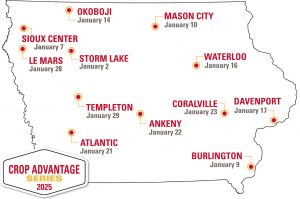
This meeting is part of a series being held at multiple locations across the state throughout the month of January. For more program details and registration information, for Atlantic or other Crop Advantage locations, including dates, times, and program details visit: https://go.iastate.edu/cropadvantage. Early registration for each location is $75; late registration completed less than seven days prior to the meeting, or on-site, is $100. Early registration for the Atlantic location closes at midnight on January 14th. Registration includes lunch, refreshments and CCA credits. Private pesticide applicator continuing education will also be available and will require a separate fee payable at the location. Online registration is now open at https://go.iastate.edu/cropadvantage.
For registration questions, please reach out to Registration Services at registrations@iastate.edu or 515-294-6222. For all other questions, email crops@iastate.edu or contact your local extension field agronomist Aaron Saeugling at clonz5@iastate.edu.


 Facebook
 Twitter
 YouTube
 RSS
RSS