

CLICK HERE for the latest market quotes from the Iowa Agribusiness Network!
CLICK HERE for the latest market quotes from the Brownfield Ag News Network!


CLICK HERE for the latest market quotes from the Iowa Agribusiness Network!
CLICK HERE for the latest market quotes from the Brownfield Ag News Network!
WILLIAMSBURG, Iowa (KCRG) – Kinze Manufacturing, Inc., is laying off 53 employees from its operation in Williamsburg, the company confirmed Wednesday. In the announcement, the company cited ongoing economic challenges in the agricultural sector. The January layoffs, which impact 53 of its 550 employees in Williamsburg, come after nearly 200 employees were laid off there in August 2024.
“Kinze has a fantastic workforce and this was an incredibly difficult decision,” said Susanne Veatch, President of Kinze. “Unfortunately, the continued downturn in the agricultural market necessitated this workforce adjustment.” 
Kinze is a global manufacturer of planters, grain carts, and high-speed tillage equipment.
In other unemployment news, more than two dozen people are losing their jobs at a central Iowa company. According to Iowa Warn, IES Communications in Altoona is laying off 28 people. The business is not closing completely. The layoffs are taking effect immediately.
ATLANTIC, IA (January 14, 2025) – Have you heard the buzz? Produce in the Park’s Sweetheart Market is all about bees and local honey. The farmer’s market’s theme is, “Bee Mine, Honey,” and the market will feature multiple local honey vendors in addition to organizations sharing information on bees, including the Southwest Iowa Beekeepers.
Sweetheart Market will be held at the Nishna Valley Family YMCA (1100 Maple St. Atlantic, IA 50022) on Saturday, February 8 from 10 AM to 1 PM. Sweetheart Market will also be hosting The Pancake Man who will be serving all-you-can-eat pancakes, sausage, and drinks for $8 per adult and $5 per child (under 18). Proceeds from the pancake meal will be donated to Cass County food pantries.
Sweetheart Market shoppers can enjoy bee and honey-themed face painting, as well as a variety of local food and craft vendors. Vendors will offer lots of local vegetables including fresh greens, squashes, sweet potatoes, carrots, and spinach, as well as beef, pork, lamb, chicken, and farm-fresh eggs. True to its name, the market will also offer a variety of sweet treats including gourmet cupcakes, kringle, and other baked goods and desserts. In addition to local foods, Sweetheart Market vendors will be selling candles, body products, wood craft products, seasonal home decorations, plants, earrings, and more.
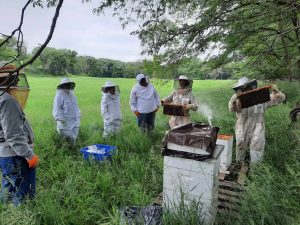
Southwest Iowa Beekeepers (Photo submitted)
As with all Produce in the Park farmers markets, there is no cost to enter Sweetheart Market, and local organizations–including Cass County Tourism–will be at the market sharing information. All Produce in the Park farmers markets accept SNAP EBT, otherwise known as food stamps, for all qualifying food items. Produce in the Park continues to accept vendor applications for Sweetheart Market. Vendor of the application are available at the Atlantic Area Chamber of Commerce (102 Chestnut St., Atlantic, IA 50022). Produce in the Park seeks vendors selling handmade or homegrown products, including local foods, as well as beauty products, candles, crafts, art, and decorations.
Sweetheart Market 2025 is sponsored by Atlantic Area Chamber of Commerce, Cass County Tourism, Cass Health, City of Atlantic, First Whitney Bank & Trust and Nishna Valley Family YMCA.
For the latest information on Sweetheart Market, and all Produce in the Park markets, follow Produce in the Park on Facebook (www.facebook.com/ProduceInThePark) or Instagram (https://www.instagram.com/produceintheparkatlanticia/).
(Iowa News Service) – Advocates for small communities in Iowa are calling on state lawmakers not to pass the so-called “Cancer Gag Act,” which they said would give pesticide companies immunity from lawsuits by Iowans harmed by their products. Iowa lawmakers considered Senate File 2412 last year but ran out of time to act on it.
Caitlin Golle, Community Organizer for the advocacy group Iowa Citizens for Community Action, said lawmakers are already poised to take up a similar measure in the new session. She and the Iowa Cancer Registry think it is the wrong thing to do in a state already seeing high cancer rates. “In 2023, the Iowa Cancer Registry reported that Iowa has the second-highest cancer rate in the country,” Golle pointed out. “The National Cancer Institute reported Iowa is the only state where the rate of new cancers increased significantly from 2015 to 2019.”

Agriculture tractor spraying fertilizer on green tea fields, Technology smart farm concept
Pesticides often waft into the air and seep into groundwater. Golle worries giving pesticide manufacturers immunity from lawsuits will add to the problems in rural Iowa, where large animal confinement operations are already polluting ground and surface water with manure runoff. Ag companies said they apply pesticides safely and are always looking for better ways to produce meat while keeping up with consumer demand.
Golle and other grassroots advocates want to see Iowa join a growing list of states refusing to give pesticide makers like Bayer immunity from lawsuits brought by Iowans, who said they have suffered health effects from chemicals like glyphosate.
“Chemicals like glyphosate, or ‘Roundup,’ are known to cause cancer,” Golle noted. “A study published by Frontiers in Cancer Control and Society finds that pesticides may cause cancer on a level equivalent to smoking cigarettes.” The pesticide company Bayer has four registered lobbyists in Iowa compared to other large companies with just one, if any.
Iowa Citizens for Community Improvement held a webinar late last week to mobilize people on the issue before the bill is introduced.
DES MOINES, Iowa, Jan. 14, 2025 – U.S. Department of Agriculture (USDA) Rural Development State Director in Iowa Theresa Greenfield today (Tuesday) announced that she is departing her leadership position effective at noon on January 20, 2025. Deputy State Director Kate Sand will then assume responsibility for the Agency’s role in providing loans and grants to help expand economic opportunities, create jobs, and improve the quality of life for thousands of Iowans in rural areas.
“It’s been an honor to serve the people of Iowa as State Director for USDA Rural Development,” said Director Greenfield. “From helping to fund healthcare needs—for example—in Muscatine, Shenandoah, Sioux Center, and Grundy Center, to supporting our Iowa co-operatives in Boone, Butler, and Calhoun counties, to fostering the movement to clean energy on hundreds of livestock and grain farms, USDA is making a positive impact in the lives of Iowans. What a privilege it has been to be a part of that!”
Director Greenfield began her tenure at USDA in November of 2021 after a career focused on community development, housing, and real estate. During her time at USDA, she oversaw the distribution of millions of congressionally appropriated dollars for critical hospital, emergency response, and water infrastructure projects across the state.

Theresa Greenfield, USDA Rural Development State Director in Iowa, spoke with Kate Sand, USDA Rural Development Deputy State Director in Iowa, at a training conference for USDA employees at the Neal Smith Federal Building in Des Moines, Iowa, on September 13, 2022. USDA photo by Cecilia Lynch
Acting State Director
Acting State Director Sand has worked alongside rural Iowans since she began her career with USDA Rural Development in 2004. She has served in in multiple positions, programs, and area offices while serving rural communities, businesses, and homeowners for the past 20 years. For nearly ten years, she served as the Community Program Director before taking on the role of Deputy State Director in November of 2022.
Sand grew up on a corn and soybean farm near Joice, Iowa, population 208. She holds a Bachelor of Arts degree in public administration from Buena Vista University in Storm Lake and a Master of Arts degree in political science from the University of Iowa.
For the complete list of leadership for USDA Rural Development programs in Iowa, read it online here.
(Radio Iowa) – A former N-F-L cheerleader who’s spent the past 25 years as an explorer for National Geographic will open the Des Moines Civic Center’s “Explorer Series” next week. Mireya Mayor travels to some of the world’s most remote locations where animals are critically endangered, and she’s discovered new species. Mayor says she’s come a long ways, growing up in Miami as the only child of very protective, Cuban immigrant parents. “I remember when I asked my mom if I could join the Girl Scouts, and she said, ‘Absolutely not. That is far too dangerous,'” Mayor says, laughing. “So the fact that I went on to become an explorer and in fact, National Geographic’s first female wildlife correspondent, really speaks to the testament that — go after your dreams.”
Mayor says she’s overcome a host of stereotypes, like becoming a scientist after her early career of cheering for the Miami Dolphins. As a primatologist and anthropologist, Mayor says she’s swam with sharks, been chased by gorillas, stampeded by elephants, bitten by snakes, and much more — but wouldn’t trade any of her experiences. “There are times I look back and think I am either incredibly brave or just, you know, really stupid, taking all these risks,” she says, “but there are no regrets. First of all, yes, I’ve been charged by no less than dozens of gorillas, but only a couple times have I felt like maybe it may not end well.” Those times include surviving a plane crash in the Congo, but Mayor says the stories she’s able to bring to the global Nat Geo audience make her lifestyle very worthwhile.

Mireya Mayor (Submitted photo)
“It’s all about being out there and trying to make a difference. And some of the animals that I’ve studied had never been studied before. They were on the verge of extinction, and I think pretty much had been written off,” she says. “So it feels really good to really make a difference and try to help them.” Mayor is the mother of six. Her kids range in age from nine to 19, so maintaining a work/life balance can be challenging, given her weeks-long adventures. She says she runs her life much like she runs her expeditions. “I have a Plan A and a Plan B, and always a contingency Plan C, because as you know, things change, especially with kids, and the same is out in the field,” Mayor says. “I say it takes a village. I kind of have a village. I have my mom and very supportive husband and I just make it work.”
Mayor’s lecture, called “Pink Boots & a Machete,” is scheduled for next Tuesday at the Des Moines Civic Center.
(On the web at civiccenter.org)
(Ames, Iowa) – Soybean cyst nematodes have been present in every Iowa county since 2017 and new survey results show the costly crop pests continue to spread to more counties across the country and in Canada. The Iowa Capital Dispatch reports Greg Tylka, a nematologist at Iowa State University, led the survey that has monitored the spread of soybean cyst nematodes, or SCN, since 2014, and found 31 counties in 10 states reported SCN for the first time between 2020 and 2023.
“It’s reasonable to conclude that increased soybean yield losses due to the nematode will follow, if not already occurring in these areas,” Tylka said in a press release about the new report. Soybean cyst nematodes are estimated to cost farmers close to $1.5 billion in lost profits, annually in North America.
SCN infestations are not always evident as the fields will often look healthy, even while the nematodes are rapidly generating, infesting the roots of the soybeans and limiting the plant’s ability to absorb nutrients and produce beans.
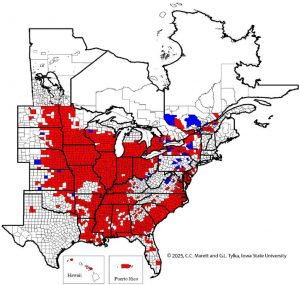
The map, part of the Plant Health Survey on soybean cyst nematodes, shows the known distribution of SCN in the United States and Canada. Those counties and rural municipalities first reported as infested between 2020 and 2023 are shown in blue; those known as infested before 2020 are indicated in red. (Photo courtesy of the SCN Coalition)
SCN can also exasperate the effects of crop diseases, like sudden death syndrome, by causing additional stress to the plants.
Tylka hopes the survey results will alert farmers of the presence in their counties so they know to get a soil test and figure out how to farm with SCN.
There is little a farmer can do to prevent SCN from entering or leaving a soybean field. The nematodes live in the soil and therefore can spread anytime soil moves. Even a dust storm could carry SCN from one county to the next.
There is also no way to completely eliminate SCN from a field, so farmers have to rely on crop rotations and SCN resistant soybean varieties to minimize the effects of SCN.
Rotating corn into the field helps to manage some of the SCN population since the nematodes will only feed on soybeans.
Soybean varieties with PI 88788 genetics have been the dominant SCN resistant varieties for the past several decades, but SCN populations have begun to develop a resistance to PI 88788 due to its heavy use.
Tylka’s research with ISU showed that the number of SCN resistant varieties using Peking genetics have more than doubled from 2023 to 2024, which he said gives farmers more opportunity to rotate Peking and PI 88788 varieties. Tylka said at a media event in November 2024 that the rotation of SCN resistant varieties is vital to the long-term management of the nematodes, as it will prolong the time it will take SCN populations to develop resistance. “I am terrified about losing Peking,” Tylka said, noting that while Peking has good resistance now, it will probably lose effectiveness within five to six seasons.
“My message is, farmers must not abandon 88788, but rotate it with Peking,” Tylka said.
Farmers can also make use of fall soil tests that measure SCN presence and resources from the SCN Coalition, including a profit checker, that estimates a farmer’s losses per field due to SCN factors.
(Iowa Capital Dispatch) – The U.S. Environmental Protection Agency affirmed its November decision to add seven additional segments to Iowa’s list of impaired waters, following a public comment period. The EPA announced in November it had partially approved the Iowa Department of Natural Resources’ assessment of surface water quality in the state and called for the inclusion of additional segments on the Cedar, Des Moines, Iowa and South Skunk rivers, based on measured levels of nitrate.
Per EPA documentation, a vast majority of the public comments submitted were in favor of the EPA decision. DNR, which monitors and compiles the impaired waters list every two years, per the Clean Water Act, called EPA’s assessment “illegal” since nitrate is not officially listed as a “toxic pollutant” under the Clean Water Act.
Once a segment is designated as impaired, a total maximum daily load, or TMDL, of the excessive pollutant is established and contributing polluters are allocated a share of this load to help bring down the total concentration. Lyon also argued EPA did not provide reasoning, data or methodology for its decision. In its comment, submitted Dec. 19, DNR requested EPA withdraw its decision to add the seven segments, or otherwise establish loads that are consistent with federal code and allow the public to review and comment on it.

The Raccoon River from the Bill Riley Trail in Des Moines on Dec. 28, 2024. (Photo by Cami Koons/Iowa Capital Dispatch)
In the EPA response to DNR, the Iowa Farm Bureau Federation and the Fertilizer Institute, which all wrote comments opposing the decision, the agency acknowledged the water quality standards and assessment approaches toward nitrates “vary across states.” The agency points to Iowa water quality standards that say “all substances toxic or detrimental to humans” or to the water treatment process are to be limited to “nontoxic or nondetrimental concentrations.” EPA said it used this water quality standard to justify the additional segments, because water treatment facilities must use “additional treatment” to meet drinking water nitrate standards, per its own code.
EPA said it gathered data from DNR’s own reports and public data from Des Moines Water Works, which was among several public water suppliers that submitted comments supporting the EPA decision. EPA said it “adhered to all legally applicable requirements” in its action.
EPA said it received 83 comments about the decision, 72 of which were in support of including the additional seven segments to Iowa’s impaired water list.
Environmental advocacy groups, including the Iowa chapter of the Sierra Club, Iowa Environmental Council and Iowa Citizens for Community Improvement were among supportive commenters. The same groups submitted a letter to EPA in the fall, urging the agency to take action on protecting drinking water sources from nitrate pollution.
A spokesperson for Iowa DNR declined to comment on the EPA decision.
(Des Moines, Iowa) – As the Biden administration enters its final days in the White House, biofuel industry leaders hoped for finalized rules on a tax credit for sustainable aviation fuel, but what they got was a “notice of intent to propose regulations” from the U.S. Department of the Treasury. The Iowa Capital Dispatch reports Iowa Renewable Fuels Association Director Monte Shaw says the notice leaves producers “stuck in neutral” as the guidelines could and likely will be changed once the Trump administration takes office. According to Shaw, “What’s in it is somewhat meaningless, because in 10 days, what the Biden administration intended to do doesn’t matter anymore. The Trump administration will come in and take a fresh look at this, and that’s true of any change in administration at any time in our country’s history.”
According to the U-S Department of Treasury, the guidance issued Friday provided clarity on eligibility for the credit and how lifecycle greenhouse gas emissions will be determined. Deputy Secretary of the Treasury Wally Adeyemo said “This guidance will help put America on the cutting-edge of future innovation in aviation and renewable fuel while also lowering transportation costs for consumers.” A press release from the Treasury said the department intends to release its Greenhouse gases, Regulated Emissions, and Energy use in Technologies, or GREET, model for determining 45z emissions rates “in the coming days.”
The tax credit was announced in 2023 as part of the Inflation Reduction Act and was set to give a per-gallon tax credit on fuel produced with in a set range of lifetime emissions guidelines. Monte Shaw said since September, IRFA and other industry groups have been calling on the Treasury to issue a safe harbor rule that would use existing carbon models to estimate the value of credits while the department finalizes its guidelines. Shaw says “We have biodiesel plants that are sitting idle today, that are not running, because they don’t know what the value of the credit is. Feedstock suppliers don’t know how to price the feedstock, biodiesel producers don’t know what to pay for them.”

Southwest Iowa Renewable Energy, LLC in Council Bluffs. (Photo courtesy of David Kosling, USDA AudioVisual Production Specialist)
Shaw said he presumes the incoming administration will want to put “more than a few fingerprints” on the intended regulations that were issued by the Treasury. To him, that means Iowa biofuels plants cannot claim the credits “with any certainty or lack of risk” under the unfinalized rules. Shaw says “Iowa biofuels plants, collectively, made hundreds of millions of dollars of investments based on this 45z program that’s supposed to be here for ‘25, ‘26 and ‘27 and right now they can’t access it.” He said IRFA will work with the Trump administration and hopes to get rules for the credit, or a safe harbor, in place as soon as possible.
DES MOINES, Iowa — The Iowa Department of Natural Resources is asking for the public’s help with a carcass dumping investigation. The DNR says five dead deer were found at the Highway 44 boat ramp of the Raccoon River, in Dallas County.
In Iowa, it is illegal to leave a dead animal without disposing of it in a timely manner. If you have any information, call 515-883-0228 or email dustin.eghmy@dnr.iowa.gov.
The DNR says you can remain anonymous and there could be a reward for your tip.
(Red Oak, Iowa) – The Montgomery County Board of Supervisors will discuss and likely approve 2025 Bridge Embargoes during their meeting that begins at 9-a.m. Tuesday (Jan. 14), in Red Oak. Bridge embargoes are designed to prevent accidents involving overweight vehicles that cause damage to a bridge, such as what occurred in Audubon County in October, 2008, when a farmer was hauling a load of corn across a four span wood bridge. The structure collapsed and a grain wagon dropped into a creek. At the time, officials said the load likely weighed about 70,800 pounds, with ~64,800 bearing on the single cart axle. Along with his tractor the total load was around 90,0000 pounds. The posted bridge weight limit was 9-tons.
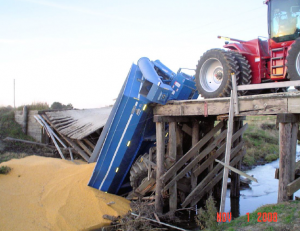
Bridge collapse under heavy grain/tractor load in Audubon County (2008 file photo)
In other business, the Montgomery County Supervisors will discuss and likely approve:
Their next regular meeting will be Jan. 21st, at 9-a.m.
*Please note the Jan. 14th meeting is a public meeting; however, it may be conducted via ZOOM
Join Zoom Meeting
https://us02web.zoom.us/j/85039693411
Meeting ID: 850 3969 3411
Dial by your location +1 312 626 6799 If you are calling in, Press *9 to raise your hand if you wish to speak.31


 Facebook
 Twitter
 YouTube
 RSS
RSS