

CLICK HERE for the latest market quotes from the Iowa Agribusiness Network!
CLICK HERE for the latest market quotes from the Brownfield Ag News Network!


CLICK HERE for the latest market quotes from the Iowa Agribusiness Network!
CLICK HERE for the latest market quotes from the Brownfield Ag News Network!
(Radio Iowa) – After a 12-year run as the U.S. Secretary of Agriculture, former Iowa Governor Tom Vilsack will be the next C-E-O of the World Food Prize Foundation. Former Iowa Governor Terry Branstad’s tenure as leader of the Des Moines-based organization is set to end January 31st. Vilsack will take over on March 1st. Vilsack has said his interest in the agriculture sector was rooted in his work as a Mount Pleasant lawyer representing farmers during the Farm Crisis. “As a mayor, as a state senator, as a governor and as secretary I’ve had the opportunity to be involved in, to encourage and support programs that will advance opportunities for farmers, ranchers and producers,” Vilsack says, “because I remember the pain of the Farm Crisis of the ’80s.”

Ag Secretary Tom Vilsack (photo from Ag Secretary’s office)
Vilsack turned 74 in December and, during an interview with Radio Iowa last month, Vilsack indicated he did not intend to retire. “My hope is I get a chance to figure out ways in which I can continue to make a contribution. I don’t think I’m ready for retirement and I don’t think I’d be very good at it,” Vilsack said. “…I hope that I’m able to continue focusing on ways in which I can showcase the work of American agriculture, that I can showcase opportunities to expand rural economies and the farm economy to give small and mid-sized producers a chance. I also have been working extraordinarily hard on nutrition and food security issues both domestically and globally.”
The World Food Prize Foundation announced Vilsack’s hiring early this (Tuesday) morning.
(Iowa Capital Dispatch) – The latest data from the CDC and USDA show the continued devastating effects of bird flu outbreaks across the United States – with Iowa, the nation’s leading egg producer, suffering substantial losses. Since November 2023, more than 12.1 million poultry birds have been affected in Sioux County, Iowa. Statewide, nearly 30-million birds have been affected.
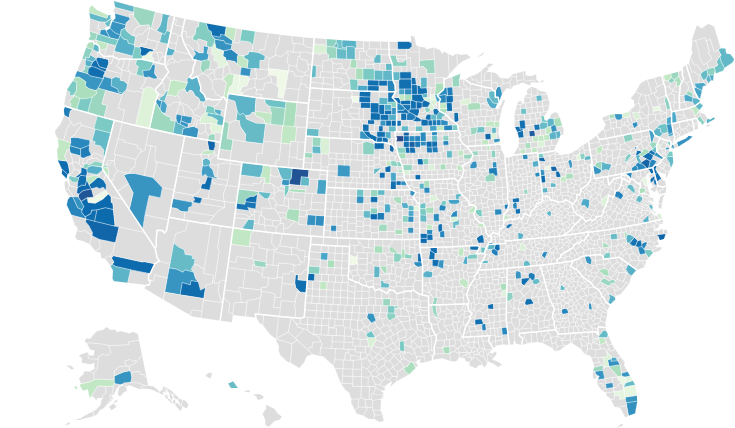
On Jan. 17, health officials in Georgia, the nation’s leading state for chicken production, announced it was suspending poultry sales after detecting bird flu, for the first time, in flocks designated for commercial sale. This recent development is not yet reflected in the CDC and USDA databases used for this analysis.
Since federal and state government officials began tracking in February 2022, at least 1,400 outbreaks have been reported in more than 600 counties nationwide, affecting nearly 135 million birds. Other counties experiencing severe losses include Weld County, Colorado, with 9.95 million since April 2022, and Merced County, California, recording 8.35 million, according to the data.
Midwest states with the highest number of birds affected include Iowa, Ohio, Minnesota, Michigan, and Nebraska. Meanwhile, 67 human cases have been reported in the U.S. since the flu was first detected in humans in 2024, according to the CDC.
“While the current public health risk is low, CDC is watching the situation carefully and working with states to monitor people with animal exposures,” the agency stated on its website, which is regularly updated with the latest information.
McLEAN, Va., Jan. 23, 2025 — Glen R. Smith, a native of Atlantic (Iowa), was elected this week as chairman of the Farm Credit System Insurance Corporation board of directors. He succeeds Jeffery Hall, who served as chairman of the FCSIC board of directors from November 2016 until he was designated board chairman and CEO of the Farm Credit Administration (FCA) on Jan. 20, 2025.
“I would like to thank the FCSIC board for electing me chair,” said Chairman Smith. “I am honored to have the opportunity to lead FCSIC because I recognize and value the role it plays in maintaining investor confidence in the Farm Credit System (FCS or System). This confidence is crucial for the System to have a dependable source of funds to lend to agriculture and rural America. I also want to thank Board Member Jeff Hall for his exemplary leadership of the FCSIC board of directors for the past eight years. I look forward to working with him and Board Member Vincent Logan as we continue to fulfill FCSIC’s mission.”
The Insurance Corporation is an independent U.S. government-controlled corporation responsible for ensuring the repayment of principal and interest on certain Farm Credit System debt obligations issued to investors. As of Sept. 30, 2024, the FCSIC insurance fund held $7.8 billion in total assets, insuring $434.8 billion in outstanding FCS debt. The FCS includes a nationwide network of borrower-owned cooperative lending institutions and affiliated service entities that have a leading role in providing financing to agriculture and rural America. The Insurance Corporation is managed by a three-member board of directors consisting of individuals who serve concurrently as members of the FCA board. FCA is the regulator of the FCS.
Chairman Smith has served as a member of the FCA board, as well as a member of the FCSIC board of directors, since December 2017, when President Donald J. Trump appointed him to the FCA board. President Trump designated him chairman of the board and CEO of FCA in 2019, and he served in that capacity through most of 2022. In his role on the FCA board, Mr. Smith has been particularly interested in encouraging the advancement of System programs for young, beginning, and small farmers and ranchers, in addition to promoting the safety and soundness of System institutions. These board efforts culminated in regulatory actions that were entered into the Federal Register in February 2024.

Glen R. Smith (File photo)
Chairman Smith was raised on a diversified crop and livestock farm in rural Atlantic. His farm experience started at a very early age, after his father was involved in a disabling farm accident. He graduated from Iowa State University in 1979 with a Bachelor of Science degree in agricultural business. In 1982 Chairman Smith and his wife, Fauzan, moved back to his hometown and started their family agricultural operation as “beginning farmers.” In that same year, he established a locally based land service company. Today, their family farm, Smith Generation Farms Inc., has grown to encompass about 2,000 owned acres devoted to corn, soybeans, and hay. The company, Smith Land Service, specializes in farm management, land appraisal, and farmland brokerage, serving landowners in about 30 Iowa counties.
The Smiths have four grown children and six grandchildren, all involved in various degrees with production agriculture. In 2017, their son Peter assumed managerial responsibilities for both the family farm and business.
(Iowa News Service) A company working to create sustainable energy sources is investing in corn to make jet fuel, which it said burns far cleaner than the traditional, petroleum-based version. Some Iowa farmers see it as a market for their crops in addition to the ethanol they already create. Alyssa Shousse, a corn farmer near Griswold, sees producing jet fuel with her corn as an opportunity to create sustainable energy from her crops beyond ethanol and on a much bigger scale. Jets used nearly 100 billion gallons of fuel last year.
“It’s an absolutely insane number,” Shousse acknowledged. “If there’s a better way that we can break into that market, make it a little bit more renewable, I think any of that is good for making a better impact for the environment.” Supporters want federal lawmakers to create incentives to encourage more sustainable airline fuel production in Iowa and across the U.S., perhaps creating incentives mirroring the support ethanol receives.
Patrick Gruber is CEO of the fuel development firm Gevo, which has facilities in Iowa and is part of the Sustainable Aviation Fuel Coalition. He said it is competitive with traditional jet fuel and far more environmentally friendly. “A petro-jet spews out about 22 pounds of CO2 per gallon,” Gruber pointed out. “We can eliminate that whole footprint of 22 pounds.”
Supporters argued sustainable aviation fuel burns cleaner than traditional jet fuel. They want to expand the practice to include more sectors of agriculture. Critics have countered the effects of agricultural-based jet fuel are still up in the air.
CLIVE, IOWA – Carroll County pig farmer Aaron Juergens has been named the new president of the Iowa Pork Producers Association (IPPA). He assumed the role during the organization’s annual meeting in Des Moines on January 21. Juergens manages over 100,000 nursery and finishing pig spaces for Sunburst Valley Farms near Carroll. Juergens said in a press release, “It’s an incredible honor to lead this outstanding organization and work alongside such a dedicated board of directors. This group has always been a source of inspiration for me. I never imagined being elected to serve on the board, let alone as president. It’s truly overwhelming.”
Juergens previously served as IPPA’s president-elect in 2024. He succeeds Matt Gent, a Wellman pig farmer who now holds the position of past president on the IPPA Board of Directors. Juergens expressed his gratitude for Gent’s leadership, noting his ability to navigate the association through a challenging year. Both Juergens and Gent will serve one-year terms in their respective roles. “Matt did an outstanding job guiding us through a tough year, and I hope to build on his success,” Juergens said. “2025 looks promising, and I’m optimistic about a great year ahead for Iowa pork producers.”
Juergens has been an active member of IPPA since joining its board of directors in 2020. He has contributed to several committees, including public relations, finance, and producer education. Additionally, he is a graduate of the Iowa Pork Leadership Academy and the National Pork Producers Council’s Pork Leadership Institute. For over a decade, Juergens has served as a speaker for Operation Main Street, a program tied to his recognition as a recipient of the Dale Carnegie Course Highest Award for Achievement.
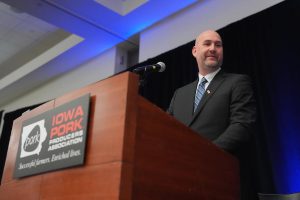
Aaron Juergens
Beyond his work with IPPA, Juergens is deeply involved in agriculture and his community. He is a member of the Carroll County Pork Producers and has received multiple accolades, including the Iowa Environmental Steward Award in 2009, the national Pork Industry Environmental Steward Award in 2010, and the inaugural Iowa Farm Environmental Leader Award in 2011. In 2014, he was named an Iowa Master Pork Producer.
Juergens also participates in several local organizations, including the Carroll County Farm Bureau, Rotary Club of Carroll, Carroll Chamber of Commerce, and the New Hope Foundation, a nonprofit supporting adults with disabilities. He holds a business management degree from Loras College in Dubuque. Juergens and his wife, Chelsey, reside in Carroll with their three children.
During the annual meeting, the delegates passed three resolutions:
The delegates passed a complimentary resolution to recognize Matt Gent for his outstanding efforts as IPPA president in 2024.
(Atlantic, Iowa) – Get ready to welcome spring by attending the Cass County Master Gardeners’ 2025 Spring Garden Seminar, scheduled for Saturday, March 8. This year’s seminar focuses on the “Flowers, Bees, Butterflies and Trees” and is open to anyone interested in learning more about local garden topics. The daylong event will be held at the Cass County Community Center in Atlantic, and feature four keynote speakers. In addition to the presentations, a variety of local vendors will be on hand with garden related crafts and décor, as well as local resources and information for gardeners of all skill levels and interests.
The event opens with registration and light refreshments at 8:30 AM. Vendor and resource tables will also be available to browse beginning at this time. The first session begins at 9 AM and will feature local garden designer and butterfly enthusiast Nicki Weiderstein sharing the monarch butterfly’s journey to their winter home in Mexico. The second speaker of the morning will be Andy Schmitz from the Brenton Arboretum with a deep dive into planting trees, including some hands-on demonstrations of root health. After the second morning speaker, a light lunch will be served and attendees are invited to visit the vendor and resource fair again to discover a variety of local treasures.
The afternoon begins with ISU Extension Bee Specialist Randall Cass, as he guides attendees through an exploration of the basics of beekeeping. Our final speaker of the day will be Aaron Steil, Consumer Horticulture Specialist for Iowa State University Extension and Outreach, discussing hydrangeas and their uses, selection and care in the Iowa landscape. The program will conclude at 3 PM with giveaways and one more chance to visit the vendor and resource fair at the end of the day. 
Plan now to join the Cass County Master Gardeners as we Gather, Learn and GROW together at the 2025 Spring Garden Seminar! Cost for the seminar sessions, including food, sessions and materials is $50 for the day if paid by February 15th. After this date regular registration and walk-in registration will be available at $55/attendee. Registration is now open and can be completed online by visiting the online registration page at https://go.iastate.edu/8PQJHF. Online registrations may be paid by credit card or check. Registrations are not refundable but may be transferred to another attendee with advance notice.
A full schedule and program registration information is also available by visiting the Cass County Extension website at www.extension.iastate.edu/cass, or by stopping into the Cass County Extension office. Previous seminar attendees with a current email address on record will also receive a registration link by email. Questions can be directed to Kate Olson at 712-243-1132, or by email at keolson@iastate.edu. Mark your calendars, get registered, and plan to join the Cass County Master Gardeners for the 2025 Spring Garden Seminar on Saturday, March 8!
(Radio Iowa) – An Iowan invited to drive his tractor in today’s (Monday) Inaugural Parade — which has been cancelled — has still been able to drive his rig on the D-C streets. Gary Leffler’s 1957 Ford H tractor is painted red, white and blue and he rolled by the line of Trump supporters waiting to attend Trump’s Sunday night rally.
“A strong, patriotic theme,” Leffler says. “It’s got an American flag over the hood of it. It’s got John 3:16 right there by the steering wheel. Underneath the hood of the tractor are all the names of our family members who have served in the United States military.” The tractor has made appearances at a number of events in Iowa for Republicans and veterans, but this was its first out-of-state engagement.
“We don’t look at this as a Gary and Janelle (Leffler) tractor. We look at this as an Iowa tractor,” Leffler says. “100% of our motive is to represent Iowa and all the good people of Iowa.” Leffler, who was a precinct captain for Trump a year ago in the Iowa Caucuses, was a bit shocked the tractor was chosen for the Inaugural Parade from over 28-hundred potential entries.
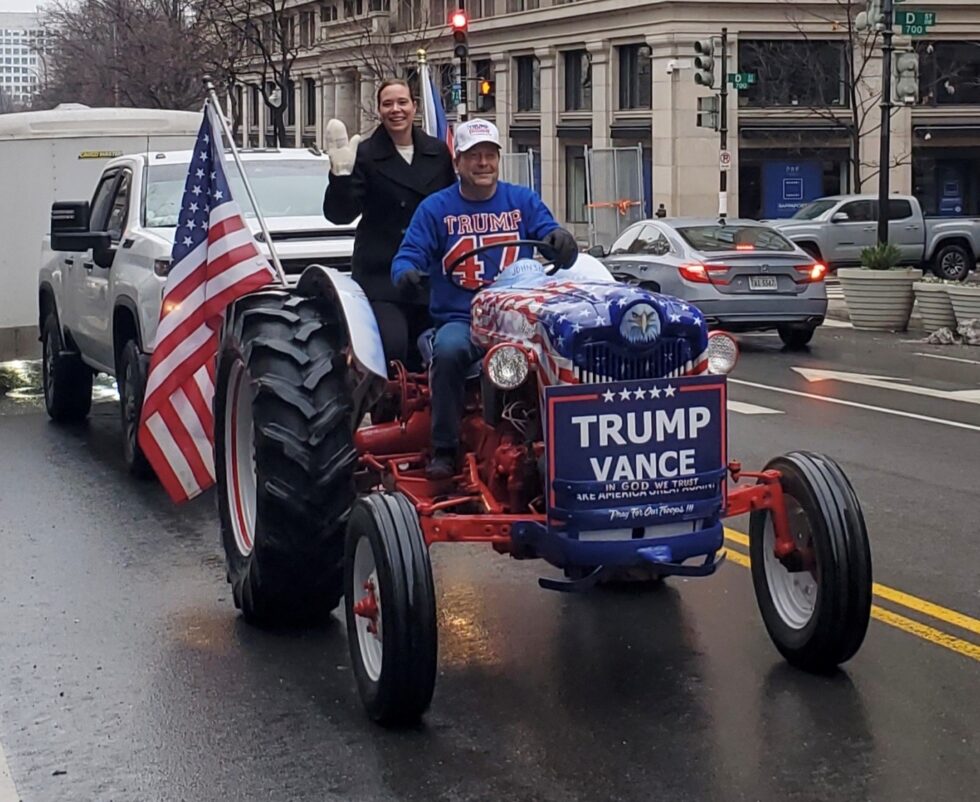
Gary and Janelle Leffler drove down D.C. streets on Saturday, passing by the line of people waiting to attend a Trump rally. (Photo courtesy of Gary Leffler)
“The idea that a Gary and Janelle tractor from West Des Moines, Iowa, is being invited to this type of a thing is just somewhere off the charts,” Leffler says. “Kiddingly, I tell people I jumped so high we had to get the sheet-rock repaired on the ceiling of the room.” The cold weather in D-C didn’t phase Leffler or his wife, who rode on the tractor, too, waving at the crowd lined up to see Trump. Leffler filled up the gas tank and got the tractor spiffed it up before loading it into a trailer for the trip to D.C.
“I had to take the tractor over to the beauty shop to get its tires and fenders done,” Leffler says. “Took it over to my friend Bob Perkins at Perk’s Auto and he detailed it all out, so it looks like it just came straight out of the factory now.” Some of the Iowans who made the trip to D-C for today’s (Monday’s) inauguration attended the Midwest Ball on Saturday night and on Sunday the six Republicans in Iowa’s congressional delegation hosted a reception for Iowa visitors. Iowa Senator Joni Ernst is among the U-S Senators who met with Trump for breakfast on Saturday morning.
The Iowa Department of Natural Resources (DNR) is hosting a series of town hall-style meetings where local staff will provide updates on recently completed hunting and trapping seasons, discuss possible changes to hunting and trapping rules and regulations, and address other topics as requested.
“We want people to come out to these meetings, listen to the seasons reviews, ask questions and hear directly from our staff,” said Todd Bishop, chief of the Iowa DNR’s Wildlife Bureau. “Part of the meeting will be devoted to discussing potential rule changes and collecting feedback as we work through the rules process.”
The meetings are open to the public. Comments collected from these public meetings will be considered along with other related comments received by the Iowa DNR prior to proposing changes to hunting rules and regulations. Proposed rules will be presented to the Natural Resource Commission during a regular public meeting for consideration and additional public comment.
Area Meeting dates, times and locations
Any person attending the public meeting that has special requirements, such as those related to mobility or hearing impairments, should contact the Iowa DNR or ADA Coordinator at 515-725-8200, Relay Iowa TTY Service 800-735-7942, or Webmaster@dnr.iowa.gov, and advise of specific needs.
DES MOINES, Iowa (By Jennifer Bamberg, Investigate Midwest ) — For nearly 200 John Deere workers in Iowa, the first few days of 2025 marked the end of their employment. On Jan. 3, 112 employees were laid off at the Waterloo facility and 80 were laid off at John Deere Davenport Works. Next month, 75 additional employees will be laid off at a plant in Ottumwa, Iowa, according to a review of WARN layoff data. The Moline, Illinois-based agricultural giant laid off 2,167 workers in 2024 at facilities in Waterloo, Davenport, Dubuque, Ankeny, Johnston, Urbandale, Ottumwa in Iowa and in Moline and East Moline in Illinois, according to layoff data.
In a statement issued Monday, Deere attributed the cuts to “challenging market conditions” and subsequent lower demand from farmers. Deere’s profits peaked at record highs in 2022 at $10.16 billion, partly due to Russia’s invasion of Ukraine that sent crop prices soaring in the U.S., allowing farmers to spend more on equipment, according to Bloomberg. Since then, sales have declined 20% and Deere’s stock price is down 16%, according to the company. Profits in 2023 fell to $7.1 billion. CEO John May received $26.7 million in compensation in 2023 and $20.3 million in 2022, according to the company’s public filings with the Securities and Exchange Commission.
In a statement from Oct. 16 regarding last year’s layoffs, Deere noted that the U.S. Department of Agriculture had projected row-crop cash receipts to fall considerably for 2024 following a 5% drop in 2023. The statement also noted that the average price for corn being harvested at the time was down 37% from 2022. Soybean prices were down 24% and wheat prices had declined 35%. In June, Deere & Co announced plans to move manufacturing of skid steer loaders and compact track loaders from a facility in Dubuque, Iowa to Mexico by the end of 2026. A Deere representative told Industrial Equipment News that the move is “unrelated to the layoffs.”
In September, then-Republican presidential nominee Donald Trump threatened to impose a 200% tariff on John Deere products built in Mexico, and erroneously claimed in October that the company called off the move in response. A spokesperson for Deere & Co. told Bloomberg that no changes have been made to shift some production from Iowa to Mexico.
Investigate Midwest is an independent, nonprofit newsroom. Its mission is to serve the public interest by exposing dangerous and costly practices of influential agricultural corporations and institutions through in-depth and data-driven investigative journalism. Visit them online at investigatemidwest.org.
(Radio Iowa) – A new study from the Iowa Pork Producers Association finds the hog industry contributed more than 15-billion dollars to Iowa’s economy last year. Association spokesman Kevin Hall says the study, which is done every four years, identified nearly 52-hundred pig farms statewide. “We provide about one-third of the nation’s pork, and that reinforces our position as the number-one pork producing state in the entire nation,” Hall says. “We are vital to Iowa’s economy, creating more than 120,000 jobs for the state, and it really provides a solid backbone for the state of Iowa’s economy and especially our rural communities.” Among those jobs, the study says 64-thousand are in hog production, 39-thousand are in hog slaughter, and another 16-thousand jobs are in hog processing.
Overall, Hall says the pork industry contributed 15-point-4 billion dollars to Iowa’s economy last year. “When we did the study four years ago, it was $11.9-billion in value-added activities, so almost four-billion more now to the state’s economy in 2024 than it was in 2020,” Hall says, “and it just shows that Iowa pig farmers are vital to the state’s economy.” Next week, a new administration will take over the White House and there’s much discussion about threatened tariffs and the impact on international trade. Hall remains optimistic about the future and the role Iowa pork will play in it.
“We’re going to keep an eye on what’s happening and just keep doing what we’re doing,” Hall says. “Iowa’s pig farmers, they’ve had a rough couple years in terms of their personal economies, but they are still working hard and creating jobs all over the state, 120,000 jobs in the state alone, and they’re just going to keep working hard and producing great pork products.” The study says the top five Iowa counties for hog inventories are: Washington, Sioux, Lyon, Plymouth, and Hardin. Among those, Washington, Sioux and Lyon counties each have more than one-million pigs.
Learn more HERE:
https://www.iowapork.org/producers/resources/fact-sheets


 Facebook
 Twitter
 YouTube
 RSS
RSS