

CLICK HERE for the latest market quotes from the Iowa Agribusiness Network!
CLICK HERE for the latest market quotes from the Brownfield Ag News Network!


CLICK HERE for the latest market quotes from the Iowa Agribusiness Network!
CLICK HERE for the latest market quotes from the Brownfield Ag News Network!
(Glenwood, Iowa) – Here’s one last reminder from KJAN about an upcoming Iowa Department of Natural Resources town hall-style meeting. Locally, the meeting will take place on Monday, at 6:30-p.m., in Glenwood, at the Southwest Iowa Sportsman’s Club, at 22896 Jamett Road. DNR Wildlife biologist Matt Dollison talks about the opportunity for you to discuss with DNR staff matters affecting the hunting season.
Dollision says there will be AN information presentation on the past hunting season, and more.
Afterward, they’ll talk about the proposed rule changes, how the hunting season went, and comments from sportsmen on what they think could be improved.
Dollison says last year, there were at least 40 people in attendance at the local town hall meeting The meetings are open to the public. Comments collected from these public meetings will be considered along with other related comments received by the Iowa DNR prior to proposing changes to hunting rules and regulations. Proposed rules will be presented to the Natural Resource Commission during a regular public meeting for consideration and additional public comment.
(Des Moines, Iowa; Iowa Capital Dispatch) – Three bills sponsored by state Rep. Charley Thomson, who has been a vocal opponent of carbon sequestration pipelines in Iowa, advanced from House subcommittee hearings, Thursday. The bills dealt with eminent domain, permit length for a pipeline carrying liquefied carbon dioxide and the office of the consumer advocate. Each bill received unanimous approval. The legislation was part of a slew of bills introduced last week aimed at the Iowa Utilities Commission, eminent domain and the Summit Carbon Solutions pipeline project. Thomson said House File 239 is an attempt to “fix” some of the problems caused by the government realignment bill passed in 2023, which moved the Office of the Consumer Advocate from an independent office to a division under the attorney general’s office.
The consumer advocate, as its name implies, advocates for members of the public in utility cases, like the Summit Carbon Solutions pipeline project. Jess Mazour, who spoke on behalf of the Iowa Chapter of the Sierra Club in favor of the bill, said prior to the restructuring of the office, the consumer advocate would file notices that it had reviewed the documents submitted by Summit in its permit application, and it would request further documentation from the company. Mazour said since the restructure of the office, the consumer advocate has been “almost absent” from the process. The former consumer advocate left the office after the restructure and said it made the office subject to political persuasion. Under the new bill, the consumer advocate would be appointed by the governor, instead of the attorney general, would give regular reports to the secretary of agriculture, auditor of the state and state treasurer and head the Office of the Consumer Advocate which would once again be independent.
While much of the conversation on the bill centered on the advocate’s role in the Summit Carbon Solutions pipeline permit, Rep. Lindsay James, D-Dubuque, said increased oversight from the OCA also would be helpful to protect Iowans in mobile homes from private equity firms who are “price gouging.” House File 242 would allow Iowa landowners to seek declaratory judgment, or a legally binding explanation of their rights, from a district court if their property were subject to an eminent domain claim in an application before the Iowa Utilities Commission. Opponents of the bill said it would lengthen the time and the cost of pipeline projects in the state. Proponents, including the Sierra Club Iowa chapter, landowners and the American Civil Liberties Union of Iowa said the bill would help to correct the “shoddy track record, regarding due process” by the IUC.

Opponents of a proposed carbon sequestration pipeline gather for a rally outside of the Iowa Capitol on Oct. 8, 2024. (Photo by Cami Koons/Iowa Capital Dispatch)
A spokesperson for Summit Carbon Solutions said in a statement the regulators in Iowa, North Dakota and Minnesota have “affirmed the project’s safety, economic advantages, and importance for energy independence” with their approval of the projects. “We have signed easements with more than 1,200 Iowa landowners and have adjusted the route based on feedback from stakeholders and regulatory agencies,” the statement said. “These actions ensure the project responds to concerns, secures the future of ethanol, and opens pathways to low-carbon markets.” The Iowa Utilities Commission granted Summit Carbon Solutions the use of eminent domain for its carbon sequestration pipeline project that would run through Iowa, Nebraska, South Dakota, North Dakota and Minnesota. Per the permit, construction on the project may not begin until the company has secured a permit in South Dakota, which is still pending.
House File 238 also advanced unanimously and would limit permits to liquefied carbon dioxide pipelines to 25 years and prohibit the IUC from renewing those permits. Nate Hohnstein opposed the bill on behalf of the Iowa Renewable Fuels Association, noting that pipelines were the safest method of transportation for liquified carbon dioxide. Supporters of the bill said they wish it went further and restricted the use of eminent domain on agricultural land.
Each of the House files have matching bills introduced and assigned to subcommittees in the Senate, Senate File 229, SF 226, and SF 225.
DES MOINES— Gov. Kim Reynolds today (Thursday) authorized a disaster proclamation for Buena Vista County, Iowa effective immediately through March 15, 2025. The USDA has confirmed a positive case of highly pathogenic avian influenza (HPAI) in a commercial turkey flock.
This proclamation allows state resources from Iowa Homeland Security, the Iowa Department of Agriculture and Land Stewardship, and other agencies to assist with tracking and monitoring, rapid detection, containment, disposal, and disinfection. The proclamation also waives regulatory provisions related to commercial vehicles responding to affected sites.
The recent HPAI detections in birds do not present an immediate public health concern, and it remains safe to eat poultry products. If producers suspect signs of HPAI in their flocks, they should contact their veterinarian immediately.
(Radio Iowa) – Deere and Company is reporting its worldwide sales and revenue fell 30 percent during the last three months. John May, Deere and Company’s C-E-O, says the company’s customers are facing uncertain market conditions, but he’s seeing compelling evidence the company is positioned to successfully navigate the current environment. Deere has reduced its workforce to slow production at plants in Iowa and elsewhere.
Over the last quarter, Deere saw sales slippage for not only its farm machinery, but for John Deere lawn mowers and its equipment for the construction and forestry industries.
(Atlantic, Iowa) – A newly formed Aquatics Committee in Atlantic held their second meeting, today (Tuesday, Feb. 10). The Committee is comprised to a YMCA Board member, the YMCA executive director, YMCA aquatics designee, Atlantic Park and Recreation Department Coordinator, a representative from Park and Recreation Advisory, a city council representative, and two other community leaders with a passion for aquatics.
Members of committee include: Dan Haynes, Ali Pieken, Jodie Hogue, Chelsie Rush, Jeff Christensen, Emily Kennedy, Chelsie Huddleson and Alliison Knox-Westmeyer.
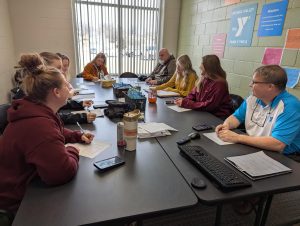
Picture order- Left to right, going around the table clockwise
Chelsie Rush, Chelsie Huddleson, Allison Knox-Westmeyer, Jodie Hogue, Jeff Christensen, Ali Pieken, Emily Kennedy and Dan Haynes. (photo courtesy Ali Pieken).
The General purpose of the Committee is to provide a structure for a formal vision and direction in matters pertaining to aquatics for the community of Atlantic, including:
The Atlantic Aquatics committee held their first meeting on January 15th. The committee completed an on site pool walk through February 6th to evaluate needed improvements for the 2025 season. Aquatics Committee spokesperson Ali Pieken said “Some of the many things discussed at (Tuesday’s) meeting included: signage for Splash Pad restrooms; a new door for concession stand; process through the state for adding additional features to the pool; membership sales; pool hours of operation, marketing and more.”
Pieken said “The committee is dedicated to provide a structure for a formal vision, direction and progression in matters pertaining to aquatics for the community of Atlantic.”
(Des Moines, Iowa) [submitted by Montgomery County resident Jan Norris ] – On Monday, a bipartisan cohort of more than 30 landowners and farmers from across Iowa met with Senator Charles Grassley to express their frustration with Summit Carbon Solution’s proposed carbon pipeline. The hazardous liquid pipeline would traverse over 1,000 miles of Iowa farmland and require the use of eminent domain for nearly 1,000 properties. Landowners and farmers claim the project is only viable due to the government subsidies available to the carbon capture industry and urged Senator Grassley to abolish a key subsidy known as the 45Q tax credit.
As the longest serving U.S. Senator currently in Congress, constituents impacted by the carbon capture industry believe Senator Grassley can influence a change in policy to end incentives that encourage the construction of unnecessary carbon pipelines. Senator Grassley, as a member of both the Senate Budget and Senate Finance Committees, has the ability to protect the land and livelihoods of Iowa farmers by recommending 45Q be cut during the budget reconciliation process currently taking place.
During the short meeting, Bremer County farmer, Ted Junker, told Senator Grassley, “Republicans, Democrats, Independents, we’ve all come together to fight this carbon capture scam. Nearly 80% of Iowans are opposed to using eminent domain for carbon pipelines. This isn’t a red or blue issue. It’s a common sense issue. Destroying our cropland is not how we support agriculture. Giving our tax dollars to shareholders in foreign countries is not how we support agriculture. Allowing a company to monopolize the ethanol industry is not how we support agriculture. Stand by farmers and cut 45Q during the budget reconciliation process.”
Senator Grassley did not provide a firm position on the request. Impacted constituents hope to follow up with the senator when they are in Washington D.C. next month.
(Radio Iowa) – About 100 people gathered at the statehouse Monday to rally against a bill that would grant some liability protection to pesticide and herbicide manufacturers. The bill cleared the Iowa Senate last year and is getting a rehearing this year. It would forbid lawsuits based on the lack of a warning about potential health risks if the product’s label complies with current federal regulations. Nancy Huisinga worked as a hospice nurse in Wright County for 20 years.
“Do we make chemical manufacturers be responsible for all cancer in the state? No. Do we stand up for people who have an illiness related to manufactured carcinogens and protect their right to take the manufacturer to court for damages? Absolutely, of course we do,” she said, to cheers.
Huisinga and others mentioned that Iowa is the only state where the cancer rate is rising. Rich Gradoville, a retired school teacher, taught at schools in New Sharon, Dyersville and the Des Moines area. He was diagnosed with bladder cancer two years ago. “What our legislators should be doing is working on bills that lower the risk for Iowans rather than working on bills that help the chemical companies protect themselves,” Grandoville said, to cheers. Dan Valentine of Iowa Citizens for Community Improvement says the bill will make it harder for Iowans who’ve been harmed to seek justice in court.
“These multi-billion dollar companies doesn’t deserve another legal shield,” Valentine said. “That’s why I’m here. Fighting to protect our communities, our kids and our grandkids, so let’s let our voices be heard.”
A top Republican in the Iowa Senate says individuals who’ve been harmed should be able to file lawsuits to recover damages, but Senate President Amy Sinclair says the bill would impede money-grabbing class action lawsuits targeting ag chemical companies that have followed the law.
(Griswold, Iowa) – An upcoming Agriculture Legislative Forum will be held on February 22nd at 9:00am at the Griswold Public Library. For more information, see the flyer below:

Cass County: Corn $4.50 Beans $9.89
Adair County: Corn $4.47 Beans $9.92
Adams County: Corn $4.47 Beans $9.88
Audubon County: Corn $4.49 Beans $9.91
East Pottawattamie County: Corn $4.53 Beans $9.89
Guthrie County: Corn $4.52 Beans $9.93
Montgomery County: Corn $4.52 Beans $9.91
Shelby County: Corn $4.53 Beans $9.89
Oats: $3.01 (same in all counties)
(Des Moines, Iowa) – The Iowa Nutrient Reduction Strategy has been updated to reflect increased access to data and new practices, including a precision ag-tool to optimize nitrogen application. According to the Iowa Capital Dispatch, the nutrient reduction strategy was developed by the Iowa Department of Agriculture and Land Stewardship, the Iowa Department of Natural Resources and Iowa State University in 2013, as part of a larger, 12-state task force to address the growing size of the hypoxia in the Gulf of Mexico by reducing nutrient levels in the Mississippi River Basin.
The strategy encourages farmers to participate in the nutrient reduction strategies, but does not mandate the conservation practices. IDALS announced the updated version of the strategy Thursday. According to the press release, the last update was completed in 2017. Excess nitrogen and phosphorus are the main contributors to the “dead zone” in what was formerly know as the Gulf of Mexico, and therefore are the nutrients the strategy seeks to reduce.
One of the 2025 updates includes a recommendation that corn farmers follow a three-year extended rotation to reduce nitrate‐N concentration in tile drainage by 42%, on average. According to the plan, that means following a four-year schedule of corn, soybean, alfalfa and alfalfa in a given field. Three years of legumes, a type of plant that fixes nitrogen in the soil, will reduce the need to apply nitrogen to the corn crop, and showed a 10% increase in corn yields.

Corn planted into no-till corn residue in 2008 near Minden, Iowa. (Photo courtesy of USDA)
The recommendation would help the state reach its goal of reducing the nitrogen load from non-point sources by 41% from the 1980-1996 benchmark nutrient levels. Point source pollution comes from sources like a wastewater facility or a factory that directly discharges into waterways. Non-point pollution is not as easy to pinpoint as it includes runoff from agricultural land, urban areas and more.
The update also notes that INRS provides quarterly updates to an online dashboard with measurements of water quality metrics, erosion control practices, funding, point source facility permits and in-field practices, instead of a “static” annual report. The Iowa Nutrient Research and Education Council, which monitors the progress of the strategy, found in its 2023 survey a 7% decrease in the use of commercial nitrogen applied to continuous corn operations and that farmers planted nearly 4 million acres of cover crops in 2023, which is also a practice promoted by the strategy to reduce nutrient runoff.
The press release from IDALS also highlighted new strategies to implement conservation practices. This included the “batch and build” process which began in 2020. The process installs nutrient reduction practices, like saturated buffers and bioreactors, on multiple farms at once, to maximize funding pools and accelerate the adoption of these practices. According to IDALS, the state has completed five “batches” so far.
The strategy is also promoting the use of the Nitrogen Fertilizer Application Consultation Tool, or N-FACT, a precision ag tool developed by the Iowa Nitrogen Initiative, to “fine-tune” fertilizer application. The public, online tool helps farmers determine the optimal rate of nitrogen application for their farm based on factors like location, precipitation and residual nitrogen.
The Iowa Nitrogen Initiative developed the tool from ISU research conducted with private farmers in every region of the state. According to a press release from IDALS, N-FACT can calculate more than 21,000 optimal nitrogen rate scenarios due to the hundreds of field trials conducted by ISU.


 Facebook
 Twitter
 YouTube
 RSS
RSS