

CLICK HERE for the latest market quotes from the Iowa Agribusiness Network!
CLICK HERE for the latest market quotes from the Brownfield Ag News Network!


CLICK HERE for the latest market quotes from the Iowa Agribusiness Network!
CLICK HERE for the latest market quotes from the Brownfield Ag News Network!
DES MOINES, Iowa (KCRG) – Iowa Secretary of Agriculture Mike Naig announced Tuesday the Iowa Farm Act, a legislative plan to support Iowa farmers and rural communities. “The Iowa Farm Act is about meeting today’s challenges while preparing for the future. It brings together ideas we have heard directly from farmers, agribusinesses, and rural communities across the state,” said Secretary Naig.
Naig is also requesting a $1.335 million budget increase to maintain essential operations in animal health, food safety, consumer protection, and water quality initiatives as part of the Department’s FY27 proposal.
Ag leaders across the state say they are thankful for Naig’s efforts in strengthening Iowa’s farming community.
(Washington, D.C., January 6, 2026) – U.S. Secretary of Agriculture Brooke L. Rollins has announced a new slate of presidential appointments to key positions at the U.S. Department of Agriculture (USDA). Among those named was Starlyn Perdue, who was appointed State Executive Director for Farm Service Agency in Iowa.
Starlyn Perdue serves as State Executive Director for Farm Service Agency (FSA) in Iowa. A lifelong resident of southwest Iowa, Starlyn and her husband raise their sons on their family’s Century Farm. With a background in economic development, agricultural advocacy, and program administration, Starlyn is committed to strengthening Iowa’s rural economy through workforce training and business development. She remains deeply rooted in Iowa’s agricultural community and is a strong advocate for policies that support farmers and strengthen America’s rural economy.
Ag Secretary Rollins said in a news release: “Under President Trump’s leadership, USDA is building a powerhouse team of Presidential Appointees deeply committed to uplifting rural America and putting Farmers First. With strong experience in agriculture, public service, and national security, this team will protect family farms, expand opportunities, and proudly implement America First policies. I look forward to working together to deliver real results for the American people, particularly the farmers, ranchers, and producers who feed and fuel our nation.”
Others appointed by Sec. Rollins include:
Read more, here: https://content.govdelivery.com/accounts/USDAOC/bulletins/402d41f
Cass County: Corn $4.10 Beans $10.03
Adair County: Corn $4.07 Beans $10.06
Adams County: Corn $4.07 Beans $10.02
Audubon County: Corn $4.09 Beans $10.05
East Pottawattamie County: Corn $4.13 Beans $10.03
Guthrie County: Corn $4.12 Beans $10.07
Montgomery County: Corn $4.12 Beans $10.05
Shelby County: Corn $4.13 Beans $10.03
Oats: $2.66 (same in all counties)
(Prices are per bushel; information is from the area Farm Service Agency [FSA] offices)
Cass County: Corn $4.09 Beans $9.99
Adair County: Corn $4.06 Beans $10.02
Adams County: Corn $4.06 Beans $9.98
Audubon County: Corn $4.08 Beans $10.01
East Pottawattamie County: Corn $4.12 Beans $9.99
Guthrie County: Corn $4.11 Beans $10.03
Montgomery County: Corn $4.11 Beans $10.01
Shelby County: Corn $4.12 Beans $9.99
Oats: $2.66 (same in all counties)
(Prices are per bushel; information is from the area Farm Service Agency [FSA] offices)
Every dollar made goes right back into our fair. Funds are used to provide:

The Cass County Fair Board says they are “humbled to have had such immense community support since the beginning over 100 years ago.” The dinner and fundraising auction Feb. 7th features a delicious dinner, exciting live and silent auctions, live music, and a fun night with friends, neighbors, and community supporters. Proceeds from the dinner auction help fund fair activities and entertainment and keep the whole thing 100% FREE to all fairgoers.
The event begins with a social at 5:30pm with music and drinks, with the dinner at 6:30pm, and auction to follow. For more information, go to https://casscofairia.com/dinnerfundraiser
(Radio Iowa) – Iowa families who put up a live Christmas tree in their houses back on Thanksgiving weekend are likely ready for it to come down now, and instead of hauling it to the curb to go into a landfill, they might consider ways to repurpose it. Chip Murrow, an urban forestry program specialist with the Iowa D-N-R, says folks with acreages might be able to “tree-cycle” that evergreen back into the great outdoors, somewhere on their own property.
Smaller songbirds will like having a place to get out of the wind and to seek refuge from predators. Murrow says you can also decorate the tree outside.
An old Christmas tree that’s sunk in a farm pond could become an excellent fish habitat, but he cautions, it has to be under certain conditions.
For best results, he suggests sinking it with a cement block secured to the trunk, so it sits upright at the bottom of the pond. For Iowans who are crafty, you could trim the branches to make a fragrant sachet, wreath, or garland to enjoy in the weeks ahead.
Another option would be to find a local Boy Scout troop that could use the tree for outdoor firewood, though with the creosote, it should -not- be burned indoors in a fireplace. A final option, use the needles as an effective mulch on perennial plants, in your garden, and to keep weeds in check next spring.
(Radio Iowa) – Some farmers in Dickinson County who were enrolled in one of the U-S-D-A’s largest commodity support programs for the 2024 crop year believe they were significantly underpaid. Scott Titterington, who farms near Milford, says they’re holding a meeting next week in Spirit Lake.
The Agricultural Risk Coverage program provides payments when a farmer’s revenue for a specific crop falls below the historical average. Titterington says it appears A-R-C payments to farmers in neighboring Emmet and Kossuth Counties were around 90 dollars an acre.
Titterington says they’ve learned just over 98-thousand acres of Dickinson County farmland was enrolled in the ARC program in 2024. Based on the estimates for Emmet and Kossuth Counties — the U-S-D-A would have paid all the Dickinson County farmers who got A-R-C payments MILLIONS more.
The meeting to plot strategy will be held Tuesday, January 6th at 10 am in the Dickinson County Expo Building in Spirit Lake. If the weather doesn’t cooperate on Tuesday, Titterington says they’ll meet Wednesday at the same time and in the same place in Spirit Lake.
(Radio Iowa) – A bill sought by a farm chemical company facing tens of thousands of lawsuits in the U-S that allege Roundup causes cancer did not come up for a vote in the Iowa House in 2025, but House leaders say they’ll talk with fellow Republicans to see if there’s enough support for it to pass in 2026.
There are 67 Republicans in the Iowa House, well over the 51 votes required to pass a bill and House Speaker Pat Grassley says he understands some of his fellow Republicans oppose the bill. “At the same time, I would say as a farmer myself I would much rather be able to buy a product that’s manufactured here, especially here in the state of Iowa, than I would in some of our foreign companies completely owning the supply chain when it comes to those, so we have to be mindful of that as part of the conversation.”
Bayer’s plant in Muscatine makes about 70 percent of the Roundup sold in North America and the company has suggested that facility could close due to financial burden of lawsuits.
The bill would give liability protection from so-called “failure to warn” lawsuits as long the label of a pesticide or herbicide follows E-P-A guidelines. The agency says there’s no risk to human health if Roundup is used according to label instructions. Grassley and House Majority Leader Bobby Kaufmann are both farmers and Kaufmann says he’d prefer Roundup be made in Iowa rather than China. House Democratic Leader Brian Meyer says the bill is a disservice to Iowans who have been and could be harmed by the use of glyphosate (gl’EYE-foh’sayt) — the main ingredient in Roundup.*
The Iowa Senate has passed the bill and Governor Reynolds has indicated she’d sign it into law.
(Iowa DNR Conservation News; Des Moines, IA) – Iowa’s trumpeter swans attempted a modern-day record 158 nests in 2025, which is an increase of 17 percent over 2022. The nesting data is from the most recent statewide observation survey completed in December. In a news release, Iowa Department of Natural Resources (DNR) state waterfowl biologist Orrin Jones, says “It’s a neat story about the restoration. We spent a lot of time and effort to get the population established and its really taking off right now.”
Recovery has taken time, but is a true modern-day conservation success story, he said. The restoration effort was supported by the Iowa DNR’s Fish and Wildlife Trust Fund; a constitutionally protected fund where hunting, fishing and trapping license fees are deposited and used, in part, to protect, restore, or manage fish and wildlife. The largest waterfowl in North America, trumpeter swans have come a long way since the 1930s, when conservation efforts began in order to protect small populations in Montana and Alaska.
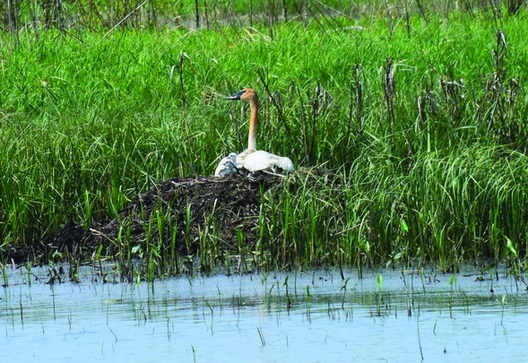
A trumpeter swan with two cygnats on a Chickasaw County wetland. Photo courtesy of the Iowa DNR.
Native to Iowa, trumpeter swans were once as widely distributed as Canada geese, but had been extirpated by the early 1880s. Early and aggressive reintroduction efforts in the Midwest by Minnesota and Wisconsin, followed a few years later by Michigan, and then Iowa, sought to return these iconic waterfowl to their traditional place on the prairie wetlands.
Iowa began with a restoration plan in 1993, followed by the first release of four swans in 1994. The plan included monitoring the swans to evaluate reintroduction success. The DNR released a total of 1,218 swans, ending in 2022. Iowa’s first trumpeter swan nest in the modern era was in 1998, in Dubuque County, followed two years later by one in Winnebago County. Nesting attempts increased slowly following the growing number of released swans. After averaging in the mid-50s for nearly a decade, nest attempts jumped to more than 120 in 2020, followed by nearly 140 in 2022.
“Reintroduction has been successful and we continue to monitor the population as time goes on,” said Taylor Ballard, wildlife research technician with the Iowa DNR’s Clear Lake office. “We ask our staff to record any observations of swans – active nests, swans with a brood – let us know if they see a successful nest and the number of cygnets that nest has, which gives us our number of cygnets of per successful nest.”
Ballard said the active nests average 4.4 cygnets, or young swans, which is helping grow the local population. Of the 158 active nests, Ballard said 98 were known to be successful in hatching. Population surveys begin in mid- to late-April, with peak surveys from May to September. Iowa DNR staff, along with staff from local county conservation boards, the U. S. Fish and Wildlife Service and private citizens check areas with preferred habitat or where nests have previously occurred.
The data is passed along to the Mississippi Flyway Council, who coordinates management with the U.S. Fish and Wildlife Service. “The birds are doing best on the large semi-permanent wetlands in the prairie pothole region and their trend is continuing to expand in abundance, like we thought it would,” said Jones. “It takes time for swans to reach maturity but once they begin nesting they are productive and we have vacant habitat available for them.”
The Iowa DNR has captured and collared cygnets as part of a survival study. Swans live as a family unit with parents providing protection and teaching the young skills needed to survive. More than 70 percent of cygnets that fledge in September will survive to March. “Trumpeter swans are emblematic of healthy wetland systems, clean water – and are a way to tie a species to the habitat,” Jones said. “It’s a neat story about the swan restoration – and we’re seeing a similar response with the sandhill cranes – they’re expanding, too – and likely will increase until population reaches the carrying capacity of the habitat.”
Iowa swans, along with swans from Minnesota and Wisconsin, are part of the interior population of trumpeter swans. Some of these birds follow traditional winter migration to Missouri and Arkansas, while others will remain in Iowa, to be joined by swans from up north. The 2025 midwinter waterfowl survey recorded more than 4,700 swans in Iowa.
While the population has been increasing, threats do remain. Collisions with powerlines is a major problem, as is ingesting lead. In the last few years, avian influenza has claimed some swans, as well.
(Radio Iowa) – Iowa dairy farmers have been able to pull out a small profit on their milk thanks to issues in other sectors of agriculture. Iowa State University Extension dairy expert Fred Hall says the drop in grain prices has been a positive for the industry.
A drop in cattle numbers has sent beef prices up, which Hall says has also helped bolster dairy producers. Dairy cows are usually bred to calve once a year, and Hall says selling some calves has brought dairies more income.
Halls says dairies can target the beef market for some of the yearly calves.
Hall says the numbers make it a good proposition for the dairy producers.
Hall says it is an unusual situation where the dairies are able to take advantage of some issues with other segments of agriculture to help make a small profit.


 Facebook
 Twitter
 YouTube
 RSS
RSS