

CLICK HERE for the latest market quotes from the Iowa Agribusiness Network!
CLICK HERE for the latest market quotes from the Brownfield Ag News Network!


CLICK HERE for the latest market quotes from the Iowa Agribusiness Network!
CLICK HERE for the latest market quotes from the Brownfield Ag News Network!
CEDAR RAPIDS, Iowa (February 19, 2025) – Alliant Energy has named 32 Iowa communities, including Atlantic and Creston, to receive grants totaling nearly $134,000 through the company’s Community Tree Planting program, part of its One Million Trees initiative. Atlantic received $2,840 toward the proposed planting of 22 trees. Creston received $5,000 to also plant 22 trees. (View the complete list of cities and grants awarded, HERE)
May Farlinger, President of Allliant Energy’s Iowa energy company and vice-preisdent of energy delivery said Wednesday, “Our commitment to supporting the communities we serve is unwavering. The Community Tree Planting program grants advance our commitment to environmental stewardship and, more importantly, help these Iowa communities achieve tree restoration goals, improve energy efficiency and provide environmental benefits for generations to come.” 
Alliant Energy partners with Trees Forever to help communities develop, select and plant a diverse mix of trees. A tree expert works with the communities to select the best species for their areas and create care and maintenance plans to ensure the new trees have long, healthy lives.
Since 1990, Trees Forever and Alliant Energy have awarded over $8 million in grants and planted more than 1.1 million trees through their partnership and programs in Iowa and Wisconsin.
Across Iowa, communities are eligible to apply for grants up to $5,000 to fund new trees.
DES MOINES— Gov. Kim Reynolds today authorized a disaster proclamation for Sac County, Iowa effective immediately through March 21, 2025. The USDA has confirmed a positive case of highly pathogenic avian influenza (HPAI) in a commercial turkey flock.
This proclamation allows state resources from Iowa Homeland Security, the Iowa Department of Agriculture and Land Stewardship, and other agencies to assist with tracking and monitoring, rapid detection, containment, disposal, and disinfection. The proclamation also waives regulatory provisions related to commercial vehicles responding to affected sites.
The recent HPAI detections in birds do not present an immediate public health concern, and it remains safe to eat poultry products. If producers suspect signs of HPAI in their flocks, they should contact their veterinarian immediately.
(Radio Iowa) – While many Iowans enjoyed those spurts of warm weather we had during January, the temporary respites from winter may have killed some of our trees now that we’re back in the deep freeze. Tivon Feeley, the Iowa DNR’s forest health program leader, anticipates moderate to severe winter burn damage statewide to conifers, like white pines. Feeley says the January thaws forced some trees to use the water reserves in their needles.
“So even though the ground is frozen, the ambient temperature above is warm, and the conifers are tricked, especially the non-native conifers, when they think that it’s springtime: ‘Let’s start using up the water reserves,’ but the root system is still frozen,” Feeley says, “so they can’t get more moisture up into that tree, and so they dry out, and that’s what winter desiccation is.”
The symptoms include browning or bleaching of the needles, trees losing needles, and eventually, tree death. Feeley says we may not see the full impact of the winter burn until much warmer weather sets in, like in late May or early June. “You look at our eastern red cedar right now. They’re brown. They’re dormant. They’ve evolved in our climate. They know what to expect, and they’re going to stay brown until we get all that spring rain, and then they’ll start to green up late,” Feeley says. “Our non-native conifers are not used to that, so as soon as it’s warm, they think it’s spring, and they’ll start trying to use water up that they don’t have.”
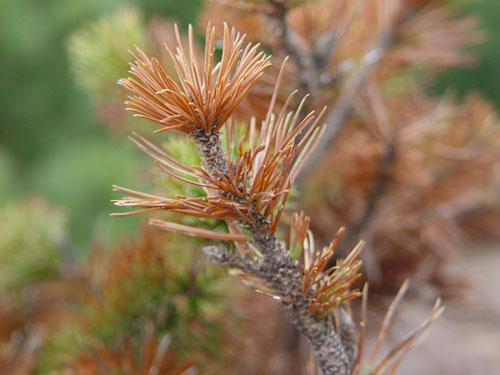
Photo courtesy of ISU Extension and Outreach
There’s really nothing Iowa homeowners can do at this point in the year to save the trees if they’re burned, but Feeley says to remember this situation in several months when autumn returns. “The best thing to do to prevent this is to mulch around the base of your tree, and if we’re dry in the fall, which is pretty common in Iowa, and you have non-native conifers, to water that all around them to get an ample moisture built up to carry it through these warm days,” Feeley says, “because later this week, it looks like we’re going to warm up again, so it could be another situation where we’re set up for this winter desiccation.”
If needles on the tree are dead but the buds are alive, he says new plant foliage will regrow to replace the winter-burned foliage. If both the buds and needles are dead, Feeley says the tree will not recover.
(Des Moines, Iowa) – The Iowa Department of Natural Resources (DNR), through a partnership with Alliant Energy, is offering a mixture of hardwoods, low-growing ornamental and evergreen tree species for $25 each. Alliant Energy customers can purchase up to two trees to be picked up at the following locations:

Submit an order form, available online at www.iowadnr.gov/trees, to reserve your trees.
(Radio Iowa) – From tractor parades to helping feed the needy through Meals from the Heartland, Iowa’s FFA members are celebrating the agricultural education organization this week through participating in a host of events. Taylor Adams, an instructor with the Webster City FFA chapter, says she’s long had an interest in the group.
“I’ve wanted to be a teacher since I was little, and once I got involved in FFA and ag throughout my high school career,” Adams says, “I knew that I wanted to continue to share my passion and teach my potential students in the future.”
The chapter’s president, Ethan Harms, says one of the false myths about FFA is that it’s only open to students who live on farms. Harms notes there are plenty of chapters in big cities and each member takes on what’s known as a Supervised
 Agricultural Experience, or SAE. “FFA is for all. Everybody has an SAE project, no matter how big or small in our ag classes,” Harms says. “It can range from managing your household pets to managing 100 head of livestock. Everybody has an SAE project.”
There are 20,000 FFA members in Iowa, with more than a million nationwide. FFA will mark its centennial in 2028.
(Des Moines, Iowa) – A bill to update Iowa’s grain indemnity fund with increased capacity and to include farmers with credit-sale contracts passed the Iowa House Agriculture Committee Tuesday. The Iowa Capital Dispatch reports committee members approved an amendment to House Study Bill 131 to clarify definitions of deferred-payment contracts and credit-sale contracts, the inclusion of which have been the dividing issue on the bill, and the reason it stalled in the Legislature last year.
Rep. Norlin Mommsen, R-DeWitt, said Tuesday, and in the subcommittee hearing Feb. 11, the bill was a compromise from his previous opinion that credit-sale contracts should be excluded. Deferred-payment contracts, which allow the price of grain on a sale to be determined after it has been delivered, are excluded from the fund. The bill would increase the indemnity fund minimum from $3 million to $8 million and the maximum from $8 million to $16 million to help cover farmers’ losses when their buyers go broke. Mommsen, who has led the bill, said the basics of the existing grain indemnity fund are solid, but need to be updated to reflect the current ag industry.
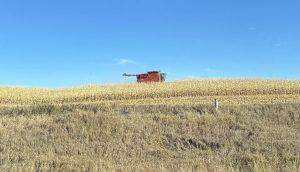
A combine in a corn field along west-bound Interstate 880. (Photo by Cami Koons/Iowa Capital Dispatch)
For example, he said the price of corn when the original grain indemnity fund started in 1986 was around $2 a bushel. “I sold corn the other day for $5,” Mommsen said. “So that shows the need to kind of upgrade stuff.” The amendment would also increase the bond amount required to be a grain dealer from $100,000 to $250,000, which Mommsen said, was just bringing the bill up to “today’s dollars.”
The bill moves next to the House floor.
Atlantic, IA – [February 17, 2025] – The Iowa Farmers Union, in collaboration with State Representative Megan Srinivas and Page County Farmer Seth Watkins, is hosting a Cancer Listening Post in Cass County. The listening session is scheduled for March 2nd, 2-3:30 PM at the American Legion Memorial Hall in Atlantic.
The event is being held to provide an opportunity for farmers, rural residents, and community members to share their personal experiences with cancer and its impact on their lives. Lawmakers will be present to listen and participate in discussions on tackling Iowa’s rising cancer rates.
Recent data highlights Iowa as one of the states with the fastest-growing cancer rates in the country. The Cancer Listening Posts will serve as a platform for individuals to voice concerns, discuss potential causes, and explore solutions to improve healthcare and prevention efforts in rural communities.
“These listening sessions are crucial for gathering firsthand accounts of how cancer is affecting our communities,” said State Rep. Megan Srinivas. “By hearing directly from those impacted, we can push for better policies, increased research, and stronger support systems for Iowans facing cancer.”
The Iowa Farmers Union encourages farmers, healthcare advocates, and concerned citizens to attend these sessions and make their voices heard. For more information, please contact thexter@iowafarmersunion.org.
DES MOINES, Iowa (February 17, 2025) – MidAmerican Energy officials says they are “taking big steps to ensure reliable, affordable power for its customers in the years to come, especially as demand for electricity keeps growing.” According to a press release, the company is proposing two new generation projects to best serve its customers – particularly during times when they need it most and regardless of the weather. MidAmerican today (Monday) filed plans with the Iowa Utilities Commission to build a solar energy project across several sites in Iowa that is expected to generate up to 800 megawatts of power.The company also plans to develop two natural gas-fired combustion turbines at one location in Adair County that will generate 465 megawatts of power. Kelcey Brown, president and CEO, said “We’re focused on ensuring our customers always have reliable power, no matter what’s going on with the weather. We’re always looking ahead, planning for decades in the future, to make sure we meet the needs of our customers in the most affordable and sustainable way.”
Currently, MidAmerican’s electric rates in Iowa are 42% below the national average. The proposed generating projects will help the company keep rates affordable while also ensuring customers have the around-the-clock energy they need. The 2025 Solar Reliability Project would complement MidAmerican’s vast wind fleet, providing increased energy at times when wind energy may be lower. Like wind, solar energy requires no fuel and helps to keep energy prices low for customers. The project is expected to produce enough energy to serve 144,000 typical homes while occupying about 4,800 acres of land.
Under the proposal, MidAmerican would add solar installations at approximately six sites through 2027 and 2028. Collectively, the project would provide nearly $25 million in property tax payments and $270 million in landowner lease payments over the operational life of the project. Not all site locations have been finalized. MidAmerican is requesting Iowa Utilities Commission approval for the company’s proposed solar project by August. If approved, construction would begin next year and generate energy beginning in 2027. “It’s crucial for our economy to have energy that’s there when we need it most – regardless of whether it’s hot, cold, windy or cloudy,” Iowa Senate President Amy Sinclair (R-Wayne County), said. “Developing a diverse mix of energy sources that keeps rates affordable and serves Iowans into the future just makes good sense.”
In addition, MidAmerican is proposing a natural gas-fired combustion turbine project in Adair County, called the Orient Energy Center, which would generate an additional 465 megawatts of power beginning in 2028. This project is a substantial commitment to energy reliability, investing in generation resources that will serve customers for the next 40 years. The Orient Energy Center is expected to operate when load is at its peak and when customers need it the most, estimated at less than 10% of the year. The facility will provide more than 400 jobs during construction, approximately $7 million in property tax revenues over its service life and will bring up to five skilled craft jobs that pay between $100,000 to $125,000 annually to the community.
“Adding a tried-and-true natural gas power plant in Adair County to MidAmerican’s existing generation resources and the proposed renewable project is an ‘all-of-the-above’ solution that will help keep Iowa ahead of the curve and ensure we maintain a reliable grid,” Iowa Rep. Ray “Bubba” Sorensen (R-Adair County), said. A planning report that MidAmerican released in November, called a resource evaluation study, examined energy demand projections over a 20-year timeline. The company study projected above-average load growth and the need for near-term capacity additions to meet the growth as soon as 2026.
The study evaluated the energy resources that would most cost-effectively and reliably serve projected customer needs. The report identified solar energy and natural gas-fired combustion turbines as the best resources in the short-term and eventually small modular nuclear reactor generation in the long-term. Through this mix of near-term solar and natural gas generating projects, MidAmerican seeks to address the looming energy supply shortfall and be able to serve customers with reliable and affordable energy well into the future – advancing its all-of-the-above and around-the-clock energy strategy.
Atlantic, IA – Cass County Extension is partnering with the SWISH (Southwest Iowa Soil Health) group to host an educational event focused on soil health for area farmers and ag professionals. The second Annual Southwest Iowa Winter Soil Health Conference will be held at the Cass County Community Center, located at 805 West 10th Street in Atlantic, from 9:00 am to 3:30 pm on Wednesday, March 5th.
The conference will feature soil health experts and farmers from across Iowa sharing their boots-in-the field experience on making conservation practices work on their farms. A meal will be served over the lunch hour. This event is free to attend and open to the public; pre-registration is required by February 26 for meal and materials. Registration can be done by phone or email to ruth.blomquist@usda.gov or 319-541-2969. Registration is also available online using the attached QR code or via the link on the Cass County Extension website at www.extension.iastate.edu/cass.
The morning session will kick off with NRCS State Soil Health Specialist, Hillary Olson talking about the efficacy of the soil health principles. Hillary will dive into soil health testing and discuss whether tests can measure differences in the soil due to management. Heartland Cooperative Conservation Manager and Nuffield Scholar, Ruth McCabe, will present her thoughts and experiences from an international study on conservation practice adoption. Following Ruth, Warren County farmer Aaron White will discuss practices he’s implemented to improve efficiency and soil health in his corn, soybean and cattle operation, and his goal of building a resilient farm for future generations.
The conference keynote presentation will be given by Brian Dougherty with Understanding Ag. A dedicated educator and regenerative ag consultant, Brian will focus his session on using a systems approach to building soil biology and improving farm resiliency and profitability. The day will conclude with a panel of local farmers sharing their on-farm experiences in making conservation practices work on their farms and building soil health for increased farm resilience.
This field day is organized by the SWISH group; a volunteer group of farmers, ISU Extension and Outreach staff, NRCS staff, IDALS staff, and industry partners who are passionate about soil health and committed to increasing soil health awareness and adoption across southwest Iowa. This field day is made possible with support from many organizations, including Iowa SARE (Sustainable Agriculture Research & Education), ISU Extension and Outreach in Cass County, Iowa Soybean Association, Dakota Bio, Midwest Soil Restore, Iowa Ag Water Alliance, Green Cover Seed, Ducks Unlimited and several southwest Iowa Soil and Water Conservation Districts.
For more information about the event, contact local extension field agronomist Aaron Saeugling at clonz5@iastate.edu, call the Cass County Extension office at 712-243-1132 or visit www.extension.iastate.edu/cass.
QR Code to registration Form:

(Radio Iowa) – The D-N-R building on the Iowa State Fairgrounds known for its large tanks displaying the various fish species from across the state is getting a new interactive display. D-N-R spokesperson Tammie Krausman says the new feature is called the Conservation Discovery Area. “We’re going to kind of give a loose interpretation of a cave, kind of representing Maquoketa Caves. And it’s going to be interactive, where anyone can go in it. We might have some like creatures in there, some bats, maybe some different things that you can feel and learn,” she says. The inside feature will also have a tower designed into it that’s modeled after the one at Pilot Knobb State Park. Krausman says another feature will be an in-floor river.
“We are looking at doing a little bit of, kind of colored concrete, and maybe some kind of walk over areas where you can look in and kind of experience what Iowa’s waterways look like, and the type of kind of fish and creatures that live in there, again, to kind of think about the stuff that you maybe don’t really think about live in our rivers. And so how can we kind of get that really close to you, and especially for all those kiddos,” Krausman says. They had various outdoor displays in the 100 years the building has been on the fairgrounds, and an archery area has been one of the more recent popular attractions. Krausman says the new feature will fit in well with what they have now.
“Yeah, we want to keep trying to bring the elements that the state has, like the fisheries, the, you know, ability to try out some recreational archery or air rifle shooting,” she says. “And now one of the things that we can do is try to bring some really cool, iconic park things into the State Fair, hopefully get people to engage with that a little bit and get curious enough that maybe they want to go out and explore to the state parks in Iowa.” Krausman says it’s hard to nail down exactly how many visitors the D-N-R building gets during the entire run of the State Fair. “We know that we have visitors from nearly every single county in the state, and we know that we have visitors from several other states and sometimes other countries. We have seen, during a pretty solid day, a weekday, that 11-thousand people came into our building in the like a two to three hour period.”
The Natural Resource Commission approved the project at its monthly meeting and Krausman says they hope to have it done sometime in July. “We are really hoping it’ll be ready for this year’s fair. So we’re excited. Last year we unveiled the courtyard and the range and the stage, and now we’re hoping to kind of complete our phase with this big inside interactive display,” she says. The N-R-C approved a contract with Austincrete of Newton for nearly 125-thousand dollars to build the display. Krausman says the money comes from a 500-thousand dollar special legislative appropriation that was made to fund the update at the D-N-R building.


 Facebook
 Twitter
 YouTube
 RSS
RSS