

CLICK HERE for the latest market quotes from the Iowa Agribusiness Network!
CLICK HERE for the latest market quotes from the Brownfield Ag News Network!


CLICK HERE for the latest market quotes from the Iowa Agribusiness Network!
CLICK HERE for the latest market quotes from the Brownfield Ag News Network!
JOHNSTON, IA – March 18, 2025 – The U.S. Department of Agriculture announced today that starting on March 19 farmers can apply for the Emergency Commodity Assistance Program. Corn growers are eligible for the program with a payment rate of $42.91 per acre for the 2024 crop year.
The new program was authorized by Congress through the American Relief Act, which passed in December. The economic assistance comes as growers are facing multiple years of low crop prices paired with high input costs.
“We appreciate USDA making economic assistance a priority and available to farmers who need it most,” said Mark Mueller, Iowa Corn Growers Association Vice President and farmer from Waverly, Iowa.
The sign-up period will run through August 15, and USDA will mail pre-filled applications to producers over the coming days. Growers can also go online, beginning tomorrow or to their local Farm Service Agency to complete the process.
Initial payments will be factored by 85% to ensure the total program does not exceed the funding provided by Congress. Once the sign-up period ends in August, USDA may provide a second payment if additional funds are still available.
ATLANTIC, Iowa – Officials with the Iowa Department of Natural Resources report Bob Harris is the recipient of the 2024 Brass Bluegill award from the Iowa DNR’s Fish Iowa! program. Harris started a nonprofit organization in 2020 to promote fishing for Junior and Senior High School students. The Southwest Iowa Fishing Team aims to promote, advance, and sponsor amateur youth fishing for boys and girls in Southwest Iowa and surrounding communities. Their primary initiative is to instill the ideals of good sportsmanship, education, conservation, and fish care through instruction, seminars, and training during all outdoor youth activities.
This endeavor has been a great success. Dozens of Junior and Senior High school aged boys and girls from all over Iowa have joined this team and competed in youth bass fishing tournaments locally and nationally. Harris also provides students with educational opportunities. Using fishing as a springboard, he and his team gain a better understanding of fish biology, habitat, and water management. He works with local agencies, organizations and businesses to access equipment, local resources, and funds for supplies.
The Southwest Iowa Fishing Team is committed to giving back to the natural resources in Iowa. Harris and his team successfully completed a fund-raising campaign to purchase materials the team used to build fish habitat at more than a dozen Southwest Iowa public fishing lakes.
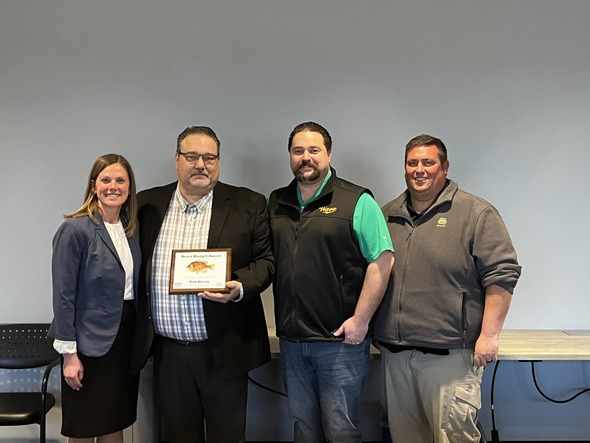
Pictured from the left is DNR director Kayla Lyon, 2025 Brass Bluegill Award recipient Bob Harris, chair of the Natural Resource Commission, Marcus Branstad, and DNR fisheries biologist Andy Jansen. Photo courtesy of the Iowa DNR.
Iowa DNR Fisheries Bureau staff have been assisting Harris and his team to help make these efforts educational and engage students to learn and expand their knowledge about aquatic fish life in the area lakes and ponds. He has built strong support for fishing, and outdoor education overall, in the area schools and community.
The award, along with a set of fishing poles to use with their Fish Iowa! programs, was presented at the Natural Resources Commission Meeting on March 13. The Brass Bluegill award has been presented each year since 1996 to Fish Iowa! educators with outstanding local programs that exemplify the goals of the Fish Iowa! Angler Education program.
(Des Moines, Iowa/Iowa Capital Dispatch) – Iowa senators advanced a bill Monday to provide farms 40 acres or larger with state protection against surveillance by drones. Lawmakers approved a law in 2024 to prohibit remote-piloted aircraft from flying over animal feeding operations and homesteads and create misdemeanor penalties for those who operate a drone over these areas. Senate File 491, would alter the law from protecting only “secured farmstead” — defined as an animal feeding operation and up to 400 feet surrounding it — to a “farmstead,” which is at least 40 contiguous acres used for farming or pasture and generates at least $15,000 in farm commodity sales annually. The bill would also prohibit the use of a drone, without the landowner’s permission, within 400 feet of farm animals, farm equipment or structures, including animal feeding operations, farmer residences, manure storage, barns and other such structures.
Sen. Dan Zumbach, R-Ryan, said the remote-operated aircraft scare livestock and invade a farmer’s privacy. Current law makes it a simple misdemeanor to fly over the restricted areas, and a serious misdemeanor, with fines up to $2,560, if the drone is equipped with “surveillance” devices that capture audio or video. The senate bill would further specify that surveillance includes the transmission of images or sound that can identify the species of farm animals and the type or use of equipment and structures on a farmstead. The bill would keep the same misdemeanor charges, but include the updated language referring to a farmstead instead of “secured farmstead.” Like the existing law, the bill would not protect farmsteads that are within city limits.
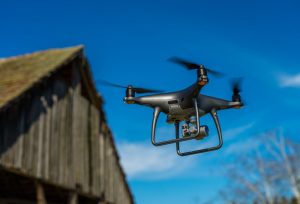
(Stock photo via Canva)
The Sierra Club Iowa Chapter is the only lobbyist registered against the bill. Efforts to pass the initial law were seen as targeting animal-welfare activists who have used the surveillance techniques to document the treatment of animals at feeding operations and dog-breeding facilities. Iowa commodity groups are registered in favor of the bill, while several groups, including the Iowa Newspaper Association, Iowa Broadcasters Association and the Iowa Board of Regents, are registered as undecided.
The bill advances to the Iowa House after a 46-3 vote, with Senate Democrats Herman Quirmbach, Tony Bisignano and Liz Bennett dissenting.
(Ames, Iowa) – From quaint hometown diners to upscale urban eateries, the competition was fierce as the Iowa Beef Industry Council and the Iowa Cattlemen’s Association accepted nominations for the 16th annual Iowa’s Best Burger Contest. This year’s contest saw impressive engagement, with more than 6,000 burger enthusiasts casting their ballots—a testament to Iowa’s deep-seated love for beef. The Top Ten finalists for 2025 (in alphabetical order) are:
“Nearly 400 restaurants were nominated during this year’s voting process,” said Kylie Peterson, Director of Marketing for the Iowa Beef Industry Council. “This year’s Top Ten restaurants are award-winning worthy, but they’re only a handful of the many outstanding establishments in Iowa that proudly serve high-quality beef raised by our state’s cattle farmers.” 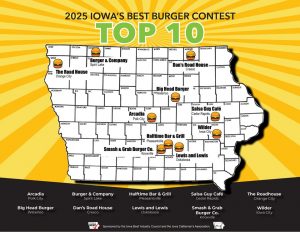
To qualify, the burger must feature a 100% real beef patty served on a bun or bread product. Toppings, condiments, sauces, and cheese are left to the creativity of the restaurant. Seven of the Top Ten restaurants are new to the list, including Arcadia, Dan’s Road House, Halftime Bar & Grill, Lewis and Lewis, Salsa Guy Café, Smash & Grab Burger Co., and The Roadhouse.
The final phase of the contest begins soon, as a panel of anonymous judges will visit each Top Ten restaurant to evaluate the burgers based on taste, appearance, and proper doneness (160°F). The 2025 Iowa’s Best Burger winner will be announced on May 1 to kick off May Beef Month.
Several Past Winners:
To view the full list of Top Ten finalists, including locations and hours, visit www.iabeef.org.
(Atlantic, Iowa) – Produce in the Park in Atlantic is now accepting vendor applications for summer markets and seeking sponsorships for the 2025-2026 market season. Vendor applications and sponsorship information can be found online at www.ProduceintheParkAtlanticiowa.com. Printed copies are available at the Atlantic Area Chamber of Commerce (102 Chestnut St. Atlantic, IA 50022). Produce in the Park is a 501(c)(3) nonprofit organization whose mission is to promote local food and build community.
Produce in the Park’s summer farmers markets are held weekly on Thursday evenings (4:30-6:30 PM) in the Atlantic City Park from June 5th through September 25th, 2025 Produce in the Park also holds holiday farmers markets just before Thanksgiving, Christmas, Valentine’s Day, and Easter.
Produce in the Park seeks vendors who sell handmade or homegrown foods and crafts. The 2025 summer market full-season vendor fee is $100. Vendors who register by May 1 will receive a $20 discount, and food vendors who participate in the Farmers Market Nutrition Program receive an additional $10 discount. Vendors can also join four summer markets for $50 or a single summer market for $25. Produce in the Park seeks sponsors who support community and wellbeing. Sponsorships offer various levels of recognition, including mention in radio ads, booth space at markets, and the organization’s logo on tote bags. 2025-2026 season sponsorships range from $250 to $2,000. 
Committed sponsors for the 2025-2026 season include the Atlantic Area Chamber of Commerce, Cass County Tourism, Cass Health, City of Atlantic, First Whitney Bank & Trust, Nishna Valley Family YMCA, Rush CPA, and the United Church of Christ of Atlantic. In addition to vendors and sponsors, Produce in the Park is always looking for volunteers interested in serving as Guest Chef or leading activities for kids. Produce in the Park is also scheduling live entertainment for summer markets now.
The next Produce in the Park farmers market will take place Saturday, April 19th from Noon-until 3-p.m., at the Nishna Valley Family YMCA, in Atlantic. The Spring Celebration Market will offer produce, meats, farm-fresh eggs, baked goods, desserts, crafts, and more. Customers can expect to find goodies for Easter baskets and food for Easter dinner. There is no cost to enter the market, and the YMCA will offer free bounce houses for kids. Pim’s Thai Food Truck and Lucky Wife Wine Slushies will be parked outside the YMCA for the duration of the market.
The Spring Celebration Market is sponsored by the Atlantic Area Chamber of Commerce, Cass County Tourism, Cass Health, City of Atlantic, First Whitney Bank & Trust and Nishna Valley Family YMCA.
(Radio Iowa) – A guide to transportation regulations for farmers is now available from the Iowa Department of Transportation. The D-O-T’s Melisa Gillett helped create the farm guide. “There are many regulations that apply to agriculture operations, and it can be challenging sometimes for farmers to really understand those regulations that apply to them, or the exceptions that may apply at the federal and state level,” Gillett says. She says this should be a one-stop place to answer some of the questions.
“What we did was try to consolidate all of that into this specific guide for farmers. And I would say, this is something we worked on when I was in the Motor Vehicle Division, and kind of inspired by my dad, who’s a farmer in western Iowa, and his friends that he meets with at the at the coffee shop at the local gas station, you know, and they have these conversations. And so he helped to kind of test this,” she says. They gave the farm guide a test drive at last year’s Iowa State Fair. “We were visiting with farmers and talking with them about what information is helpful, and so it’s gone through some iterations and some revisions since then to gather that input directly from them,” Gillet says.
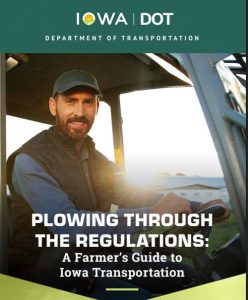
The DOT has released a farm guide to transportation regulations. (DOT photo)
Gillett says you can find the guide online or get a printed copy. “You know, I think about the farmers, they like the physical copies to have available to reference them,” she says. We also have it available on our website as well, but distributing them at our driver’s license locations. We’re working with Iowa State Patrol and the commercial motor vehicle unit as well to help help them distribute as well.” Gillett presented the finished guide at the Transportation Commission meeting Tuesday.
(Statewide) – Abnormally dry to moderate drought conditions, high winds and dry vegetation that can quickly burst into flames have resulted in 15 counties in Iowa having instituted a Burn Ban. As of March 14th, the following southwest Iowa counties are included in the ban on open burning:
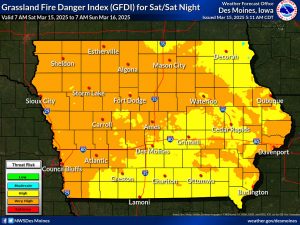 Two counties in southern Iowa and six in eastern/southeast Iowa have Burn Bans in-place. The Code of Iowa states “The State Fire Marshal, during periods of extremely dry conditions or under other conditions when the state fire marshal finds open burning constitutes a danger to life or property, may prohibit open burning in an area of the state at the request of the chief of a local fire department, a city council or a board of supervisors and when an investigation supports the need for the prohibition.”
A burn ban does not prohibit the following: supervised, controlled burn for which a permit has been issued by the fire chief of the fire district where the burn will take place, the use of outdoor fireplaces, barbecue grills, properly supervised landfills, or the burning of trash in incinerators or trash burners made of metal, concrete, masonry, or heavy one-inch wire mesh, with no openings greater than one square inch.
For specific questions about open burning in your community, please contact your local Fire Department or Emergency Management office.
(Radio Iowa) – The Iowa Soybean Association held its annual farmer roundtable in Sioux City Thursday. Association president Brent Swart of Spencer says tariffs are the key topic of discussion.
He says they learned from the last time the tariffs were put on China in 2018.
He says trade wars with Canada and Mexico are also a concern, as is the impact of bird flu.
Swart says they also have concerns about getting a new farm bill passed in Congress.
DES MOINES— Gov. Kim Reynolds today (Friday) authorized a disaster proclamation for Buena Vista County, Iowa effective immediately through April 13, 2025. The USDA has confirmed a positive case of highly pathogenic avian influenza (HPAI) in commercial pullets.
This proclamation allows state resources from Iowa Homeland Security, the Iowa Department of Agriculture and Land Stewardship, and other agencies to assist with tracking and monitoring, rapid detection, containment, disposal, and disinfection. The proclamation also waives regulatory provisions related to commercial vehicles responding to affected sites.
The recent HPAI detections in birds do not present an immediate public health concern, and it remains safe to eat poultry products. If producers suspect signs of HPAI in their flocks, they should contact their veterinarian immediately.


 Facebook
 Twitter
 YouTube
 RSS
RSS