

CLICK HERE for the latest market quotes from the Iowa Agribusiness Network!
CLICK HERE for the latest market quotes from the Brownfield Ag News Network!


CLICK HERE for the latest market quotes from the Iowa Agribusiness Network!
CLICK HERE for the latest market quotes from the Brownfield Ag News Network!
(Radio Iowa) – It’s already morel hunting season in several Iowa counties, as foodies who crave the taste of the elusive mushrooms — battered in bread crumbs, butter and garlic — hike to their closely guarded locations in the woods in hopes of finding a coveted crop. Dr. Benjamin Orozco, an emergency physician with Gundersen Health, says there are also “false morels” starting to sprout across Iowa, and they can be dangerous.
“With just a little bit of knowledge, you can avoid mistaking the two. The morel mushroom that is enjoyed by many is delicious, very safe, should be cooked and eaten,” Orozco says. “The false morel, on the other hand, is actually poisonous, and if you consume enough of it, it can cause seizures and even death.” Morel hunting can be a thrilling challenge that gets you out exercising in the sunshine, but Orozco says you absolutely need to know what you’re looking for — and what to pass by.
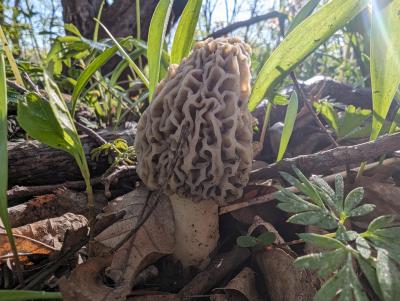
Common morel mushroom (Photo by Iowa State University Extension and Outreach)
While newbies may be fooled, he says a seasoned hunter can easily identify a false morel. “The cap is kind of misshapen. Sometimes it can be saddle-shaped or kind of brain-like in its appearance. And if you cut that false morel in half, the stalk is filled with kind of a fibrous material like the rest of the mushroom. So if that stalk is solid, or if there’s material within the mushroom, then that’s not a morel,” he says. “A morel should have a continuous stalk that goes right into the cap, and that interior should be hollow.”
Every spring, Iowa State University Extension and Outreach offers classes for anyone interested in being certified to sell wild-harvested mushrooms within Iowa. The extension also offers Wild-Harvested Mushroom Certification Workshops during the wintertime. The dates for next year will be posted in January 2026. “I recommend anyone who wants to get into mushroom foraging to look at your local clubs and consult a reference guide,” Orozco says, “and the most useful thing is to be out in the woods with someone knowledgeable who has experience and expertise with the identification of wild mushrooms.”
Gundersen Health System has clinics in Calmar, Decorah, Fayette, Lansing, Postville and Waukon, and a hospital in West Union.
DES MOINES, Iowa [KCCI] — Morel mushroom hunting is underway in Iowa. The Iowa Morel Report posted an update Friday on social media, showing where morels have already been found.
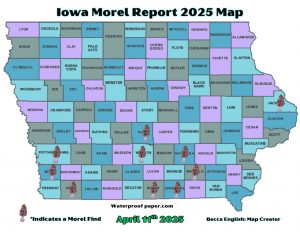
Iowa Morel Report on Facebook
As of Friday, they’ve been reported in 10 counties, including Pottawattamie, Mills and Page Counties in southwest Iowa.
FORT DODGE – The Iowa Department of Natural Resources is investigating a fish kill at the South Branch of Lizard Creek in Fort Dodge.
On Monday, April 14th, the DNR Field Office in Mason City received a call from CJ Bio America in Fort Dodge regarding a leak at their facility. A fertilizer byproduct created in the process of making lysine had emptied into a stormwater channel on the east side of the plant.
Plant staff believed the byproduct was contained, but later discovered a breach in the berm of the storm water channel. An unknown amount of the byproduct flowed from the breach into surface intakes in an adjacent field, which outlets to the South Branch of Lizard Creek.
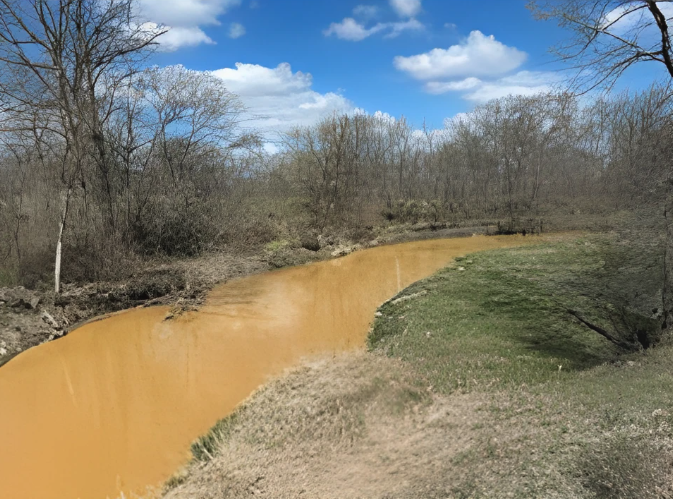
Brown, murky water flowing at the South Branch of Lizard Creek in Fort Dodge
DNR field staff responded to the incident, and upon arrival observed the byproduct in the South Branch of Lizard Creek several miles downstream from the plant. Dead fish were also observed in the creek for several miles.
The leak has been stopped, however due to flow and access restrictions, placing berms in the creek is not an option at this time. Water samples have been collected, and the investigation is ongoing. Downstream users are advised to stay out of the creek at this time.
To report a release after hours, please call the DNR’s emergency spill line at (515) 725-8694. Quick reporting can help DNR staff identify the cause of an incident. The DNR website has more information about spill reporting requirements.
(Harlan, Iowa) – The AgSafety4U certificate course replaces the tractor and farm machinery safety course which has been held for many years. Federal law restricts youth under 16 from using certain farm equipment unless their parents or guardians own the farm. This online certificate course provides an overview of the hazards common to farms and rural agricultural businesses. The course is offered locally through the ISU Extension and Outreach Shelby County office.
This program can be used for the classroom portion of the Hazardous Occupations Order for Agriculture (HOOA) safety certification program for youth 14 and 15 years of age who are seeking employment and must be certified to drive or operate tractors and machinery for hire. Additional hands-on training is required for issuing a US DOL certificate. Visit the registration site ag-safety.extension.org/agsafety4u-certificate-course. There is $10 fee for the course. 
This course is designed for youth, new and beginning farmers, and for employers and employees of agricultural operations looking to enhance their knowledge and/or to provide professional development with a heavy emphasis on tractor and machinery. Individuals who take this course and pass the online quizzes will be able to print a certificate of completion. There are two components to this certification, the online course work and a tractor driving test. A driving test will be given on Saturday, May 17 in Harlan. The online coursework must be completed prior to the tractor driving test. Participants will need to bring their course certificate to the driving test.
Contact the Shelby County Extension office to sign up for a testing time or for questions, 712-755-3104.
(Washington, D-C; Iowa Capital Dispatch) – Iowa Sen. Chuck Grassley introduced legislation this past Wednesday to increase enforcement of antitrust laws in the meatpacking industry, a step he said would help bring down the price of meat.
The Meat and Poultry Special Investigator Act would establish a team of investigators in the U.S. Department of Agriculture, tasked with ensuring compliance with existing federal laws banning anti-competitive practices in the meatpacking industry. The investigators, working with the U.S. Department of Justice and the Federal Trade Commission, would have subpoena power and be able to bring court action against meat packers and poultry dealers for violations of Packers and Stockyards Act.
A news release from Grassley’s office stated the measure was needed considering the substantial consolidation of the meatpacking industry in recent decades. Four companies currently control 85% of the beef market and 67% of the pork market, compared to controlling 36% and 34% of the markets respectively in 1980, according to Grassley’s office. Having four companies with such a large portion of control in the industry has “created a distorted marketplace through anti-competitive practices” at the expense of livestock and poultry producers, the news release stated.
Grassley said the bill, endorsed by the National Farmers Union and the U.S. Cattlemen’s Association, will help Iowa livestock farmers while bringing down grocery store prices. “For decades, America’s Big Four meat packers’ anti-competitive practices have made it harder for Iowa cattle producers to receive a fair price,” Grassley said in a statement. “Our bill empowers USDA, in coordination with the Justice Department and Federal Trade Commission, to crack down on bad actors, ensuring a fair and functional marketplace that supports everyone who produces and enjoys quality American meat.”
(Iowa Capital Dispatch; Ames, IA) – Iowa State University has been awarded more than $2 million from the U.S. Department of Agriculture to carry out six research projects that will help prevent and combat animal disease outbreaks.
The Iowa awards were part of an announcement from the USDA Animal and Plant Health Inspection Service, or APHIS, of $15.3 million for research that enhances preparedness, detection and response to “the most damaging diseases that threaten U.S. livestock.”
Molly Lee, the associate director of ISU’s Center for Food Security and Public Health, said the projects will generate free resources for producers and animal health professionals.
“Animal disease preparedness is a valuable investment that strengthens our food supply, ensures farmers’ livelihoods and protects public health,” Lee said in a statement. “Supporting animal agriculture with grants like these is a critical and efficient use of federal resources.”
Some of the projects build on general biosecurity protocol, like “Disinfection 201” which received $315,000 to further develop an existing online module with disinfection guidance for different species and diseases. The “just-in-time” project was awarded $447,000 to develop an on-demand library of information to expedite an outbreak response, and another would make general biosecurity protocol trainings more relevant to small and niche producers.
Iowa State University in Ames. (Photo by Cami Koons/Iowa Capital Dispatch)
Enhanced biosecurity has been a common phrase over the past several months as the highly pathogenic avian influenza continues to impact millions of birds and dairy cattle nationwide. U.S. Secretary of Agriculture Brooke Rollins recently announced $100 million to fund research around treatment, biosecurity and prevention of the bird flu. That funding, which is open for applications until May 19, is separate from the APHIS National Animal Disease Preparedness and Response Program, through which the ISU research was awarded.
Another ISU project was awarded $284,000 to develop training materials and workshops for preparedness against the Japanese encephalitis virus, which can infect humans and most domesticated animals, including swine. The virus is mostly present in Asia and has not been detected in the U.S.
The final two funded projects at ISU would increase biosecurity measures for horses and research around foreign animal diseases that could affect the aquatic animal industry.
The funding is part of the National Animal Disease Preparedness and Response Program which was authorized by the 2018 Farm Bill.
(Radio Iowa) – The latest Drought Monitor report shows improvement in most areas of the state thanks to above-normal precipitation in March. The D-N-R’s Jessica Reese McIntyre says western, and central and northwest Iowa got he most rain. She says northwest Iowa in particular had areas of severe drought. “That was completely removed with the rain that fell, the precipitation that northwest Iowa saw, and so that’s very encouraging,” she say. Mcintyre says there wasn’t much change in the southeast and southwest areas of the state. “They are just kind of floating along. There was a little bit of improvement in southwest Iowa, but for the most part, they are kind of holding to where they were,” McIntyre says.
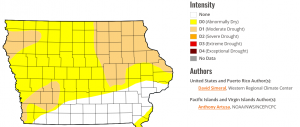
Iowa Drought Monitor map (released 4-10-25)
The eastern side of the state has the largest area of drought. “Unfortunately, northeast Iowa did not see a whole lot of improvement. They’re still in the d1 classification, which is moderate drought,” McIntyre says. McIntyre says the overall picture is pretty good right now. “We are in a significantly better position than we were this time last year, as far as drought is concerned, because we didn’t bust out of that really long record drought until the end of May, early June,” she says.
McIntyre says we are getting into our wettest months and if that holds true this year, we could see more of the dry conditions go away.
(Des Moines, Iowa) – The Iowa Department of Agriculture and Land Stewardship (IDALS) reports a case of highly pathogenic avian influenza was detected Thursday in a mixed species backyard flock in Hardin County. The H5N1 bird flu has impacted more than 168 million birds since February 2022, when outbreaks of the strain began in the country. Thus far, more than 900 flocks with cases of the flu were backyard flocks. This is the seventh HPAI detection in Iowa this year and the third detection in a backyard flock. Previous backyard flock detections in 2025 were in Dallas and Clinton counties.
HPAI has a low public health risk, according to the U.S. Centers for Disease Control and Prevention, but there have been 70 known cases of transmission to humans. Officials hold that poultry and eggs remain safe to consume. U.S. Agriculture Secretary Brooke Rollins rolled out a five-pronged plan and $1 billion to stop the spread of HPAI and to reduce the cost of eggs in the country, which has increased largely due to supply disruptions from the bird flu.
The plan includes heightened biosecurity measures, audits and research into the virus and potential treatments for birds. IDALS encourages backyard and commercial poultry producers to monitor their flocks and contact a veterinarian immediately, and report cases to the department, if they suspect signs of the bird flu.
(Radio Iowa) – The wild turkey hunting season gets underway today (Friday) with the youth season. Iowa D-N-R wildlife biologist Jim Coffey says hunters bagged a record 16-thousand birds last year. “We’re expanding a similar harvest this year as well, because most turkeys that hunters are after are the two year old birds. And we had good production in 2023. Our 2024 production was down a little bit, but it shouldn’t, shouldn’t hamper hunters from seeing plenty of birds this year,” Coffey says. Coffey says the mating season dictates the movement of the wild turkeys and that is why more of the young males are taken.
“There tends to be a dominance hierarchy, and those two year old birds are not yet on that dominance hierarchy, so they’re willing to travel, and then they have to fight a little bit more and kind of look for females versus that dominant male that just kind of stays in one area and kind of lets the ladies come to him,” he explains. Coffey says the warm weather has some of the wooded areas starting to get green and that can impact turkey hunting. “So typically what that does is the green up means a little earlier leaf out, and that makes a little more difficult to see in the woods,” Coffey says. “So from a hunter standpoint, it can help you, because it makes you a little less visible to turkeys that have great eyesight. But at the same time, it’s a little harder for you to see as well. And so as we see the season progress and get greener, it gets a little harder to see the birds and hear the birds and and so hunters like to kind of pick the right time of the year for their situation.”
Coffey says any edge you can get is important as wild turkeys have one of the lowest rates of success for hunters. “We’re going to expect around 22 to 25 percent of our hunters to be successful, and that just depends on how you define success. To me, any day you’re in the woods chasing a turkey is a good day. And some days we take a bird home, and some days we don’t, most days we don’t, most days we don’t.”
Coffey says always remember the safety rules for any hunt. “And turkey hunting world, the first thing to do is be like defensive driving. Is we don’t want to wear red, white or blue on our person, because those are, those are similar colors, so that the head of the male wild turkey. And then, of course, if we do get a chance to take a shot, we must take a shot, and know what’s beyond our bird,” he says.
The youth season starts things off and runs through Sunday. The first regular wild turkey season opens on April 18th.
(Des Moines, Iowa) – Lawmakers in a House Ways and Means Committee Wednesday advanced a bill, and uttered a number of bee-related puns, to exempt the sale of honeybees from state sales tax. According to the Iowa Capital Dispatch, the bill would bring honeybees in line with the tax protocol of other livestock, which are exempt from state sales tax. Richard Vonderohe, a beekeeper in Mason City and president of the North Iowa Beekeepers Club, said the bill would help beekeepers, — especially those who have suffered from bee losses over the winter. Commercial beekeepers lost on average 62% of their colonies from June 2024 to January 2025, according to results from a survey of beekeepers, administered by Project Apis m. and other bee industry groups.
Project Apis called it the largest honeybee loss recorded in the country, and estimated the economic impact, caused by lost revenue and the cost of replacing colonies, to be $600 million on beekeepers. The broader economic impact could be even greater, as honeybees are responsible for pollinating $15 billion worth of U.S. crops, annually, according to the U.S. Department of Agriculture. Researchers are uncertain what is causing the losses, though many, including Vonderohe, wonder if commercial pesticide use is to blame. Honeybee colonies can also be harmed by parasites, disease and starvation. “I’ve had enough losses,” Vonderohe said. “We need help with our bees.”
Rep. Mike Vondran, R-Dubuque, called House File 247 the “sweetest bill” of the day. He said exempting honeybees from the state tax has a fiscal note of less than $20,000 annually. Rep. Lindsay James, D-Dubuque, supported the bill that she said has had “lots of buzz.” According to USDA report from March, Iowa has around 41,000 honeybee colonies, though this number is likely higher as USDA only reports on producers with five colonies or more. HF 247, called a “bee-utiful bill” by Vondran in his closing remarks, passed unanimously from the committee and is now eligible for floor debate.
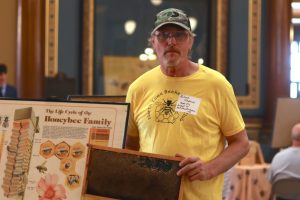
Richard Vonderohe displays a rack from a bee box at the Iowa Capitol on Iowa Honeybee Day, March 26, 2025. (Photo by Cami Koons/Iowa Capital Dispatch)
There are more than 4,000 native bee species in the country and according to the U.S. Geological Survey, bees are the primary pollinators for the majority of agricultural crops. While they won’t get any honey out of the deal, Iowans have an opportunity this summer to engage with native bee populations as part of a national survey project. The Iowa Department of Natural Resources is seeking participants in its second Bumble Bee Atlas and will host online trainings April 19 and May 10. The citizen science project aims to identify the bumblebee species of Iowa, where they’re located and their preferences in flowers.
Last year, participants conducted nearly 150 surveys and identified 10 bumblebee species. The brown-belted bumblebee was the most common species identified last year and DNR estimates there are more species to be found in Iowa. Participants need a net, cellphone or other camera, bee-holding container, a cooler and about 45-minutes to dedicate to catching and identifying bees. Those interested can register online. Twenty states participate in the Bumble Bee Atlas and collectively have observed 36 species of bumble bees and engaged more than 4,000 citizen scientists.


 Facebook
 Twitter
 YouTube
 RSS
RSS