

CLICK HERE for the latest market quotes from the Iowa Agribusiness Network!
CLICK HERE for the latest market quotes from the Brownfield Ag News Network!


CLICK HERE for the latest market quotes from the Iowa Agribusiness Network!
CLICK HERE for the latest market quotes from the Brownfield Ag News Network!
Cass County: Corn $3.43, Beans $9.32
Adair County: Corn $3.40, Beans $9.35
Adams County: Corn $3.40, Beans $9.31
Audubon County: Corn $3.42, Beans $9.34
East Pottawattamie County: Corn $3.46, Beans $9.32
Guthrie County: Corn $3.45, Beans $9.36
Montgomery County: Corn $3.45, Beans $9.34
Shelby County: Corn $3.46, Beans $9.32
Oats $2.45 (always the same in all counties)
DES MOINES, Iowa (AP) — With farmers markets set to begin in dozens of cities across Iowa, vendors and market managers alike are pulling out all the stops to keep consumers coming back for more. National data suggest the tremendous growth in farmers markets has begun to ebb, with a slight decline in sales adjusted for inflation, but officials say customer and vendor retention efforts in Iowa have helped the state’s markets so far evade such a fate.
Kelly Foss, director of the Downtown Des Moines Farmers Market, says finding ways to ensure incremental growth each year is crucial to success as the market enters its 40th season. Todd Mills sells gourmet mushrooms, and he says his latest venture in Des Moines fills a niche currently unserved at the downtown market.
w/ Host Bob Bebensee and Brian Smith, Conservation Officer for Cass and Adair Counties.
Podcast: Play in new window | Download (3.8MB)
Subscribe: RSS
With a third avian flu outbreak confirmed in Iowa, turkey hunters are being urged to take special care to halt the spread and not to shoot a bird that might be sick. Kevin Baskins, a spokesman for the Iowa Department of Natural Resources, says turkey hunters need to help minimize the risk of spreading the disease, which has already forced the euthanizing of tens of thousands of turkeys and millions of chickens in the state.
“We’re advising turkey hunters to avoid any commercial types of flocks like chickens or turkeys,” Baskins says. “Once that virus gets into a confinement situation, it will spread very rapidly and probably throughout the entire operation.” Hunters need to be vigilant for any birds that have died in the field or that appear sick. Signs include: ruffled feathers, swollen wattles, discoloration of the feet and impaired balance.
Baskins says if a dead or sick bird is spotted, hunters should mark the spot using G-P-S if possible and notify the D-N-R right away. They should not touch or try to move the birds. The avian flu is believed to be spread by migrating flocks of wild waterfowl, specifically, ducks and geese. “We don’t expect to see a lot of avian flu in turkeys,” Baskins says. “Turkeys tend to be more solitary. They move around in smaller groups. If there is an outbreak, it’ll be fairly isolated. It’s not like a confinement situation where we have commercial flocks and once it gets into a building, it spreads from bird to bird very rapidly.”
Between the shotgun and archery seasons, turkey hunting will be underway in Iowa through May 17th. Baskins says turkey hunters should follow some common sense precautions, like washing their hands with soap and water immediately after handling game — or if they’re in the field, use alcohol wipes. “We advise that you dress your game birds in the field whenever you can,” Baskins says. “Make sure you’re using the same tools, whether in the field or at home and that you don’t use those tools around other poultry or pet birds. Make sure you double-bag the internal organs and feathers so once you dispose of those, any virus that might be in there is contained.”
For more tips, visit the website: www.iowadnr.gov. There is no food safety concern, according to Baskins. Game meat should be thoroughly cooked, he says. Poultry should reach an internal temperature of 165 degrees Fahrenheit to kill disease organisms and parasites.
(Radio Iowa)
Frost and freezing conditions hit the state the last couple of nights and that has grape growers hoping they don’t see another drop in production like the one brought on by the cold last season. State Viticulture Specialist Mike White says he had not had any reports of damage following Wednesday’s freeze warning. “For the most part things look pretty good in Iowa. There might have been a vineyard or two in southern Iowa in a low area that might have had some frost, but I think right now we’re looking pretty good,” White says.
White says however, grapevines do have some built in insurance against frost damage. He says each plant has three buds inside with the first being 100 percent fruitful. “Now if it gets out there with one or two leaves and let’s say its April 27th and you get a frost, well the secondary bud inside there will bust open, and it has the ability to produce maybe 30 to 50 percent of a crop,” according to White.
White says the third layer will not produce fruit but it will sustain the plant through the season. He says wineries last year took a hit from a cold and wet spring and a late summer thunderstorm in western Iowa. Yields were cut by as much as 40 percent. Iowa has more than 100 wineries across the state.
(Radio Iowa)
DES MOINES, Iowa (AP) — Some international trade partners are declining to buy egg and poultry products from states affected by a deadly strain of bird flu while others are excluding imports only from counties where the virus has surfaced. Agriculture officials say the food supply is safe. But Mexico, Japan and Canada are among 33 countries declining to accept poultry products from entire states, including Iowa, the nation’s leading egg producer, and Minnesota, the top turkey grower in the U.S.
Other countries, including Hong Kong, limit the ban to counties where the virus has been confirmed. Jim Sumner, president of the U.S. Poultry & Egg Association, says 110 countries trade with no restrictions. Also Thursday, the governor of Minnesota, the nation’s leading turkey producer, declared a state of emergency to fight the H5N2 virus.
DES MOINES, Iowa (AP) — The Iowa Department of Agriculture says a turkey farm in Sac County has become the third farm in Iowa to have confirmed cases of bird flu. The farm’s 34,000 turkeys will be killed to contain the virus. The farm is within a six-mile monitoring zone of the first turkey farm identified in Iowa to have the H5N2 virus.
Sac County is the adjacent county south of Buena Vista County where a farm with 27,000 turkeys was confirmed to have the virus on April 13. An egg-laying facility with 3.8 million chickens in Osceola County northwest of the turkey farms also has the virus. State agriculture officials say in the latest case announced Thursday, turkeys began dying and tests at Iowa State University confirmed the bird flu virus is present.
The Iowa Department of Natural Resources says the past two weeks have seen needed rainfall over much of the state, ending a very dry stretch of weather. The rains reflect improvements to the drought, streamflow and shallow groundwater conditions.
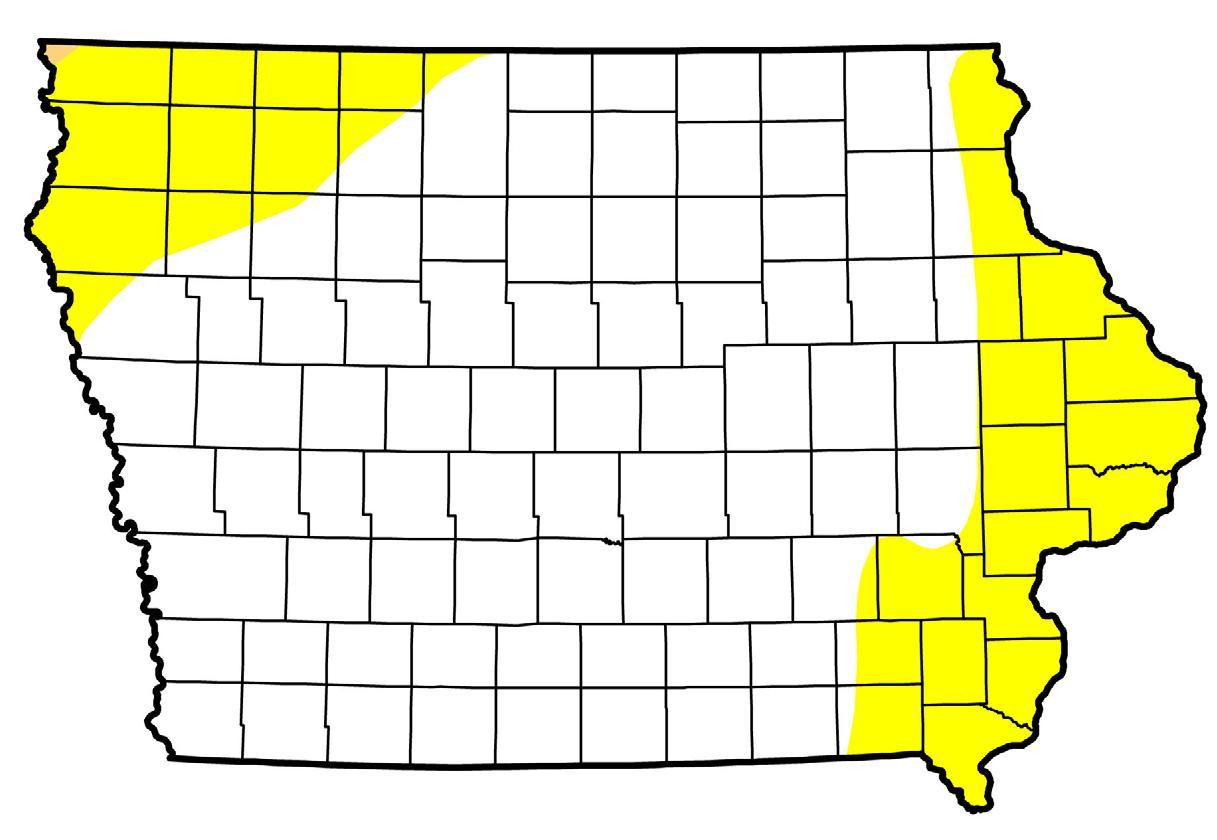
Areas in yellow are experiencing “Abnormally Dry” conditions. Areas in white are considered to have “Normal” soil conditions as of April 21st.
Rainfall totals varied from just over seven-tenths (0.70) inches at Muscatine to more than six-inches inches at Lake Mills. In Atlantic, rainfall from April 7th through this past Tuesday, amounted to 2.39-inches, which matches the statewide average. Temperatures have averaged 4.5 degrees above normal, as well. Officials say the wet weather comes at a time when Iowa is entering its traditionally wet months, and is a positive sign for conditions through spring.
The area of the state classified as abnormally dry has dropped from 50 percent to 25 percent according to the National Drought Monitor, a significant improvement over one year ago when more than 75 percent of the state was abnormally dry. Slight drought conditions remain present in far northwest and eastern Iowa.
For a thorough review of Iowa’s water resource trends, go to www.iowadnr.gov/watersummaryupdate. The report is prepared by the technical staff from the Iowa DNR, the Iowa Department of Agriculture and Land Stewardship, IIHR—Hydroscience and Engineering and the U.S. Geological Survey, in collaboration with The Iowa Homeland Security and Emergency Management Department.
Adair County residents have new tools available to them. Pam Jensen, Adair County Assessor, and the Adair County Board of Supervisors have announced that complete Adair County property information is now available to the public, 24/7, in an enhanced mapping format on the Internet at http://adair.gisworkshop.com/ through a partnership with GIS Workshop, LLC.
Visitors to the user-friendly mapping site will now find County property information at their fingertips through the Property Search tool. The search fields allow searches by parcel ID, owner name, address or legal description. All matching results will appear both on the map and in list format. In addition, residents can perform a more advanced search by sale information such as sale date, price range, acreage, or year built.
Full data regarding values, taxes, and even a photo of the property is now conveniently available to anyone with an internet connection. Additional enhancements to the site include a Measurement tool, Quick Identify tool, Photo tool, Advanced Printing tool, and Zoom in/out and Aerial Imagery slider bars featuring several years of FSA aerial imagery. The enhanced site allows anyone to access informative GIS mapping information quickly and easily.


 Facebook
 Twitter
 YouTube
 RSS
RSS