

CLICK HERE for the latest market quotes from the Iowa Agribusiness Network!
CLICK HERE for the latest market quotes from the Brownfield Ag News Network!


CLICK HERE for the latest market quotes from the Iowa Agribusiness Network!
CLICK HERE for the latest market quotes from the Brownfield Ag News Network!
The Atlantic Area Chamber of Commerce has partnered with Horizon Equipment to bring you the 2015 AtlanticFest Tractor Ride. Horizon Equipment is your local John Deere Dealership, serving the area since 1926. Registration for the Tractor Ride will begin 7-am Saturday, Aug. 8th, at the Cass County Fairgrounds, with breakfast provided by Lindeman Tractor.
The ride will depart at 8-a.m. for Duke Aerial and Precision Parts. Upon return, tractors will be parked along 6th street, and riders will enjoy lunch at the Senior Center provided by Country Tire. The annual AtlanticFest Tractor Ride is organized by the Lions Club of Atlantic.
For more information about the AtlanticFest Tractor Ride, or additional AtlanticFest information visit www.atlanticiowa.com or call the Atlantic Area Chamber of Commerce at (712)243-3017.
As summer winds down, the ISU Extension Farm Management Team is hosting Farmland Leasing informational meetings across the state. The annual meetings are offered to address questions that land owners, tenants or other interested individuals have about leasing farmland, as well as to provide resources to make decisions regarding farmland ownership, management, and leasing practices as they plan for the future.
Cass County Extension will be hosting a meeting on Tuesday, August 11th from 9-until 11:30-a.m., at the Cass County Community Center, 805 West 10th Street in Atlantic. A meeting in Page County will be held in Shenandoah on August 26th, also from 9-until 11:30-a.m., at the Rose Garden on W. Ferguson Avenue.
The Farm Leasing Arrangements meeting in Atlantic will focus on current issues related to farmland ownership, management and leasing arrangements. Tim Eggers, ISU Extension & Outreach Field Agriculture Economist will discuss Trends in Farm Land Values, Cash Rental Rates and Costs of Production. The special emphasis topic for this year’s farm leasing arrangements is negotiating a fair cash rental rate. Attendees will gain understanding of current cash rental rate surveys and factors driving next year’s rents such as market trends and input costs. Additional information on the 2014 Iowa State Land Value Survey, 2014 Farm Bill, flexible leases, Corn Suitability Rating Index (CSR2) and Iowa’s Nutrient Reduction Strategy will also be discussed.
The Farm Leasing Arrangements meetings in Atlantic and Shenandoah cost $15 per person, and pre-registration is requested by August 10th for the Atlantic session, and August 24th for the meeting in Shenandoah, to ensure space is available. Each registrant will receive a 100-page workbook with resources regarding land leasing agreements such as surveys, sample written lease agreements and termination forms and many other publications, as well as a copy of the day’s presentation.
To pre-register for the Atlantic location, call the Cass County Extension office at 712-243-1132 or email xcass@iastate.edu. To pre-register for the Shenandoah session, call the Page County Extension Office at 712-542-5171.
Information on other leasing meeting locations around the state, as well as links to ISU Extension farmland leasing resources, can be found on the Ag Decision Maker website at http://www.extension.iastate.edu/agdm/info/meetings.html
DES MOINES, Iowa (AP) – Iowa agriculture officials say a majority of the quarantine zones set up around poultry farms infected with bird flu are being lifted. When bird flu was confirmed on a farm, a six-mile zone was established to control traffic. State officials said Tuesday 77 zones were set up but they are in the process of lifting 69 now. Once completed, officials say there will only be control zones remaining on six farms in Adair, Sioux and Wright counties.
Iowa lost 34 million birds to the bird flu outbreak. Officials say one of the first infected turkey farms – Brad Moline’s family farm in Manson – has restocked with new birds and Moline will host state and federal officials at a news conference on Monday to discuss the recovery process.
The Iowa Department of Transportation has begun implementation of the Statewide Park and Ride System Plan. As a part of this implementation process, the Iowa DOT is launching its first statewide Park and Ride System website www.iowadot.gov/ParkRide and accompanying interactive map. The interactive map identifies the locations of state-owned and operated park and ride lots as well as amenity information.
Park and ride lots can be used as places to park your car when connecting with car pools, van pools, and public transit. The Iowa DOT provides many park and ride lots throughout the state that are open to the public and free of charge. For more information on park and ride locations in your area, please visit the website at: www.iowadot.gov/ParkRide.
NEW YORK (AP) – Deere is recalling more than 2,000 lawn tractors because the brake arm can fail and cause a crash. There have been no reports of injuries, the U.S. Consumer Product Safety Commission said Tuesday. The recall is for John Deere models D110, D125, D130, D140, D155, D160 and D170 with serial numbers beginning with 1GXD. They were sold at Home Depot, Lowe’s and other stores since May. They cost between $1,700 and $2,700. About 1,700 were sold in the U.S. and 370 in Canada.
Deere & Co., based in Moline, Illinois, said customers should stop using the tractors and contact the company for a free repair. Owners can call (800) 537-8233 or go to http://www.deere.com and select “Recall Information” from the Services & Support menu.
The Department of Natural Resources says it’s checking on a manure spill from a hog farrowing operation that occurred in Adams County, Thursday afternoon. Officials say at about 3:45 p.m., manure backed up and ran out a pipe at a New Fashion Pork facility near Nodaway. The spill occurred during a routine transfer of manure from a barn to a storage lagoon.
Staff immediately shut off flow, but estimate 15,000 gallons may have been released. The manure flowed under a county road and across a pasture with some reaching a ditch that flows to the Middle Nodaway River.
Farm staff built a temporary dam with hay bales and dirt, quickly stopping the manure flow at the edge of the pasture by 5:20 p.m. when DNR staff arrived. The DNR collected water samples Thursday evening. Field tests in the ditch and a tributary to the river showed slightly elevated levels of ammonia and no signs of dead fish.
A contractor was working Friday to excavate manure and saturated soil from the pasture, expecting to complete cleanup by early morning. The DNR will monitor cleanup and consider appropriate enforcement action.
A ribbon cutting ceremony and grand opening was held this (Friday) morning in Atlantic, for the Buck Creek Dog Park, located on the northwest side of the Schildberg Recreation Area.
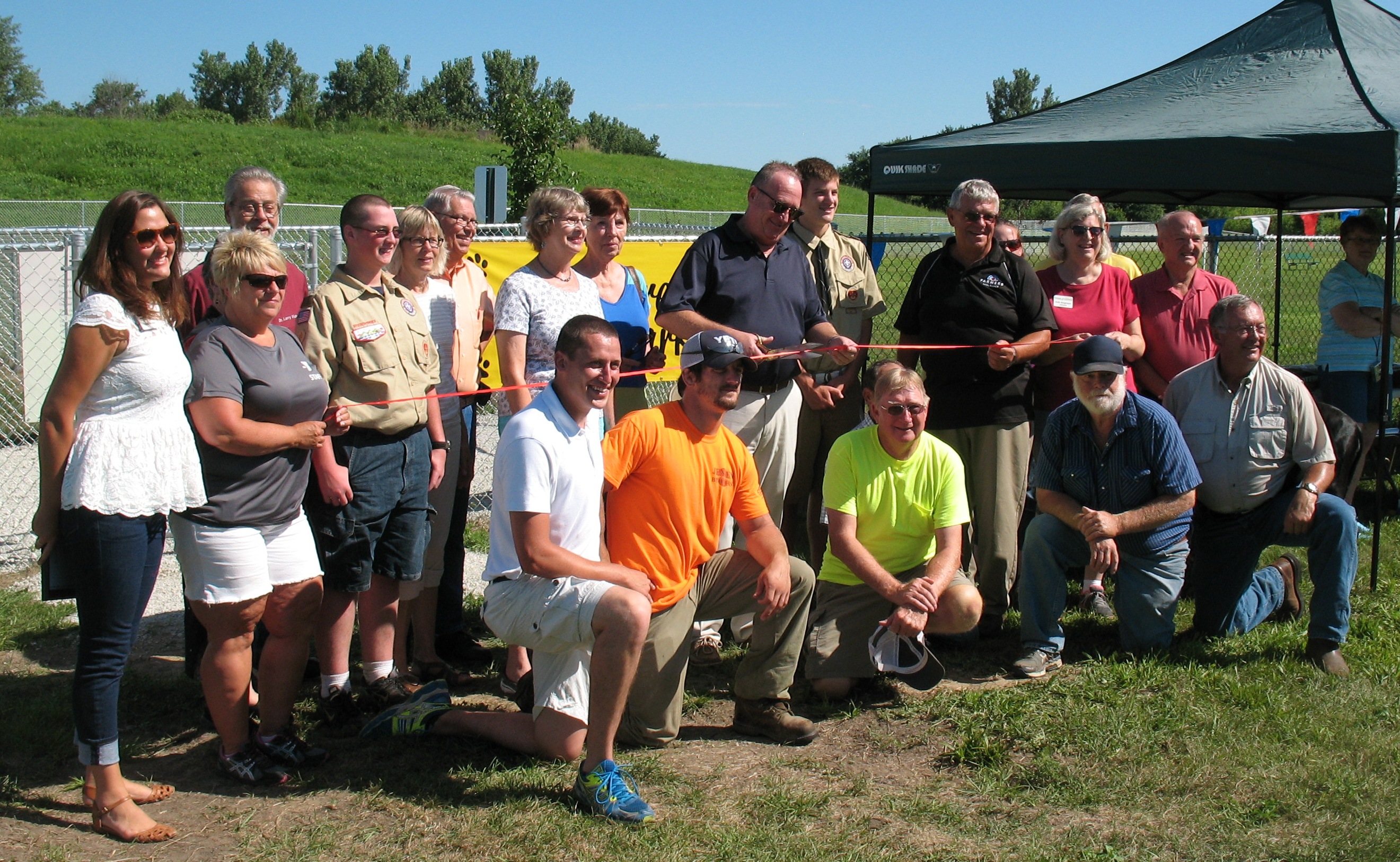
Parks & Rec Board President Stuart Dusenberry cuts the ribbon for the Buck Creek Dog Park
Local dignitaries, park staff, Street Department personnel, the Dog Park Committee, Parks and Rec Board members, and members of the public gathered for the event, which, according to Atlantic Mayor Dave Jones has been in the works for about four-years, ever since his daughter came to him asking why Atlantic doesn’t have a facility similar to her town, in Nebraska.
Parks and Rec Director Roger Herring says he got the ball rolling by asking Dr. Keith Leonard (retired) from Atlantic Animal Health Center (currently owned by The Hoffman Family, and Dr. Victora with the Cass County Animal Clinic,if they would be willing to place collection jars at their businesses, to garner interest and funds for the facility.
After the Parks and Rec Department publicly announced plans for the Dog Park, Herring says a member of the community stepped forward with a substantial donation. Kevin and Christi Garrett put up $1,000 as seed money.
A huge chunk of money for the fencing came from the Cass County Community Foundation, which provided a grant amounting to $10,000, or nearly two-thirds of the cost.
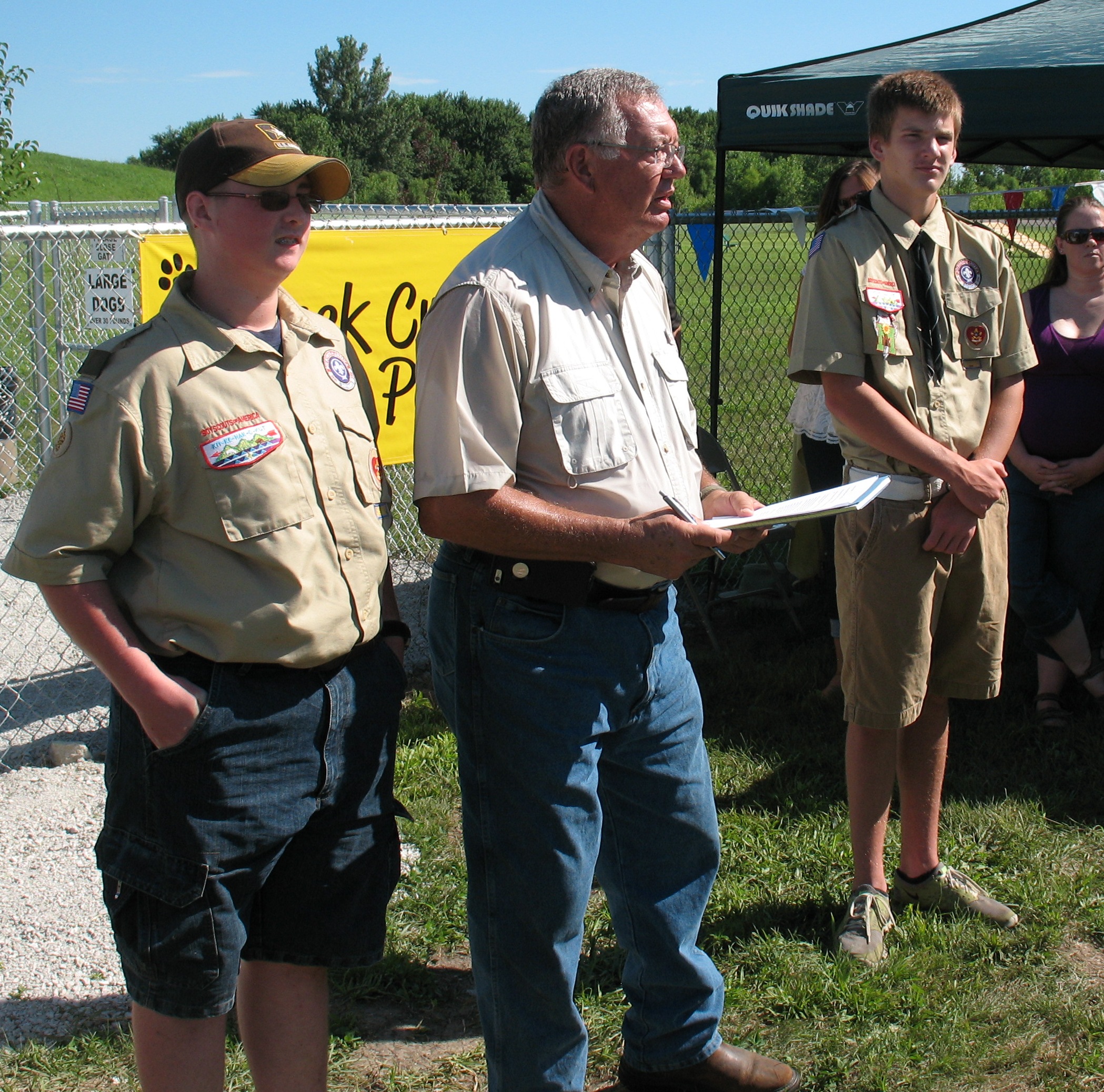
Eagle Scouts Cain Page (Left) & Eric Wieser (right). Parks & Rec Director Roger Herring (Center)
And, two young men with the Eagle Scouts contributed time and labor toward the project, including Eric Wieser, who built and installed the exercise and agility equipment at the park. Cain Page, who built cantilevered sunshades and benches. Steve Livengood, of Atlantic also contributed a substantial amount of his time and effort toward the project.
Herring thanked everyone who donated their time, effort and of course contributions toward making the Buck Creek Dog Park a facility Atlantic can be proud of.
Iowa farmers who want to better understand weed resistance are invited to a series of workshops starting on Monday. The Iowa State University Extension is sponsoring “Weeds Week” at its five research facilities statewide. Angie Rieck-Hinz, an extension field agronomist for nine counties in north-central Iowa, says virtually every grower in the state could benefit from attending.
“We’re having a series of workshops, hands-on stuff, to help those farmers and ag retailers to manage for herbicide resistance,” Rieck-Hinz says. “This is a big issue in Iowa. We see more weeds becoming resistant to herbicides every year.” It may cost a chemical company millions of dollars to create a new herbicide and Rieck-Hinz says it doesn’t appear that we should hope for any new products anytime soon.
“We know that in the developmental pipeline, there are no new chemistries or sites of action that are out there,” she says. “We want to make sure we preserve our existing tools in our tool box, our herbicides, as well as some other practices we can do to make sure we have good weed control in the future.” The workshops will include sessions on identifying the weeds, hands-on educational activities and tours of plots.
The programs will be held Monday at the I-S-U research facility in Crawfordsville, Tuesday in Lewis, Wednesday in Nashua, Thursday in Sutherland and next Friday (August 7) in Boone. Learn more at the website: www.aep.iastate.edu/weeds
(Radio Iowa)
The Atlantic FFA, CAM FFA, and Griswold FFA chapters are working in cooperation to build a new FFA Food Stand at the Cass County Fair. Kevin Blair, Agricultural Education Teacher at the Griswold High School, says “As we all know, the FFA Food Stand is in dire need of repair. The building has long served its purpose and we are looking at replacing the entire structure.”
Over the past 3 years the FFA Chapters have raised over $12,000 through the operation of the old Food Stand during the Cass County Fair. With the generous help of outside organizations, the FFA is close to its goal of $45,000. Blair says they need your help to reach their goal of building a new, attractive, and safe FFA Food Stand.
All proceeds raised will go towards the building of the new FFA Food Stand, which include new equipment, fixtures and seating. This will continue to allow FFA members to serve the Fair-goers and help keep the Cass County Fair free for everyone as we donate 25% of our profits back to the Cass County Fair Board.
Several individuals and businesses have already donated towards the new Food Stand and the FFA will recognize all sponsors permanently in the new building. The sponsorship levels are: over $5,000 are Platinum Sponsors; $1,000 to $4,999 are Gold Sponsors; and $100 to $999 are Blue Sponsors. If you would like to donate to the FFA Food Stand you may contact any of the FFA Advisors in Cass County or you can send your donation payable to the Griswold Schools, which is where the account is held.
Please send your donations to: Kevin Blair, FFA Advisor; Griswold Comm. Schools; 20 Madison St; Box 280; Griswold, IA 51535.
Iowa Secretary of Agriculture Bill Northey is encouraging Iowans to take advantage of fresh fruits and vegetables available at the more than 220 farmers markets in Iowa as part of National Farmers Market Week, which runs from Aug. 2nd through the 8th.
Northey says “Farmers markets are a great place to find healthy and delicious Iowa grown fruits, vegetables, meats and other products. National Farmers Market Week, and every week, is a great time to visit your local farmers market to support the vendors who are there and enjoy some of the great food grown in this state.”
As part of National Farmers Market Week, Northey highlighted the WIC Farmers Market Nutrition and Senior Farmers Market Nutrition Programs. These programs provide eligible low-income seniors as well as women and children in Iowa with checks that can be redeemed for fresh, locally grown produce at authorized farmers markets and farm stands from June 1st through October 31st, 2015.
The Iowa Department of Agriculture and Land Stewardship administers the programs in partnership with the Iowa Department of Public Health and Iowa Department on Aging. For more information contact Paul Ovrom, Program Administrator, at 515-242-6239 (or at Paul.Ovrom@iowaagriculture.gov).

Farmers Market App
Northey also encouraged Iowans to take advantage of the free Iowa Farmers Market app for smartphones that can help Iowans locate the farmers markets in their area. The app allows users to find the farmers market closest to them by using GPS location services or to search for specific farmers markets by city or zip code. Once they have located a market, the user can view the hours of the market, browse a list of vendors and see a phone number and email address of the market manager. App users can also leave reviews of the market and vendors and upload their photos to share with others.
The app is free to download and is available through Apple’s App store and Google Play by searching “Iowa Farmers Markets.” The app was developed for the Iowa Department of Agriculture and Land Stewardship using funds from the USDA Specialty Crop Block Grant Program.

 Facebook
 Twitter
 YouTube
 RSS
RSS