

CLICK HERE for the latest market quotes from the Iowa Agribusiness Network!
CLICK HERE for the latest market quotes from the Brownfield Ag News Network!


CLICK HERE for the latest market quotes from the Iowa Agribusiness Network!
CLICK HERE for the latest market quotes from the Brownfield Ag News Network!
(Radio Iowa) – A contract botanist from northeast Iowa who says he’s eaten more than a hundred species of wild Iowa mushrooms says he wants to set the record straight about what some mushroom hunters call “false” morels. Ben Hoksch, of Elkader, describes himself as a longtime forager of wild plants and mushrooms, who has a master’s degree in biology from U-N-I. “The term false morel is a common name that actually encompasses a large group of mushrooms, of which the most commonly identified mushrooms as false morels,” Hoksch says, “which in Iowa can be seven or eight or nine species, none of them are poisonous.” Though he notes, if you go to other parts of the country, there are mushrooms called false morels, some of which are poisonous. Hoksch has spent years learning the characteristics of various plants to distinguish between things that might be hazardous and those that are nutritious and delicious.
“To the lay person, two mushrooms can look superficially similar,” Hoksch says. “They can say, ‘I can’t tell the difference between those two,’ but an individual that spends any amount of time in the woods studying the features of these can easily tell the difference between something that’s called a false morel — which there aren’t any poisonous ones in Iowa — and a morel.” The key to mushroom hunting, he says, is to learn from others who are well-trained and knowledgeable.”The Prairies States Mushroom Club, they’re based out of Cedar Rapids,” Hoksch says. “They’re a great organization and honestly, a lot of the identification groups on social media do a good job, if you can rifle through the lay people who comment and look to the group experts and moderators of the well-recognized pages.”
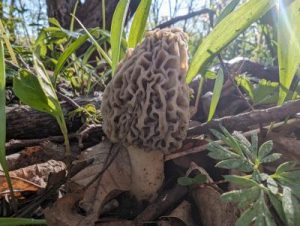
Common morel mushroom (Photo by Iowa State University Extension and Outreach)
Hoksch says wild food is everywhere around us and his breakfast most mornings is as local as it gets. “I walked down to the river. I picked three different types of wild greens. I picked cutleaf coneflower, nettles and wild mustard. I cooked that up with eggs from the backyard and a steak of venison that I harvested last winter,” Hoksch says. “Food didn’t always come from a grocery store, and I still think today it’s a great way to connect with the land and have a deeper connection with community.”
Cass County: Corn $4.47 Beans $9.97
Adair County: Corn $4.44 Beans $10.00
Adams County: Corn $4.44 Beans $9.96
Audubon County: Corn $4.46 Beans $9.99
East Pottawattamie County: Corn $4.50 Beans $9.97
Guthrie County: Corn $4.49 Beans $10.01
Montgomery County: Corn $4.49 Beans $9.99
Shelby County: Corn $4.50 Beans $9.97
Oats: $2.95 (same in all counties)
(Radio Iowa) – Green sprouts from the corn and soybeans Iowa farmers planted in mid-April are starting to emerge from the soil, but many farmers are still waiting to get their crops planted. Angie Rieck Hinz, an agronomist for the Iowa State University Extension in north-central Iowa, says planting started around April 10th and continued “going gangbusters” for a little over a week. “Ever since then, it’s been raining or drizzling in some cases, where we haven’t got a lot rain, but we’re not getting a lot of soil drying out,” she says, “so it’s been very difficult for people to get back in the fields since April 19th.” Rieck Hinz says the U-S-D-A crop report that came out earlier this week may not be telling the full story.
“The North Central Crop Reporting District shows us at about 23% of the corn planted and 11% of the beans, compared to statewide where we have 34% of the corn and 25% of the beans planted,” she says. “I think most people would tell you those numbers seem pretty low, that there’s actually a higher percentage of corn and beans planted.” Rieck Hinz offered a bit of advice to farmers who are anxious to get their planting work completed. “We have a lot of time to get crop in the ground once it dries out,” she says. “We’re supposed to go into a hot, dry period starting the end of next week, so I think once we get dried out, we’ll be back in the field relatively quickly and we’ll finish up planting for this season.”
Farmers need to be patient and wait for conditions to be right for planting, she says, otherwise seeds won’t be at the right depth and won’t root well. Rieck Hinz says yields last year were just as good for the early-planted crops as for those that were planted later.
(Radio Iowa) – The Iowa D-N-R says its spring efforts to collect walleye eggs to raise the next generation of fish was one of the fastest in the program’s history. Jay Rudacille oversaw the operation at Lake Rathbun and says all the fisheries seemed to benefit from warmer water temperatures during the spawn. “Most of our walleyes get stocked as just one to two day old fish that are very small and they have a fairly low survival rate, but we can we can produce them very cheaply and we can produce them in mass. So it’s an easy thing to do,” he says. Other walleyes are kept around a little longer before being released.
“We will raise fish to an inch and a half size and we will stock those about the first two weeks of June. And those are mostly stocked in rivers, and then we will raise some fish to the eight to nine-inch size at both our Rathbun and Spirit Lake hatcheries, and those get stocked into constructed and natural lakes in the month of October and early November,” Rudacille says. Rudacille says their goal is to have 116 million walleye fry. He says that’s believe to be second only to Minnesota, which looks to stock 257 million walleye. Rudacille is the D-N-R Warm and Coolwater Fish Culture Supervisor, and says Iowa doesn’t grow all the fish it stocks here in the state. He says they do a lot of fish trading with other states.
“Yellow perch from South Dakota. We will be providing some muskellunge to back to South Dakota and we’ll be sending some down to the state of Missouri. In exchange for those muskies that we send down to Missouri, in return, we’re going to get channel catfish and also paddlefish. So, there is a fair amount of fish trading,” he says. The fish trading is somewhat similar to the old kids card game “Go Fish” as he says if Iowa has more of one fish than it needs, they can trade for something they don’t have. “We don’t necessarily want to duplicate efforts, so if a state is very good at producing a certain species and we can have something to give them an exchange for that, there’s no real reason for us necessarily to go through the learning curve to try to develop a program for that same species,’ Rudacille says.
There is little natural reproduction of walleyes in most Iowa lakes and rivers, and Rudacille says keeping the population of those fish up depends on the stockings.
(Radio Iowa) – The Iowa Department of Agriculture and Land Stewardship awarded nearly two-point-seven (2.7) million dollars in its latest round of matching grants for14 urban water quality projects. Secretary of Agriculture Mike Naig (like egg) says state grant dollars will support water quality features, like native plantings, bioretention cells and a stormwater wetland. “This is where stormwater manage meets water quality improvements,” he says. Naig made the announcement Monday at the Legacy Woods Nature Sanctuary in West Des Moines where water drains into Jordan Creek and then the Raccoon River.
“I hope it will inspire folks who spend time here to consider what they might do on their own property but also, other cities can come and see how this can be incorporated into the landscape,” Naig says. The park is adding bioretention cells to collect and filter stormwater with the help of native plants, a specific soil mix and a layer of rock. Ag Department urban conservationist Ann Seda says a stormwater wetland will collect overflow in bigger rain events. “And there again, the water will be treated to get the nitrogen uptake in that wetland before it discharges to Jordan Creek and then further downstream to the Raccoon River,” she says.
Cost-share grants through the state’s Water Quality Initiative have supported 140 projects in the last decade. Naig says they play a role in Iowa’s Nutrient Reduction Strategy goals.
(Atlantic, Iowa) – Local Trees Forever spokesperson Dolly Bergmann has announced spring tree vouchers are available through the Trees Forever program, beginning May 1st. Bergmann says there is a limited number of vouchers available, and the limit is one voucher per homeowner, so more people can get a start replacing trees that are being removed.
Tree vouchers are a great way to help with the cost of a tree to plant. The vouchers are for $30 off the cost of a tree, and can be obtained at the Atlantic Hy-Vee, 1630 E 7th Street when you purchase a tree. Voucher information should be completed at the time of use, as that information is of a great help to Atlantic Trees Forever. 
Hy-Vee Garden Center personnel in Atlantic can help you determine what kind of tree would work best in the location you would like to plant a tree. Bergmann reminds those who plant trees to water them this spring, and during the summer.
(Des Moines, Iowa) – The Iowa Department of Natural Resources (DNR) will be presenting new proposed deer hunting regulations for portions of Western Iowa, that are intended to allow the deer herd to recover from a major sustained decline throughout the region for the past 15 years.
Proposed regulations will be presented and discussed at three public meetings: May 19, in Denison, at Yellow Smoke Park Lookout Shelter; May 20, in Hinton, at Dennis L. Sohl Center; and May 21, in Sioux Center, at Sandy Hollow Lodge. The meetings begin at 6:30 p.m.
“Hunters have an opportunity to provide support or concern for these proposals to help guide our path forward,” said Jace Elliott, state deer biologist with the Iowa DNR. “Deer hunting is one of Iowa’s most recreationally and economically important traditions. Our goal is to manage deer numbers at a level that is acceptable to our citizens and that supports a quality hunting experience.”
The Iowa DNR held eight meetings in Western Iowa last July to address the sustained decline in deer population in that region. Attendees were provided with information on the population decline, impacts of disease, changes in land cover and high doe harvest over the past decade, and were surveyed for their satisfaction of the local deer density, current antlerless harvest restrictions, support for further harvest restrictions and more. The results from the survey guided the new proposed regulations.
This is the second phase of the Western Iowa deer initiative where the Iowa DNR will present specific proposed regulations for the region, different from anything done in the past, and gauge the support and tolerances of the hunters.
Cass County: Corn $4.51 Beans $10.04
Adair County: Corn $4.48 Beans $10.07
Adams County: Corn $4.48 Beans $10.03
Audubon County: Corn $4.50 Beans $10.06
East Pottawattamie County: Corn $4.54 Beans $10.04
Guthrie County: Corn $4.53 Beans $10.08
Montgomery County: Corn $4.53 Beans $10.06
Shelby County: Corn $4.54 Beans $10.04
Oats: $2.96 (same in all counties)
(Radio Iowa) – There was planting progress last week despite widespread rain.The U-S-D-A report says there were just two-point-three days suitable for fieldwork due to wet conditions. The corn planted was up 16 percent to 34 percent, and that is two days ahead of the five-year average. Soybean planting moved from eleven to 25 percent complete, which is four days ahead of last year.
The report says cooler temperatures have slowed the emergence of the seeds already in the ground.
WEST DES MOINES, IA – The U-S Environmental Protection Agency (EPA) has announced that due to fuel supply shortages, the agency will issue emergency waivers to permit the nationwide sale of E15 for the 2025 summer driving season. Even though Iowa and seven other Midwest states received approval to allow year-round sales of E15 on a permanent basis, a nationwide waiver provides additional E15 access to consumers outside of the eight Midwest states.
Iowa Renewable Fuels Association (IRFA) Executive Director Monte Shaw said “While Iowa consumers and retailers already have E15 certainty, we still want consumers all across the nation to have the ability to save 15 to 20 cents per gallon at the pump. And during a time of tight fuel supplies, it would be ridiculous to tell retailers to bag their E15 pumps. Today is good news for Iowa farmers as well when you consider that 96.5 percent of ethanol produced at Iowa plants is utilized outside of the state.”
U.S. Secretary of Agriculture Brooke Rollins issued the following statement in support of the Environmental Protection Agency’s emergency approval of the summer sale of E-15: “President Trump is committed to lowering energy prices by unleashing American energy production, and it all starts with U.S. farmers. This move to allow the summer sale of E-15 will provide immediate relief to consumers, provide more choices at the pump, and drive demand for corn grown, processed, and used right here in America. Our nation’s great corn growers are critical to helping the U.S. achieve energy independence which is essential to national security.”
Rollins said “At USDA we look forward to our continued partnership with EPA and are working diligently to increase our energy dominance in the U.S. and abroad by expanding market access for American biofuels on the world stage.”


 Facebook
 Twitter
 YouTube
 RSS
RSS