

CLICK HERE for the latest market quotes from the Iowa Agribusiness Network!
CLICK HERE for the latest market quotes from the Brownfield Ag News Network!


CLICK HERE for the latest market quotes from the Iowa Agribusiness Network!
CLICK HERE for the latest market quotes from the Brownfield Ag News Network!
(Radio Iowa) – With the forecast calling for highs climbing into the 80s this week, the warmer weather is inspiring many Iowa boaters to hit the state’s lakes and rivers. Iowa Department of Natural Resources conservation officer Nate Carr says, before taking the boat off the trailer, check over your supply of life jackets. “They need to be the appropriate size for your passengers and in good working condition, so not old and faded and torn as they can get sometimes,” Carr says. “Make sure you go through those and make sure they’re all for however many passengers are on your boat, that’s how many life jackets you need to have.”
Along with a fire extinguisher and a horn, Carr says life jackets are a must-have safety items on a boat. “Anytime your boat is underway, any child under the age of 13 must be wearing their life jacket,” Carr says. “Also, regarding life jackets, anybody driving a jet ski, or riding on a jet ski for that matter, is required to be wearing their life jacket at all times, regardless of age.” Life jackets are also required for anyone being pulled behind a boat, including skiers and inner-tubers. Carr says the agency has officers on the waters, too, watching for signs of drunken boaters. “The same rules apply on the water that apply on the road, you cannot be operating while over a .08 or under the influence of any other kind of substance,” Carr says. “So make sure you have a designated driver, even on a boat.”
National Safe Boating Week is May 17th through the 23rd. Find more boater safety information at the Iowa DNR website.
(Radio Iowa) – The Iowa House and Senate have agreed to redirect two-and-a-half million dollars that’s sitting unused in the Iowa Brucellosis and Tuberculosis Eradication Fund. The fund was created to test for the contagious diseases which were a threat to cattle and other livestock in the past, but have largely been eliminated in the United States. Representative Norlin Mommsen, a farmer from DeWitt, says the focus — and the funds — need to shift to other foreign animal diseases.
“Most of the time the only conversation that takes place about eggs is about how you want them cooked, but with the outbreak of Avian influenza the conversation has been more about price and availability,” Mommsen said. “…We tried to address this issue as best we could.” Mommsen is chairman of the House panel that drafts the annual budget for the Iowa Department of Agriculture. It calls for taking 100-thousand dollars from the State Brucellosis Fund and spending it on development of a bird flu vaccine.
“Second we appropriated money to the Vet Diagnostic Lab and third we appropriated money for the equipment that might be necessary in the event of an outbreak,” Mommsen said. “We attempted to take a broad approach to addresing the price of eggs and other potential disease issues that might affect the State of Iowa.” A 450-thousand dollar technology upgrade will help the state ag department better track outbreaks of livestock diseases in Iowa, based on what’s called a premise number that identifies each Iowa barn and pasture where animals are being raised.
There’s 250-thousand dollars in the legislature’s state bduget plan to cover moving into Iowa State University’s expanded Vet Diagnostic Lab. Another 450-thousand dollars is to be spent on state efforts to buy equipment, plan for, and address any foreign animal disease outbreak. The legislation also eliminates the property levy the Iowa Brucellosis and Tuberculosis Eradiction Fund. It amounts to less than 50 cents per year for the average Iowa homeowner.
(Radio Iowa) – A microbiologist from Brazil is the recipient of the 2025 Des Moines-based World Food Prize. Mariangela Hungria is the 10th woman to be named a World Food Prize Laureate. Mashal Husain — president of the World Food Prize Foundation — says Hungria changed the way fertilizer is used in Brazilians soybean fields. “Thanks to her work, over 40 million hectares of Brazilian farmland now benefit from this technology,” she said. “This achievement has saved Brazilian farmers an estimated $250 billion each year in input costs, mitigated greenhouse gas emissions and improved soil health.”
Hungria’s work has expanded to other crops and other continents. “Proving that the smallest organisms can create the most profound transformations,” Husain said, “…reshaping the very ground we stand on.” Each World Food Prize Laureate received a half a MILLION dollar award. The announcement of each year’s laureate is typically made in Washington, D.C., but the ceremony was held last (Tuesday) night at World Food Prize headquarters in Des Moines. Iowa Governor Kim Reynolds addressed the crowd.
“Hosting this event in Iowa is more than a homecoming,” Reynolds said. “It’s also a powerful reminder of what this prize represents and where this story began.”
The World Food Prize was the dream of Iowa native Norman Borlaug, a Cresco, Iowa native who won the 1970 Nobel Peace Prize for his research that improved wheat yields in the developing world. Hungria is the 56th World Food Prize Laureate. She is scheduled to be in Des Moines this fall for the annual World Food Prize Symposium.
(Radio Iowa) – The Iowa DNR has released fish kill numbers from a spill last month in the south Branch of Lizard Creek in Fort Dodge.
The DNR says 71,933 fish were killed after a fertilizer byproduct leaked from the CJ Bio America plant and into the creek on April 14th. A statement from DNR fisheries biologist Ben Wallace says cooler water and higher flow reduced the number of fish impacted, and larger fish species may have still been in the Des Moines River and not the creek.
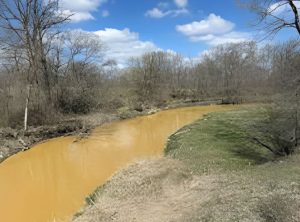
Iowa DNR reports thousands of fish killed in Lizard Creek spill
The DNR says samples no longer show any byproduct in the water, and they will complete their investigation before determining any enforcement action against the company.
(Radio Iowa) – A study at Iowa State University shows how packaging can affect your choice of bacon. Stephanie Major is a senior in meat science who looked into the issue as they tested natural antioxidants and their impact on the way meat looks. “My project kind of came about because we were just kind of interested in seeing how those natural antioxidants might hold up in kind of like a retail setting with LED lights and a couple of different types of packaging type,” Major says. The meat can take on a grayer color due to lighting and exposure to oxygen, but it is still okay to eat. Major says the vacuum packed bacon kept its color better than bacon that was simply wrapped in plastic.
“We all shop with our eyes and you see something that’s prettier in the store shelves is a little bit redder, pinker. And so we’re going to kind of shift our gear towards buying that product,” Major says. Major says the vacuum packaged bacon also did better than bacon in an open meat case. “What was interesting was, is we actually saw the bacon become redder in pigmentation so it became more desirable appearance wise,” she says. Major says the study leads to several tips for displaying bacon. “I would say with stores, pretty much controlling the atmosphere, controlling the lighting conditions, especially because you know as that lighting intensity becomes brighter and becomes more intense, especially with those LED lights. you see further oxidation occurring more rapidly and you also see that color fading occur more rapidly as well,” she says.
Major is from Albia and plans to do an internship with Tyson Foods after graduation, and then wants to return to Iowa State to attend graduate school.
(Radio Iowa) – Iowa Senator Chuck Grassley says he had a private meeting late Monday afternoon with Mexico’s ambassador to the U-S. Grassley says he and Ambassador Esteban Moctezuma Barragán focused on trade issues between our two countries, which included discussion of deadly threats to livestock and humans from a tiny parasite. Grassley says the Mexicans are also concerned about exports of a certain vegetable. Grassley says, “He’s asking for consideration of certain attempts by some members of Congress to end a decades agreement that we’ve had on tomatoes.” Almost all of Mexico’s tomato exports come to the U-S, and the Trump administration plans to end the trade agreement that allows Mexican tomatoes into the U-S duty-free. Starting in July, the U-S Commerce Department says tomatoes from south of the border will face a tariff of nearly 21-percent.
“A certain percentage of the tomatoes that are eaten in the United States come from Mexico,” Grassley says, “and that’s under some agreement that certain states — and their senators from those states — want to abrogate that agreement.” The looming changes worry Mexican growers, Grassley says, as tomato exports to the U-S generated more than a billion dollars in revenue in 2023. Grassley says there’s rising concern about parasitic screwworms that are coming into the U-S on some livestock from Mexico, though he notes the animals may have originated in South America. A release from the U-S-D-A says New World screwworms are deadly flies that lay eggs in open wounds. Once the larva hatches, it attacks living flesh and can be extremely deadly for livestock, pets, wildlife and even humans. “So yesterday, the Secretary of Agriculture put some restrictions on bison, cattle and other animals coming into the country because they could possibly bring in screwworms,” Grassley says. “That’s hopefully just a temporary restriction.”
The U-S has halted all imports of live cattle, horses and bison from Mexico, a ban U-S-D-A officials say will be reviewed on a month-to-month basis.
(Radio Iowa) – Dry weather gave farmers almost one full week to pull their planters through the fields, and they got a lot of seed into the ground. Corn planting moved from 49 to 76 percent complete by the end of last week. That percentage pushed the planting from two days behind last year to eight days ahead.
Soybean planting has moved from 38 to 64 percent, now completed. Corn planting is three days ahead of the five-year average, and soybean planting is five days ahead of average.
The U-S-D-A report says 30 percent of the corn has emerged and 16 percent of the beans are popping out of the ground.
(Radio Iowa) – The legislature has approved a bill to make it clear that when the State of Iowa seizes abandoned animals, the state owns the livestock. Last September, the state took over the care of one-point-three million chickens after the owners of Pure Prairie Poultry in Charles City declared bankruptcy. Iowa Agriculture Secretary Mike Naig says after several weeks, the State of Iowa went to the bankruptcy court with a plan to have the broiler chickens processed. “Those animals were getting bigger and we were going to miss their marketing window,” Naig said.
Other Pure Prairie Poultry creditors objected, arguing over ownership of the birds, and the chickens were euthanized. “After we took custody of the animals we were unable to market them and recoup costs for the taxpayer because of some lien issues and title issues with the livestock,” Naig said. “What we wanted to do this legislative session was to ensure that if the State of Iowa has to step in that the taxpayers are first in line to recoup any costs or any revenue that’s generated then from the sale of the livestock.”
The bill ensures the state of Iowa will hold the ownership title to seized livestock. Naig says the state has long had the authority to get a court order to take custody of abandoned animals, but it’s Naig says rarely used. In the case of Pure Prairie Poultry, the State of Iowa spent two MILLION dollars on feed and about three-hundred thousand dollars to euthanize the chickens.
(Iowa News Service) – New research at Iowa State University shows elevated nitrate levels have an outsize effect on the state’s most vulnerable populations. Studies show exposure to nitrates can increase the risks of birth defects and various types of cancer. ISU Water Resources Assistant Professor Liu Lu said nitrates, which are prominent in ground and surface water near commercial agriculture operations, exceed safe levels, and affect Iowa’s most vulnerable. “Such as people of color,” said Lu, “low-income populations, elderly, and also children.”
Despite their negative health impacts, the Iowa Environmental Council reports only 4% of public water utilities in Iowa have nitrate removal systems. The data show the presence of nitrates in the water is especially high in rural communities, and Liu said northeast Iowa’s Blackhawk County stands out in her research. “This county has very high nitrate in their treated water,” said Lu. “They also have very high social vulnerability. So, people living in that county are disproportionately exposed to high nitrate in their drinking water.”

Giving granulated fertilizer, Hand in glove closeup, excess fertilizers, a lot of nitrates, excess pesticides, too much harmful chemicals, generative ai illustration
Her research includes an interactive map that shows which parts of the state have the highest nitrate pollution in their groundwater.
Liu’s work was published in Environmental Science: Water Research & Technology.

 Facebook
 Twitter
 YouTube
 RSS
RSS