

CLICK HERE for the latest market quotes from the Iowa Agribusiness Network!
CLICK HERE for the latest market quotes from the Brownfield Ag News Network!


CLICK HERE for the latest market quotes from the Iowa Agribusiness Network!
CLICK HERE for the latest market quotes from the Brownfield Ag News Network!
Cass County: Corn $4.34 Beans $10.12
Adair County: Corn $4.31 Beans $10.15
Adams County: Corn $4.33 Beans $10.11
Audubon County: Corn $4.33 Beans $10.14
East Pottawattamie County: Corn $4.37 Beans $10.12
Guthrie County: Corn $4.36 Beans $10.16
Montgomery County: Corn $4.36 Beans $10.14
Shelby County: Corn $4.37 Beans $10.12
Oats: $3.14 (same in all counties)
(Iowa News Service) – Farmers in Iowa fear that proposed cuts in SNAP benefit funding could limit the market for their products. The Trump administration says it is cutting federal spending across all budget sectors. The Food Bank of Iowa says nearly 11% of Iowans, including almost 111,000 children, don’t know where their next meal is coming from.
Iowa Farmers Union President Aaron Lehman said food insecurity is a problem, not just in urban areas but also in rural ones. “We know that this impacts our people directly,” said Lehman, “and also impacts our farms, who are growing the food that’s used in the SNAP program ” Lehman added that fewer SNAP dollars mean less money for recipients to buy the products raised by Iowa growers, which would trickle down to Iowa farmers. 
He said the SNAP program helps farmers broaden their markets, which ag producers need now more than ever as they face their own set of economic challenges. “Because farmers are experiencing all sorts of market upsets due to trade tensions and tariffs,” said Lehman, “and we’re also selling into a monopolized marketplace, where just a few people buy what we sell.”
Lehman added that some Iowa farmers are already selling their crops below production costs, which would only worsen with fewer places to sell them, and reducing the number of buyers would further stiffen their economic challenges.
(Radio Iowa) – A bill to give the company that makes Roundup some liability protection from lawsuits that allege the weed killer causes cancer failed to pass the Iowa House again this year. Governor Kim Reynolds says it’s a common sense bill and she wishes she could sign it into law. A plant in Muscatine makes most of the Roundup used in North America.
“We make 70% of that in the state of Iowa,” Reynolds said. “We have about 500 employees at that plant making it and (glyphosate) has a significant impact on what we can grow.” Reynolds says federal officials have determined the weed killer is not a carcinogen.
“If they change the parameters on the labeling then that’s a different story,” Reynolds says. Monsanto developed Roundup and Bayer bought Monsanto in 2018. As of this month, Bayer has paid about 11 BILLION dollars to settle 100-thousand Roundup lawsuits. Roundup has been a federally registered pesticide since 1974 and it’s used today on 70 percent of Iowa soybean fields and 63 percent of corn fields in the state.
In 2020 the E-P-A reviewed the product and said there are no risks to human health if customers use Roundup according to the instructions on its label. Reynolds says the company shouldn’t be sued, then, for failing to warn customers there are health risks.
“My reasoning for supporting that bill is (EPA) has already signed off on it and therefore it shouldn’t be subject to the lawsuits that we’re seeing,” Reynold says. Reynolds made her comments during an appearance this past weekend on “Iowa Press” on Iowa P-B-S. The bill passed the Senate this year — as it did in 2023. Opponents of the bill say Iowans who believe they’ve been harmed from the use of Roundup should be able to court and make their case for damages.
DES MOINES, Iowa — Memorial Day weekend is the unofficial start of summer, and that means swimming. The Iowa Department of Natural Resources has released its first beach advisory this year. Swimming is not recommended at four including the beaches at Backbone, Beeds Lake, Black Hawk and Nine Eagle state parks.
Forty-one beaches were tested. E. coli levels were found to exceed the standard at those four. The DNR tests weekly through Labor Day. 
(Radio Iowa) – The most recent rains do not figure into the U-S Drought Monitor report this week, which shows nearly 47 percent of Iowa was drought-free. The Iowa D-N-R’s Jessica Reese-McIntyre says things have been heading in the right direction. “When you compare it to a year ago in like mid-May of last year, we are sitting a little bit better statewide,” she says. Reese-McIntyre says this weeks rains will help build up groundwater as we enter a time when the crops are growing and water use overall increases with warmer temperatures. She says it’s not certain if the wetter trend will continue.
“According to the National Weather Service Climate Prediction Center, the month of June outlook for precipitation looks to be equal chances of precipitation, so there’s no real clear signal, but it will be one way or the other. So we could likely see just normal precipitation, which is good, because May and June are the wettest months,” she says. Reese-McIntyre says one issue looming is the amount of rain the driest areas of the state in western Iowa will get. “It looks like the western third of the state will see the chances of precipitation are leaning below normal more significantly than the rest of the state,” Reese-McIntyre says.
She says that is just a forecast for now, and she is hopeful those areas will get rain to help with their deficits.
Thousands of Iowans will be camping and building campfires this Memorial Day weekend and throughout the summer. The Iowa Department of Natural Resources (DNR) encourages campers to buy firewood from where they will burn it instead of bringing it from home.
“Moving unseasoned firewood around the state can threaten the health of our forests by spreading insects like emerald ash borer (EAB), oak wilt, and other pests that live in firewood,” explains Tivon Feeley, DNR Forest Health Forester.
Plenty of firewood is available locally to your favorite state or county park. Ask a park ranger or campground host where you can get local firewood. Make sure you burn all of your firewood at your campsite; don’t leave it or transport to a new area.
The Iowa Department of Agriculture and Land Stewardship requires all firewood sold or acquired in Iowa to have the county and state of harvest location on the label of packages and the delivery ticket for bulk firewood.
Learn more about the importance of using local or certified heat-treated firewood at www.dontmovefirewood.org/.
DES MOINES (Iowa DNR News) – — Fawning season has officially arrived, which means Iowans will see lots of deer on the move. From now until late June, DNR field staff across the state will receive many phone calls and emails regarding “abandoned deer.” But in reality, most of the wildlife reported to DNR field staff are not really abandoned at all. And while the people who attempt to “rescue” these babies have the best of intentions, they are doing more harm than good. Fawning season traditionally begins during the last week of May and peaks in the first couple of weeks in June before gradually tapering off.
Does are secretive about the birthing process and will venture out from normal use areas looking for a secluded spot to deliver this year’s crop of fawns in peace. “These spots can be anything from an open hay field to a field terrace to the flowerbed in your backyard,” says Jim Coffey, forest wildlife research biologist with the Iowa Department of Natural Resources (DNR). “This seclusion process is a driving force in protection for the lanky, wavering fawn. Fawns will be left alone while the doe returns only to nurse. This is normal deer behavior,” he said.
“The doe searches out an isolated location where she feels safe and, on occasion, those places may leave us scratching our heads wondering what the doe was thinking. But she chose that location because it made sense to her,” Coffey said. “The worst thing someone can do at this stage is to ‘rescue’ the fawn. The mother is likely nearby and watching you. Leave it be, or if you did handle the fawn, return it to where you found it and walk away.”

Fawning season typically runs from late May through most of June
The Iowa DNR will not be rehabilitating or commingling fawns with other deer to avoid the potential of spreading chronic wasting disease – or other disease – to new areas. This emphasizes the point of leaving ‘abandoned’ fawns be. The spindly legged newborn fawn is designed with a few survival tools built in – its spots are cryptic camouflage that emulates the sunlight spots projected onto leaf litter of the forest floor and its lack of movement the first two weeks helps to reduce scent patterns. This combination is the fawn’s best chance at survival until it is capable of following the doe.
Fawning season also coincides with an increase in deer vehicle collisions. “There is a lot of movement this time of year that relates to the social structure of deer. The doe is on the move looking for the safe isolated place to have the fawns. Additional movement comes from last year’s fawns that are now isolated teenagers starting to venture out to find new space. These yearlings have to make their own decisions for the first time, encounter other adult deer and build new social structures,” Coffey said. “This movement behavior can occur during all times of the day. Once it settles out, the active movement time will return to dawn and dusk.
“The key to remember is that for the next month deer may not be acting like we think deer should act, stay alert while driving at any time of the day.” Drivers are reminded to drive defensively, avoid distractions, slow down, and provide safe distance between vehicles. Don’t veer for deer! If a driver does hit a deer, drivers can get a salvage tag for the meat by calling either the local conservation officer or local law enforcement agency. The salvage tag is free and is required to legally possess the meat. Salvaging requires that the entire deer be removed from the roadway.
(Iowa Dept. of Natural Resources) – Officials with the Iowa DNR say the popular Iowa online interactive fishing atlas has been updated to include DNR managed lakes, community fishing ponds, hundreds of miles of Iowa rivers including the Mississippi and Missouri rivers, and miles of trout streams. New search features allow anglers to search by waterbody and quickly zoom in to find lake contours, fishing structures, river bends, and trout stream riffles with aerial imagery.
The mobile-friendly atlas will sync with your current GPS location to help you navigate a river segment and find specific lake contours, fish structure locations, and amenities such as fish cleaning stations. DNR Fisheries Biologist Lewis Bruce says “Anglers preferring a paper map can easily create a custom map with the new print tool. You can print a small area of a lake or an entire river segment to identify fish structures in lakes or a trout stream segment.”
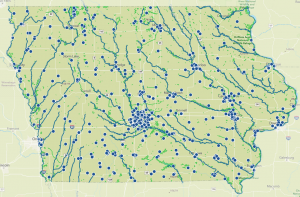
Iowa Fishing Atlas (Screenshot)
Go to https://programs.iowadnr.gov/maps/fishingatlas to plan your next fishing adventure. You can also find the fishing atlas on the free Go Outdoors Iowa App. “Anglers can view the fishing atlas on both desktop computers and mobile devices,” said Lewis. “Making it the perfect tool for every angler throughout all fishing seasons.”
Cass County: Corn $4.26 Beans $10.06
Adair County: Corn $4.23 Beans $10.09
Adams County: Corn $4.23 Beans $10.05
Audubon County: Corn $4.25 Beans $10.08
East Pottawattamie County: Corn $4.29 Beans $10.06
Guthrie County: Corn $4.28 Beans $10.10
Montgomery County: Corn $4.28 Beans $10.08
Shelby County: Corn $4.29 Beans $10.06
Oats: $3.11 (same in all counties)
(Radio Iowa) – The manager of an ethanol plant near Council Bluffs says a bill that would set new restrictions on the proposed Summit Carbon Solutions pipeline in Iowa would also impact his company’s plan connect to a Nebraska pipeline. Mike Jerke is C-E-O of what’s known as SIRE — Southwest Iowa Renewable Energy.
“SIRE has engaged two different engineering companies to look at expansion of our facility,” he says. “All of that is predicated on the ability to sequester CO2 and the demand pull that would bring.” A nearly 400 mile long natural gas pipeline in Nebraska is being retooled and will start capturing carbon from ethanol plants this fall. Jerke says his ethanol facility plans to start sequestering carbon in mid-2026 and connect to the Tallgrass Trailblazer pipeline in Nebraska.
“We have 100% voluntary easements for our project,” Jerke says. “We have those secured.” Jerke says the bill requires a type of insurance that would violate the permit his company is seeking and the legislation would set a 25 year limit on operating a pipeline transporting liquid carbon dioxide. Jerke says that would be a death blow because his company already negotiated 45 million dollars worth of contracts to buy the equipment needed to sequester C-O-2.
“We’ve probably spent a little over half that because equipment purchases take time and construction will come here in the fall,” Jerke says. “Apparently this is going to be, if this is to stand or be signed into law, something that we would only be able to operate for 25 years…Just extremely problematic would probably be putting it lightly.”
Jerke made his comments during an online news conference hosted by the Iowa Renewable Fuels Association. The group is urging Governor Reynolds to veto the pipeline bill.


 Facebook
 Twitter
 YouTube
 RSS
RSS